Wall Street Banks Launch Credit Default Swap Index
Written by Emily J. Thompson, Senior Investment Analyst
Updated: 2 days ago
0mins

Source: seekingalpha
- Index Launch: JPMorgan Chase and other major Wall Street banks are collaborating with S&P Global to introduce a credit-default swap index, expected to begin sales next week, aimed at providing investors with tools to hedge against corporate default risks and enhance market liquidity.
- Private Credit Inclusion: The CDX Financials index will include 12% from private credit funds managed by Apollo Global Management, Ares Management, and Blackstone, reflecting the growing significance of the private credit market and its appeal to investors.
- Rising Market Demand: Investors reportedly sought over $20 billion in redemptions from private credit firms in Q1 2026, indicating increasing concerns about the asset class, which may drive demand for the new product and prompt market adjustments.
- Revival of Credit Default Swaps: Although credit-default swaps fell out of favor after the 2008 financial crisis, trading volumes reached a record $38 trillion in 2025, signaling a renewed recognition and growing demand for this derivative instrument in the market.
Trade with 70% Backtested Accuracy
Stop guessing "Should I Buy JPM?" and start using high-conviction signals backed by rigorous historical data.
Sign up today to access powerful investing tools and make smarter, data-driven decisions.
Analyst Views on JPM
Wall Street analysts forecast JPM stock price to rise
19 Analyst Rating
11 Buy
7 Hold
1 Sell
Moderate Buy
Current: 310.330

Low
260.00
Averages
341.38
High
400.00
Current: 310.330
Low
260.00
Averages
341.38
High
400.00
About JPM
JPMorgan Chase & Co. is a financial holding company. The Company is engaged in investment banking, financial services for consumers and small businesses, commercial banking, financial transaction processing and asset management. The Company operates through three segments: Consumer & Community Banking (CCB), Commercial & Investment Bank (CIB), and Asset & Wealth Management (AWM). Its CCB segment offers products and services to consumers and small businesses through bank branches, ATMs, digital and telephone banking. Its CIB segment consists of banking and payments and markets and securities services, and offers a suite of investment banking, lending, payments, market-making, financing, custody and securities products and services to a global base of corporate and institutional clients. AWM segment offers investment and wealth management solutions. It offers multi-asset investment management solutions, retirement products and services, brokerage, custody, estate planning, and others.
About the author

Emily J. Thompson
Emily J. Thompson, a Chartered Financial Analyst (CFA) with 12 years in investment research, graduated with honors from the Wharton School. Specializing in industrial and technology stocks, she provides in-depth analysis for Intellectia’s earnings and market brief reports.

JPMorgan Chase Outperforms with Significant Economic Moat

- Outstanding Returns: JPMorgan Chase has achieved a total return of 601% over the past decade, significantly outperforming the S&P 500 index, highlighting its strong performance and attractiveness in the financial services sector.
- Significant Economic Moat: With total assets of $4.4 trillion and total sales of $182 billion, JPMorgan Chase has established a notable economic moat that enhances its ability to attract cheap deposits and benefit from operating leverage.
- Diversified Business Structure: The bank operates across consumer and commercial banking, asset management, and capital markets activities, allowing it to better navigate various macroeconomic conditions due to demand diversification across its three official segments.
- Attractive Valuation: Although its price-to-book ratio stands at 2.4, higher than peers like Bank of America and Wells Fargo, JPMorgan Chase's superior return on equity and return on assets justify the premium valuation, making it a compelling investment option.
See More
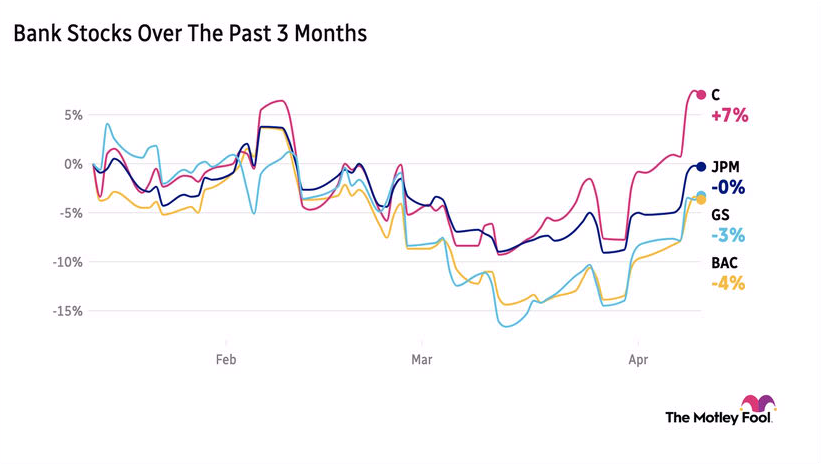
Big Banks Kick Off Earnings Season


- Market Recovery: The S&P 500 rose by 3.6% and the Nasdaq by 4.7% as the threat of escalating conflict in Iran subsided, indicating a recovery in market sentiment, although futures show slight declines that may affect investor confidence.
- Bank Earnings Reports: Goldman Sachs is set to release its Q1 earnings before the market opens today, with JPMorgan Chase, Wells Fargo, and Citigroup scheduled for Tuesday, which are expected to provide crucial earnings guidance that could influence investor sentiment towards bank stocks.
- Surge in Semiconductor Demand: The skyrocketing demand for agentic AI has led to chip shortages and rationing of computing power, likely boosting revenues for major semiconductor firms, with Taiwan Semiconductor and ASML's upcoming earnings reports being key market focal points.
- FTC Settlement with Advertisers: The Federal Trade Commission is negotiating with several advertising companies over allegations of coordinated boycotts against platform X, and while no wrongdoing is admitted, this move could reshape the competitive landscape of the advertising market.
See More
JPMorgan Chase: A Financial Services Giant's Performance
- Massive Asset Base: JPMorgan Chase, as the largest bank in the U.S., boasts total assets of $4.4 trillion as of December 31, 2025, showcasing its dominant position in the financial services sector, which enables it to better navigate various macroeconomic conditions.
- Diversified Operations Advantage: The company operates across consumer and commercial banking, asset management, and capital markets, reporting total sales of $182 billion last year, with a net profit margin of 31%, providing a significant cost advantage that attracts cheaper deposits.
- Shareholder Return Potential: While JPMorgan Chase's stock has delivered a total return of 601% over the past decade, it is unlikely to yield 50-fold or 100-fold gains over the next 25 years, necessitating cautious evaluation of its growth potential in a mature phase.
- Valuation Appeal: Currently, the stock trades 7% below its peak with a price-to-book ratio of 2.4, which, although higher than its peers, can be justified by its superior return on equity and assets, making it a reasonable investment despite the elevated valuation.
See More

U.S. Navy to Blockade Iranian Ports, Oil Prices Surge

- Naval Blockade: The U.S. Navy plans to blockade Iranian ports starting Monday after negotiations with Iran failed, which is expected to significantly impact the global oil supply chain and potentially lead to further increases in oil prices.
- Oil Price Surge: Following the announcement, oil prices jumped sharply due to escalating geopolitical tensions, raising concerns about future supply disruptions that could affect the global economic recovery process.
- Consequences of Failed Talks: The inability to reach an agreement with Iran highlights the complexities of international relations and may lead to stricter sanctions, impacting Iran's oil exports and the stability of global markets.
- Market Reaction: Investor concerns over future developments have intensified, leading to declines in the futures market, indicating the market's sensitivity to geopolitical risks, which could influence investment decisions in related sectors.
See More

Market Faces Multiple Challenges and Opportunities


- Impact of Iran War: Since the onset of the Iran war, oil prices have doubled, and despite a significant drop following the two-week ceasefire news, the S&P 500 remains only 2.3% below its all-time high, indicating market resilience and adaptability to rising oil prices.
- Tech Stock Turmoil: Software stocks like ServiceNow and Salesforce have plummeted by 30% to 40% despite strong profitability due to fears of AI's impact, while hardware stocks have surged by 50% to 150%, reflecting a stark divergence in market sentiment towards the tech sector.
- Bond Market Stability: The 10-year Treasury yield peaked at 4.5% on March 27 before settling at 4.32%, with the low-rate environment providing support for the stock market, even as discussions about Federal Reserve policies remain prevalent.
- Bank Earnings Season: Goldman Sachs is set to report earnings, expected to showcase a stronger narrative than traditional banks, while Wells Fargo's performance may be influenced by market underestimations of its historical issues, potentially leading to more realistic expectations.
See More

Iran War Uncertainty Impacts Markets Ahead of Earnings Season


- Iran Talks Fail: Peace negotiations between the U.S. and Iran, led by Vice President JD Vance, ended without an agreement, increasing market concerns about the blockade of the Strait of Hormuz, which could affect 20% of global oil exports and drive prices higher.
- Earnings Season Approaches: Major companies like Goldman Sachs, Wells Fargo, and Johnson & Johnson are set to report earnings this week, with analysts focusing on Goldman’s deal-making environment and trading desk performance, expecting EPS of $16.49 and revenues of $16.97 billion.
- Wells Fargo Faces Headwinds: Wells Fargo's earnings report comes amid low market expectations due to significant exposure to non-depository financial institutions, with analysts forecasting revenues of $21.77 billion and EPS of $1.58, while looking for guidance on net interest income.
- Inflation Data Release: The Producer Price Index (PPI) will be released this week, expected to show a 1.2% month-over-month increase and a 4.6% annual rise, reflecting the impact of the Iran war on energy prices, prompting investors to watch for cost pass-through to consumers.
See More
JPMorgan Chase Outperforms with Significant Economic Moat
- Outstanding Returns: JPMorgan Chase has achieved a total return of 601% over the past decade, significantly outperforming the S&P 500 index, highlighting its strong performance and attractiveness in the financial services sector.
- Significant Economic Moat: With total assets of $4.4 trillion and total sales of $182 billion, JPMorgan Chase has established a notable economic moat that enhances its ability to attract cheap deposits and benefit from operating leverage.
- Diversified Business Structure: The bank operates across consumer and commercial banking, asset management, and capital markets activities, allowing it to better navigate various macroeconomic conditions due to demand diversification across its three official segments.
- Attractive Valuation: Although its price-to-book ratio stands at 2.4, higher than peers like Bank of America and Wells Fargo, JPMorgan Chase's superior return on equity and return on assets justify the premium valuation, making it a compelling investment option.
See More
Big Banks Kick Off Earnings Season
- Market Recovery: The S&P 500 rose by 3.6% and the Nasdaq by 4.7% as the threat of escalating conflict in Iran subsided, indicating a recovery in market sentiment, although futures show slight declines that may affect investor confidence.
- Bank Earnings Reports: Goldman Sachs is set to release its Q1 earnings before the market opens today, with JPMorgan Chase, Wells Fargo, and Citigroup scheduled for Tuesday, which are expected to provide crucial earnings guidance that could influence investor sentiment towards bank stocks.
- Surge in Semiconductor Demand: The skyrocketing demand for agentic AI has led to chip shortages and rationing of computing power, likely boosting revenues for major semiconductor firms, with Taiwan Semiconductor and ASML's upcoming earnings reports being key market focal points.
- FTC Settlement with Advertisers: The Federal Trade Commission is negotiating with several advertising companies over allegations of coordinated boycotts against platform X, and while no wrongdoing is admitted, this move could reshape the competitive landscape of the advertising market.
See More
JPMorgan Chase: A Financial Services Giant's Performance
- Massive Asset Base: JPMorgan Chase, as the largest bank in the U.S., boasts total assets of $4.4 trillion as of December 31, 2025, showcasing its dominant position in the financial services sector, which enables it to better navigate various macroeconomic conditions.
- Diversified Operations Advantage: The company operates across consumer and commercial banking, asset management, and capital markets, reporting total sales of $182 billion last year, with a net profit margin of 31%, providing a significant cost advantage that attracts cheaper deposits.
- Shareholder Return Potential: While JPMorgan Chase's stock has delivered a total return of 601% over the past decade, it is unlikely to yield 50-fold or 100-fold gains over the next 25 years, necessitating cautious evaluation of its growth potential in a mature phase.
- Valuation Appeal: Currently, the stock trades 7% below its peak with a price-to-book ratio of 2.4, which, although higher than its peers, can be justified by its superior return on equity and assets, making it a reasonable investment despite the elevated valuation.
See More
U.S. Navy to Blockade Iranian Ports, Oil Prices Surge
- Naval Blockade: The U.S. Navy plans to blockade Iranian ports starting Monday after negotiations with Iran failed, which is expected to significantly impact the global oil supply chain and potentially lead to further increases in oil prices.
- Oil Price Surge: Following the announcement, oil prices jumped sharply due to escalating geopolitical tensions, raising concerns about future supply disruptions that could affect the global economic recovery process.
- Consequences of Failed Talks: The inability to reach an agreement with Iran highlights the complexities of international relations and may lead to stricter sanctions, impacting Iran's oil exports and the stability of global markets.
- Market Reaction: Investor concerns over future developments have intensified, leading to declines in the futures market, indicating the market's sensitivity to geopolitical risks, which could influence investment decisions in related sectors.
See More
Market Faces Multiple Challenges and Opportunities
- Impact of Iran War: Since the onset of the Iran war, oil prices have doubled, and despite a significant drop following the two-week ceasefire news, the S&P 500 remains only 2.3% below its all-time high, indicating market resilience and adaptability to rising oil prices.
- Tech Stock Turmoil: Software stocks like ServiceNow and Salesforce have plummeted by 30% to 40% despite strong profitability due to fears of AI's impact, while hardware stocks have surged by 50% to 150%, reflecting a stark divergence in market sentiment towards the tech sector.
- Bond Market Stability: The 10-year Treasury yield peaked at 4.5% on March 27 before settling at 4.32%, with the low-rate environment providing support for the stock market, even as discussions about Federal Reserve policies remain prevalent.
- Bank Earnings Season: Goldman Sachs is set to report earnings, expected to showcase a stronger narrative than traditional banks, while Wells Fargo's performance may be influenced by market underestimations of its historical issues, potentially leading to more realistic expectations.
See More
Iran War Uncertainty Impacts Markets Ahead of Earnings Season
- Iran Talks Fail: Peace negotiations between the U.S. and Iran, led by Vice President JD Vance, ended without an agreement, increasing market concerns about the blockade of the Strait of Hormuz, which could affect 20% of global oil exports and drive prices higher.
- Earnings Season Approaches: Major companies like Goldman Sachs, Wells Fargo, and Johnson & Johnson are set to report earnings this week, with analysts focusing on Goldman’s deal-making environment and trading desk performance, expecting EPS of $16.49 and revenues of $16.97 billion.
- Wells Fargo Faces Headwinds: Wells Fargo's earnings report comes amid low market expectations due to significant exposure to non-depository financial institutions, with analysts forecasting revenues of $21.77 billion and EPS of $1.58, while looking for guidance on net interest income.
- Inflation Data Release: The Producer Price Index (PPI) will be released this week, expected to show a 1.2% month-over-month increase and a 4.6% annual rise, reflecting the impact of the Iran war on energy prices, prompting investors to watch for cost pass-through to consumers.
See More