AMD Set to Ship AI Chips, Data Center Revenue Expected to Double
Written by Emily J. Thompson, Senior Investment Analyst
Updated: Apr 04 2026
0mins
Should l Buy AMD?
Source: NASDAQ.COM
- Data Center Revenue Growth: AMD anticipates a nearly 60% increase in data center revenue by 2026, which could double its record $16.6 billion revenue from 2025, highlighting the company's strong growth potential in the AI market.
- New Product Launch: AMD will start shipping its MI450 GPUs in the second half of 2023, expected to deliver 36 times the performance of the MI400 and MI355, further solidifying its competitive position in the data center GPU market.
- Strong Customer Demand: Major clients like Meta and OpenAI plan to deploy 6 gigawatts of computing capacity over the next few years, with these deals potentially worth tens of billions of dollars, showcasing robust demand for AMD's high-performance computing solutions.
- Resilient Market Performance: Despite a 5% drop in the overall market in March, AMD's stock rose by 2.5%, reflecting investor confidence in the company's future growth, particularly against the backdrop of surging demand for AI chips.
Trade with 70% Backtested Accuracy
Stop guessing "Should I Buy AMD?" and start using high-conviction signals backed by rigorous historical data.
Sign up today to access powerful investing tools and make smarter, data-driven decisions.
Analyst Views on AMD
Wall Street analysts forecast AMD stock price to rise
33 Analyst Rating
25 Buy
8 Hold
0 Sell
Strong Buy
Current: 236.640

Low
210.00
Averages
289.13
High
377.00
Current: 236.640
Low
210.00
Averages
289.13
High
377.00
About AMD
Advanced Micro Devices, Inc. is a global semiconductor company. The Company is focused on high-performance computing and artificial intelligence (AI). Its segments include Data Center, Client and Gaming, and Embedded. Data Center segment includes AI accelerators, microprocessors (CPUs) for servers, graphics processing units (GPUs), accelerated processing units (APUs), data processing units (DPUs), Field Programmable Gate Arrays (FPGAs), and Adaptive system-on-Chip (SoC) products for data centers. Client and Gaming segment includes CPUs, APUs, chipsets for desktops and notebooks, discrete GPUs, and semi-custom SoC products and development services. Embedded segment includes embedded CPUs, APUs, FPGAs, system on modules (SOMs), and Adaptive SoC products. It markets and sells its products under the AMD trademark. Its products include AMD EPYC, AMD Ryzen, AMD Ryzen PRO, Virtex UltraScale+, among others.
About the author

Emily J. Thompson
Emily J. Thompson, a Chartered Financial Analyst (CFA) with 12 years in investment research, graduated with honors from the Wharton School. Specializing in industrial and technology stocks, she provides in-depth analysis for Intellectia’s earnings and market brief reports.

Trump's Weekend Activities and Surge in Oil Prices


- Surge in Oil Prices: Crude oil futures jumped over 8% on Monday as the U.S. Navy prepares to blockade Iranian ports, with U.S. crude surpassing $100 per barrel and Brent also rising over 8%, indicating significant implications for the global energy market.
- Military Blockade Announcement: U.S. Central Command stated that it will begin blocking all maritime traffic entering and exiting Iranian ports at 10 a.m. ET on Monday, a move that could disrupt international supply chains related to Iran and significantly impact global oil prices.
- Trump's Dispute with the Pope: Trump criticized Pope Leo XIV on social media for his stance on the U.S. war in Iran, asserting he does not want a Pope who criticizes him, reflecting a hardline approach in both domestic and foreign policy that may affect his supporters' confidence.
- Hungarian Election Results: The election results in Hungary indicate a victory for the opposition Tisza party, marking the first new government in 16 years, which poses a challenge to Trump and his allies in Europe and may lead to future policy adjustments.
See More

Market Comparison of AMD and Nvidia


- Market Performance Divergence: Despite Nvidia's stock soaring 1,120% in 2023 compared to AMD's 242%, AMD has outperformed over the past year with a 165% increase versus Nvidia's 82%, indicating AMD's short-term investment appeal.
- Revenue Comparison: Nvidia's latest quarterly revenue reached $68.2 billion, up 73% year-over-year, with its data center segment generating $62.3 billion, a 75% increase; in contrast, AMD reported $10.3 billion in revenue, a 34% increase, with its data center segment at $5.4 billion, up 39%, highlighting Nvidia's market dominance.
- Growth Expectations: AMD aims for a 35% compounded annual growth rate (CAGR) over the next five years, with its data center division projected to grow at 60%, indicating AMD's efforts to close the gap with Nvidia, though it will take time to realize this potential.
- Valuation Discrepancy: Despite Nvidia's growth rate being double that of AMD, AMD's stock trades at over a 50% premium compared to Nvidia, suggesting a mispricing that may prompt investors to reassess the investment value of both companies.
See More
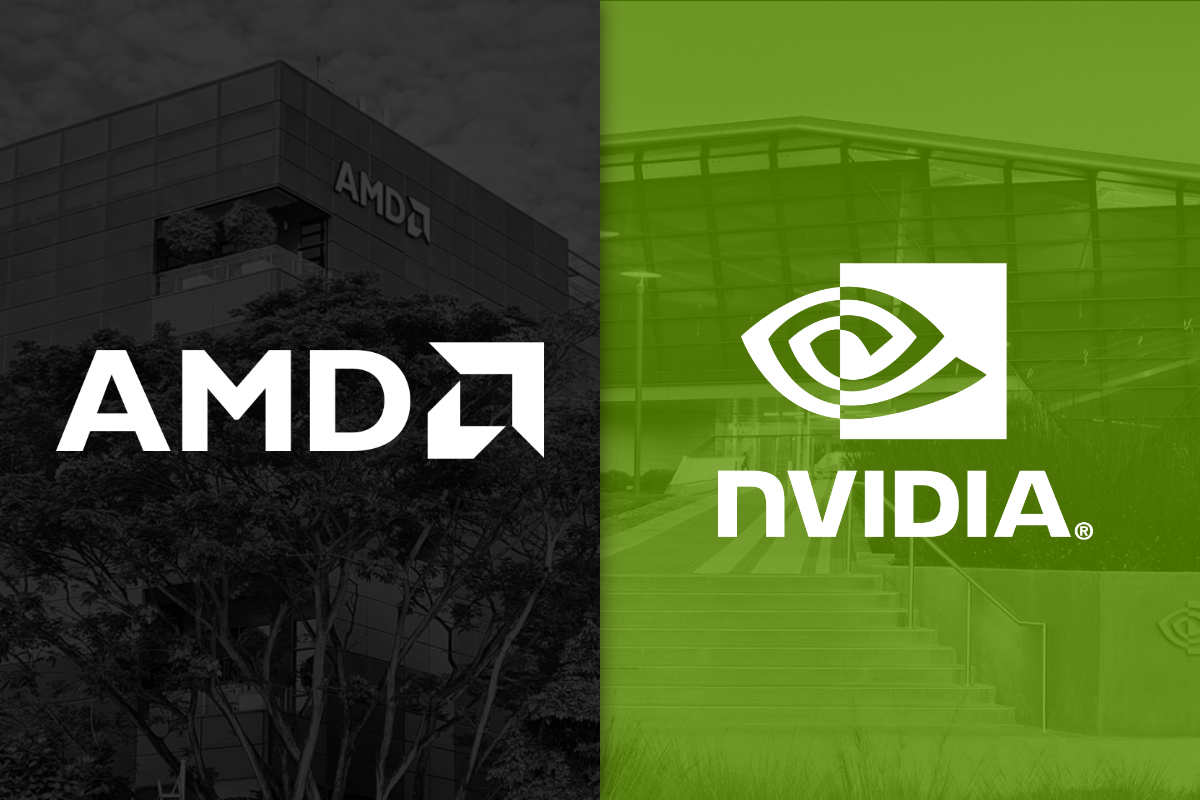
Competitive Analysis of AMD and Nvidia
- Stock Performance Comparison: Since 2023, Nvidia's stock has surged by 1,120%, while AMD has also shown strong performance with a 242% increase, highlighting the intense competition between the two in the AI sector.
- Significant Revenue Disparity: Nvidia's most recent quarterly revenue reached $68.2 billion, up 73% year-over-year, compared to AMD's $10.3 billion, which grew by 34%, indicating Nvidia's dominance in the data center business.
- Growth Expectations and Strategy: AMD projects a 35% compound annual growth rate (CAGR) for revenue over the next five years, with its data center division expected to grow at a remarkable 60%, potentially enhancing its competitive position in the market.
- Valuation Discrepancy Analysis: Despite Nvidia's faster growth, its stock is valued lower than AMD's, requiring investors to pay over a 50% premium for AMD shares, making Nvidia a more attractive investment option.
See More

Amazon's Diversification Risks and Investment Insights


- Investment Diversification Risks: While Amazon dominates e-commerce and cloud computing, investors should avoid concentrating all assets in its stock due to potential financial risks akin to Enron, which could lead to significant losses.
- Competitive Disadvantages: Amazon's investments in robotics, satellites, and AI chips, although promising, place it at a disadvantage compared to companies like Tesla that focus on hardware, potentially impacting future growth.
- Lack of Financial Transparency: With a market cap of $2.5 trillion, Amazon's financial reporting is often vague, leaving investors unclear about its R&D spending on robotics and AI, which increases investment uncertainty.
- Competition from Industry Leaders: Although Amazon's investments in robotics and satellite technology may drive growth, the lack of direct cost and benefit transparency suggests that investors should consider market leaders in these fields rather than relying solely on Amazon's diversification strategy.
See More

Analysis of Investment Risks in Amazon
- Investment Risk Warning: Despite Amazon's dominance in e-commerce and cloud computing, investors should avoid concentrating all assets in its stock, as historical collapses like Enron highlight the importance of diversification.
- Technological Competitive Disadvantage: Amazon faces competitive disadvantages in robotics, satellites, and AI chips, particularly against companies like Tesla and SpaceX that specialize in hardware and satellite technology, which may impact its long-term growth potential.
- Lack of Financial Transparency: With a market cap of $2.5 trillion, Amazon's financial reporting tends to be vague, making it difficult for investors to understand specific expenditures on robotics, satellites, and AI chip development and their impact on overall financials.
- Industry Focus Recommendation: Investors interested in robotics, satellite development, or AI chips should consider market leaders in those sectors rather than Amazon, as the latter's investments in these areas do not directly reflect in its financial performance.
See More

Trump Orders Complete Blockade of Strait of Hormuz Amidst Stalled U.S.-Iran Talks


- Blockade Order: President Trump has ordered a complete blockade of the Strait of Hormuz, prohibiting all vessels from passing, aimed at pressuring Iran to abandon its nuclear weapons pursuit, which could lead to a tightening of global energy supplies.
- Surge in Oil Prices: Trump's announcement of the blockade caused oil prices to surge over 8%, reflecting market concerns over a potential energy crisis while exacerbating investor anxiety and impacting global market performance.
- Market Reaction: Following the blockade news, Asian markets fell in early Monday trading, and U.S. futures also tumbled, with Dow Jones Industrial Average futures losing 517 points, indicating a pessimistic sentiment among investors regarding the economic outlook.
- Decline in Consumer Confidence: American consumer confidence plunged to a record low in April, reflecting the domestic economic impact of the ongoing conflict, further intensifying market uncertainty.
See More
Trump's Weekend Activities and Surge in Oil Prices
- Surge in Oil Prices: Crude oil futures jumped over 8% on Monday as the U.S. Navy prepares to blockade Iranian ports, with U.S. crude surpassing $100 per barrel and Brent also rising over 8%, indicating significant implications for the global energy market.
- Military Blockade Announcement: U.S. Central Command stated that it will begin blocking all maritime traffic entering and exiting Iranian ports at 10 a.m. ET on Monday, a move that could disrupt international supply chains related to Iran and significantly impact global oil prices.
- Trump's Dispute with the Pope: Trump criticized Pope Leo XIV on social media for his stance on the U.S. war in Iran, asserting he does not want a Pope who criticizes him, reflecting a hardline approach in both domestic and foreign policy that may affect his supporters' confidence.
- Hungarian Election Results: The election results in Hungary indicate a victory for the opposition Tisza party, marking the first new government in 16 years, which poses a challenge to Trump and his allies in Europe and may lead to future policy adjustments.
See More
Market Comparison of AMD and Nvidia
- Market Performance Divergence: Despite Nvidia's stock soaring 1,120% in 2023 compared to AMD's 242%, AMD has outperformed over the past year with a 165% increase versus Nvidia's 82%, indicating AMD's short-term investment appeal.
- Revenue Comparison: Nvidia's latest quarterly revenue reached $68.2 billion, up 73% year-over-year, with its data center segment generating $62.3 billion, a 75% increase; in contrast, AMD reported $10.3 billion in revenue, a 34% increase, with its data center segment at $5.4 billion, up 39%, highlighting Nvidia's market dominance.
- Growth Expectations: AMD aims for a 35% compounded annual growth rate (CAGR) over the next five years, with its data center division projected to grow at 60%, indicating AMD's efforts to close the gap with Nvidia, though it will take time to realize this potential.
- Valuation Discrepancy: Despite Nvidia's growth rate being double that of AMD, AMD's stock trades at over a 50% premium compared to Nvidia, suggesting a mispricing that may prompt investors to reassess the investment value of both companies.
See More
Competitive Analysis of AMD and Nvidia
- Stock Performance Comparison: Since 2023, Nvidia's stock has surged by 1,120%, while AMD has also shown strong performance with a 242% increase, highlighting the intense competition between the two in the AI sector.
- Significant Revenue Disparity: Nvidia's most recent quarterly revenue reached $68.2 billion, up 73% year-over-year, compared to AMD's $10.3 billion, which grew by 34%, indicating Nvidia's dominance in the data center business.
- Growth Expectations and Strategy: AMD projects a 35% compound annual growth rate (CAGR) for revenue over the next five years, with its data center division expected to grow at a remarkable 60%, potentially enhancing its competitive position in the market.
- Valuation Discrepancy Analysis: Despite Nvidia's faster growth, its stock is valued lower than AMD's, requiring investors to pay over a 50% premium for AMD shares, making Nvidia a more attractive investment option.
See More
Amazon's Diversification Risks and Investment Insights
- Investment Diversification Risks: While Amazon dominates e-commerce and cloud computing, investors should avoid concentrating all assets in its stock due to potential financial risks akin to Enron, which could lead to significant losses.
- Competitive Disadvantages: Amazon's investments in robotics, satellites, and AI chips, although promising, place it at a disadvantage compared to companies like Tesla that focus on hardware, potentially impacting future growth.
- Lack of Financial Transparency: With a market cap of $2.5 trillion, Amazon's financial reporting is often vague, leaving investors unclear about its R&D spending on robotics and AI, which increases investment uncertainty.
- Competition from Industry Leaders: Although Amazon's investments in robotics and satellite technology may drive growth, the lack of direct cost and benefit transparency suggests that investors should consider market leaders in these fields rather than relying solely on Amazon's diversification strategy.
See More
Analysis of Investment Risks in Amazon
- Investment Risk Warning: Despite Amazon's dominance in e-commerce and cloud computing, investors should avoid concentrating all assets in its stock, as historical collapses like Enron highlight the importance of diversification.
- Technological Competitive Disadvantage: Amazon faces competitive disadvantages in robotics, satellites, and AI chips, particularly against companies like Tesla and SpaceX that specialize in hardware and satellite technology, which may impact its long-term growth potential.
- Lack of Financial Transparency: With a market cap of $2.5 trillion, Amazon's financial reporting tends to be vague, making it difficult for investors to understand specific expenditures on robotics, satellites, and AI chip development and their impact on overall financials.
- Industry Focus Recommendation: Investors interested in robotics, satellite development, or AI chips should consider market leaders in those sectors rather than Amazon, as the latter's investments in these areas do not directly reflect in its financial performance.
See More
Trump Orders Complete Blockade of Strait of Hormuz Amidst Stalled U.S.-Iran Talks
- Blockade Order: President Trump has ordered a complete blockade of the Strait of Hormuz, prohibiting all vessels from passing, aimed at pressuring Iran to abandon its nuclear weapons pursuit, which could lead to a tightening of global energy supplies.
- Surge in Oil Prices: Trump's announcement of the blockade caused oil prices to surge over 8%, reflecting market concerns over a potential energy crisis while exacerbating investor anxiety and impacting global market performance.
- Market Reaction: Following the blockade news, Asian markets fell in early Monday trading, and U.S. futures also tumbled, with Dow Jones Industrial Average futures losing 517 points, indicating a pessimistic sentiment among investors regarding the economic outlook.
- Decline in Consumer Confidence: American consumer confidence plunged to a record low in April, reflecting the domestic economic impact of the ongoing conflict, further intensifying market uncertainty.
See More