Nvidia-Backed Reflection in Talks to Raise $2.5B

Nvidia (NVDA) backed startup Reflection is in discussions to raise $2.5B at a valuation of $25B, Berber Jin and Kate Clark of The Wall Street Journal reports, citing people familiar with the matter. The company is looking to build a network of "open source" AI models, which can be used and repurposed by businesses, labs, and universities as needed. JPMorgan Chase (JPM) is in talks to participate in the round, the sources added.
Trade with 70% Backtested Accuracy
Analyst Views on NVDA

About NVDA
About the author


French AI Startup Mistral Secures $830 Million in Debt Financing

- Significant Financing: French AI startup Mistral has successfully secured $830 million in debt financing, which will be allocated towards building a data center near Paris, marking a substantial investment in AI infrastructure.
- Infrastructure Expansion Plans: The company plans to utilize these funds to acquire thousands of Nvidia chips to support the operation of its data center, aiming to enhance its competitiveness in AI model development, particularly against rivals like OpenAI and Anthropic.
- Demand-Driven Strategy: CEO Arthur Mensch stated that with surging demand from governments, enterprises, and research institutions for customized AI environments, Mistral will continue to invest in infrastructure to ensure that AI innovation and autonomy remain central to Europe.
- Strong Banking Support: The financing transaction was backed by a consortium of seven top-tier global banks, including Bpifrance, BNP Paribas, and Crédit Agricole CIB, reflecting strong market confidence in Mistral's future growth.

Nvidia Advances Space Data Center Concept
- Potential of Space Data Centers: Nvidia's Space-1 Vera Rubin module, announced on March 16, aims to address data transmission bottlenecks in space by enabling real-time data analysis, thereby laying the groundwork for future orbital data centers.
- Market Demand and Challenges: While the concept of space data centers garners interest, practical implementation faces high launch costs and technical hurdles, with Nvidia's advancements potentially serving as a first step in overcoming these obstacles.
- Partnerships: Nvidia collaborates with several space tech companies, including Starcloud, which successfully launched the first satellite operating an Nvidia H100 GPU in space, showcasing its strategic positioning in the space market.
- Investment Outlook: Although market expectations for Nvidia's future growth have moderated, the current forward P/E ratio of 21.4 still reflects its core position in AI and data centers, with the success of space data centers likely to further enhance its market value.
Nvidia Stock Pullback but Rebound Hopes Remain
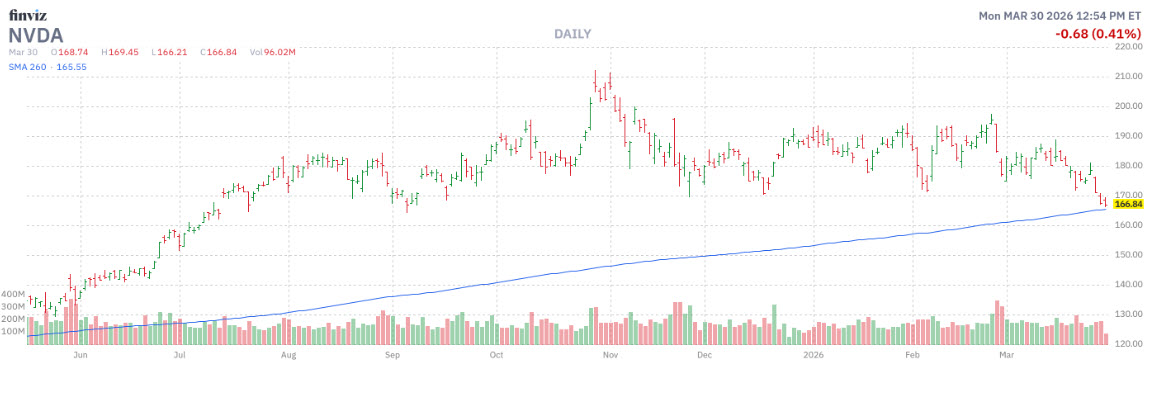
- Price Pullback Trend: Nvidia's stock is down 0.4% today, trading at $166.84, marking its eighth loss in ten sessions, indicating a pullback since hitting a record high of $212.89 in October.
- Technical Indicator Analysis: The stock is currently testing the 20-day average true range (ATR) of the 260-day moving average, having remained above this level 80% of the time in the last two weeks, suggesting potential rebound opportunities.
- Historical Performance Signal: Similar technical signals have occurred five times in the past decade, with the stock rising 80% of the time one month later, averaging a 14.7% increase, which would bring shares back to $191 if repeated.
- Options Market Sentiment: Bearish sentiment is growing in the options market, with Nvidia's 10-day put/call volume ratio at 0.72, higher than 98% of annual readings, indicating that if this bearish attention unwinds, it could provide additional support for the stock.

Are Single-Stock ETFs a Risky Trend or a Chance for Growth?

Single-Stock ETFs: The rise of single-stock ETFs, which allow investors to gain leveraged exposure to individual stocks, has gained popularity, particularly for companies like NVIDIA and Tesla, due to their historical performance and potential for high returns.
Investment Risks: While these funds can amplify gains, they also carry significant risks, including the potential for substantial losses, especially in volatile markets, making them suitable primarily for risk-tolerant investors.
Market Trends: Despite the appeal of single-stock ETFs, recent trends indicate a decline in net inflows for some funds, suggesting that retail investors may be hesitant or facing losses, particularly in the case of NVIDIA.
Regulatory Concerns: The regulatory status of single-stock ETFs is under scrutiny due to their unique risks, which differ from traditional ETFs, raising questions about their long-term viability in the investment landscape.

ETF Component Trading Dynamics Analysis

- Nvidia Trading Performance: Nvidia saw a slight increase of about 0.1% on Monday, with over 74.4 million shares traded, indicating investor confidence in its growth potential despite overall market volatility.
- Intel Price Decline: Intel's stock fell approximately 3.4% during the same session, with over 32.4 million shares changing hands, reflecting market concerns regarding its future performance, which could impact its competitive position in the semiconductor industry.
- United Therapeutics Strong Rebound: United Therapeutics surged about 13.1% on Monday, making it the best-performing component of the ETF, suggesting a positive market reaction to its new products or R&D progress, potentially driving future growth.
- Sysco Significant Drop: Sysco's stock declined approximately 12.9% during the same trading session, underperforming its peers, likely due to market concerns over its profitability and supply chain challenges, which could affect its market share in the food distribution sector.
Oppenheimer's Top Semiconductor Picks Amid AI Spending Surge

- AI Spending Surge: Oppenheimer analyst Rick Schafer highlights that artificial intelligence spending is accelerating, with cloud service provider demand expected to persist into 2027, leading to supply tightness in advanced wafers, packaging, and memory, with prices broadly rising and likely to be passed on to customers.
- Rising Demand for ASICs: Driven by Google's tensor processing units, the demand for application-specific integrated circuits is ramping up, with numerous projects increasing to support the growth of large language models, indicating strong market demand for AI technologies.
- Nvidia Server Architecture Expansion: Schafer anticipates that Nvidia's Grace Blackwell and Vera Rubin server architectures will exceed 75,000 units this year, with Vera Rubin's average selling price potentially approaching $7 million and its power management requirements being five times that of Grace Blackwell, benefiting Monolithic Power.
- Impact on Handset and PC Markets: While the overall handset market is expected to decline, the low and mid-tier segments are most affected, particularly with Chinese handsets down nearly 20%, and the PC market projected to drop 11%, although higher-priced AI PCs may offset some unit weakness.
French AI Startup Mistral Secures $830 Million in Debt Financing
- Significant Financing: French AI startup Mistral has successfully secured $830 million in debt financing, which will be allocated towards building a data center near Paris, marking a substantial investment in AI infrastructure.
- Infrastructure Expansion Plans: The company plans to utilize these funds to acquire thousands of Nvidia chips to support the operation of its data center, aiming to enhance its competitiveness in AI model development, particularly against rivals like OpenAI and Anthropic.
- Demand-Driven Strategy: CEO Arthur Mensch stated that with surging demand from governments, enterprises, and research institutions for customized AI environments, Mistral will continue to invest in infrastructure to ensure that AI innovation and autonomy remain central to Europe.
- Strong Banking Support: The financing transaction was backed by a consortium of seven top-tier global banks, including Bpifrance, BNP Paribas, and Crédit Agricole CIB, reflecting strong market confidence in Mistral's future growth.
Nvidia Advances Space Data Center Concept
- Potential of Space Data Centers: Nvidia's Space-1 Vera Rubin module, announced on March 16, aims to address data transmission bottlenecks in space by enabling real-time data analysis, thereby laying the groundwork for future orbital data centers.
- Market Demand and Challenges: While the concept of space data centers garners interest, practical implementation faces high launch costs and technical hurdles, with Nvidia's advancements potentially serving as a first step in overcoming these obstacles.
- Partnerships: Nvidia collaborates with several space tech companies, including Starcloud, which successfully launched the first satellite operating an Nvidia H100 GPU in space, showcasing its strategic positioning in the space market.
- Investment Outlook: Although market expectations for Nvidia's future growth have moderated, the current forward P/E ratio of 21.4 still reflects its core position in AI and data centers, with the success of space data centers likely to further enhance its market value.
Nvidia Stock Pullback but Rebound Hopes Remain
- Price Pullback Trend: Nvidia's stock is down 0.4% today, trading at $166.84, marking its eighth loss in ten sessions, indicating a pullback since hitting a record high of $212.89 in October.
- Technical Indicator Analysis: The stock is currently testing the 20-day average true range (ATR) of the 260-day moving average, having remained above this level 80% of the time in the last two weeks, suggesting potential rebound opportunities.
- Historical Performance Signal: Similar technical signals have occurred five times in the past decade, with the stock rising 80% of the time one month later, averaging a 14.7% increase, which would bring shares back to $191 if repeated.
- Options Market Sentiment: Bearish sentiment is growing in the options market, with Nvidia's 10-day put/call volume ratio at 0.72, higher than 98% of annual readings, indicating that if this bearish attention unwinds, it could provide additional support for the stock.
Are Single-Stock ETFs a Risky Trend or a Chance for Growth?
Single-Stock ETFs: The rise of single-stock ETFs, which allow investors to gain leveraged exposure to individual stocks, has gained popularity, particularly for companies like NVIDIA and Tesla, due to their historical performance and potential for high returns.
Investment Risks: While these funds can amplify gains, they also carry significant risks, including the potential for substantial losses, especially in volatile markets, making them suitable primarily for risk-tolerant investors.
Market Trends: Despite the appeal of single-stock ETFs, recent trends indicate a decline in net inflows for some funds, suggesting that retail investors may be hesitant or facing losses, particularly in the case of NVIDIA.
Regulatory Concerns: The regulatory status of single-stock ETFs is under scrutiny due to their unique risks, which differ from traditional ETFs, raising questions about their long-term viability in the investment landscape.
ETF Component Trading Dynamics Analysis
- Nvidia Trading Performance: Nvidia saw a slight increase of about 0.1% on Monday, with over 74.4 million shares traded, indicating investor confidence in its growth potential despite overall market volatility.
- Intel Price Decline: Intel's stock fell approximately 3.4% during the same session, with over 32.4 million shares changing hands, reflecting market concerns regarding its future performance, which could impact its competitive position in the semiconductor industry.
- United Therapeutics Strong Rebound: United Therapeutics surged about 13.1% on Monday, making it the best-performing component of the ETF, suggesting a positive market reaction to its new products or R&D progress, potentially driving future growth.
- Sysco Significant Drop: Sysco's stock declined approximately 12.9% during the same trading session, underperforming its peers, likely due to market concerns over its profitability and supply chain challenges, which could affect its market share in the food distribution sector.
Oppenheimer's Top Semiconductor Picks Amid AI Spending Surge
- AI Spending Surge: Oppenheimer analyst Rick Schafer highlights that artificial intelligence spending is accelerating, with cloud service provider demand expected to persist into 2027, leading to supply tightness in advanced wafers, packaging, and memory, with prices broadly rising and likely to be passed on to customers.
- Rising Demand for ASICs: Driven by Google's tensor processing units, the demand for application-specific integrated circuits is ramping up, with numerous projects increasing to support the growth of large language models, indicating strong market demand for AI technologies.
- Nvidia Server Architecture Expansion: Schafer anticipates that Nvidia's Grace Blackwell and Vera Rubin server architectures will exceed 75,000 units this year, with Vera Rubin's average selling price potentially approaching $7 million and its power management requirements being five times that of Grace Blackwell, benefiting Monolithic Power.
- Impact on Handset and PC Markets: While the overall handset market is expected to decline, the low and mid-tier segments are most affected, particularly with Chinese handsets down nearly 20%, and the PC market projected to drop 11%, although higher-priced AI PCs may offset some unit weakness.