D-Wave Quantum Shares Down, Mixed Options Sentiment
Written by Emily J. Thompson, Senior Investment Analyst
Updated: 3 days ago
0mins
Should l Buy QBTS?
Mixed options sentiment in D-Wave Quantum (QBTS), with shares down 2c near $21.50. Options volume running well above average with 74k contracts traded and calls leading puts for a put/call ratio of 0.36, compared to a typical level near 0.47. Implied volatility (IV30) dropped 5.7 near 104.2,and above the 52wk median, suggesting an expected daily move of $1.41. Put-call skew steepened, indicating increased demand for downside protection.Looking ahead: D-Wave Quantum (QBTS) will report earnings after the close on None.Option markets are pricing in a 50% probability of a move greater than 0.0% or $0.00.
Trade with 70% Backtested Accuracy
Stop guessing "Should I Buy QBTS?" and start using high-conviction signals backed by rigorous historical data.
Sign up today to access powerful investing tools and make smarter, data-driven decisions.
Analyst Views on QBTS
Wall Street analysts forecast QBTS stock price to rise
13 Analyst Rating
13 Buy
0 Hold
0 Sell
Strong Buy
Current: 21.690

Low
35.00
Averages
40.67
High
48.00
Current: 21.690
Low
35.00
Averages
40.67
High
48.00
About QBTS
D-Wave Quantum Inc. is a quantum computing company, which is engaged in the development and delivery of quantum computing systems, software, and services. The Company builds and delivers systems, cloud services, application development tools, and professional services to support the end-to-end quantum computing journey for enterprises and developers. The Company's products include Cloud Platform, Systems, Professional Services, and others. Under its Cloud Platform, the Leap quantum cloud service delivers immediate, real-time access to its quantum computers and hybrid solvers services. Under its Systems, the Advantage quantum system is a quantum computer designed for business. It also offers quantum applications to a range of customers, including resource scheduling, factory scheduling, industrial construction design, drug discovery, and others. It offers solutions across workforce scheduling, production scheduling, vehicle routing, resource optimization, and cargo loading.
About the author

Emily J. Thompson
Emily J. Thompson, a Chartered Financial Analyst (CFA) with 12 years in investment research, graduated with honors from the Wharton School. Specializing in industrial and technology stocks, she provides in-depth analysis for Intellectia’s earnings and market brief reports.

Nvidia Sparks Quantum Computing Stock Rally


- Quantum Stock Surge: Following Nvidia's launch of the Ising open-source models, quantum computing stocks like IonQ and D-Wave Quantum surged by 60% and 47%, respectively, indicating strong market interest and increased investor confidence in quantum technology.
- Technical Milestone: IonQ announced it achieved a foundational milestone by photonic interconnecting two independent trapped-ion quantum systems, marking a key step towards scaling quantum computing, which is expected to attract more government and corporate investments.
- Software Ecosystem Development: Nvidia's CUDA-Q platform acts as middleware for quantum computing, facilitating collaboration among GPUs, CPUs, and quantum processing units, enhancing the complexity and efficiency of quantum applications, thereby solidifying its leadership in the quantum computing space.
- Strategic Investment Opportunity: Nvidia's quantum computing strategy mirrors its success in AI, and is expected to provide stable returns for investors, positioning it as a
See More
Nvidia Leads Quantum Computing Rally
- Quantum Stock Surge: Over the past five days, IonQ's stock surged 60%, D-Wave Quantum rose 47%, and Quantum Computing Inc. and Rigetti jumped 35% and 29% respectively, reflecting strong market interest and heightened investor confidence in quantum computing.
- IonQ's Major Milestone: IonQ announced it achieved a foundational technical milestone by photonically interconnecting two independent trapped-ion quantum systems, a breakthrough that lays the groundwork for scaling quantum computing, while also securing a contract from DARPA, enhancing its market position.
- Nvidia's Open-Source Platform: Nvidia launched the Ising family of open-source models aimed at making AI the control plane for quantum computers, enhancing the reliability and scalability of quantum-GPU systems, showcasing its strategic positioning in the quantum computing space.
- Middleware Layer Development: Nvidia's CUDA-Q platform integrates GPUs, CPUs, and quantum processing units, improving the management of complex quantum computing applications, thereby solidifying its core position in the quantum computing industry.
See More
Analysis of Investment Prospects in Quantum Computing Industry

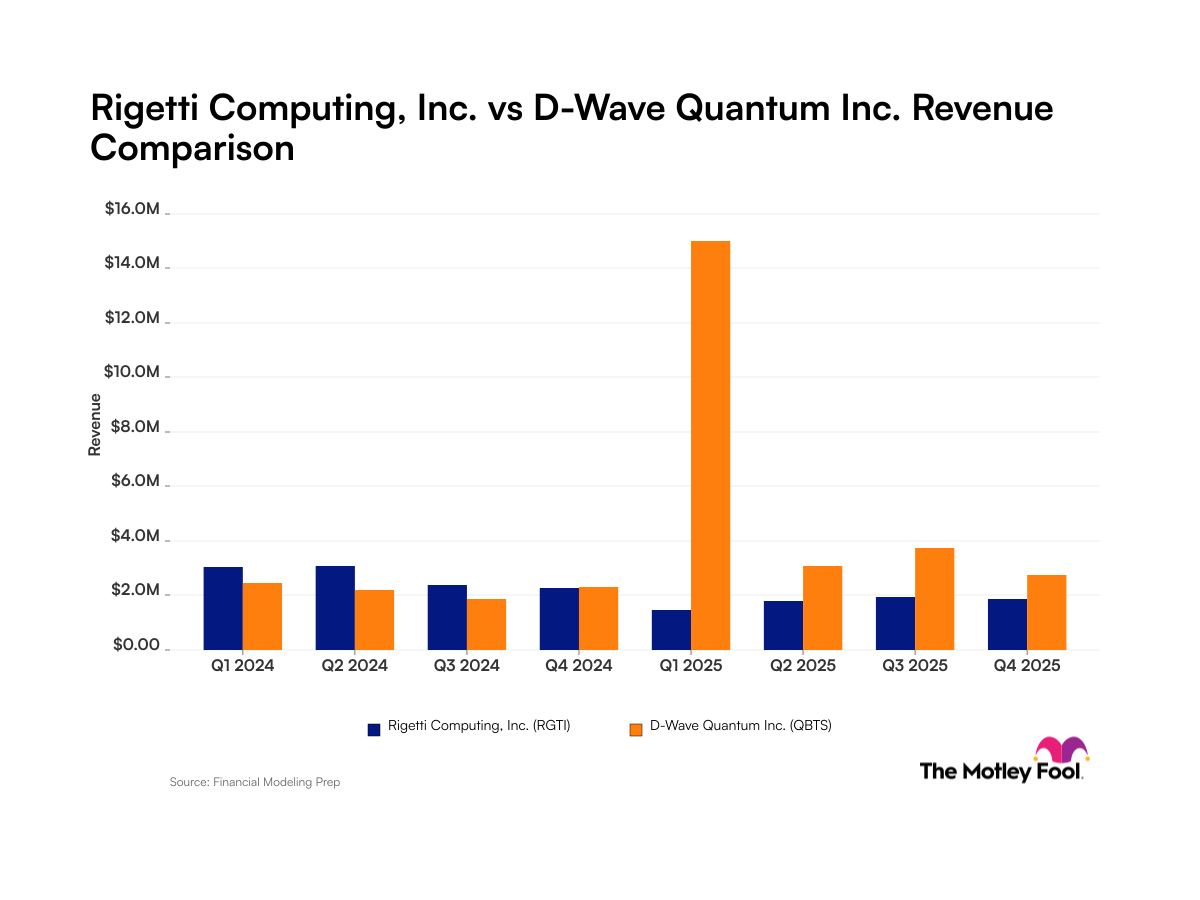
- Rigetti Revenue Challenges: Rigetti Computing reported a net loss of $18 million in Q4 2025, despite achieving $3.1 million in revenue in Q1 2024, indicating significant competitive pressure in the quantum computing market as overall revenue growth remains weak.
- D-Wave Revenue Growth: D-Wave Quantum generated $15 million in revenue in Q1 2025, a 179% increase over 2024, although it still faced a net loss of approximately $42 million, highlighting its rapid market expansion and customer appeal.
- Quantum Computing Market Outlook: Despite both Rigetti and D-Wave facing substantial losses, the quantum computing sector is still in its infancy, with potential for explosive growth over the next five years, particularly for companies that can scale quickly.
- Investor Focus: Investors should closely monitor upcoming quarterly reports from both companies to assess whether the revenue gap narrows or if D-Wave continues to pull ahead, reflecting the competitive landscape of the quantum computing industry.
See More

Analysis of Financial Volatility in Quantum Computing Firms
- Revenue Comparison: D-Wave Quantum generated $24 million in revenue last year, significantly outpacing Rigetti Computing's $7 million, indicating D-Wave's strong market performance despite both companies reporting losses of $18 million and $42 million, respectively.
- Market Volatility: Both companies have exhibited quarter-over-quarter revenue volatility over the past eight quarters, prompting investors to watch for consistent revenue growth or continued extreme fluctuations, which will directly impact their competitive positioning in the market.
- Development Stage: Quantum computing is still in its early stages, and while Rigetti and D-Wave's stock prices have risen by 135% and 237%, respectively, profitability is not the current focus; rather, the emphasis is on which company can scale the fastest over the next five years.
- Investor Focus: Investors should closely monitor upcoming quarterly reports to assess whether the revenue gap narrows or if D-Wave continues to pull ahead, as future market competition may significantly influence their long-term growth potential.
See More

D-Wave Quantum Shares Surge Amid AI Developments
- Stock Surge: D-Wave Quantum's shares have skyrocketed approximately 54% since last week's close, reaching $21.68, with a market cap of $8 billion, reflecting strong market interest and heightened investor confidence in quantum computing.
- AI-Driven Catalyst: Nvidia's announcement of the open-source quantum AI model Ising aims to accelerate computing technology, prompting D-Wave CEO Alan Baratz to issue a warning, indicating that quantum computing could surpass traditional AI accelerators, further fueling the rise in quantum computing stocks.
- Intensifying Market Competition: Baratz stated at the World Economy Summit that if he were Nvidia, he would be concerned, as quantum computing has the potential to dominate the next generation of computing power, signaling a more competitive future market landscape.
- Key Technological Evolution: Nvidia's Ising model is seen as the operating system for quantum machines, capable of transforming fragile qubits into scalable and reliable quantum-GPU systems, indicating that the integration of quantum computing and AI will drive further industry advancements.
See More

Quantum Computing Stocks Surge Again Amid AI Hype

- Surging Returns: As of mid-October 2025, quantum computing stocks have seen trailing 12-month returns as high as 6,217%, reflecting strong investor interest in this emerging technology, despite underlying bubble risks.
- Market Value Forecast: Analysts at Boston Consulting Group predict that quantum computing could create up to $850 billion in global economic value by 2040, highlighting its significance and potential applications in the future economy.
- Major Investment Trends: In October, JPMorgan launched a $1.5 trillion Security and Resiliency Initiative, identifying quantum computing as one of 27 sub-areas for potential investment, indicating strong interest from major financial institutions.
- Bubble Risk Warning: Despite quantum computing stocks surging between 26% and 45% recently, their price-to-sales ratios exceed 30, suggesting that market expectations for future profitability may be overly optimistic, urging caution among investors.
See More
Nvidia Sparks Quantum Computing Stock Rally
- Quantum Stock Surge: Following Nvidia's launch of the Ising open-source models, quantum computing stocks like IonQ and D-Wave Quantum surged by 60% and 47%, respectively, indicating strong market interest and increased investor confidence in quantum technology.
- Technical Milestone: IonQ announced it achieved a foundational milestone by photonic interconnecting two independent trapped-ion quantum systems, marking a key step towards scaling quantum computing, which is expected to attract more government and corporate investments.
- Software Ecosystem Development: Nvidia's CUDA-Q platform acts as middleware for quantum computing, facilitating collaboration among GPUs, CPUs, and quantum processing units, enhancing the complexity and efficiency of quantum applications, thereby solidifying its leadership in the quantum computing space.
- Strategic Investment Opportunity: Nvidia's quantum computing strategy mirrors its success in AI, and is expected to provide stable returns for investors, positioning it as a
See More
Nvidia Leads Quantum Computing Rally
- Quantum Stock Surge: Over the past five days, IonQ's stock surged 60%, D-Wave Quantum rose 47%, and Quantum Computing Inc. and Rigetti jumped 35% and 29% respectively, reflecting strong market interest and heightened investor confidence in quantum computing.
- IonQ's Major Milestone: IonQ announced it achieved a foundational technical milestone by photonically interconnecting two independent trapped-ion quantum systems, a breakthrough that lays the groundwork for scaling quantum computing, while also securing a contract from DARPA, enhancing its market position.
- Nvidia's Open-Source Platform: Nvidia launched the Ising family of open-source models aimed at making AI the control plane for quantum computers, enhancing the reliability and scalability of quantum-GPU systems, showcasing its strategic positioning in the quantum computing space.
- Middleware Layer Development: Nvidia's CUDA-Q platform integrates GPUs, CPUs, and quantum processing units, improving the management of complex quantum computing applications, thereby solidifying its core position in the quantum computing industry.
See More
Analysis of Investment Prospects in Quantum Computing Industry
- Rigetti Revenue Challenges: Rigetti Computing reported a net loss of $18 million in Q4 2025, despite achieving $3.1 million in revenue in Q1 2024, indicating significant competitive pressure in the quantum computing market as overall revenue growth remains weak.
- D-Wave Revenue Growth: D-Wave Quantum generated $15 million in revenue in Q1 2025, a 179% increase over 2024, although it still faced a net loss of approximately $42 million, highlighting its rapid market expansion and customer appeal.
- Quantum Computing Market Outlook: Despite both Rigetti and D-Wave facing substantial losses, the quantum computing sector is still in its infancy, with potential for explosive growth over the next five years, particularly for companies that can scale quickly.
- Investor Focus: Investors should closely monitor upcoming quarterly reports from both companies to assess whether the revenue gap narrows or if D-Wave continues to pull ahead, reflecting the competitive landscape of the quantum computing industry.
See More
Analysis of Financial Volatility in Quantum Computing Firms
- Revenue Comparison: D-Wave Quantum generated $24 million in revenue last year, significantly outpacing Rigetti Computing's $7 million, indicating D-Wave's strong market performance despite both companies reporting losses of $18 million and $42 million, respectively.
- Market Volatility: Both companies have exhibited quarter-over-quarter revenue volatility over the past eight quarters, prompting investors to watch for consistent revenue growth or continued extreme fluctuations, which will directly impact their competitive positioning in the market.
- Development Stage: Quantum computing is still in its early stages, and while Rigetti and D-Wave's stock prices have risen by 135% and 237%, respectively, profitability is not the current focus; rather, the emphasis is on which company can scale the fastest over the next five years.
- Investor Focus: Investors should closely monitor upcoming quarterly reports to assess whether the revenue gap narrows or if D-Wave continues to pull ahead, as future market competition may significantly influence their long-term growth potential.
See More
D-Wave Quantum Shares Surge Amid AI Developments
- Stock Surge: D-Wave Quantum's shares have skyrocketed approximately 54% since last week's close, reaching $21.68, with a market cap of $8 billion, reflecting strong market interest and heightened investor confidence in quantum computing.
- AI-Driven Catalyst: Nvidia's announcement of the open-source quantum AI model Ising aims to accelerate computing technology, prompting D-Wave CEO Alan Baratz to issue a warning, indicating that quantum computing could surpass traditional AI accelerators, further fueling the rise in quantum computing stocks.
- Intensifying Market Competition: Baratz stated at the World Economy Summit that if he were Nvidia, he would be concerned, as quantum computing has the potential to dominate the next generation of computing power, signaling a more competitive future market landscape.
- Key Technological Evolution: Nvidia's Ising model is seen as the operating system for quantum machines, capable of transforming fragile qubits into scalable and reliable quantum-GPU systems, indicating that the integration of quantum computing and AI will drive further industry advancements.
See More
Quantum Computing Stocks Surge Again Amid AI Hype
- Surging Returns: As of mid-October 2025, quantum computing stocks have seen trailing 12-month returns as high as 6,217%, reflecting strong investor interest in this emerging technology, despite underlying bubble risks.
- Market Value Forecast: Analysts at Boston Consulting Group predict that quantum computing could create up to $850 billion in global economic value by 2040, highlighting its significance and potential applications in the future economy.
- Major Investment Trends: In October, JPMorgan launched a $1.5 trillion Security and Resiliency Initiative, identifying quantum computing as one of 27 sub-areas for potential investment, indicating strong interest from major financial institutions.
- Bubble Risk Warning: Despite quantum computing stocks surging between 26% and 45% recently, their price-to-sales ratios exceed 30, suggesting that market expectations for future profitability may be overly optimistic, urging caution among investors.
See More