AMD and Celestica Partner to Launch New Product
Written by Emily J. Thompson, Senior Investment Analyst
Updated: Mar 16 2026
0mins

Source: Yahoo Finance
- Partnership Announcement: AMD and Celestica have announced a collaboration aimed at launching a new product, which is expected to enhance both companies' influence in the semiconductor market and strengthen their competitive positions.
- Product Innovation: The partnership will focus on the development of next-generation technologies, anticipated to improve product performance and production efficiency, thereby meeting the increasing market demand.
- Market Outlook: Through this collaboration, AMD and Celestica will be better positioned to tackle industry challenges and seize rapidly growing market opportunities, driving long-term growth for both companies.
- Strategic Implications: This initiative not only demonstrates the commitment of both companies to technological innovation but also lays the groundwork for future collaborations, potentially enhancing their positions in the global market.
Trade with 70% Backtested Accuracy
Stop guessing "Should I Buy AMD?" and start using high-conviction signals backed by rigorous historical data.
Sign up today to access powerful investing tools and make smarter, data-driven decisions.
Analyst Views on AMD
Wall Street analysts forecast AMD stock price to rise
33 Analyst Rating
25 Buy
8 Hold
0 Sell
Strong Buy
Current: 196.040

Low
210.00
Averages
289.13
High
377.00
Current: 196.040
Low
210.00
Averages
289.13
High
377.00
About AMD
Advanced Micro Devices, Inc. is a global semiconductor company. The Company is focused on high-performance computing and artificial intelligence (AI). Its segments include Data Center, Client and Gaming, and Embedded. Data Center segment includes AI accelerators, microprocessors (CPUs) for servers, graphics processing units (GPUs), accelerated processing units (APUs), data processing units (DPUs), Field Programmable Gate Arrays (FPGAs), and Adaptive system-on-Chip (SoC) products for data centers. Client and Gaming segment includes CPUs, APUs, chipsets for desktops and notebooks, discrete GPUs, and semi-custom SoC products and development services. Embedded segment includes embedded CPUs, APUs, FPGAs, system on modules (SOMs), and Adaptive SoC products. It markets and sells its products under the AMD trademark. Its products include AMD EPYC, AMD Ryzen, AMD Ryzen PRO, Virtex UltraScale+, among others.
About the author

Emily J. Thompson
Emily J. Thompson, a Chartered Financial Analyst (CFA) with 12 years in investment research, graduated with honors from the Wharton School. Specializing in industrial and technology stocks, she provides in-depth analysis for Intellectia’s earnings and market brief reports.

Zhipu AI Reports Strong Q1 Earnings Growth


- Significant Revenue Growth: Zhipu AI reported a 132% year-over-year revenue increase to 724 million yuan in Q1 2025, although it fell short of the 760 million yuan analyst estimate, indicating both potential and challenges in the rapidly evolving AI market.
- Widening Net Loss: The company posted an adjusted net loss of 3.18 billion yuan, up 29.1% from the previous year, primarily due to increased R&D spending, reflecting ongoing investments in technological innovation amid competitive pressures.
- Technological Advancements and Market Positioning: The recent release of Zhipu's GLM-5 model, which matches U.S. rivals on several key performance metrics, underscores its competitiveness in the global AI landscape and reinforces its status as one of China's
See More

Nvidia Shares Surge on $2 Billion Marvell Investment
- Stock Surge: Nvidia's stock rose 5.56% to $174.40, primarily driven by a $2 billion investment from Marvell Technology and an expanded AI infrastructure partnership, indicating a new catalyst for AI demand.
- Volume Spike: Trading volume reached 214.6 million shares, 16.6% above the three-month average, reflecting strong market interest and confidence in Nvidia's future growth potential.
- Market Performance: With Nvidia's influence, the S&P 500 and Nasdaq rose 2.92% and 3.83%, respectively, showcasing overall market optimism towards the semiconductor sector, particularly amid the AI investment surge.
- Strategic Implications: The partnership with Marvell not only strengthens Nvidia's position in AI networking and custom chip development but also signifies ongoing expansion across the AI supply chain, prompting investors to watch for similar large-scale infrastructure deals to sustain market momentum.
See More

Nvidia Stock Rises on $2 Billion Investment News
- Investment Boost: Nvidia's stock closed at $174.40 on Tuesday, up 5.59%, primarily driven by news of a $2 billion investment from Marvell Technology and an expanded AI infrastructure partnership, indicating strong market expectations for AI demand.
- Surge in Trading Volume: The trading volume reached 214.6 million shares, approximately 16.6% above the three-month average of 184 million shares, reflecting increased investor confidence in Nvidia's future growth prospects.
- Strong Market Performance: Within the semiconductor sector, peer stocks also performed well, with AMD and Intel rising by 3.77% and 7.14% respectively, showcasing an optimistic sentiment across the industry regarding AI and semiconductor demand.
- Infrastructure Expansion: The partnership with Marvell not only strengthens Nvidia's position in AI networking and custom chip development but also indicates the company's ongoing expansion within the AI supply chain, potentially attracting more large-scale infrastructure deals to sustain market momentum.
See More

OpenAI Closes Record Funding Round at $852 Billion Valuation


- Record Funding Size: OpenAI announced the closure of a $122 billion funding round, increasing from the $110 billion commitment disclosed in February, reflecting strong investor confidence in its future growth and solidifying its leadership in the AI sector.
- User Base Expansion: As of March, ChatGPT supports over 900 million weekly active users, with more than 50 million being paid subscribers, indicating widespread market acceptance and commercial potential, driving continued growth for the company.
- Significant Revenue Growth: OpenAI generates $2 billion in monthly revenue, with total revenue reaching $13.1 billion last year; although still unprofitable, this robust revenue stream lays the groundwork for future profitability, especially in light of a potential IPO.
- Strategic Investor Support: Strategic investors like Amazon, Nvidia, and SoftBank have committed $50 billion, $30 billion, and $30 billion respectively, demonstrating market trust in OpenAI's long-term prospects while providing ample funding for future expansion.
See More

Microsoft Faces AI Growth Pressure as Stock Plummets


- Stock Plunge: Microsoft experienced a 23% drop in stock price during Q1, marking its worst quarterly performance since the 2008 financial crisis, significantly outpacing the Nasdaq's 7% decline, indicating investor concerns over its AI growth prospects that could impact future financing capabilities.
- AI Assistant Challenges: Microsoft's Copilot AI assistant has seen low user adoption, with only 3% of commercial Office customers holding licenses, forcing the company to allocate Azure cloud resources for improvements to maintain market share amid fierce competition.
- Executive Shake-up: Microsoft reassigned Copilot development head Mustafa Suleyman and appointed former Snap executive Jacob Andreou to lead the Copilot experience for consumers and commercial clients, raising market concerns about the company's strategic direction and potentially affecting team morale.
- Cloud Business Growth: Despite challenges, Microsoft's Azure cloud service achieved a 39% revenue growth in the December quarter, with commercial remaining performance obligations exceeding $625 billion, reflecting strong demand in the cloud infrastructure market that may support the company's future.
See More
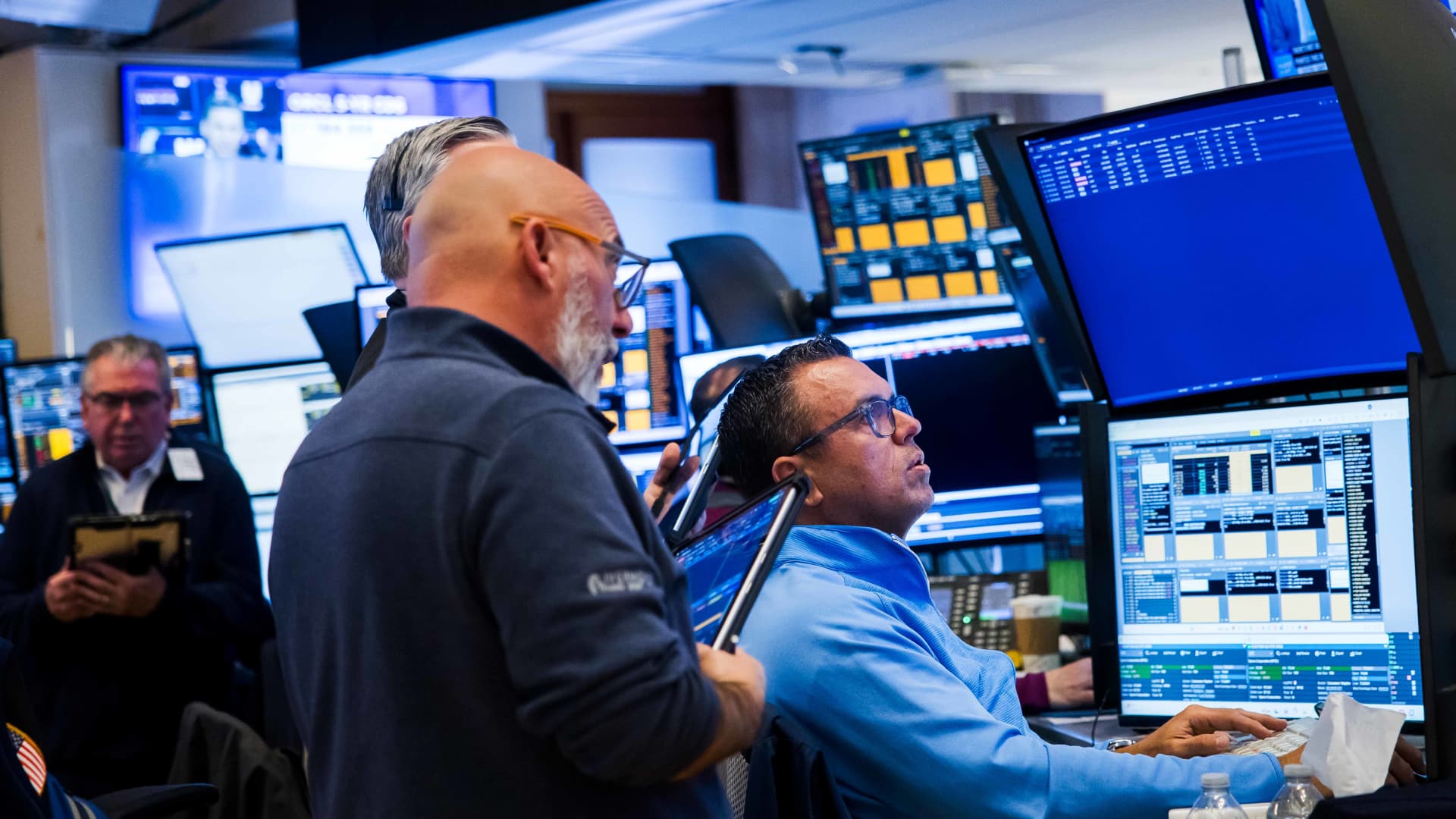
Semiconductor Market Approaching Bottom

- Market Sentiment Analysis: The current market sentiment is heavily bearish, with investors adopting a cautious outlook; however, historical trends indicate that market lows often precede improvements in sentiment and fundamentals, suggesting potential rebound opportunities.
- Semiconductor ETF Performance: The VanEck Semiconductor ETF (SMH) has shown a standard A-B-C corrective pattern since its February highs, currently trading in the $360 to $370 range, which may act as a support zone, indicating that selling pressure could be nearing exhaustion.
- Relative Strength Indicator: The ratio chart of SMH to the S&P 500 indicates a more tempered performance of the semiconductor sector relative to the broader market, with a triangle consolidation pattern that typically suggests a potential upward breakout, further supporting a long-term bullish outlook.
- Nvidia Valuation Analysis: Nvidia (NVDA) is currently trading at a forward P/E ratio of 20.5 times, with expected earnings of $8.29 per share in 2027, highlighting its growth potential significantly surpassing the market average; investors face a choice between paying 46 times earnings for a slow-growing company or approximately 20 times for a company with nearly 70% growth.
See More
Zhipu AI Reports Strong Q1 Earnings Growth
- Significant Revenue Growth: Zhipu AI reported a 132% year-over-year revenue increase to 724 million yuan in Q1 2025, although it fell short of the 760 million yuan analyst estimate, indicating both potential and challenges in the rapidly evolving AI market.
- Widening Net Loss: The company posted an adjusted net loss of 3.18 billion yuan, up 29.1% from the previous year, primarily due to increased R&D spending, reflecting ongoing investments in technological innovation amid competitive pressures.
- Technological Advancements and Market Positioning: The recent release of Zhipu's GLM-5 model, which matches U.S. rivals on several key performance metrics, underscores its competitiveness in the global AI landscape and reinforces its status as one of China's
See More
Nvidia Shares Surge on $2 Billion Marvell Investment
- Stock Surge: Nvidia's stock rose 5.56% to $174.40, primarily driven by a $2 billion investment from Marvell Technology and an expanded AI infrastructure partnership, indicating a new catalyst for AI demand.
- Volume Spike: Trading volume reached 214.6 million shares, 16.6% above the three-month average, reflecting strong market interest and confidence in Nvidia's future growth potential.
- Market Performance: With Nvidia's influence, the S&P 500 and Nasdaq rose 2.92% and 3.83%, respectively, showcasing overall market optimism towards the semiconductor sector, particularly amid the AI investment surge.
- Strategic Implications: The partnership with Marvell not only strengthens Nvidia's position in AI networking and custom chip development but also signifies ongoing expansion across the AI supply chain, prompting investors to watch for similar large-scale infrastructure deals to sustain market momentum.
See More
Nvidia Stock Rises on $2 Billion Investment News
- Investment Boost: Nvidia's stock closed at $174.40 on Tuesday, up 5.59%, primarily driven by news of a $2 billion investment from Marvell Technology and an expanded AI infrastructure partnership, indicating strong market expectations for AI demand.
- Surge in Trading Volume: The trading volume reached 214.6 million shares, approximately 16.6% above the three-month average of 184 million shares, reflecting increased investor confidence in Nvidia's future growth prospects.
- Strong Market Performance: Within the semiconductor sector, peer stocks also performed well, with AMD and Intel rising by 3.77% and 7.14% respectively, showcasing an optimistic sentiment across the industry regarding AI and semiconductor demand.
- Infrastructure Expansion: The partnership with Marvell not only strengthens Nvidia's position in AI networking and custom chip development but also indicates the company's ongoing expansion within the AI supply chain, potentially attracting more large-scale infrastructure deals to sustain market momentum.
See More
OpenAI Closes Record Funding Round at $852 Billion Valuation
- Record Funding Size: OpenAI announced the closure of a $122 billion funding round, increasing from the $110 billion commitment disclosed in February, reflecting strong investor confidence in its future growth and solidifying its leadership in the AI sector.
- User Base Expansion: As of March, ChatGPT supports over 900 million weekly active users, with more than 50 million being paid subscribers, indicating widespread market acceptance and commercial potential, driving continued growth for the company.
- Significant Revenue Growth: OpenAI generates $2 billion in monthly revenue, with total revenue reaching $13.1 billion last year; although still unprofitable, this robust revenue stream lays the groundwork for future profitability, especially in light of a potential IPO.
- Strategic Investor Support: Strategic investors like Amazon, Nvidia, and SoftBank have committed $50 billion, $30 billion, and $30 billion respectively, demonstrating market trust in OpenAI's long-term prospects while providing ample funding for future expansion.
See More
Microsoft Faces AI Growth Pressure as Stock Plummets
- Stock Plunge: Microsoft experienced a 23% drop in stock price during Q1, marking its worst quarterly performance since the 2008 financial crisis, significantly outpacing the Nasdaq's 7% decline, indicating investor concerns over its AI growth prospects that could impact future financing capabilities.
- AI Assistant Challenges: Microsoft's Copilot AI assistant has seen low user adoption, with only 3% of commercial Office customers holding licenses, forcing the company to allocate Azure cloud resources for improvements to maintain market share amid fierce competition.
- Executive Shake-up: Microsoft reassigned Copilot development head Mustafa Suleyman and appointed former Snap executive Jacob Andreou to lead the Copilot experience for consumers and commercial clients, raising market concerns about the company's strategic direction and potentially affecting team morale.
- Cloud Business Growth: Despite challenges, Microsoft's Azure cloud service achieved a 39% revenue growth in the December quarter, with commercial remaining performance obligations exceeding $625 billion, reflecting strong demand in the cloud infrastructure market that may support the company's future.
See More
Semiconductor Market Approaching Bottom
- Market Sentiment Analysis: The current market sentiment is heavily bearish, with investors adopting a cautious outlook; however, historical trends indicate that market lows often precede improvements in sentiment and fundamentals, suggesting potential rebound opportunities.
- Semiconductor ETF Performance: The VanEck Semiconductor ETF (SMH) has shown a standard A-B-C corrective pattern since its February highs, currently trading in the $360 to $370 range, which may act as a support zone, indicating that selling pressure could be nearing exhaustion.
- Relative Strength Indicator: The ratio chart of SMH to the S&P 500 indicates a more tempered performance of the semiconductor sector relative to the broader market, with a triangle consolidation pattern that typically suggests a potential upward breakout, further supporting a long-term bullish outlook.
- Nvidia Valuation Analysis: Nvidia (NVDA) is currently trading at a forward P/E ratio of 20.5 times, with expected earnings of $8.29 per share in 2027, highlighting its growth potential significantly surpassing the market average; investors face a choice between paying 46 times earnings for a slow-growing company or approximately 20 times for a company with nearly 70% growth.
See More