Major US Averages Mixed as Unemployment Rate Rises to 4.6%


The major averages had a mixed day as traders reacted to delayed jobs data that could influence the Federal Reserve's interest-rate path next year. Though November's jobs report came in better-than-expected, with an increase of 64,000 jobs for the month, the Bureau of Labor Statistics also reported that 105,000 jobs were shed in October, with the unemployment rate climbing to 4.6%.Record highs earlier in December have given way to a softer backdrop as investors weigh the release of the delayed nonfarm payrolls and other indicators like retail sales and CPI inflation, which were postponed by the longest U.S. government shutdown in history.Looking to commodities, gold was mostly unchanged, while oil fell sharply ahead of API crude numbers set for release this afternoon.Get caught up quickly on the top news and calls moving stocks with these five Top Five lists.1. STOCK NEWS:Fordsaid it expectsto "rationalize" U.S. EV-related assetsPfizerreiterated its guidance for FY25 and provided aPayPalhas submitted applications toApplewill expand its iPhone lineup to seven models by 2027,The U.S. Trade Representative said it will use "every tool" to2. WALL STREET CALLS:Rokuto Overweight from Underweight at Morgan StanleyLockheed Martinto Equal Weight at Morgan StanleyOktato Buy at JefferiesStubHubto Market Perform at CitizensWells FargoGapto Overweight3. AROUND THE WEB:Apollo Globalis exploring a potential sale of Atlas Air,Trump is slated to interview Fed governor Christopher Waller on Tuesday for the position of Fed chair,Oraclesigned roughly $150B of data center leases in the three months ending November 30, raising its total data center and cloud capacity commitments to $248B,Metaearned more than $18B in annual ad sales from China in 2024, making up over 10% of its global revenue, with more than $3B linked to fraudulent ads, like for scams,The U.K. government wants Apple, Google, and others to block explicit images at the OS level by default to protect kids and have adults verify their ages,4. MOVERS:Cementos Pacasmayoincreases in New York after announcingof the Hochschild Group, which controls 50.01% of the companyRezolve AIgains in New York afterannual recurring revenue view of $500M or moreAldeyrahigher after announcing thetarget action date for the reproxalap New Drug ApplicationLightwave Logicfalls after announcing anNavanlower after announcing the departure of5. EARNINGS/GUIDANCE:Vestisreaffirmed itsVital Farmsfor FY25Organigram, with Executive Chair Peter Amirault calling fiscal 2025 "marked by purposeful growth"Humanafor FY25CSP Inc., with EPS and revenue higher year-over-yearINDEXES:The Dow fell 302.30, or 0.62%, to 48,114.26, the Nasdaq gained 54.05, or 0.23%, to 23,111.46, and the S&P 500 declined 16.25, or 0.24%, to 6,800.26.
Trade with 70% Backtested Accuracy
Analyst Views on F

About F
About the author


Ford Faces $2 Billion Loss Due to Aluminum Supply Disruption

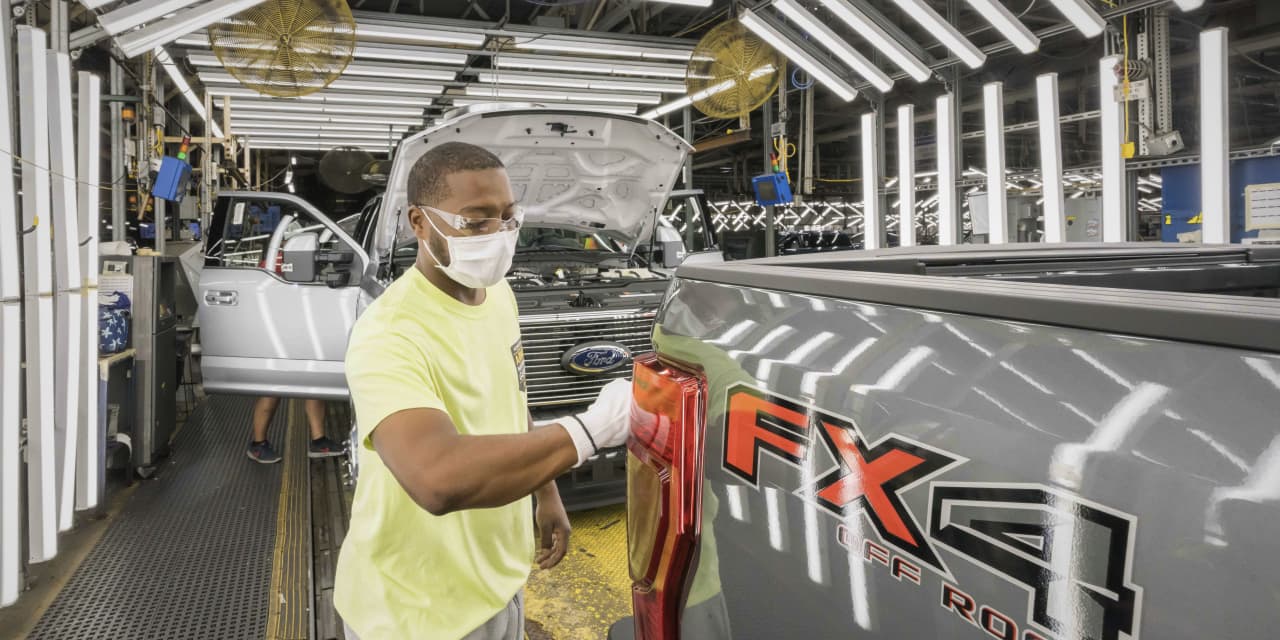
- Aluminum Supply Disruption: Ford's inventory of F-Series trucks has been severely impacted due to two fires at Novelis' aluminum production facility in New York, leading to an estimated loss of up to $2 billion and forcing the company to lower its 2025 profit forecast.
- Sales Decline: The sales of Ford's F-Series declined by 13% in May and are down 15% year-to-date, with inventory dropping to approximately 183,900 units at the end of May, a 16% decrease from the previous year, posing challenges to the company's profitability.
- Production Recovery: Novelis has restarted production at its New York facility and is working closely with customers to accelerate the supply of aluminum products, which is critical for Ford as it approaches a popular selling season.
- Future Outlook: Despite the challenges, Ford expects to recover about half of the EBIT losses by 2026, with analysts predicting adjusted EBIT to range between $8.5 billion and $10.5 billion, indicating the company's potential for recovery amidst adversity.
EV Demand Rebounds, Ford Seizes Opportunity

- EV Sales Rebound: In May, U.S. EV sales surpassed 85,000 units despite the absence of federal tax credits, indicating a significant recovery since last year's third quarter, which may present new growth opportunities for EV manufacturers.
- Average Transaction Price Decline: The average transaction price for EVs fell to $54,532 in May, a 4% decrease from the previous year, suggesting that manufacturers are working to reduce costs despite rising demand, which could impact future pricing strategies.
- Increased Incentive Spending: Automakers allocated approximately 14% of an EV's ATP to incentives, equating to about $7,600 per vehicle, which is double the industry average and may pressure profit margins, warranting close investor scrutiny.
- Ford's Strategic Shift: Ford plans to launch a new midsize EV platform in 2027, and despite a 58% decline in EV sales year-to-date, the rebound in market demand offers hope for future profitability, highlighting the company's potential in the EV sector.
BYD Considers Entering Formula 1 Racing

- Brand Expansion Plan: BYD is interested in entering the F1 circuit to enhance its brand presence outside China, although becoming the first Chinese F1 team could cost hundreds of millions, significantly impacting its financials.
- Market Potential Analysis: With 221.1 million F1 fans in China and BYD being the world's largest EV maker, a successful entry into F1 could greatly aid its international market expansion.
- Sponsorship Strategy Advantage: By sponsoring a midfield or back-of-the-pack team, BYD could participate in F1 at a lower cost, avoiding hefty infrastructure investments and technical compliance requirements, thus reducing risk while increasing brand visibility.
- Competition and Challenges: While sponsorship may be a lower-risk option, BYD's status as an OEM could conflict with existing F1 auto manufacturers, potentially affecting its brand positioning and technical showcase in the sport.

Ford Enters Battery Storage Market with New Subsidiary
- New Business Launch: Ford has officially launched Ford Energy, a subsidiary focused on providing large-scale battery storage systems for data centers and the electric grid, marking a significant entry into the rapidly growing AI infrastructure market.
- Stock Price Fluctuation: Following the announcement of the new business, Ford's stock price surged above $17 but has since retreated to around $14, indicating mixed short-term market reactions that investors should consider carefully.
- Growing Market Demand: As the construction of new data centers accelerates, the demand for battery storage is skyrocketing, with Ford planning to produce at least 20 gigawatts of battery storage capacity annually to capitalize on this trend.
- Long-Term Investment Opportunity: While Ford Energy may not deliver immediate profits, Cramer believes that it will make Ford a more attractive investment in the long run, especially as oil prices and interest rates are expected to decline.

Stellantis Faces Major Turnaround Challenges

- Stock Performance Divergence: Over the past three years, GM's stock surged 124%, Ford's gained a mere 4%, while Stellantis plummeted nearly 60%, highlighting significant differences in market performance that reflect each company's operational strategies and market acceptance.
- Recall Cost Pressure: Ford led the U.S. automotive industry in 2025 with 153 recalls, while Stellantis followed with 53; however, 80% of Ford's recalls were resolved via over-the-air software updates, minimizing repair costs, whereas Stellantis faced staggering warranty expenses of $7.4 billion, indicating quality control challenges.
- Warranty Expense Comparison: Stellantis's warranty costs accounted for 4.4% of total revenue, significantly exceeding the historical industry norm of 2% to 3%, while Ford's ratio stood at 3.1%, showing an upward trend, yet Ford's improvement in warranty claims reflects its commitment to quality management.
- Future Growth Potential: Stellantis plans to invest $70 billion over the next decade for a comprehensive product overhaul, with approximately 60% allocated to North America, aiming to launch 11 new models and achieve a 35% sales increase in the region, which could enhance market share and profitability if successful.

Stellantis Faces Rising Recall Costs Amid Turnaround Efforts
- Recall Volume Analysis: Stellantis reported 53 recalls in the U.S. for 2025, significantly lower than Ford's 153, yet its recall costs soared to $7.4 billion, highlighting major quality control challenges.
- Warranty Cost Comparison: Stellantis's warranty expenses accounted for 4.4% of total revenue, well above the historical industry norm of 2% to 3%, which not only impacts profitability but also reflects its competitive disadvantage in the market.
- Turnaround Plan: Stellantis is executing a $70 billion turnaround plan aimed at launching 11 new models to boost sales volume in North America by 35%, which is crucial for regaining market share and improving financial health.
- Quality Improvement Strategy: Executives emphasize that enhancing product quality is central to their North American strategy, and if successful, Stellantis could lower warranty costs in the coming years, thereby improving overall financial performance.
Ford Faces $2 Billion Loss Due to Aluminum Supply Disruption
- Aluminum Supply Disruption: Ford's inventory of F-Series trucks has been severely impacted due to two fires at Novelis' aluminum production facility in New York, leading to an estimated loss of up to $2 billion and forcing the company to lower its 2025 profit forecast.
- Sales Decline: The sales of Ford's F-Series declined by 13% in May and are down 15% year-to-date, with inventory dropping to approximately 183,900 units at the end of May, a 16% decrease from the previous year, posing challenges to the company's profitability.
- Production Recovery: Novelis has restarted production at its New York facility and is working closely with customers to accelerate the supply of aluminum products, which is critical for Ford as it approaches a popular selling season.
- Future Outlook: Despite the challenges, Ford expects to recover about half of the EBIT losses by 2026, with analysts predicting adjusted EBIT to range between $8.5 billion and $10.5 billion, indicating the company's potential for recovery amidst adversity.
EV Demand Rebounds, Ford Seizes Opportunity
- EV Sales Rebound: In May, U.S. EV sales surpassed 85,000 units despite the absence of federal tax credits, indicating a significant recovery since last year's third quarter, which may present new growth opportunities for EV manufacturers.
- Average Transaction Price Decline: The average transaction price for EVs fell to $54,532 in May, a 4% decrease from the previous year, suggesting that manufacturers are working to reduce costs despite rising demand, which could impact future pricing strategies.
- Increased Incentive Spending: Automakers allocated approximately 14% of an EV's ATP to incentives, equating to about $7,600 per vehicle, which is double the industry average and may pressure profit margins, warranting close investor scrutiny.
- Ford's Strategic Shift: Ford plans to launch a new midsize EV platform in 2027, and despite a 58% decline in EV sales year-to-date, the rebound in market demand offers hope for future profitability, highlighting the company's potential in the EV sector.
BYD Considers Entering Formula 1 Racing
- Brand Expansion Plan: BYD is interested in entering the F1 circuit to enhance its brand presence outside China, although becoming the first Chinese F1 team could cost hundreds of millions, significantly impacting its financials.
- Market Potential Analysis: With 221.1 million F1 fans in China and BYD being the world's largest EV maker, a successful entry into F1 could greatly aid its international market expansion.
- Sponsorship Strategy Advantage: By sponsoring a midfield or back-of-the-pack team, BYD could participate in F1 at a lower cost, avoiding hefty infrastructure investments and technical compliance requirements, thus reducing risk while increasing brand visibility.
- Competition and Challenges: While sponsorship may be a lower-risk option, BYD's status as an OEM could conflict with existing F1 auto manufacturers, potentially affecting its brand positioning and technical showcase in the sport.
Ford Enters Battery Storage Market with New Subsidiary
- New Business Launch: Ford has officially launched Ford Energy, a subsidiary focused on providing large-scale battery storage systems for data centers and the electric grid, marking a significant entry into the rapidly growing AI infrastructure market.
- Stock Price Fluctuation: Following the announcement of the new business, Ford's stock price surged above $17 but has since retreated to around $14, indicating mixed short-term market reactions that investors should consider carefully.
- Growing Market Demand: As the construction of new data centers accelerates, the demand for battery storage is skyrocketing, with Ford planning to produce at least 20 gigawatts of battery storage capacity annually to capitalize on this trend.
- Long-Term Investment Opportunity: While Ford Energy may not deliver immediate profits, Cramer believes that it will make Ford a more attractive investment in the long run, especially as oil prices and interest rates are expected to decline.
Stellantis Faces Major Turnaround Challenges
- Stock Performance Divergence: Over the past three years, GM's stock surged 124%, Ford's gained a mere 4%, while Stellantis plummeted nearly 60%, highlighting significant differences in market performance that reflect each company's operational strategies and market acceptance.
- Recall Cost Pressure: Ford led the U.S. automotive industry in 2025 with 153 recalls, while Stellantis followed with 53; however, 80% of Ford's recalls were resolved via over-the-air software updates, minimizing repair costs, whereas Stellantis faced staggering warranty expenses of $7.4 billion, indicating quality control challenges.
- Warranty Expense Comparison: Stellantis's warranty costs accounted for 4.4% of total revenue, significantly exceeding the historical industry norm of 2% to 3%, while Ford's ratio stood at 3.1%, showing an upward trend, yet Ford's improvement in warranty claims reflects its commitment to quality management.
- Future Growth Potential: Stellantis plans to invest $70 billion over the next decade for a comprehensive product overhaul, with approximately 60% allocated to North America, aiming to launch 11 new models and achieve a 35% sales increase in the region, which could enhance market share and profitability if successful.
Stellantis Faces Rising Recall Costs Amid Turnaround Efforts
- Recall Volume Analysis: Stellantis reported 53 recalls in the U.S. for 2025, significantly lower than Ford's 153, yet its recall costs soared to $7.4 billion, highlighting major quality control challenges.
- Warranty Cost Comparison: Stellantis's warranty expenses accounted for 4.4% of total revenue, well above the historical industry norm of 2% to 3%, which not only impacts profitability but also reflects its competitive disadvantage in the market.
- Turnaround Plan: Stellantis is executing a $70 billion turnaround plan aimed at launching 11 new models to boost sales volume in North America by 35%, which is crucial for regaining market share and improving financial health.
- Quality Improvement Strategy: Executives emphasize that enhancing product quality is central to their North American strategy, and if successful, Stellantis could lower warranty costs in the coming years, thereby improving overall financial performance.