Comparison of Vanguard and Schwab Short-Term Treasury ETFs
Written by Emily J. Thompson, Senior Investment Analyst
Updated: Jan 26 2026
0mins
Source: Fool
- Cost and Yield Comparison: Both Vanguard Short-Term Treasury ETF (VGSH) and Schwab Short-Term U.S. Treasury ETF (SCHO) have a 0.03% expense ratio, although SCHO offers a slightly higher yield of 4.06% compared to VGSH's 4.95%, making SCHO more appealing to income-focused investors.
- Assets Under Management: VGSH boasts an assets under management (AUM) of $30.38 billion, significantly larger than SCHO's $12.37 billion, indicating VGSH's greater influence and stability among conservative fixed income investors.
- Risk and Return Analysis: Both ETFs exhibit similar maximum drawdowns, with VGSH at 5.69% and SCHO at 5.71%, demonstrating their comparable risk management, making them suitable for investors seeking low volatility.
- Investor Choice Implications: As interest rate expectations remain unsettled, investors are reassessing low-risk capital allocations, making the choice between these ETFs crucial; VGSH suits those wanting a widely accepted Treasury core, while SCHO caters to those preferring Schwab's framework.
Trade with 70% Backtested Accuracy
Stop guessing "Should I Buy T?" and start using high-conviction signals backed by rigorous historical data.
Sign up today to access powerful investing tools and make smarter, data-driven decisions.
Analyst Views on T
Wall Street analysts forecast T stock price to rise
15 Analyst Rating
8 Buy
5 Hold
2 Sell
Moderate Buy
Current: 25.900

Low
20.00
Averages
28.27
High
33.00
Current: 25.900
Low
20.00
Averages
28.27
High
33.00
About T
AT&T Inc. is a holding company. The Company is a provider of telecommunications and technology services globally. The Company’s segments include Communications and Latin America. The Communications segment provides wireless and wireline telecom and broadband services to consumers located in the United States and businesses globally. The business units of the Communication segment include Mobility, Business Wireline, and Consumer Wireline. Mobility provides nationwide wireless service and equipment. Business Wireline provides advanced Ethernet-based fiber services, Internet Protocol (IP) Voice and managed professional services, as well as legacy voice and data services and related equipment, to business customers. Consumer Wireline provides broadband services, including fiber connections. Consumer Wireline provides legacy telephony voice communication services. The Latin America segment provides wireless services and equipment in Mexico.
About the author

Emily J. Thompson
Emily J. Thompson, a Chartered Financial Analyst (CFA) with 12 years in investment research, graduated with honors from the Wharton School. Specializing in industrial and technology stocks, she provides in-depth analysis for Intellectia’s earnings and market brief reports.

Amazon's Satellite Internet Service Poised for Growth

- New Business Outlook: Amazon plans to launch its satellite internet service, Amazon Leo, in Q3 2026, which is expected to become a new revenue growth engine, with CEO Andy Jassy stating it has the potential to become a multi-billion dollar revenue source.
- Strong Customer Base: Amazon Leo has already secured customers like AT&T, Delta Air Lines, JetBlue, and NASA, and notably gained Apple's support through the acquisition of Globalstar, enhancing its competitive position in the market.
- Significant Technical Advantages: Jassy noted that Amazon Leo will improve downlink and uplink performance by 2x and 6x over existing competitors, respectively, while also offering cost advantages, which is expected to attract more users, especially in underserved broadband areas.
- Notable Synergies: The launch of Amazon Leo is likely to boost AWS revenues, as Jassy mentioned that governments and enterprises want to store satellite data in the cloud and perform analytics, creating a compelling market appeal for the combined services.
See More
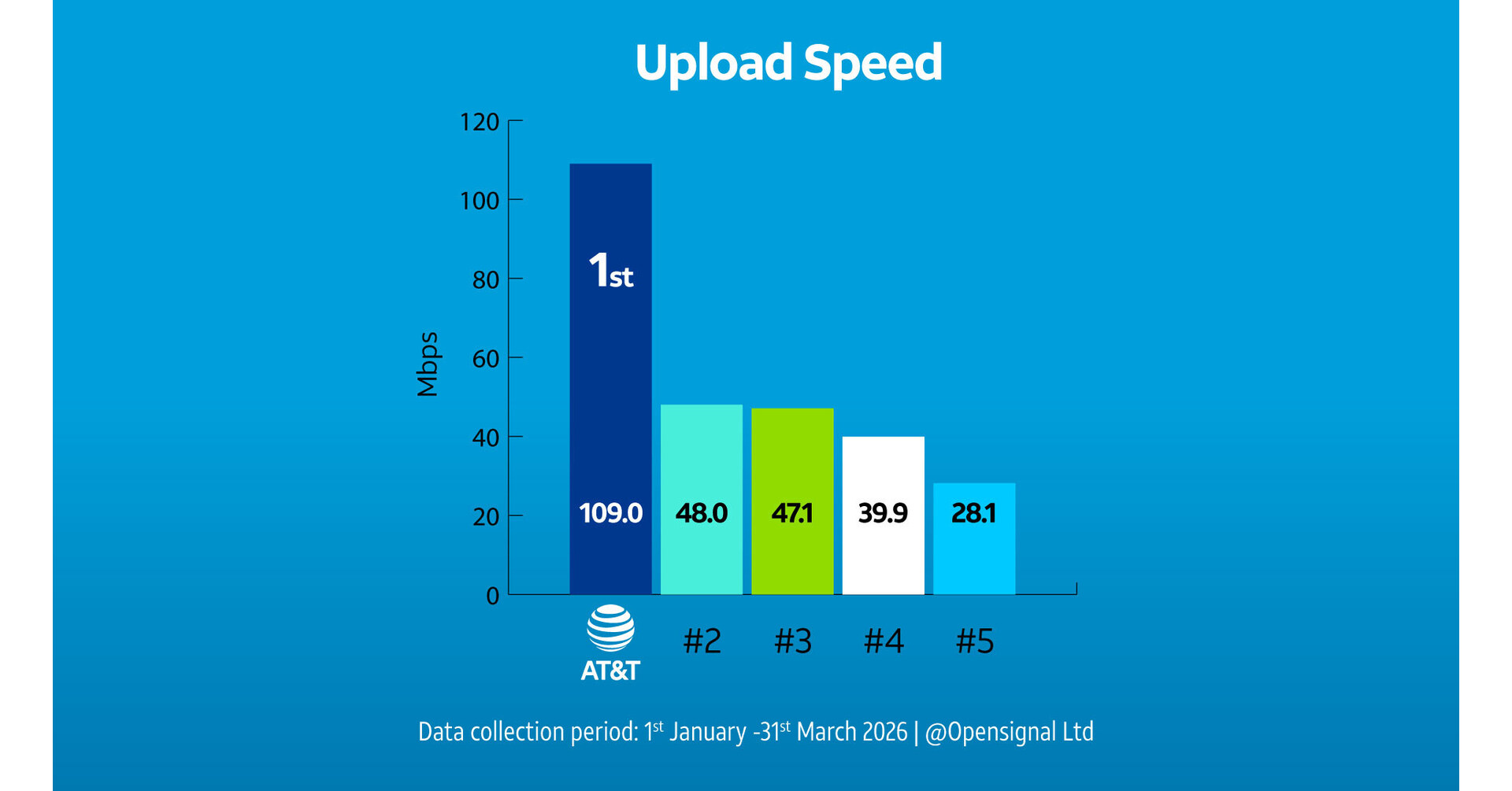
AT&T Achieves Fastest Upload Speeds Nationwide

- Upload Speed Advantage: According to Opensignal's report, AT&T's upload speeds are over twice as fast as the nearest competitor, showcasing its significant lead nationwide and reinforcing its competitive position in the market.
- Fiber Service Performance: AT&T Fiber ranks first in both upload and download speeds, outperforming other fiber, broadband, and fixed wireless competitors, indicating its leadership in home broadband technology and meeting user demands for high-speed internet.
- Demand in the AI Era: As AI technology becomes increasingly integrated into daily life, the importance of upload speeds is highlighted, with AT&T's infrastructure investments ensuring users have the high-speed connectivity they need both at home and on the go.
- Customer Preference Trends: With 42% of AT&T home internet customers also opting for AT&T wireless services, this reflects a strong preference for converged services, further driving the company's leadership position in the market.
See More

AT&T Leads the Nation in Upload Speeds
- Upload Speed Advantage: AT&T has been ranked as having the fastest upload speeds in America, with speeds more than twice as fast as its closest competitor, showcasing a significant edge in network performance that solidifies its market leadership.
- Converged Speed Ranking: The combination of AT&T's fiber and wireless services ranks #1 in both upload and download speeds, outperforming other fiber, cable, and fixed wireless competitors, indicating strong competitiveness in home and mobile network services.
- Growing Market Demand: As AI technology becomes more prevalent, the importance of upload speeds is increasing, with upstream usage growing faster than other broadband metrics in 2025, and AT&T's network investments are well-positioned to meet this demand.
- Customer Experience Commitment: With 42% of AT&T's home internet customers also opting for its wireless services, this highlights the appeal of its converged offerings, and AT&T is committed to enhancing user experience, further solidifying its leadership position in the market.
See More

Comparing the Benefits of Roth IRA vs 401(k)
- Importance of Company Matching: If a company offers a 401(k) plan with a dollar-for-dollar match, such as up to 6%, investors can effectively double their contributions by investing $6,000 and receiving an additional $6,000, resulting in a 100% return on investment, which significantly enhances retirement savings efficiency.
- Tax Treatment Differences: While 401(k) accounts are taxed upon withdrawal, Roth IRAs are taxed before investment, allowing for completely tax-free withdrawals, making Roth IRAs more attractive for long-term investments, especially in a potentially rising tax environment.
- Long-term Tax Considerations: With the U.S. national debt increasing from $10 trillion to $30 trillion over the past decade, there is a risk of rising tax rates in the future; choosing a Roth IRA can help avoid potential high tax burdens at retirement, thus protecting investment gains.
- Impact of Contribution Limits: The contribution limit for Roth IRAs is $7,000, while 401(k) plans exceed $22,000, reflecting the IRS's expectations regarding future tax policies, and investors should consider their income levels and tax planning when making their choices.
See More
Verizon Faces Debt Crisis, Dividend at Risk

- Rising Debt Burden: Verizon's total debt has surged to $172 billion, up from $158 billion at the end of last year and $144 billion a year ago, significantly exceeding its total equity of $105 billion, indicating increasing financial strain on the company.
- Acquisition Impact: The recent debt increase primarily stems from the $20 billion acquisition of Frontier Communications, and the $53 billion spent on C-band spectrum in 2021, which, while enhancing network quality, has further exacerbated the debt load.
- Ongoing Capital Expenditures: Verizon plans to allocate $16 billion to $16.5 billion in capital expenditures this year, only slightly down from $17 billion last year, which continues to pressure cash flow, as evidenced by a first-quarter free cash flow of $3.8 billion that barely covers $2.9 billion in dividend payments.
- Dividend Risk Escalation: With rising debt and interest expenses, Verizon may face the necessity to cut or suspend its dividend, akin to AT&T's situation in 2022, potentially prompting income investors to sell their shares, leading to short-term stock price declines.
See More
AT&T Small Business Contest Returns with $50,000 Grand Prize
- Generous Prize Pool: The 2026 AT&T Small Business Contest opens on May 1, offering applicants a chance to win a grand prize of $50,000 for business investment, while four finalists will each receive $5,000, significantly enhancing financial support and growth potential for small businesses.
- Community Connection Opportunities: The contest aims to spotlight small businesses driving change in their communities, allowing participants not only to secure funding but also to join a network of small business owners, gaining access to essential tools and resources for growth, fostering a healthy business ecosystem.
- Cybersecurity Innovation: On May 4, AT&T will launch Dynamic Defense®, providing embedded proactive protection for small and medium-sized businesses, helping clients block cyber threats without adding hardware or operational complexity, ensuring business continuity.
- Support for Women Entrepreneurs: Winners of the AT&T Small Business Contest will be featured in her show, showcasing women's breakthroughs in business and sports, further elevating the influence and societal recognition of female entrepreneurs, and promoting the growth and development of the next generation.
See More
Amazon's Satellite Internet Service Poised for Growth
- New Business Outlook: Amazon plans to launch its satellite internet service, Amazon Leo, in Q3 2026, which is expected to become a new revenue growth engine, with CEO Andy Jassy stating it has the potential to become a multi-billion dollar revenue source.
- Strong Customer Base: Amazon Leo has already secured customers like AT&T, Delta Air Lines, JetBlue, and NASA, and notably gained Apple's support through the acquisition of Globalstar, enhancing its competitive position in the market.
- Significant Technical Advantages: Jassy noted that Amazon Leo will improve downlink and uplink performance by 2x and 6x over existing competitors, respectively, while also offering cost advantages, which is expected to attract more users, especially in underserved broadband areas.
- Notable Synergies: The launch of Amazon Leo is likely to boost AWS revenues, as Jassy mentioned that governments and enterprises want to store satellite data in the cloud and perform analytics, creating a compelling market appeal for the combined services.
See More
AT&T Achieves Fastest Upload Speeds Nationwide
- Upload Speed Advantage: According to Opensignal's report, AT&T's upload speeds are over twice as fast as the nearest competitor, showcasing its significant lead nationwide and reinforcing its competitive position in the market.
- Fiber Service Performance: AT&T Fiber ranks first in both upload and download speeds, outperforming other fiber, broadband, and fixed wireless competitors, indicating its leadership in home broadband technology and meeting user demands for high-speed internet.
- Demand in the AI Era: As AI technology becomes increasingly integrated into daily life, the importance of upload speeds is highlighted, with AT&T's infrastructure investments ensuring users have the high-speed connectivity they need both at home and on the go.
- Customer Preference Trends: With 42% of AT&T home internet customers also opting for AT&T wireless services, this reflects a strong preference for converged services, further driving the company's leadership position in the market.
See More
AT&T Leads the Nation in Upload Speeds
- Upload Speed Advantage: AT&T has been ranked as having the fastest upload speeds in America, with speeds more than twice as fast as its closest competitor, showcasing a significant edge in network performance that solidifies its market leadership.
- Converged Speed Ranking: The combination of AT&T's fiber and wireless services ranks #1 in both upload and download speeds, outperforming other fiber, cable, and fixed wireless competitors, indicating strong competitiveness in home and mobile network services.
- Growing Market Demand: As AI technology becomes more prevalent, the importance of upload speeds is increasing, with upstream usage growing faster than other broadband metrics in 2025, and AT&T's network investments are well-positioned to meet this demand.
- Customer Experience Commitment: With 42% of AT&T's home internet customers also opting for its wireless services, this highlights the appeal of its converged offerings, and AT&T is committed to enhancing user experience, further solidifying its leadership position in the market.
See More
Comparing the Benefits of Roth IRA vs 401(k)
- Importance of Company Matching: If a company offers a 401(k) plan with a dollar-for-dollar match, such as up to 6%, investors can effectively double their contributions by investing $6,000 and receiving an additional $6,000, resulting in a 100% return on investment, which significantly enhances retirement savings efficiency.
- Tax Treatment Differences: While 401(k) accounts are taxed upon withdrawal, Roth IRAs are taxed before investment, allowing for completely tax-free withdrawals, making Roth IRAs more attractive for long-term investments, especially in a potentially rising tax environment.
- Long-term Tax Considerations: With the U.S. national debt increasing from $10 trillion to $30 trillion over the past decade, there is a risk of rising tax rates in the future; choosing a Roth IRA can help avoid potential high tax burdens at retirement, thus protecting investment gains.
- Impact of Contribution Limits: The contribution limit for Roth IRAs is $7,000, while 401(k) plans exceed $22,000, reflecting the IRS's expectations regarding future tax policies, and investors should consider their income levels and tax planning when making their choices.
See More
Verizon Faces Debt Crisis, Dividend at Risk
- Rising Debt Burden: Verizon's total debt has surged to $172 billion, up from $158 billion at the end of last year and $144 billion a year ago, significantly exceeding its total equity of $105 billion, indicating increasing financial strain on the company.
- Acquisition Impact: The recent debt increase primarily stems from the $20 billion acquisition of Frontier Communications, and the $53 billion spent on C-band spectrum in 2021, which, while enhancing network quality, has further exacerbated the debt load.
- Ongoing Capital Expenditures: Verizon plans to allocate $16 billion to $16.5 billion in capital expenditures this year, only slightly down from $17 billion last year, which continues to pressure cash flow, as evidenced by a first-quarter free cash flow of $3.8 billion that barely covers $2.9 billion in dividend payments.
- Dividend Risk Escalation: With rising debt and interest expenses, Verizon may face the necessity to cut or suspend its dividend, akin to AT&T's situation in 2022, potentially prompting income investors to sell their shares, leading to short-term stock price declines.
See More
AT&T Small Business Contest Returns with $50,000 Grand Prize
- Generous Prize Pool: The 2026 AT&T Small Business Contest opens on May 1, offering applicants a chance to win a grand prize of $50,000 for business investment, while four finalists will each receive $5,000, significantly enhancing financial support and growth potential for small businesses.
- Community Connection Opportunities: The contest aims to spotlight small businesses driving change in their communities, allowing participants not only to secure funding but also to join a network of small business owners, gaining access to essential tools and resources for growth, fostering a healthy business ecosystem.
- Cybersecurity Innovation: On May 4, AT&T will launch Dynamic Defense®, providing embedded proactive protection for small and medium-sized businesses, helping clients block cyber threats without adding hardware or operational complexity, ensuring business continuity.
- Support for Women Entrepreneurs: Winners of the AT&T Small Business Contest will be featured in her show, showcasing women's breakthroughs in business and sports, further elevating the influence and societal recognition of female entrepreneurs, and promoting the growth and development of the next generation.
See More