Broadcom and Meta Expand Strategic Partnership to Support AI Infrastructure


Catch up on the top artificial intelligence news and commentary by Wall Street analysts on publicly traded companies in the space with this daily recap compiled by The Fly.EXPANDED PARTNERSHIP:Broadcomand Metaannounced a multi-year, multi-generation strategic partnership to support Meta's artificial intelligence compute infrastructure. Building on their existing partnership, Broadcom will deliver technology supporting Meta Training and Inference Accelerator, or MTIA, chips, with plans to extend through 2029. This technology will serve as the backbone for Meta's deployment of AI data centers. The initial commitment exceeds 1GW and is the first phase of a sustained, multi-gigawatt rollout. This reinforces a shared roadmap to co-design and scale the hardware required to bring generative AI features and "personal superintelligence" to billions of people globally across apps like WhatsApp, Instagram, and Threads. Central to this expanding infrastructure footprint is the rapid deployment of Meta's MTIA silicon, made possible by deep engineering co-design through Broadcom's XPU platform. This platform approach allows Broadcom and Meta to couple logic, memory, and high-speed I/O for current deployments, while establishing a blueprint to co-develop future iterations of the MTIA portfolio over the coming years. Broadcom is delivering its Ethernet networking solutions to address scale-up, scale-out, and scale-across requirements. Broadcom CEO Hock Tan will transition off of Meta's board of directors and into an advisor role for Meta, where he'll provide guidance on Meta's custom silicon roadmap and help shape the future of their infrastructure investments.VC OFFERS:Anthropic has fielded multiple offers from VCs valuing the company at as much as $800B in recent weeks, Business Insider's Ben Bergman, citing multiple people familiar with the matter. The firm was valued at $380B in February, the report notes.ACQUISITION:OpenAI has acquired personal finance startup Hiro Finance, founder Ethan Bloch announced on Monday. "The Hiro product will stop functioning on April 20, 2026 and all data will be deleted from our servers on May 13, 2026. Existing users can export all of their data from settings until May 13, 2026," Bloch said. The founder added: "We started Hiro with the vision of building an AI personal CFO, and we worked relentlessly to make it real. Since then, we've helped clients plan for and manage more than $1 billion in assets, and we're incredibly proud of what we've built and learned along the way." Terms of the deal were not disclosed.AMAZON BIO DISCOVERY:AWS announced AmazonBio Discovery, a new AI-powered application designed to help scientists design and test novel drugs more quickly and confidently. "Amazon Bio Discovery gives scientists direct access to a broad catalog of specialized AI models called biological foundation models that are trained on vast biological datasets," the company said. These models generate and evaluate potential drug molecules, known as candidates, helping scientists accelerate antibody therapies during the early stages of drug discovery. With Amazon Bio Discovery, scientists can converse naturally in their preferred terminology with an AI agent and can also train models on their prior experimental data to make more accurate predictions. Furthermore, they can easily send candidates to physical labs for synthesis and testing-with results routing back to the application for rapid iteration, creating a lab-in-the-loop experimentation cycle.AI-RAN TECHNOLOGIES:Nokiaand Orangeannounced a new collaboration focused on developing and evaluating artificial intelligence radio access network, or AI-RAN, technologies powered by Nokia's anyRAN 5G software and NvidiaAI infrastructure. The initiative aims to explore how emerging AI-RAN capabilities can enhance network performance, energy efficiency and enable new services for Orange customers. Through a structured co-innovation framework, Nokia and Orange will jointly identify, design and evaluate new AI-RAN capabilities. The collaboration aims to explore how a GPU-based radio processor can boost radio performance with more advanced receivers, and how AI can be tightly integrated into the RAN to further improve performance, support new services such as sensing, and bring greater automation and intelligence to both cloud-based and purpose-built RAN environments.PARTNERSHIP WITH NVIDIA:Cadenceannounced an expanded partnership with Nvidiato deliver accelerated solutions across agentic AI, physics-based simulation and digital twins to unlock new levels of productivity and accelerate next-generation engineering design flows across semiconductor design, physical AI systems and hyperscale AI factories. The company said, "By combining Cadence's leadership in agentic AI-driven design, electronic design automation and system design and analysis with Nvidia CUDA-X, AI physics and Omniverse libraries for industrial digital twin solutions, the two companies are redefining engineering productivity across three critical design domains-accelerating innovation at true agent speed. Cadence and Nvidia are accelerating Cadence EDA and SDA solutions with Nvidia CUDA-X, AI-physics, Omniverse libraries and the Cadence Millennium M2000 Supercomputer, powered by Nvidia AI infrastructure. As part of this expanded collaboration, Cadence will accelerate its wide range of principled solvers and leverage AI physics models to deliver engineering workflows up to 100X speedup. Cadence EDA and SDA customers and partners, including Ascendence, Argonne National Laboratory, Honda R&D, Samsung and SK Hynix are already leveraging Cadence solutions accelerated by Nvidia to bring accelerated products to market faster."AI-DRIVEN CHIP DESIGN:Cadenceannounced a strategic collaboration with Googleto optimize the Cadence ChipStack AI Super Agent with Gemini on Google Cloud. The company said, "This collaboration positions Cadence at the forefront of the shift toward agentic design automation, creating an agent-driven, scalable, cloud-native platform for next-generation chip design and verification."AI TRANSFORMATIONS:Thoma Bravo and Google Cloud have launched a strategic partnership to help enterprise software companies accelerate their AI transformations. Through the partnership, Thoma Bravo's portfolio companies will receive streamlined access to Google Cloud's AI platform including its Gemini models and Gemini Enterprise platform for agentic AI; teams of Google forward deployed engineers to rapidly solve deep technical challenges; and new routes to market for SaaS companies through Google Cloud's Marketplace and co-sell programs. "This partnership will allow our portfolio companies to rapidly implement leading AI technology from Google Cloud, which will enable our companies to build and deliver the most innovative AI solutions for their customers," said Orlando Bravo, a Founder and Managing Partner at Thoma Bravo. "Through our partnership with Google, our portfolio companies will be in position to build the next generation of AI solutions for nearly every process, function, and industry across enterprises including human capital management, interconnected planning, procurement, aviation, manufacturing, financial services, healthcare, real estate, and almost every segment across cybersecurity solutions." Additionally, Thoma Bravo's cybersecurity portfolio will partner with Google Cloud to identify and mitigate rapidly evolving security risks with AI.
Trade with 70% Backtested Accuracy
Analyst Views on AVGO

About AVGO
About the author


Analysis of SpaceX IPO Prospects and Investment Recommendations


- Valuation and Fundraising Goals: SpaceX aims for a $1.75 trillion valuation in its IPO, seeking to raise $75 billion, which would position it as the eighth most valuable company globally; however, such a high valuation necessitates substantial profits to justify it.
- Revenue and Profit Data: Reports indicate that SpaceX generated $15 billion to $16 billion in revenue in 2022, with around $8 billion in profit, and projections suggest that by 2026, its rocket launch and Starlink businesses could yield approximately $20 billion in revenue, highlighting its strong market potential.
- Market Risk Warning: While SpaceX's IPO may initially attract investors, a price-to-sales ratio of 87 suggests excessive optimism about future growth, as historically similar IPOs often surge initially before declining, posing risks for retail investors.
- Alternative Investment Options: For those interested in space exploration investments, it is advisable to consider space-themed exchange-traded funds (ETFs) like the Ark Space and Invesco Aerospace & Defense ETF, which mitigate risk through diversified holdings while outperforming the S&P 500.

SpaceX Files for IPO, Eyeing $1.75 Trillion Valuation
- IPO Plans and Valuation: SpaceX has confidentially filed for an IPO aiming for a staggering $1.75 trillion valuation and plans to raise $75 billion, which would position it as the eighth most valuable company globally, though such a high valuation necessitates substantial profits to justify.
- Revenue Sources and Clients: Beyond theoretical space travel, SpaceX collaborates with the U.S. Defense Department and NASA, with projections indicating that its rocket launch and Starlink businesses could generate around $20 billion in revenue by 2026, highlighting strong market demand and profit potential.
- Market Risks and Investment Advice: Despite the excitement surrounding SpaceX's IPO, the astronomical price-to-sales ratio of 87 suggests an overly optimistic market outlook, leading to potential short-term volatility, thus advising investors to consider space-themed ETFs as a safer investment alternative.
- Competition and Alternative Investments: Various space-themed ETFs, such as Ark Space and Invesco Aerospace & Defense ETF, offer diversified exposure to the sector and have outperformed the S&P 500, providing a more stable investment option amidst the speculative nature of SpaceX's IPO.

Broadcom and AMD: Competition and Collaboration


- Revenue Growth Comparison: Broadcom achieved a 28% year-over-year revenue growth in Q4 2025, while AMD reported a 34% increase during the same period, indicating AMD's superior growth despite Broadcom's better profit margins, showcasing the competitive dynamics between the two companies.
- Margin Discrepancy: Broadcom's net profit margin stood at 47.3% in Q4 2025, compared to AMD's 14.7%, highlighting Broadcom's stronger revenue retention capabilities; however, if AMD can improve its margins, it could see significant profit increases.
- Deepening Strategic Partnerships: AMD's collaboration with Meta Platforms to deploy 6 gigawatts of GPUs is expected to yield

AI Chip Market Outlook Remains Positive
- Market Growth Potential: Grandview Research projects a 29% compound annual growth rate for the AI chip industry from 2024 to 2030, indicating that AI chip stocks still have upside potential, attracting investor interest.
- Deepening Partnerships: AMD's collaboration with Meta Platforms to deploy 6 gigawatts of GPUs is expected to yield 'substantial multiyear revenue growth', while Broadcom has also expanded its partnerships with Meta and Alphabet to supply custom AI chips, further solidifying its market position.
- Financial Performance Comparison: In Q4 of fiscal year 2025, Broadcom achieved a 28% year-over-year revenue growth, while AMD led with a 34% growth, showcasing a competitive landscape in revenue growth between the two companies.
- Margin Discrepancies: Although AMD outperforms in revenue growth, Broadcom's net profit margin reached 47.3% in Q4 2025, significantly higher than AMD's 14.7%, giving Broadcom a clear advantage in profitability.
Intensifying Competition in AI Chip Market

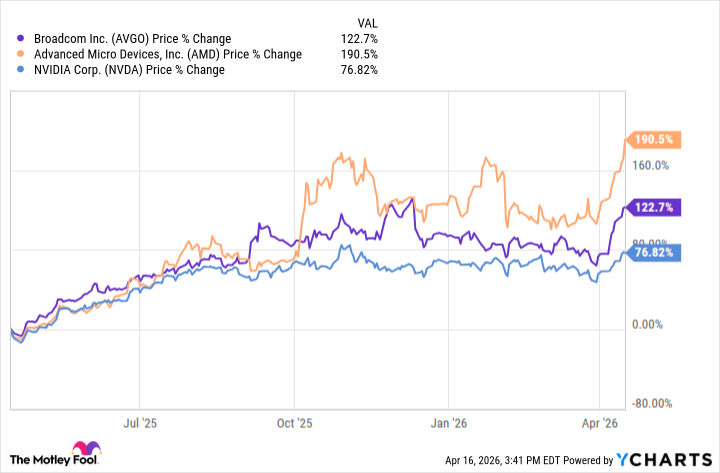
- Market Growth Potential: Grandview Research projects a 29% compound annual growth rate for the AI chip industry from 2024 to 2030, indicating significant upside potential that attracts investor interest in related stocks.
- Deepening Partnerships: AMD has partnered with Meta Platforms to deploy 6 gigawatts of AMD GPUs, which is expected to yield “substantial multiyear revenue growth,” showcasing its competitive edge in a high-demand market.
- Financial Performance Comparison: In Q4 of fiscal year 2025, Broadcom achieved a 28% year-over-year revenue growth, while AMD led with a 34% growth, suggesting AMD's stronger performance in revenue growth may attract more investors.
- Margin Discrepancies: Although Broadcom excels in profit margins with a net profit margin of 47.3% in Q4 2025 compared to AMD's 14.7%, AMD has greater room for margin improvement, which could lead to significant profit growth if realized.
Chip Stocks Face Pullback Risks After Rally

- Market Performance Review: The three major indexes surged this week, with the S&P 500 recording its largest one-week gain since May, while the information technology sector climbed 8%, indicating a strong market rebound.
- Overbought Signals: Following the significant market gains, CNBC Pro screened for overbought stocks, with AMD's relative strength index (RSI) exceeding 80, as shares jumped over 13% this week, suggesting potential short-term pullback risks.
- Analyst Ratings Optimistic: Despite concerns of a pullback, most analysts polled by FactSet maintain a buy rating for AMD, expecting about 5% more upside, reflecting confidence in its long-term performance.
- Other Stock Performances: In addition to AMD, ON Semiconductor, Intel, and Broadcom also showed strong performances with RSIs in the high 70s, while Synchrony Financial's RSI approached 74, indicating potential for an 8% increase over the next year despite a year-to-date decline of over 6%.
Analysis of SpaceX IPO Prospects and Investment Recommendations
- Valuation and Fundraising Goals: SpaceX aims for a $1.75 trillion valuation in its IPO, seeking to raise $75 billion, which would position it as the eighth most valuable company globally; however, such a high valuation necessitates substantial profits to justify it.
- Revenue and Profit Data: Reports indicate that SpaceX generated $15 billion to $16 billion in revenue in 2022, with around $8 billion in profit, and projections suggest that by 2026, its rocket launch and Starlink businesses could yield approximately $20 billion in revenue, highlighting its strong market potential.
- Market Risk Warning: While SpaceX's IPO may initially attract investors, a price-to-sales ratio of 87 suggests excessive optimism about future growth, as historically similar IPOs often surge initially before declining, posing risks for retail investors.
- Alternative Investment Options: For those interested in space exploration investments, it is advisable to consider space-themed exchange-traded funds (ETFs) like the Ark Space and Invesco Aerospace & Defense ETF, which mitigate risk through diversified holdings while outperforming the S&P 500.
SpaceX Files for IPO, Eyeing $1.75 Trillion Valuation
- IPO Plans and Valuation: SpaceX has confidentially filed for an IPO aiming for a staggering $1.75 trillion valuation and plans to raise $75 billion, which would position it as the eighth most valuable company globally, though such a high valuation necessitates substantial profits to justify.
- Revenue Sources and Clients: Beyond theoretical space travel, SpaceX collaborates with the U.S. Defense Department and NASA, with projections indicating that its rocket launch and Starlink businesses could generate around $20 billion in revenue by 2026, highlighting strong market demand and profit potential.
- Market Risks and Investment Advice: Despite the excitement surrounding SpaceX's IPO, the astronomical price-to-sales ratio of 87 suggests an overly optimistic market outlook, leading to potential short-term volatility, thus advising investors to consider space-themed ETFs as a safer investment alternative.
- Competition and Alternative Investments: Various space-themed ETFs, such as Ark Space and Invesco Aerospace & Defense ETF, offer diversified exposure to the sector and have outperformed the S&P 500, providing a more stable investment option amidst the speculative nature of SpaceX's IPO.
Broadcom and AMD: Competition and Collaboration
- Revenue Growth Comparison: Broadcom achieved a 28% year-over-year revenue growth in Q4 2025, while AMD reported a 34% increase during the same period, indicating AMD's superior growth despite Broadcom's better profit margins, showcasing the competitive dynamics between the two companies.
- Margin Discrepancy: Broadcom's net profit margin stood at 47.3% in Q4 2025, compared to AMD's 14.7%, highlighting Broadcom's stronger revenue retention capabilities; however, if AMD can improve its margins, it could see significant profit increases.
- Deepening Strategic Partnerships: AMD's collaboration with Meta Platforms to deploy 6 gigawatts of GPUs is expected to yield
AI Chip Market Outlook Remains Positive
- Market Growth Potential: Grandview Research projects a 29% compound annual growth rate for the AI chip industry from 2024 to 2030, indicating that AI chip stocks still have upside potential, attracting investor interest.
- Deepening Partnerships: AMD's collaboration with Meta Platforms to deploy 6 gigawatts of GPUs is expected to yield 'substantial multiyear revenue growth', while Broadcom has also expanded its partnerships with Meta and Alphabet to supply custom AI chips, further solidifying its market position.
- Financial Performance Comparison: In Q4 of fiscal year 2025, Broadcom achieved a 28% year-over-year revenue growth, while AMD led with a 34% growth, showcasing a competitive landscape in revenue growth between the two companies.
- Margin Discrepancies: Although AMD outperforms in revenue growth, Broadcom's net profit margin reached 47.3% in Q4 2025, significantly higher than AMD's 14.7%, giving Broadcom a clear advantage in profitability.
Intensifying Competition in AI Chip Market
- Market Growth Potential: Grandview Research projects a 29% compound annual growth rate for the AI chip industry from 2024 to 2030, indicating significant upside potential that attracts investor interest in related stocks.
- Deepening Partnerships: AMD has partnered with Meta Platforms to deploy 6 gigawatts of AMD GPUs, which is expected to yield “substantial multiyear revenue growth,” showcasing its competitive edge in a high-demand market.
- Financial Performance Comparison: In Q4 of fiscal year 2025, Broadcom achieved a 28% year-over-year revenue growth, while AMD led with a 34% growth, suggesting AMD's stronger performance in revenue growth may attract more investors.
- Margin Discrepancies: Although Broadcom excels in profit margins with a net profit margin of 47.3% in Q4 2025 compared to AMD's 14.7%, AMD has greater room for margin improvement, which could lead to significant profit growth if realized.
Chip Stocks Face Pullback Risks After Rally
- Market Performance Review: The three major indexes surged this week, with the S&P 500 recording its largest one-week gain since May, while the information technology sector climbed 8%, indicating a strong market rebound.
- Overbought Signals: Following the significant market gains, CNBC Pro screened for overbought stocks, with AMD's relative strength index (RSI) exceeding 80, as shares jumped over 13% this week, suggesting potential short-term pullback risks.
- Analyst Ratings Optimistic: Despite concerns of a pullback, most analysts polled by FactSet maintain a buy rating for AMD, expecting about 5% more upside, reflecting confidence in its long-term performance.
- Other Stock Performances: In addition to AMD, ON Semiconductor, Intel, and Broadcom also showed strong performances with RSIs in the high 70s, while Synchrony Financial's RSI approached 74, indicating potential for an 8% increase over the next year despite a year-to-date decline of over 6%.