Broadcom's AI Chip Revenue Expected to Exceed $100 Billion by 2027

Broadcom Inc's stock surged 5% as it reached a 5-day high, reflecting strong investor confidence in the company's future growth prospects.
CEO Hock Tan projected that Broadcom's AI chip revenue will exceed $100 billion by 2027, driven by a significant increase in demand for custom silicon chips. The company has secured supply chains for memory and wafer production through 2028, which will enhance its competitive position in the AI market. This positive outlook, combined with better-than-expected quarterly results, has led to a strong market reaction, benefiting not only Broadcom but also related companies in the sector.
The implications of this growth forecast are substantial, as it positions Broadcom as a leader in the AI semiconductor market. The company's strategic partnerships with major clients like Google and Meta further solidify its role in the evolving AI landscape, suggesting continued revenue growth and market dominance.
Trade with 70% Backtested Accuracy
Analyst Views on AVGO

About AVGO
About the author


Analysis of SpaceX IPO Prospects and Investment Recommendations


- Valuation and Fundraising Goals: SpaceX aims for a $1.75 trillion valuation in its IPO, seeking to raise $75 billion, which would position it as the eighth most valuable company globally; however, such a high valuation necessitates substantial profits to justify it.
- Revenue and Profit Data: Reports indicate that SpaceX generated $15 billion to $16 billion in revenue in 2022, with around $8 billion in profit, and projections suggest that by 2026, its rocket launch and Starlink businesses could yield approximately $20 billion in revenue, highlighting its strong market potential.
- Market Risk Warning: While SpaceX's IPO may initially attract investors, a price-to-sales ratio of 87 suggests excessive optimism about future growth, as historically similar IPOs often surge initially before declining, posing risks for retail investors.
- Alternative Investment Options: For those interested in space exploration investments, it is advisable to consider space-themed exchange-traded funds (ETFs) like the Ark Space and Invesco Aerospace & Defense ETF, which mitigate risk through diversified holdings while outperforming the S&P 500.

SpaceX Files for IPO, Eyeing $1.75 Trillion Valuation
- IPO Plans and Valuation: SpaceX has confidentially filed for an IPO aiming for a staggering $1.75 trillion valuation and plans to raise $75 billion, which would position it as the eighth most valuable company globally, though such a high valuation necessitates substantial profits to justify.
- Revenue Sources and Clients: Beyond theoretical space travel, SpaceX collaborates with the U.S. Defense Department and NASA, with projections indicating that its rocket launch and Starlink businesses could generate around $20 billion in revenue by 2026, highlighting strong market demand and profit potential.
- Market Risks and Investment Advice: Despite the excitement surrounding SpaceX's IPO, the astronomical price-to-sales ratio of 87 suggests an overly optimistic market outlook, leading to potential short-term volatility, thus advising investors to consider space-themed ETFs as a safer investment alternative.
- Competition and Alternative Investments: Various space-themed ETFs, such as Ark Space and Invesco Aerospace & Defense ETF, offer diversified exposure to the sector and have outperformed the S&P 500, providing a more stable investment option amidst the speculative nature of SpaceX's IPO.

Broadcom and AMD: Competition and Collaboration

- Revenue Growth Comparison: Broadcom achieved a 28% year-over-year revenue growth in Q4 2025, while AMD reported a 34% increase during the same period, indicating AMD's superior growth despite Broadcom's better profit margins, showcasing the competitive dynamics between the two companies.
- Margin Discrepancy: Broadcom's net profit margin stood at 47.3% in Q4 2025, compared to AMD's 14.7%, highlighting Broadcom's stronger revenue retention capabilities; however, if AMD can improve its margins, it could see significant profit increases.
- Deepening Strategic Partnerships: AMD's collaboration with Meta Platforms to deploy 6 gigawatts of GPUs is expected to yield

AI Chip Market Outlook Remains Positive
- Market Growth Potential: Grandview Research projects a 29% compound annual growth rate for the AI chip industry from 2024 to 2030, indicating that AI chip stocks still have upside potential, attracting investor interest.
- Deepening Partnerships: AMD's collaboration with Meta Platforms to deploy 6 gigawatts of GPUs is expected to yield 'substantial multiyear revenue growth', while Broadcom has also expanded its partnerships with Meta and Alphabet to supply custom AI chips, further solidifying its market position.
- Financial Performance Comparison: In Q4 of fiscal year 2025, Broadcom achieved a 28% year-over-year revenue growth, while AMD led with a 34% growth, showcasing a competitive landscape in revenue growth between the two companies.
- Margin Discrepancies: Although AMD outperforms in revenue growth, Broadcom's net profit margin reached 47.3% in Q4 2025, significantly higher than AMD's 14.7%, giving Broadcom a clear advantage in profitability.
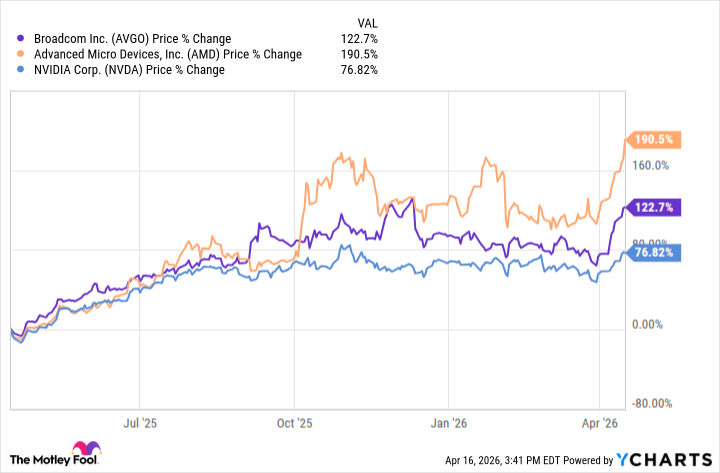
Intensifying Competition in AI Chip Market

- Market Growth Potential: Grandview Research projects a 29% compound annual growth rate for the AI chip industry from 2024 to 2030, indicating significant upside potential that attracts investor interest in related stocks.
- Deepening Partnerships: AMD has partnered with Meta Platforms to deploy 6 gigawatts of AMD GPUs, which is expected to yield “substantial multiyear revenue growth,” showcasing its competitive edge in a high-demand market.
- Financial Performance Comparison: In Q4 of fiscal year 2025, Broadcom achieved a 28% year-over-year revenue growth, while AMD led with a 34% growth, suggesting AMD's stronger performance in revenue growth may attract more investors.
- Margin Discrepancies: Although Broadcom excels in profit margins with a net profit margin of 47.3% in Q4 2025 compared to AMD's 14.7%, AMD has greater room for margin improvement, which could lead to significant profit growth if realized.
Chip Stocks Face Pullback Risks After Rally

- Market Performance Review: The three major indexes surged this week, with the S&P 500 recording its largest one-week gain since May, while the information technology sector climbed 8%, indicating a strong market rebound.
- Overbought Signals: Following the significant market gains, CNBC Pro screened for overbought stocks, with AMD's relative strength index (RSI) exceeding 80, as shares jumped over 13% this week, suggesting potential short-term pullback risks.
- Analyst Ratings Optimistic: Despite concerns of a pullback, most analysts polled by FactSet maintain a buy rating for AMD, expecting about 5% more upside, reflecting confidence in its long-term performance.
- Other Stock Performances: In addition to AMD, ON Semiconductor, Intel, and Broadcom also showed strong performances with RSIs in the high 70s, while Synchrony Financial's RSI approached 74, indicating potential for an 8% increase over the next year despite a year-to-date decline of over 6%.
Analysis of SpaceX IPO Prospects and Investment Recommendations
- Valuation and Fundraising Goals: SpaceX aims for a $1.75 trillion valuation in its IPO, seeking to raise $75 billion, which would position it as the eighth most valuable company globally; however, such a high valuation necessitates substantial profits to justify it.
- Revenue and Profit Data: Reports indicate that SpaceX generated $15 billion to $16 billion in revenue in 2022, with around $8 billion in profit, and projections suggest that by 2026, its rocket launch and Starlink businesses could yield approximately $20 billion in revenue, highlighting its strong market potential.
- Market Risk Warning: While SpaceX's IPO may initially attract investors, a price-to-sales ratio of 87 suggests excessive optimism about future growth, as historically similar IPOs often surge initially before declining, posing risks for retail investors.
- Alternative Investment Options: For those interested in space exploration investments, it is advisable to consider space-themed exchange-traded funds (ETFs) like the Ark Space and Invesco Aerospace & Defense ETF, which mitigate risk through diversified holdings while outperforming the S&P 500.
SpaceX Files for IPO, Eyeing $1.75 Trillion Valuation
- IPO Plans and Valuation: SpaceX has confidentially filed for an IPO aiming for a staggering $1.75 trillion valuation and plans to raise $75 billion, which would position it as the eighth most valuable company globally, though such a high valuation necessitates substantial profits to justify.
- Revenue Sources and Clients: Beyond theoretical space travel, SpaceX collaborates with the U.S. Defense Department and NASA, with projections indicating that its rocket launch and Starlink businesses could generate around $20 billion in revenue by 2026, highlighting strong market demand and profit potential.
- Market Risks and Investment Advice: Despite the excitement surrounding SpaceX's IPO, the astronomical price-to-sales ratio of 87 suggests an overly optimistic market outlook, leading to potential short-term volatility, thus advising investors to consider space-themed ETFs as a safer investment alternative.
- Competition and Alternative Investments: Various space-themed ETFs, such as Ark Space and Invesco Aerospace & Defense ETF, offer diversified exposure to the sector and have outperformed the S&P 500, providing a more stable investment option amidst the speculative nature of SpaceX's IPO.
Broadcom and AMD: Competition and Collaboration
- Revenue Growth Comparison: Broadcom achieved a 28% year-over-year revenue growth in Q4 2025, while AMD reported a 34% increase during the same period, indicating AMD's superior growth despite Broadcom's better profit margins, showcasing the competitive dynamics between the two companies.
- Margin Discrepancy: Broadcom's net profit margin stood at 47.3% in Q4 2025, compared to AMD's 14.7%, highlighting Broadcom's stronger revenue retention capabilities; however, if AMD can improve its margins, it could see significant profit increases.
- Deepening Strategic Partnerships: AMD's collaboration with Meta Platforms to deploy 6 gigawatts of GPUs is expected to yield
AI Chip Market Outlook Remains Positive
- Market Growth Potential: Grandview Research projects a 29% compound annual growth rate for the AI chip industry from 2024 to 2030, indicating that AI chip stocks still have upside potential, attracting investor interest.
- Deepening Partnerships: AMD's collaboration with Meta Platforms to deploy 6 gigawatts of GPUs is expected to yield 'substantial multiyear revenue growth', while Broadcom has also expanded its partnerships with Meta and Alphabet to supply custom AI chips, further solidifying its market position.
- Financial Performance Comparison: In Q4 of fiscal year 2025, Broadcom achieved a 28% year-over-year revenue growth, while AMD led with a 34% growth, showcasing a competitive landscape in revenue growth between the two companies.
- Margin Discrepancies: Although AMD outperforms in revenue growth, Broadcom's net profit margin reached 47.3% in Q4 2025, significantly higher than AMD's 14.7%, giving Broadcom a clear advantage in profitability.
Intensifying Competition in AI Chip Market
- Market Growth Potential: Grandview Research projects a 29% compound annual growth rate for the AI chip industry from 2024 to 2030, indicating significant upside potential that attracts investor interest in related stocks.
- Deepening Partnerships: AMD has partnered with Meta Platforms to deploy 6 gigawatts of AMD GPUs, which is expected to yield “substantial multiyear revenue growth,” showcasing its competitive edge in a high-demand market.
- Financial Performance Comparison: In Q4 of fiscal year 2025, Broadcom achieved a 28% year-over-year revenue growth, while AMD led with a 34% growth, suggesting AMD's stronger performance in revenue growth may attract more investors.
- Margin Discrepancies: Although Broadcom excels in profit margins with a net profit margin of 47.3% in Q4 2025 compared to AMD's 14.7%, AMD has greater room for margin improvement, which could lead to significant profit growth if realized.
Chip Stocks Face Pullback Risks After Rally
- Market Performance Review: The three major indexes surged this week, with the S&P 500 recording its largest one-week gain since May, while the information technology sector climbed 8%, indicating a strong market rebound.
- Overbought Signals: Following the significant market gains, CNBC Pro screened for overbought stocks, with AMD's relative strength index (RSI) exceeding 80, as shares jumped over 13% this week, suggesting potential short-term pullback risks.
- Analyst Ratings Optimistic: Despite concerns of a pullback, most analysts polled by FactSet maintain a buy rating for AMD, expecting about 5% more upside, reflecting confidence in its long-term performance.
- Other Stock Performances: In addition to AMD, ON Semiconductor, Intel, and Broadcom also showed strong performances with RSIs in the high 70s, while Synchrony Financial's RSI approached 74, indicating potential for an 8% increase over the next year despite a year-to-date decline of over 6%.