Ericsson and Intel Collaborate to Advance AI-native 6G
Written by Emily J. Thompson, Senior Investment Analyst
Updated: Mar 02 2026
0mins

Should l Buy INTC?
Source: PRnewswire
- Deepening Technical Collaboration: Ericsson and Intel announced an extension of their collaboration at the 2026 Mobile World Congress in Barcelona, aimed at accelerating ecosystem readiness for AI-native 6G, enhancing mobile connectivity, cloud technologies, and computing capabilities to improve market responsiveness and technology deployment efficiency.
- Industry Leadership Position: Ericsson's CEO Börje Ekholm stated that 6G is not merely an iteration of mobile technology but the infrastructure that distributes AI across devices, edge, and cloud, highlighting the company's leadership in network innovation and large-scale operator deployments, facilitating the transition of 6G from research to commercialization.
- Future Performance Assurance: Intel's CEO Lip-Bu Tan emphasized the company's ambition to be the technology leader in unifying RAN, Core, and edge AI, ensuring performance and supply security required by leading global operators through future Ericsson silicon and Intel Xeon processors.
- Ecosystem Synergy: As 6G transitions from research to commercial reality, the collaboration will advance high-performance, energy-efficient computing architectures that combine intelligent and programmable networks, enhancing service responsiveness and efficiency, thereby laying a strong foundation for future networks.
Trade with 70% Backtested Accuracy
Stop guessing "Should I Buy INTC?" and start using high-conviction signals backed by rigorous historical data.
Sign up today to access powerful investing tools and make smarter, data-driven decisions.
Analyst Views on INTC
Wall Street analysts forecast INTC stock price to fall
29 Analyst Rating
5 Buy
19 Hold
5 Sell
Hold
Current: 43.420

Low
20.00
Averages
39.30
High
52.00
Current: 43.420
Low
20.00
Averages
39.30
High
52.00
About INTC
Intel Corporation is a global designer and manufacturer of semiconductor products. The Company operates through three segments: Intel Products, Intel Foundry, and All Other. Its Intel Products segment includes Client Computing Group (CCG), Data Center and AI (DCAI), Network and Edge (NEX). The CCG is bringing together the operating system, system architecture, hardware, and software application integration to enable PC experiences. DCAI delivers workload-optimized solutions to cloud service providers and enterprises, along with silicon devices for communications service providers, network and edge, and HPC customers. NEX helps networks and edge compute systems from fixed-function hardware to general-purpose compute, acceleration, and networking devices running cloud native software on programmable hardware. The Intel Foundry segment comprises technology development, manufacturing and foundry services. All Other segments include Altera, Mobileye, Other.
About the author

Emily J. Thompson
Emily J. Thompson, a Chartered Financial Analyst (CFA) with 12 years in investment research, graduated with honors from the Wharton School. Specializing in industrial and technology stocks, she provides in-depth analysis for Intellectia’s earnings and market brief reports.

Cardano's 42% Drop: Is It Still a Buy?


- Insufficient Economic Activity: Cardano's total value locked (TVL) stands at approximately $141 million, significantly lower than many lesser-known chains, indicating a lack of appeal in the decentralized finance (DeFi) space and limited future growth potential.
- Poor Chain Revenue: During the 24-hour period ending March 8, Cardano generated only $270 in chain revenue from $1,350 in transaction fees, while Ethereum earned $77,095 in the same timeframe, highlighting its sluggish economic activity.
- Low User Engagement: Cardano's daily active wallet addresses fluctuate between 30,000 and 40,000, compared to Ethereum's 700,000, suggesting a weak user base and an inability to attract developers and capital effectively.
- Bleak Development Outlook: Although Cardano has the potential to develop new features to attract users, its current roadmap lacks innovations of sufficient scale and impact, making it unlikely to change its fortunes in the short term.
See More
Nasdaq-100 Index Faces Challenges Amid AI Concerns
- Market Stagnation: After three consecutive years of significant gains, the Nasdaq-100 index has stagnated in 2026, primarily due to concerns about the negative impact of artificial intelligence on the global economy and valuation levels, which have shifted it from a market leader to a laggard.
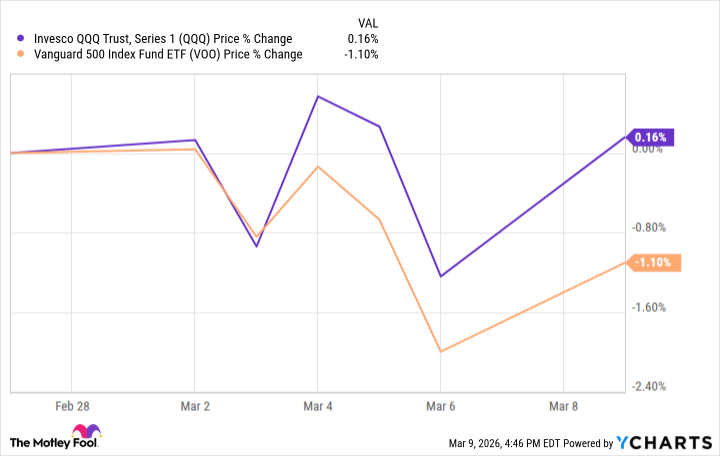
- ETF Performance Comparison: From February 27, the last trading day before the Israel-Iran war began, to March 9, the Invesco QQQ ETF, which tracks the Nasdaq-100, outperformed the Vanguard S&P 500 ETF, indicating short-term resilience in tech stocks, though overall market trends remain to be seen.
- Earnings Growth Expectations: The tech sector is projected to deliver the highest earnings and revenue growth among the S&P 500 sectors in 2026, with a slowdown to a 20% growth rate expected in 2027; however, long-term earnings growth remains a key driver of stock performance.
- Valuation Reasonableness: While U.S. stock valuations are above historical averages, the forward P/E ratio for the S&P 500 information technology sector stands at 24.2, down from 31 a year ago, suggesting that if companies meet current expectations, the Nasdaq-100's valuation may not be excessively high.
See More
Netflix Reports Strong Earnings but Faces High Valuation Risks

- Strong Financial Performance: Netflix's fourth-quarter revenue increased by 17.6% year-over-year to $12.1 billion, demonstrating robust growth momentum in the global market, although the market has already priced in future growth.
- Improving Profitability: The company expects its operating margin to reach 29.5% in 2025, up from 26.7% in 2024, with a further increase to 31.5% in 2026, which will support future earnings growth.
- Surge in Ad Revenue: Netflix's advertising revenue is projected to rise over 150% in 2025 to exceed $1.5 billion, providing a new revenue stream that reduces reliance on subscription price increases and enhances financial stability.
- Valuation Risks Emerge: While the company anticipates an 18% annual growth in earnings per share over the next five years, increasing competition and slowing revenue growth could compress Netflix's price-to-earnings ratio from 38.5 to 20, leading to a price target of $116 and an annualized return of less than 4%.
See More

Analysis of GitLab's 24.8% Stock Plunge

- Significant Stock Drop: GitLab's stock plummeted by 24.8% in February, contrasting with the S&P 500's 0.9% decline, indicating a broader market retreat from software stocks amid concerns over the industry's outlook.
- Earnings Beat but Dim Guidance: Although GitLab reported a Q4 adjusted profit of $0.30 per share and sales of $260.4 million, both exceeding analyst expectations, the company's forward guidance failed to support stock gains, projecting lower sales than anticipated.
- Market Environment Impact: GitLab's stock continued to decline in March due to geopolitical and macroeconomic pressures, particularly the volatility from the U.S.-Israel conflict with Iran and unexpected job losses in February, which heightened market uncertainty.
- Investor Confidence Erosion: With GitLab's guidance falling short of market expectations, investor concerns about the company's near-term growth prospects intensified, leading multiple investment firms to lower their one-year price targets for the stock.
See More

Nvidia Stock Rises as AI Hardware Anticipation Grows

- Stock Price Surge: Nvidia (NVDA) shares rose 2.71% to close at $182.64, reflecting strong investor anticipation for AI hardware announcements at the upcoming GTC 2026 conference, which could drive long-term AI demand.
- Volume Insights: The trading volume reached 6.8 million shares, slightly below the three-month average of 177 million shares, indicating sustained market interest in Nvidia's future products despite a minor dip in short-term trading activity.
- New Product Expectations: The anticipated Rubin platform, expected in the second half of 2026, marks the next phase in Nvidia's AI accelerator architecture, potentially solidifying its lead in high-performance computing and attracting attention from developers and cloud service providers.
- Strategic Investment: Nvidia's multiyear optics partnership with Lumentum includes a multibillion-dollar purchase commitment and a $2 billion investment aimed at securing high-bandwidth interconnects for next-generation AI data centers, demonstrating the company's long-term strategic positioning in AI infrastructure spending.
See More

Intel Stock Volatility and Future Outlook

- Stock Performance: Intel's stock has more than doubled in value over the past 12 months, yet it has declined approximately 18% from its 52-week high of $54.60 reached in January, indicating market uncertainty about its future.
- Profitability Challenges: While Intel's foundry business saw a 4% growth, overall revenue fell by 4%, and the foundry segment's operating loss increased to $2.5 billion, highlighting significant challenges in profitability.
- Overvaluation: Currently, Intel's price-to-earnings ratio stands at 85, significantly higher than the S&P 500's average of 22, suggesting that the market has priced in excessive optimism regarding its future growth, posing high risks for investors.
- Market Sentiment and Risks: Despite a strong performance at the beginning of 2026, the optimism surrounding Intel may already be fully reflected in its stock price, prompting investors to carefully consider whether to hold or buy the stock.
See More
Cardano's 42% Drop: Is It Still a Buy?
- Insufficient Economic Activity: Cardano's total value locked (TVL) stands at approximately $141 million, significantly lower than many lesser-known chains, indicating a lack of appeal in the decentralized finance (DeFi) space and limited future growth potential.
- Poor Chain Revenue: During the 24-hour period ending March 8, Cardano generated only $270 in chain revenue from $1,350 in transaction fees, while Ethereum earned $77,095 in the same timeframe, highlighting its sluggish economic activity.
- Low User Engagement: Cardano's daily active wallet addresses fluctuate between 30,000 and 40,000, compared to Ethereum's 700,000, suggesting a weak user base and an inability to attract developers and capital effectively.
- Bleak Development Outlook: Although Cardano has the potential to develop new features to attract users, its current roadmap lacks innovations of sufficient scale and impact, making it unlikely to change its fortunes in the short term.
See More
Nasdaq-100 Index Faces Challenges Amid AI Concerns
- Market Stagnation: After three consecutive years of significant gains, the Nasdaq-100 index has stagnated in 2026, primarily due to concerns about the negative impact of artificial intelligence on the global economy and valuation levels, which have shifted it from a market leader to a laggard.
- ETF Performance Comparison: From February 27, the last trading day before the Israel-Iran war began, to March 9, the Invesco QQQ ETF, which tracks the Nasdaq-100, outperformed the Vanguard S&P 500 ETF, indicating short-term resilience in tech stocks, though overall market trends remain to be seen.
- Earnings Growth Expectations: The tech sector is projected to deliver the highest earnings and revenue growth among the S&P 500 sectors in 2026, with a slowdown to a 20% growth rate expected in 2027; however, long-term earnings growth remains a key driver of stock performance.
- Valuation Reasonableness: While U.S. stock valuations are above historical averages, the forward P/E ratio for the S&P 500 information technology sector stands at 24.2, down from 31 a year ago, suggesting that if companies meet current expectations, the Nasdaq-100's valuation may not be excessively high.
See More
Netflix Reports Strong Earnings but Faces High Valuation Risks
- Strong Financial Performance: Netflix's fourth-quarter revenue increased by 17.6% year-over-year to $12.1 billion, demonstrating robust growth momentum in the global market, although the market has already priced in future growth.
- Improving Profitability: The company expects its operating margin to reach 29.5% in 2025, up from 26.7% in 2024, with a further increase to 31.5% in 2026, which will support future earnings growth.
- Surge in Ad Revenue: Netflix's advertising revenue is projected to rise over 150% in 2025 to exceed $1.5 billion, providing a new revenue stream that reduces reliance on subscription price increases and enhances financial stability.
- Valuation Risks Emerge: While the company anticipates an 18% annual growth in earnings per share over the next five years, increasing competition and slowing revenue growth could compress Netflix's price-to-earnings ratio from 38.5 to 20, leading to a price target of $116 and an annualized return of less than 4%.
See More
Analysis of GitLab's 24.8% Stock Plunge
- Significant Stock Drop: GitLab's stock plummeted by 24.8% in February, contrasting with the S&P 500's 0.9% decline, indicating a broader market retreat from software stocks amid concerns over the industry's outlook.
- Earnings Beat but Dim Guidance: Although GitLab reported a Q4 adjusted profit of $0.30 per share and sales of $260.4 million, both exceeding analyst expectations, the company's forward guidance failed to support stock gains, projecting lower sales than anticipated.
- Market Environment Impact: GitLab's stock continued to decline in March due to geopolitical and macroeconomic pressures, particularly the volatility from the U.S.-Israel conflict with Iran and unexpected job losses in February, which heightened market uncertainty.
- Investor Confidence Erosion: With GitLab's guidance falling short of market expectations, investor concerns about the company's near-term growth prospects intensified, leading multiple investment firms to lower their one-year price targets for the stock.
See More
Nvidia Stock Rises as AI Hardware Anticipation Grows
- Stock Price Surge: Nvidia (NVDA) shares rose 2.71% to close at $182.64, reflecting strong investor anticipation for AI hardware announcements at the upcoming GTC 2026 conference, which could drive long-term AI demand.
- Volume Insights: The trading volume reached 6.8 million shares, slightly below the three-month average of 177 million shares, indicating sustained market interest in Nvidia's future products despite a minor dip in short-term trading activity.
- New Product Expectations: The anticipated Rubin platform, expected in the second half of 2026, marks the next phase in Nvidia's AI accelerator architecture, potentially solidifying its lead in high-performance computing and attracting attention from developers and cloud service providers.
- Strategic Investment: Nvidia's multiyear optics partnership with Lumentum includes a multibillion-dollar purchase commitment and a $2 billion investment aimed at securing high-bandwidth interconnects for next-generation AI data centers, demonstrating the company's long-term strategic positioning in AI infrastructure spending.
See More
Intel Stock Volatility and Future Outlook
- Stock Performance: Intel's stock has more than doubled in value over the past 12 months, yet it has declined approximately 18% from its 52-week high of $54.60 reached in January, indicating market uncertainty about its future.
- Profitability Challenges: While Intel's foundry business saw a 4% growth, overall revenue fell by 4%, and the foundry segment's operating loss increased to $2.5 billion, highlighting significant challenges in profitability.
- Overvaluation: Currently, Intel's price-to-earnings ratio stands at 85, significantly higher than the S&P 500's average of 22, suggesting that the market has priced in excessive optimism regarding its future growth, posing high risks for investors.
- Market Sentiment and Risks: Despite a strong performance at the beginning of 2026, the optimism surrounding Intel may already be fully reflected in its stock price, prompting investors to carefully consider whether to hold or buy the stock.
See More