AMD, Intel, and Lattice Price Targets Raised by Stifel
Written by Emily J. Thompson, Senior Investment Analyst
Updated: 2 days ago
0mins


Should l Buy AMD?
Source: seekingalpha
- AMD Price Target Increase: Stifel raised AMD's price target from $280 to $320, driven by multi-gigawatt strategic commitments from Meta and OpenAI, despite worsening supply constraints, with the upcoming MI450/Helios launch expected to provide additional growth momentum.
- Intel Outlook Analysis: While Stifel increased Intel's price target from $42 to $65, analysts noted that Intel's near-term gross margins remain in the low-to-mid 30% range, and the absence of an AI compute strategy limits investment opportunities, necessitating attention to its long-term transformation progress.
- Lattice Semiconductor Growth Potential: Lattice's price target was raised from $110 to $130, with analysts highlighting that FPGA attach rates per server are increasing from approximately $1 to $3–4, and server-based revenue is projected to grow by 85% in 2025, indicating strong market demand.
- Market Competitive Landscape: Stifel believes Lattice's valuation is relatively reasonable and its execution complexity is lower than that of AMD and Intel, positioning Lattice favorably in the expanding AI market, which could further enhance its market share.
Trade with 70% Backtested Accuracy
Stop guessing "Should I Buy AMD?" and start using high-conviction signals backed by rigorous historical data.
Sign up today to access powerful investing tools and make smarter, data-driven decisions.
Analyst Views on AMD
Wall Street analysts forecast AMD stock price to rise
33 Analyst Rating
25 Buy
8 Hold
0 Sell
Strong Buy
Current: 284.490

Low
210.00
Averages
289.13
High
377.00
Current: 284.490
Low
210.00
Averages
289.13
High
377.00
About AMD
Advanced Micro Devices, Inc. is a global semiconductor company. The Company is focused on high-performance computing and artificial intelligence (AI). Its segments include Data Center, Client and Gaming, and Embedded. Data Center segment includes AI accelerators, microprocessors (CPUs) for servers, graphics processing units (GPUs), accelerated processing units (APUs), data processing units (DPUs), Field Programmable Gate Arrays (FPGAs), and Adaptive system-on-Chip (SoC) products for data centers. Client and Gaming segment includes CPUs, APUs, chipsets for desktops and notebooks, discrete GPUs, and semi-custom SoC products and development services. Embedded segment includes embedded CPUs, APUs, FPGAs, system on modules (SOMs), and Adaptive SoC products. It markets and sells its products under the AMD trademark. Its products include AMD EPYC, AMD Ryzen, AMD Ryzen PRO, Virtex UltraScale+, among others.
About the author

Emily J. Thompson
Emily J. Thompson, a Chartered Financial Analyst (CFA) with 12 years in investment research, graduated with honors from the Wharton School. Specializing in industrial and technology stocks, she provides in-depth analysis for Intellectia’s earnings and market brief reports.
Google Unveils New AI Processors TPU 8t and 8i at Cloud Next 2026


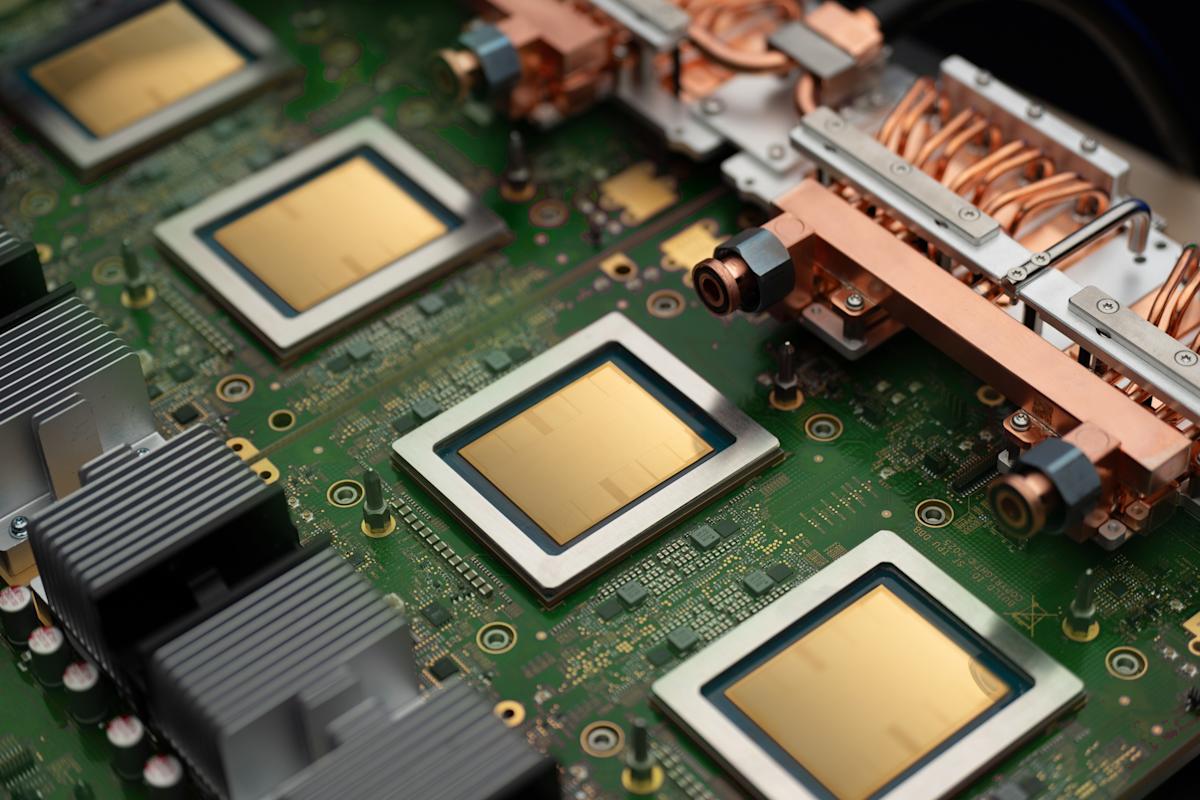
- Processor Launch: Google unveiled its TPU 8t and TPU 8i AI processors at the 2026 Cloud Next conference, intensifying competition with Nvidia and AMD, which is expected to enhance its market share in the AI sector.
- TPU 8t Performance Boost: The TPU 8t is optimized for training AI models, capable of reducing the frontier model development cycle from months to weeks while offering 2.8x better price-to-performance ratio, catering to customers needing high-performance chips.
- TPU 8i Use Cases: The TPU 8i is designed for inferencing and running AI models, set to be available later this year, further strengthening Google's competitive edge in the AI inference space.
- Intensifying Market Competition: With Amazon and Microsoft also expanding their AI chip businesses, Google's launch could pressure Nvidia's market share, especially considering that hyperscalers account for over 50% of Nvidia's data center revenue.
See More
Surge in AI Infrastructure Spending

- Massive Spending: Over $700 billion is expected to be spent on AI infrastructure this year, surpassing the GDP of most countries, indicating strong market confidence in AI's potential.
- Tech Leadership: Nvidia remains a leader in AI infrastructure, leveraging its CUDA software platform for AI model training, while its partnership with Groq enhances its inference capabilities.
- AMD's Market Opportunity: Although AMD missed the initial wave of AI model training, its upcoming MI450 chip and partnerships with Meta and OpenAI position it well for growth in inference and agentic AI.
- Memory Market Outlook: Micron Technology stands to benefit from soaring demand for high-bandwidth memory (HBM), with expectations of a tight memory market in the coming years, driving its stock price upward.
See More

Nvidia Continues to Lead the AI Market
- Surge in AI Infrastructure Spending: Global spending on AI infrastructure is expected to exceed $700 billion in 2023, surpassing the GDP of most countries, indicating a strong commitment from companies that could drive stock prices higher.
- Nvidia's Market Dominance: Nvidia maintains its lead in AI model training by leveraging its CUDA software platform and its partnership with Groq to introduce language processing units specifically designed for inference, enhancing its competitive edge in inference and agentic AI, ensuring its market position for the future.
- AMD's Growth Potential: Although AMD missed the initial wave of AI model training, its upcoming MI450 chip and partnerships with Meta and OpenAI are set to drive growth in inference and agentic AI, particularly as its leadership in high-performance CPUs positions it for significant revenue opportunities.
- Micron's Memory Cycle: Micron Technology's forward P/E ratio is just 4.5 times, and despite ongoing concerns about the memory cycle, the soaring demand for high-bandwidth memory is expected to boost its stock price, with the memory market likely remaining tight in the coming years, further solidifying Micron's market position.
See More

Tech Stocks Rise Amid Market Decline as AI Boom Resurfaces


- Market Pullback: Major indexes fell for the second consecutive day as negotiations between Iran and the U.S. did not proceed as scheduled, reminding investors that the Iran war situation remains unresolved, making further stock market gains challenging.
- Tech Sector Resilience: Despite rising tensions in the Middle East, the technology sector continued to rise, with the State Street Technology ETF and iShares Semiconductor ETF marking their 15th consecutive day of gains, indicating a potential decoupling of tech stocks from the broader market.
- AI Investment Resurgence: As concerns over the Iran war fade, the AI investment landscape is revitalizing, with Anthropic's powerful AI model and SpaceX's $60 billion deal to acquire Cursor signaling that the AI boom is alive, likely channeling tens of billions into chip stocks.
- Chip Industry Developments: Intel's participation in the Terafab Project aims for 1 terawatt of computing power annually, while Broadcom signed a long-term deal with Google, and Nvidia announced its first open-source quantum AI model, showcasing positive momentum in the chip sector that could drive stock prices higher.
See More

Tech ETFs Record 15 Straight Days of Gains Amid Market Tensions
- Strong Performance of Tech ETFs: The State Street Technology ETF and iShares Semiconductor ETF have recorded 15 consecutive days of gains since March 31, indicating a potential decoupling of the tech sector from the broader market amidst ongoing tensions in the Middle East.
- Positive Developments in AI Sector: As concerns over the Iran war fade, investments in the AI sector are rebounding, highlighted by Anthropic's powerful AI model and SpaceX's $60 billion deal to acquire Cursor, signaling that the AI boom remains robust and is likely to drive growth in chip stocks like Nvidia.
- Deepening Collaborations in Chip Industry: Intel's participation in the Terafab project aims to produce 1 terawatt of computing power annually in partnership with SpaceX, xAI, and Tesla, while Broadcom has signed a long-term agreement with Google, further solidifying strategic collaborations within the chip industry.
- High Market Valuations: Despite the high price-to-earnings ratios of tech stocks, with the State Street Tech Sector ETF at 37 and SOXX at 47, the ongoing AI boom could propel these stocks higher, especially with the upcoming earnings season expected to reveal strong results.
See More

Trump Extends Iran Ceasefire Deadline Amid Market Uncertainty


- Ceasefire Extension: President Trump has extended the Iran ceasefire deadline by two weeks, a move that may exacerbate uncertainty in the Middle East conflict as Tehran shows reluctance to engage in diplomatic efforts, potentially impacting global market sentiment.
- Tariff Policy Impact: Trump expressed hope that U.S. companies that have not sought refunds for his tariffs will adhere to a 'no take back' policy, despite the Supreme Court ruling the tariffs illegal; major firms like Apple and Amazon have yet to file for refunds, which could affect their future financial performance.
- Market Reaction: Following Trump's announcement of the ceasefire extension, U.S. stock index futures rose, despite a lower close on Tuesday, while crude oil prices increased, indicating market sensitivity to developments in the Middle East.
- Aviation Industry Outlook: United Airlines has slashed its 2026 earnings outlook due to supply chain issues stemming from the Middle East conflict, reflecting the direct impact of soaring fuel prices on the airline industry and potentially leading to broader industry adjustments.
See More
Google Unveils New AI Processors TPU 8t and 8i at Cloud Next 2026
- Processor Launch: Google unveiled its TPU 8t and TPU 8i AI processors at the 2026 Cloud Next conference, intensifying competition with Nvidia and AMD, which is expected to enhance its market share in the AI sector.
- TPU 8t Performance Boost: The TPU 8t is optimized for training AI models, capable of reducing the frontier model development cycle from months to weeks while offering 2.8x better price-to-performance ratio, catering to customers needing high-performance chips.
- TPU 8i Use Cases: The TPU 8i is designed for inferencing and running AI models, set to be available later this year, further strengthening Google's competitive edge in the AI inference space.
- Intensifying Market Competition: With Amazon and Microsoft also expanding their AI chip businesses, Google's launch could pressure Nvidia's market share, especially considering that hyperscalers account for over 50% of Nvidia's data center revenue.
See More
Surge in AI Infrastructure Spending
- Massive Spending: Over $700 billion is expected to be spent on AI infrastructure this year, surpassing the GDP of most countries, indicating strong market confidence in AI's potential.
- Tech Leadership: Nvidia remains a leader in AI infrastructure, leveraging its CUDA software platform for AI model training, while its partnership with Groq enhances its inference capabilities.
- AMD's Market Opportunity: Although AMD missed the initial wave of AI model training, its upcoming MI450 chip and partnerships with Meta and OpenAI position it well for growth in inference and agentic AI.
- Memory Market Outlook: Micron Technology stands to benefit from soaring demand for high-bandwidth memory (HBM), with expectations of a tight memory market in the coming years, driving its stock price upward.
See More
Nvidia Continues to Lead the AI Market
- Surge in AI Infrastructure Spending: Global spending on AI infrastructure is expected to exceed $700 billion in 2023, surpassing the GDP of most countries, indicating a strong commitment from companies that could drive stock prices higher.
- Nvidia's Market Dominance: Nvidia maintains its lead in AI model training by leveraging its CUDA software platform and its partnership with Groq to introduce language processing units specifically designed for inference, enhancing its competitive edge in inference and agentic AI, ensuring its market position for the future.
- AMD's Growth Potential: Although AMD missed the initial wave of AI model training, its upcoming MI450 chip and partnerships with Meta and OpenAI are set to drive growth in inference and agentic AI, particularly as its leadership in high-performance CPUs positions it for significant revenue opportunities.
- Micron's Memory Cycle: Micron Technology's forward P/E ratio is just 4.5 times, and despite ongoing concerns about the memory cycle, the soaring demand for high-bandwidth memory is expected to boost its stock price, with the memory market likely remaining tight in the coming years, further solidifying Micron's market position.
See More
Tech Stocks Rise Amid Market Decline as AI Boom Resurfaces
- Market Pullback: Major indexes fell for the second consecutive day as negotiations between Iran and the U.S. did not proceed as scheduled, reminding investors that the Iran war situation remains unresolved, making further stock market gains challenging.
- Tech Sector Resilience: Despite rising tensions in the Middle East, the technology sector continued to rise, with the State Street Technology ETF and iShares Semiconductor ETF marking their 15th consecutive day of gains, indicating a potential decoupling of tech stocks from the broader market.
- AI Investment Resurgence: As concerns over the Iran war fade, the AI investment landscape is revitalizing, with Anthropic's powerful AI model and SpaceX's $60 billion deal to acquire Cursor signaling that the AI boom is alive, likely channeling tens of billions into chip stocks.
- Chip Industry Developments: Intel's participation in the Terafab Project aims for 1 terawatt of computing power annually, while Broadcom signed a long-term deal with Google, and Nvidia announced its first open-source quantum AI model, showcasing positive momentum in the chip sector that could drive stock prices higher.
See More
Tech ETFs Record 15 Straight Days of Gains Amid Market Tensions
- Strong Performance of Tech ETFs: The State Street Technology ETF and iShares Semiconductor ETF have recorded 15 consecutive days of gains since March 31, indicating a potential decoupling of the tech sector from the broader market amidst ongoing tensions in the Middle East.
- Positive Developments in AI Sector: As concerns over the Iran war fade, investments in the AI sector are rebounding, highlighted by Anthropic's powerful AI model and SpaceX's $60 billion deal to acquire Cursor, signaling that the AI boom remains robust and is likely to drive growth in chip stocks like Nvidia.
- Deepening Collaborations in Chip Industry: Intel's participation in the Terafab project aims to produce 1 terawatt of computing power annually in partnership with SpaceX, xAI, and Tesla, while Broadcom has signed a long-term agreement with Google, further solidifying strategic collaborations within the chip industry.
- High Market Valuations: Despite the high price-to-earnings ratios of tech stocks, with the State Street Tech Sector ETF at 37 and SOXX at 47, the ongoing AI boom could propel these stocks higher, especially with the upcoming earnings season expected to reveal strong results.
See More
Trump Extends Iran Ceasefire Deadline Amid Market Uncertainty
- Ceasefire Extension: President Trump has extended the Iran ceasefire deadline by two weeks, a move that may exacerbate uncertainty in the Middle East conflict as Tehran shows reluctance to engage in diplomatic efforts, potentially impacting global market sentiment.
- Tariff Policy Impact: Trump expressed hope that U.S. companies that have not sought refunds for his tariffs will adhere to a 'no take back' policy, despite the Supreme Court ruling the tariffs illegal; major firms like Apple and Amazon have yet to file for refunds, which could affect their future financial performance.
- Market Reaction: Following Trump's announcement of the ceasefire extension, U.S. stock index futures rose, despite a lower close on Tuesday, while crude oil prices increased, indicating market sensitivity to developments in the Middle East.
- Aviation Industry Outlook: United Airlines has slashed its 2026 earnings outlook due to supply chain issues stemming from the Middle East conflict, reflecting the direct impact of soaring fuel prices on the airline industry and potentially leading to broader industry adjustments.
See More