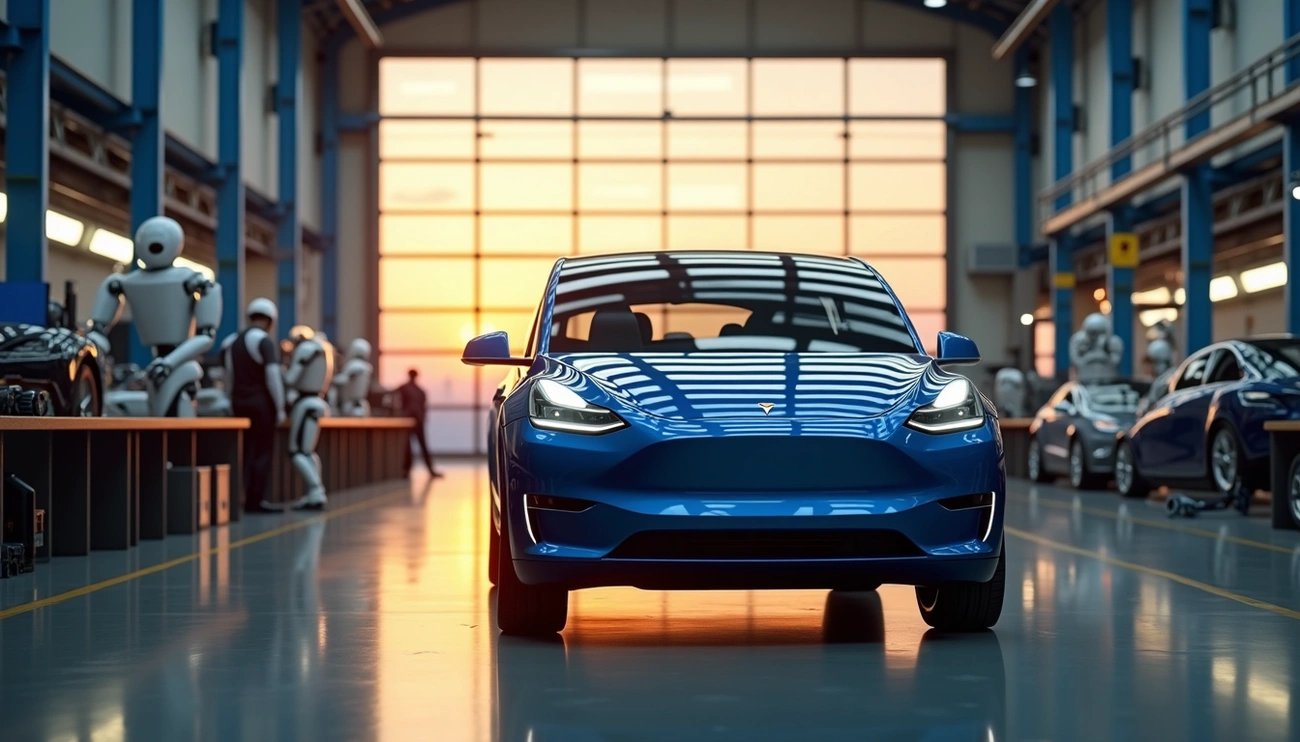
Key Takeaways
Tesla's 2026 investment outlook reveals a company at a critical crossroads, balancing declining automotive performance against ambitious AI and robotics ventures that could redefine its future value proposition.
• Tesla's core auto business shows concerning trends with 7.7% delivery decline in 2025 and operating margins shrinking from 10.8% to 5.8%
• The company's robotaxi service launched in Austin represents a potential $10 trillion revenue opportunity, with ARK predicting it could comprise 60% of Tesla's value by 2026
• Wall Street remains deeply divided with price targets ranging from $25 to $630, reflecting extreme uncertainty about Tesla's transformation from automaker to AI platform
• Tesla's premium valuation at 292x P/E ratio and regulatory hurdles for autonomous driving create significant downside risks for investors
• Success hinges on whether robotaxi rollout and Optimus robot production can offset automotive sector challenges and justify current stock prices
The investment decision ultimately depends on your risk tolerance and belief in Tesla's ability to execute its ambitious pivot from traditional automaker to integrated AI and robotics platform company.
Many investors ask if Tesla will be a good stock to buy in 2026. The question becomes more fascinating when you think about Nvidia's remarkable performance - a $10,000 investment in 2015 would have grown to $3.7 million. Tesla's current path shows some worrying signs. The company delivered 1.63 million vehicles in 2025, and Model 3 sedans and Model Y SUVs made up almost 97% of these deliveries. Global deliveries fell by 1.1% year-over-year in 2024 and analysts project a 7.7% drop in 2025.
Tesla's position as the world's largest electric vehicle manufacturer has been taken by Chinese competitor BYD. Tesla's operating margin has shrunk to 5.8% from last year's 10.8%. This decline makes investors question Tesla's stock outlook for 2026. Revenue growth expectations stand at just over 13% in 2026 after a 3% decline in 2025. Investors remain uncertain about Tesla stock's future trajectory and investment potential. Some pessimistic analysts predict Tesla's stock value could drop to $80.
This piece will help you find what experts say about Tesla's future, its standing in the changing EV market, and whether its bold investments in robotaxis and AI can help overcome its automotive sector challenges.
Tesla’s 2026 Performance Snapshot
Tesla's financial world in 2026 shows a complex picture for investors who want to know if the stock makes a good investment. The company's performance metrics show both opportunities and challenges that need careful analysis.
Vehicle deliveries and revenue trends
Tesla's delivery numbers tell a challenging story. The company's once impressive growth in vehicle deliveries has hit a wall. Tesla delivered about 1.63 million vehicles in 2025, which showed a 7.7% drop from the previous year. This decline continued for the second year after a 1.1% dip in 2024.
The Model 3 sedan and Model Y SUV make up almost 97% of Tesla's vehicle deliveries today. This heavy dependence on aging models raises questions about breakthroughs and market saturation. The Cybertruck and refreshed Model 3 (Highland) haven't boosted overall delivery numbers by a lot, though they brought modest revenue increases.
Revenue growth has slowed down drastically. After a 3% drop in 2025, analysts predict revenue to grow about 13% in 2026. While modest compared to Tesla's past performance, this could signal a turnaround. The operating margins have fallen to 5.8% from 10.8% a year earlier, which shows rising cost pressures and competitive pricing in the market.
Tesla vs. BYD: Who guides the EV race?
The competitive scene has changed drastically as Chinese manufacturer BYD has taken Tesla's crown as the world's largest electric vehicle producer. Tesla keeps its focus on pure electric vehicles in the premium segment, while BYD has grown its product range across different price points and powertrain technologies, including hybrids.
BYD's aggressive pricing strategy and quick product development have helped it gain much market share, especially in Asia and emerging markets. Tesla still has stronger brand recognition in North America and Europe. All the same, BYD's manufacturing scale gives it big cost advantages to compete on price.
Tesla has responded to competition with selective price cuts and greater emphasis on its energy and AI initiatives instead of joining direct price wars. The company's reduced market leadership position has affected how investors see its future growth potential.
Effect of expiring EV tax credits
EV tax incentives ending across major markets have created new challenges for Tesla's sales performance. Changes to the U.S. Inflation Reduction Act's EV credit structure have cut down the number of Tesla models eligible for full incentives. European markets have also reduced the generous EV subsidies that once helped boost adoption rates.
These reduced government supports come alongside broader economic pressures, including higher interest rates that make monthly payments bigger for financed vehicles. Tesla buyers now pay thousands more compared to previous years when full incentives existed.
The entry-level segment feels these changes the most as buyers there are more sensitive to price. Tesla has tried to balance these changes with price adjustments from time to time. Yet the combined effect of ending incentives and increased competition has pushed down both sales volumes and profit margins throughout 2025 and into 2026.
The Bullish Case: Why Some Experts Still Believe

Image Source: TrendSpider
Tesla keeps attracting optimistic views from analysts and investors who look beyond its current automotive challenges. These optimists bet on Tesla's bold expansion plans that go far beyond making cars.
Robotaxi rollout and FSD progress
Tesla's self-driving goals are the life-blood of optimistic investment views. The company launched its Robotaxi service in Austin, Texas on June 22, 2025. This was a key milestone that showed real progress. The service started with 10-20 modified Model Y vehicles in a restricted area. Human safety monitors sit in the front passenger seat—a careful approach that doesn't match Elon Musk's earlier promises.
The company wants to bring its Robotaxi service to "a dozen cities" across the United States by late 2025, if regulators approve. Tesla also develops the Cybercab—a vehicle without steering wheel or pedals. Production should start in April 2026.
Tesla's Full Self-Driving (FSD) software keeps getting better. The latest version 14 won MotorTrend's 2026 Best Tech Driver Assistance award as the top driver assistance system available. We have a long way to go, but we can build on this progress. Tesla's camera-only approach is different from competitors who use cameras, lidar, radar, and ultrasonic sensors together.
Optimus robot and AI-driven growth
While vehicle sales slow down, Tesla's humanoid robot project could propel massive growth. CEO Elon Musk believes about 80% of Tesla's future value will come from the Optimus robot program. This matches his Master Plan Part IV, which focuses on physical AI and factory-to-field automation.
Tesla has bold robot production goals. The company plans to:
Build about 1 million Optimus units yearly at the Fremont factory by late 2026
Start production at Gigafactory Texas in 2027 with plans to make 10 million units yearly
Set prices around $20,000 per robot once full production begins[103]
Musk predicts Optimus could bring in more than $10 trillion long-term and become "10 times bigger than the next biggest product ever made". Competition in humanoid robots is heating up, with companies like Figure AI getting major funding. Yet Tesla might have an edge because of its integrated AI capabilities.
Cathie Wood and other bullish forecasts
ARK Invest's Cathie Wood stands out as one of Tesla's biggest supporters. She predicts Tesla's stock could hit $2,600 by 2030. This bold target would value the company at $8.19 trillion. Wood remains positive about Tesla's future in self-driving and robotics, even after selling some Tesla stock recently.
ARK's new Tesla valuation model shows:
A $4,600 per share target price in 2026
Low and high estimates of $2,900 and $5,800 per share in 2026
Tesla's future robotaxi business making up 60% of expected value and over half of expected EBITDA in 2026
More analysts now share this optimism. Wedbush expects Tesla to launch robotaxi services in more than 30 cities in 2026 while ramping up Cybercab production. They value the stock at $600, with potential to reach $800. These analysts believe Tesla deserves its high valuation as it changes from an electric car company into a tech powerhouse—making breakthroughs in AI, self-driving, robotics, and clean energy.
The Bearish View: Risks and Red Flags
Market analysts are growing skeptical about whether Tesla is a good stock to buy in 2026, even as fans remain fascinated by the company's ambitious projects. A closer look reveals troubling trends that investors should think over.
Falling margins and slowing growth
Tesla's automotive business faces tough challenges. The company's vehicle deliveries dropped to 1.63 million in 2025, showing an 8.5% decline from 2024—the biggest sales drop in its history. Q4 2025 made things worse with deliveries falling about 15% year-over-year to 418,000 units.
Tesla's market share in Europe fell from 2.4% to 1.7% during 2025. Chinese rival BYD showed stronger performance with a 28% worldwide sales increase in the same period. These competitive pressures have hit profits hard, and gross margins have plunged from 27.1% to 17%.
The outlook for 2026 shows automotive revenue dropping 16% below its peak, while gross margins might reach only half of what they were in 2022.
Regulatory hurdles for autonomy
Legal and regulatory obstacles keep piling up for Tesla's autonomous driving goals. The company's Full Self-Driving software lacks approval for unsupervised use across the United States. This puts its robotaxi strategy at risk.
The California Department of Motor Vehicles has sued to stop Tesla's sales and manufacturing for 30 days. They claim the company misleads customers about its "Full Self-Driving" technology. A federal judge has also allowed a class-action lawsuit against Tesla for allegedly overstating self-driving capabilities.
A Miami jury's recent verdict found Tesla 33% responsible for a fatal crash with its Autopilot system. The victim's family received $243 million. Legal experts say this verdict will lead to more lawsuits.
Valuation concerns and overpricing
The numbers raise red flags about Tesla's stock value. The stock trades at a P/E ratio of 292 based on trailing earnings of $1.44 per share. This is striking since the next most expensive trillion-dollar stock's P/E ratio is 75% lower.
Tesla's price-to-sales ratio stands at 15.21x, much higher than the auto industry's average of 0.82x. A discounted cash flow analysis suggests the stock is overpriced by 155.9%.
The company scores 0/6 on complete valuation checks, earning an F in Value Grade and the label "Ultra Expensive". Analyst price targets range from $25 to $630 per share, showing how divided experts are about Tesla's true value.
Tesla Beyond Cars: The AI and Autonomy Bet

Image Source: Reddit
Tesla's move beyond traditional automaking is a vital factor for investors wondering is tesla a good stock to buy in 2026. The company bets big on artificial intelligence and autonomy technologies that could change its financial future dramatically.
How Robotaxi could change Tesla's business model
Tesla's Robotaxi initiative signals a move from one-time, low-margin hardware sales to recurring, high-margin revenue streams. The company launched its Robotaxi service to select users in Austin, Texas in June 2025. ARK Invest's research suggests this is a big deal as it means that Tesla's Robotaxi business could make up about 90% of its enterprise value by 2029.
The company just needs about 200,000 vehicles to meet Austin's urban vehicle miles traveled demand. The plan includes adding privately owned vehicles to the network (as with Airbnb's model). Tesla has three key advantages over competitors like Waymo:
Vertically integrated manufacturing (producing 5,000+ vehicles daily versus Waymo's partnership-dependent approach)
Data collection (gathering 40x more ground driving data daily)
Cost efficiency (potentially 30-50% lower cost per mile)
The promise and limitations of Optimus
The Optimus humanoid robot stands as another key part of Tesla's diversification strategy. It utilizes AI systems originally created for vehicles. Optimus walks, fine-tunes limbs, picks up objects, and recognizes environments. Elon Musk believes its importance could exceed that of the automotive sector.
Notwithstanding that, real challenges exist. Musk's claims about Optimus performing surgery or eliminating poverty are nowhere near current technological reality. Tesla plans to produce 5,000 units in 2025 for assembly line use. The target price ranges from $20,000 to $30,000 per unit at scale—too expensive for most consumers.
Will Tesla become a platform company?
Tesla's path to becoming a platform company is different from traditional tech giants. The company builds an integrated ecosystem that combines manufacturing capabilities with autonomous technologies. A unified AI brain powers both Full Self-Driving vehicles and Optimus robots through Tesla's neural network architecture.
This approach makes Tesla a leader in "ground AI" that connects digital and physical domains. Tesla isn't just selling cars—it develops an autonomous technology platform that merges with transportation, manufacturing, healthcare, and home environments.
Investors thinking about tesla stock prediction 2026 must decide if these ambitious AI initiatives can overcome challenges in Tesla's core automotive business and justify its premium valuation.
What Experts Predict for Tesla Stock in 2026

Image Source: Ark Invest
Heading into 2026, Wall Street remains sharply divided on is Tesla a good stock to buy. Price targets span an unusually wide range that shows deep uncertainty about the company's future path.
Tesla stock prediction 2026: Analyst consensus
Expert opinions on Tesla stock lean toward caution. The consensus rating among 30 analysts covering Tesla is a "Hold." The breakdown shows 12 analysts rating it a "Buy," 11 a "Hold," and 7 a "Sell". Current recommendations paint a mixed picture: 23% say Strong Buy, 23% suggest Buy, 31% advise Holding, 12% recommend Selling, and 12% predict a Strong Sell. These divided views highlight Tesla's polarizing nature as an investment.
Price targets and valuation models
Wall Street has set Tesla's median one-year price target at $397.47, pointing to a 9.15% potential downside. Not all analysts share this bearish view though. Wedbush maintains a $600 price target, while Piper Sandler targets $500. Long-term investors might note ARK Invest's optimistic outlook - they expect $4,600 per share in 2026, with bull and bear cases reaching $5,800 and $2,900 respectively.
Will Tesla stock go up or correct?
Betting markets provide extra insights. Polymarket traders stay bullish, showing 97% probability for $465 in January 2026. The investment case depends heavily on Tesla's robotaxi business. ARK estimates this could make up 60% of expected value and over half of expected EBITDA by 2026. Investors should watch out for Tesla's high valuation though. The price-to-earnings ratio sits at 292, and negative free cash flow might start in Q2 2026. Declining deliveries could speed up to 15% in 2026. These factors make Tesla a high-risk, high-reward choice for investors thinking about whether they should buy Tesla stock.
Conclusion
Tesla stock offers huge opportunities but comes with major risks as we look toward 2026. The company faces real challenges right now. Vehicle deliveries are down, margins keep shrinking, and BYD is becoming a serious competitor. The regulatory landscape also makes Tesla's autonomous driving goals harder to achieve. Its high valuation metrics raise valid concerns about the stock being overpriced.
Notwithstanding that, Tesla's bold move to become a technology platform instead of just a car maker could change its financial future. The new Robotaxi business might bring in steady, high-margin revenue that supports optimistic price targets. Success isn't guaranteed though. The Optimus robot program shows promise as another growth driver, but it's still in its early stages.
Wall Street can't agree on Tesla. Price targets range from $25 to $630 per share, making it one of the market's most controversial stocks. Of course, your investment choice should weigh Tesla's track record of innovation against the risks tied to its current valuation.
The answer to "Is Tesla a good stock to buy?" mostly depends on how long you want to invest and your comfort with risk. Short-term investors might worry about Tesla's price swings and premium valuation. Long-term believers in Tesla's vision might see today's challenges as speed bumps on the road to massive returns. Without doubt, Tesla's future depends on whether its big bets on robotaxis, AI, and robotics can make up for its struggling car business.
Tesla remains a high-risk, high-reward investment that needs careful thought rather than quick decisions. The company that changed electric vehicles wants to reshape transportation and robotics completely. The big question is whether this vision will become reality soon enough to benefit today's investors.