U.S. New Vehicle Sales Expected to Decline 7.3%
Written by Emily J. Thompson, Senior Investment Analyst
Updated: 4 days ago
0mins

Source: seekingalpha
- Sales Forecast Decline: According to a joint report by J.D. Power and GlobalData, U.S. new vehicle sales are expected to decline 7.3% year-over-year to 1.36 million units in April 2026, reflecting weakened consumer demand and market uncertainty.
- Retail Spending Decrease: Retail consumer expenditure is projected to drop to $49.9 billion in April, down $4 billion from a year earlier, indicating a negative impact on overall consumer spending due to the slower sales pace and economic challenges.
- Loan Rate Changes: While the average interest rate on new vehicle loans is expected to decline by 0.3 percentage points to 6.73%, average monthly finance payments are projected to increase by 3.1% year-over-year to $812, primarily due to continued deterioration in trade-in equity, adding to consumer burdens.
- Global Market Outlook: The total global vehicle sales forecast has been revised down from 92.6 million to 91.7 million units, significantly influenced by the Middle East crisis, although positive growth is expected in China and India, declines in North America and the Middle East are likely to drag the overall global market into negative territory.
Trade with 70% Backtested Accuracy
Stop guessing "Should I Buy F?" and start using high-conviction signals backed by rigorous historical data.
Sign up today to access powerful investing tools and make smarter, data-driven decisions.
Analyst Views on F
Wall Street analysts forecast F stock price to fall
14 Analyst Rating
3 Buy
10 Hold
1 Sell
Hold
Current: 13.670

Low
11.00
Averages
13.65
High
16.00
Current: 13.670
Low
11.00
Averages
13.65
High
16.00
About F
Ford Motor Company develops and delivers Ford trucks, sport utility vehicles, commercial vans and cars, and Lincoln luxury vehicles, along with connected services, including BlueCruise (ADAS) and security. The Company's segments include Ford Blue, Ford Model e, Ford Pro, and Ford Credit. The Ford Blue segment primarily includes the sale of Ford and Lincoln internal combustion engine (ICE) and hybrid vehicles, service parts, accessories, and digital services for retail customers. The Ford Model e segment primarily includes the sale of its electric vehicles, service parts, accessories, and digital services for retail customers. The Ford Pro segment primarily includes the sale of Ford and Lincoln vehicles, service parts, accessories, and services for commercial, government, and rental customers. The Ford Credit segment consists of the Ford Credit business on a consolidated basis, which is primarily vehicle-related financing and leasing activities. Its vehicle brands are Ford and Lincoln.
About the author

Emily J. Thompson
Emily J. Thompson, a Chartered Financial Analyst (CFA) with 12 years in investment research, graduated with honors from the Wharton School. Specializing in industrial and technology stocks, she provides in-depth analysis for Intellectia’s earnings and market brief reports.
Hindalco Projects Novelis to Earn $500 per Tonne by Fiscal 2027

- Earnings Outlook: Hindalco anticipates its subsidiary Novelis will achieve earnings of approximately $500 per tonne by fiscal 2027, reflecting confidence in future profitability amid strong demand in its Indian aluminium and copper sectors.
- Financial Impact: The fire-related disruptions at Novelis' Oswego plant resulted in a one-time charge of ₹41.71 billion (approximately $437.59 million) for fiscal 2026, impacting Hindalco's earnings; however, management asserts that “the worst is over.”
- Market Dynamics: Hindalco's U.S. operations contribute about 60% of revenue, reporting adjusted EBITDA of $462 per tonne for fiscal 2026, despite rising input costs due to the Middle East conflict affecting overall profitability.
- Growth Prospects: The company expects high double-digit growth in its domestic aluminium downstream business this fiscal year, driven by the ramp-up of its new rolling facility, Aditya FRP, and expansion into higher-value products such as EV components and construction materials.
See More

Analysis of Revenue Gap Between Ford and Tesla

- Revenue Gap Persistence: Ford consistently generates higher revenue than Tesla across all observed periods, with Ford's revenue showing a 6% year-over-year increase in Q1 2026, while Tesla's revenue grew by 16%, indicating a widening gap.
- Profitability Comparison: Ford reported a net income margin of approximately 6% for Q1 2026, compared to Tesla's 2%, highlighting Ford's superior profitability despite Tesla's faster revenue growth.
- Market Reaction Discrepancy: Ford's stock reached a 52-week high of $14.95 on May 22, while Tesla's stock exceeded $400, illustrating that revenue alone does not necessarily drive stock prices, as Tesla's rapid growth attracts more investor interest.
- Strategic Transformation and Challenges: Ford's newly established energy division aims to provide battery storage solutions, presenting a transformative opportunity, though associated costs may erode profits, while Tesla expands revenue through its ride-hailing service, minimizing operational costs.
See More
Financial Dynamics Analysis of Ford and Tesla
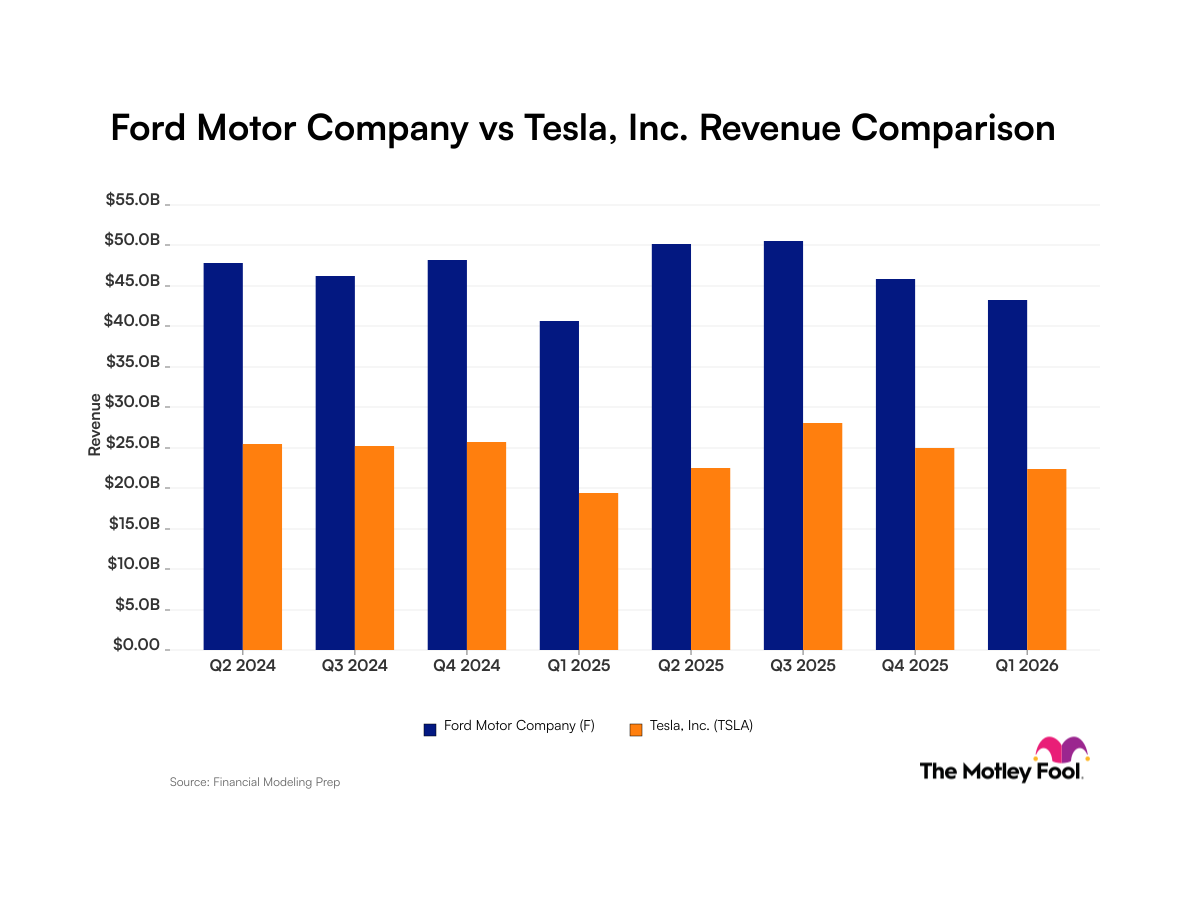
- Ford's Revenue Stability: Ford reported approximately $43.3 billion in revenue for Q1 2026, with a modest year-over-year growth of 6%, yet the establishment of a new product development organization is expected to enhance future innovation and market competitiveness.
- Tesla's Revenue Fluctuations: Tesla's revenue for Q1 2026 was $22.4 billion, reflecting a robust 16% year-over-year growth, despite challenges from workforce reductions and a transition to a subscription model for its Full Self-Driving software.
- Market Performance Comparison: While Ford's sales significantly exceed Tesla's, Ford's stock peaked at $14.95 over the past year, compared to Tesla's stock exceeding $400, indicating a market perception of Tesla's higher growth potential.
- Strategic Transformation Impact: Ford's newly established energy division aims to provide battery storage solutions, which may increase operational costs but also opens new revenue opportunities, while Tesla continues to enhance revenue through its autonomous ride-hailing service, maintaining its market leadership.
See More
Ford vs Tesla Revenue Comparison
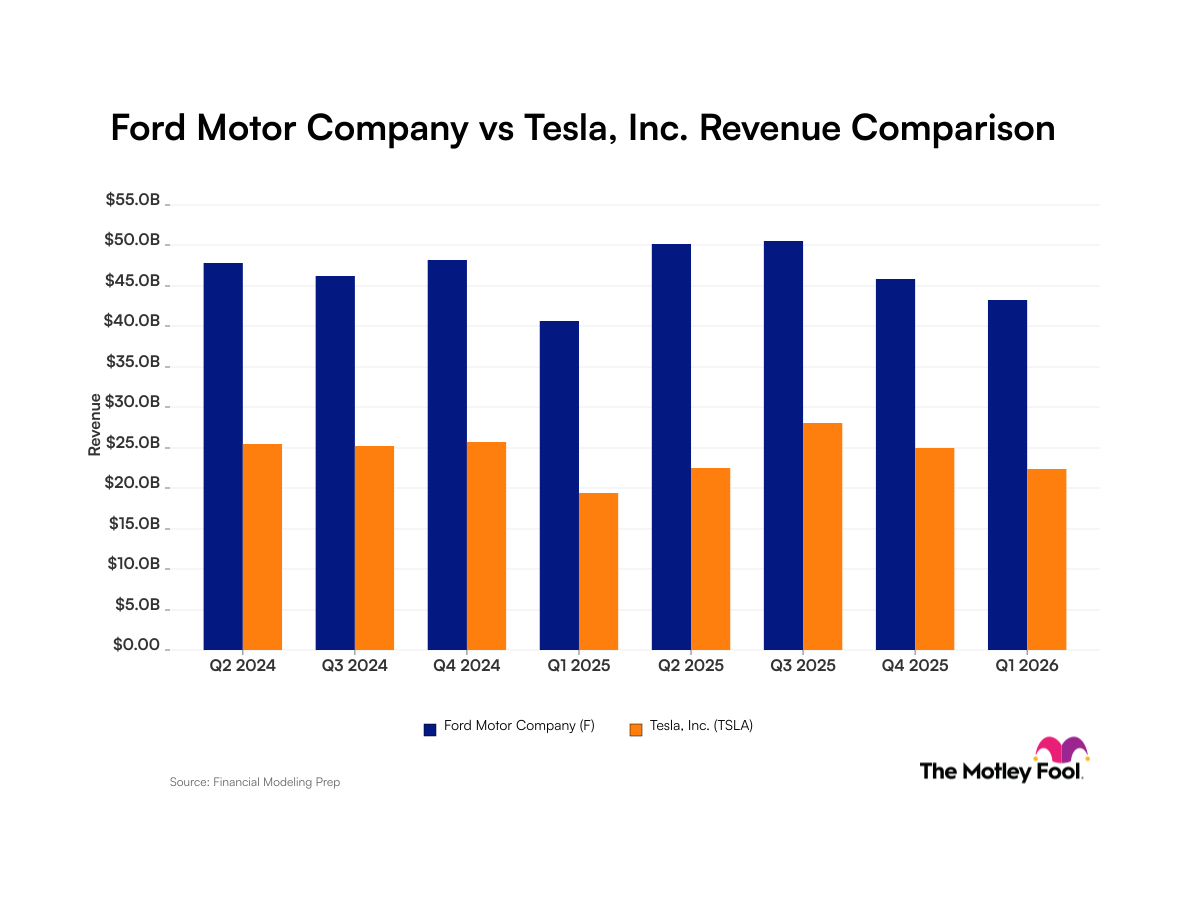
- Ford's Stable Revenue: Ford reported approximately $43.3 billion in revenue for Q1 2026, with a modest 6% year-over-year growth; however, the establishment of a new product development organization is expected to enhance future product innovation and market competitiveness.
- Tesla's Revenue Fluctuations: Tesla's revenue for Q1 2026 was $22.4 billion, reflecting a 16% year-over-year increase, and despite facing workforce reductions and transition challenges, the subscription model for its Full Self-Driving software may enhance long-term revenue stability.
- Market Performance Discrepancy: While Ford's revenue significantly exceeds Tesla's, Ford's stock reached a 52-week high of $14.95, compared to Tesla's stock exceeding $400, indicating a market expectation for Tesla's future growth potential that is higher than Ford's.
- Strategic Transformation Impact: Ford's newly established energy division will provide battery storage solutions, which may increase short-term costs, but in the long run, it is expected to bolster the company's competitiveness in the battery market, particularly against Tesla's already established presence.
See More

Ford's Challenges and Opportunities in the European Market
- New Model Launch Plan: Ford plans to introduce five all-new passenger vehicles by the end of 2029, including a new multi-energy rugged compact SUV from the global Bronco family to be produced at its Spain plant in 2028, aiming to enhance its competitiveness in the European market.
- Declining Market Share: Despite the launch of new models to tackle market challenges, Ford's market share in Europe has been declining for several years, particularly under the pressure of low-cost competition from Chinese automakers, which poses a significant threat to its passenger vehicle business.
- Chinese Competition Threat: Chinese automakers doubled their market share in Europe last year to 6%, driven by their compelling low-cost offerings and advanced electric vehicle technology, putting Ford at a disadvantage in price competition.
- Profitability Risks: Ford's passenger vehicle business in Europe continues to face losses, and if the new models fail to attract consumers effectively, it is conceivable that in the next five to ten years, Ford may only retain its high-margin commercial vehicle business, facing significant strategic transformation risks.
See More

Ford Faces Challenges and Opportunities in European Market
- Market Share Decline: Ford continues to struggle with declining market share in Europe, where its commercial vehicle segment performs well, but the passenger vehicle division faces significant profitability challenges, potentially leading to a future where only the commercial business remains in operation within five to ten years.
- New Model Launch Plans: By the end of 2029, Ford plans to launch five all-new passenger vehicles, including a new multi-energy compact SUV to be produced at its Spain plant in 2028, aiming to attract consumers by combining off-road design with on-road performance.
- Increased Chinese Competition: Chinese automakers doubled their market share in Europe last year to 6%, posing a direct threat to Ford with their compelling low-cost offerings and advanced electric vehicle technology, particularly in a fiercely competitive pricing environment.
- EU Tariff Policies: Although the European Union has imposed a 35% tariff on Chinese-made electric vehicles, this does not include plug-in hybrids or combustion engine vehicles, allowing Chinese manufacturers to maintain strong sales momentum in Europe, thereby increasing competitive pressure on Ford.
See More
Hindalco Projects Novelis to Earn $500 per Tonne by Fiscal 2027
- Earnings Outlook: Hindalco anticipates its subsidiary Novelis will achieve earnings of approximately $500 per tonne by fiscal 2027, reflecting confidence in future profitability amid strong demand in its Indian aluminium and copper sectors.
- Financial Impact: The fire-related disruptions at Novelis' Oswego plant resulted in a one-time charge of ₹41.71 billion (approximately $437.59 million) for fiscal 2026, impacting Hindalco's earnings; however, management asserts that “the worst is over.”
- Market Dynamics: Hindalco's U.S. operations contribute about 60% of revenue, reporting adjusted EBITDA of $462 per tonne for fiscal 2026, despite rising input costs due to the Middle East conflict affecting overall profitability.
- Growth Prospects: The company expects high double-digit growth in its domestic aluminium downstream business this fiscal year, driven by the ramp-up of its new rolling facility, Aditya FRP, and expansion into higher-value products such as EV components and construction materials.
See More
Analysis of Revenue Gap Between Ford and Tesla
- Revenue Gap Persistence: Ford consistently generates higher revenue than Tesla across all observed periods, with Ford's revenue showing a 6% year-over-year increase in Q1 2026, while Tesla's revenue grew by 16%, indicating a widening gap.
- Profitability Comparison: Ford reported a net income margin of approximately 6% for Q1 2026, compared to Tesla's 2%, highlighting Ford's superior profitability despite Tesla's faster revenue growth.
- Market Reaction Discrepancy: Ford's stock reached a 52-week high of $14.95 on May 22, while Tesla's stock exceeded $400, illustrating that revenue alone does not necessarily drive stock prices, as Tesla's rapid growth attracts more investor interest.
- Strategic Transformation and Challenges: Ford's newly established energy division aims to provide battery storage solutions, presenting a transformative opportunity, though associated costs may erode profits, while Tesla expands revenue through its ride-hailing service, minimizing operational costs.
See More
Financial Dynamics Analysis of Ford and Tesla
- Ford's Revenue Stability: Ford reported approximately $43.3 billion in revenue for Q1 2026, with a modest year-over-year growth of 6%, yet the establishment of a new product development organization is expected to enhance future innovation and market competitiveness.
- Tesla's Revenue Fluctuations: Tesla's revenue for Q1 2026 was $22.4 billion, reflecting a robust 16% year-over-year growth, despite challenges from workforce reductions and a transition to a subscription model for its Full Self-Driving software.
- Market Performance Comparison: While Ford's sales significantly exceed Tesla's, Ford's stock peaked at $14.95 over the past year, compared to Tesla's stock exceeding $400, indicating a market perception of Tesla's higher growth potential.
- Strategic Transformation Impact: Ford's newly established energy division aims to provide battery storage solutions, which may increase operational costs but also opens new revenue opportunities, while Tesla continues to enhance revenue through its autonomous ride-hailing service, maintaining its market leadership.
See More
Ford vs Tesla Revenue Comparison
- Ford's Stable Revenue: Ford reported approximately $43.3 billion in revenue for Q1 2026, with a modest 6% year-over-year growth; however, the establishment of a new product development organization is expected to enhance future product innovation and market competitiveness.
- Tesla's Revenue Fluctuations: Tesla's revenue for Q1 2026 was $22.4 billion, reflecting a 16% year-over-year increase, and despite facing workforce reductions and transition challenges, the subscription model for its Full Self-Driving software may enhance long-term revenue stability.
- Market Performance Discrepancy: While Ford's revenue significantly exceeds Tesla's, Ford's stock reached a 52-week high of $14.95, compared to Tesla's stock exceeding $400, indicating a market expectation for Tesla's future growth potential that is higher than Ford's.
- Strategic Transformation Impact: Ford's newly established energy division will provide battery storage solutions, which may increase short-term costs, but in the long run, it is expected to bolster the company's competitiveness in the battery market, particularly against Tesla's already established presence.
See More
Ford's Challenges and Opportunities in the European Market
- New Model Launch Plan: Ford plans to introduce five all-new passenger vehicles by the end of 2029, including a new multi-energy rugged compact SUV from the global Bronco family to be produced at its Spain plant in 2028, aiming to enhance its competitiveness in the European market.
- Declining Market Share: Despite the launch of new models to tackle market challenges, Ford's market share in Europe has been declining for several years, particularly under the pressure of low-cost competition from Chinese automakers, which poses a significant threat to its passenger vehicle business.
- Chinese Competition Threat: Chinese automakers doubled their market share in Europe last year to 6%, driven by their compelling low-cost offerings and advanced electric vehicle technology, putting Ford at a disadvantage in price competition.
- Profitability Risks: Ford's passenger vehicle business in Europe continues to face losses, and if the new models fail to attract consumers effectively, it is conceivable that in the next five to ten years, Ford may only retain its high-margin commercial vehicle business, facing significant strategic transformation risks.
See More
Ford Faces Challenges and Opportunities in European Market
- Market Share Decline: Ford continues to struggle with declining market share in Europe, where its commercial vehicle segment performs well, but the passenger vehicle division faces significant profitability challenges, potentially leading to a future where only the commercial business remains in operation within five to ten years.
- New Model Launch Plans: By the end of 2029, Ford plans to launch five all-new passenger vehicles, including a new multi-energy compact SUV to be produced at its Spain plant in 2028, aiming to attract consumers by combining off-road design with on-road performance.
- Increased Chinese Competition: Chinese automakers doubled their market share in Europe last year to 6%, posing a direct threat to Ford with their compelling low-cost offerings and advanced electric vehicle technology, particularly in a fiercely competitive pricing environment.
- EU Tariff Policies: Although the European Union has imposed a 35% tariff on Chinese-made electric vehicles, this does not include plug-in hybrids or combustion engine vehicles, allowing Chinese manufacturers to maintain strong sales momentum in Europe, thereby increasing competitive pressure on Ford.
See More