Rigetti Computing Faces Financial Challenges Amid Quantum Computing Hopes
Written by Emily J. Thompson, Senior Investment Analyst
Updated: 3 days ago
0mins

Should l Buy RGTI?
Source: Fool
- Escalating Financial Losses: Rigetti reported an operating loss of $84.7 million in 2025, worsening from a $68.5 million loss the previous year, indicating ongoing pressure on profitability that may undermine investor confidence.
- Accelerating Cash Burn: The company's operating cash burn increased from $50.6 million in 2024 to $58.5 million, suggesting that as it pursues quantum computing technology, the pace of cash outflow is intensifying, potentially leading to long-term survival risks.
- Stock Price Volatility and Market Reaction: Although Rigetti's stock price has risen approximately 14% over the past two weeks, from $12.90 to $14.70, it remains below its 52-week high of $58.15, reflecting a cautious market sentiment regarding its future prospects.
- High Market Valuation: Despite Rigetti's market cap nearing $5 billion and a price-to-sales ratio exceeding 600, the intense competition in the quantum computing space may render this high valuation too risky for most investors.
Trade with 70% Backtested Accuracy
Stop guessing "Should I Buy RGTI?" and start using high-conviction signals backed by rigorous historical data.
Sign up today to access powerful investing tools and make smarter, data-driven decisions.
Analyst Views on RGTI
Wall Street analysts forecast RGTI stock price to rise
10 Analyst Rating
7 Buy
3 Hold
0 Sell
Moderate Buy
Current: 19.110

Low
30.00
Averages
39.75
High
51.00
Current: 19.110
Low
30.00
Averages
39.75
High
51.00
About RGTI
Rigetti Computing, Inc. is a full-stack quantum computing company. The Company operates quantum computers over the cloud and serves global enterprise, government, and research clients through its Rigetti Quantum Cloud Services platform. The Company’s quantum-classical infrastructure provides high-performance integration with public and private clouds for practical quantum computing. It has developed a multi-chip quantum processor for scalable quantum computing systems. Through the Company’s Quantum Computing as a Service (QCaaS) platform, its machines can be integrated into any public, private or hybrid cloud. It is also engaged in the sale of quantum processing units (QPUs) and custom computing components, and development contracts and other services. Its QPUs contain fabricated silicon-based chips featuring superconducting qubits. The Company designs and manufactures its chips in-house at Fab-1, an integrated quantum device manufacturing facility.
About the author

Emily J. Thompson
Emily J. Thompson, a Chartered Financial Analyst (CFA) with 12 years in investment research, graduated with honors from the Wharton School. Specializing in industrial and technology stocks, she provides in-depth analysis for Intellectia’s earnings and market brief reports.

D-Wave Quantum Stock Rises 3.41% Amid Renewed Interest in Quantum AI

- Stock Increase: D-Wave Quantum's stock rose 3.41% to $21.52, driven by renewed interest in quantum applications linked to Nvidia's new open-source AI models and comments from the CEO at the Semafor World Economy conference, indicating a resurgence in market focus on quantum computing.
- Surge in Trading Volume: The trading volume reached 84.3 million shares, approximately 195% higher than the three-month average of 28.6 million shares, suggesting a significant increase in investor interest in the quantum computing sector, which may indicate future revenue growth momentum.
- Industry Dynamics: Following Nvidia's launch of its Ising open model family, quantum computing companies have gained investor attention, with D-Wave's CEO highlighting the advantages of quantum technology in energy efficiency and revenue growth, challenging Nvidia's dominance in the GPU-AI space.
- Acquisition Impact: After D-Wave's $550 million acquisition of Quantum Circuits earlier this year, investors will closely monitor its revenue growth, although the Motley Fool analyst team did not include it in their current list of top investment stocks, reflecting a cautious market sentiment regarding its future performance.
See More

D-Wave Quantum Stock Rises 3.41% Amid Renewed Interest
- Stock Price Increase: D-Wave Quantum (QBTS) saw a 3.41% rise in stock price, closing at $21.52, reflecting renewed market interest in quantum computing applications, particularly following Nvidia's launch of new open-source AI models, indicating increased investor confidence in the sector.
- Surge in Trading Volume: Today's trading volume reached 84.3 million shares, approximately 195% higher than the three-month average of 28.6 million shares, suggesting a significant uptick in market interest for D-Wave, which may signal future revenue growth potential.
- Industry Dynamics: D-Wave's CEO highlighted the energy efficiency and rapid revenue growth of quantum technology at the Semafor World Economy conference, challenging Nvidia's dominance in the GPU-AI space, which further attracted investor attention.
- Acquisition Impact: Following D-Wave's $550 million acquisition of Quantum Circuits earlier this year, market expectations for its future growth have intensified, leading investors to closely monitor subsequent revenue performance.
See More

D-Wave Quantum Stock Rises 3.41% Following Nvidia AI Boost
- Stock Price Surge: D-Wave Quantum's stock closed at $21.52, up 3.41%, primarily driven by renewed interest in quantum applications linked to Nvidia's new open-source AI models, indicating potential revenue growth momentum for the company.
- Volume Spike: Trading volume reached 84.3 million shares, approximately 195% higher than the three-month average of 28.6 million shares, reflecting a significant increase in investor interest in the quantum computing sector, which may impact short-term stock volatility.
- CEO Comments Draw Attention: D-Wave's CEO highlighted the energy efficiency and rapid revenue growth of quantum technology at the Semafor World Economy conference, challenging Nvidia's dominance in the GPU-AI space, thereby attracting investor focus.
- Acquisition Impact: Following D-Wave's $550 million acquisition of Quantum Circuits earlier this year, investors will closely monitor revenue growth trends to assess the long-term impact of the acquisition on the company's development.
See More
Quantum Computing Stocks Surge Amid Nvidia's AI Models Launch

- Stock Surge: Since the beginning of the week, shares of IonQ and D-Wave Quantum have skyrocketed by 50%, while Rigetti Computing and Quantum Computing have each surged over 20%, reflecting strong market enthusiasm and investment in quantum computing.
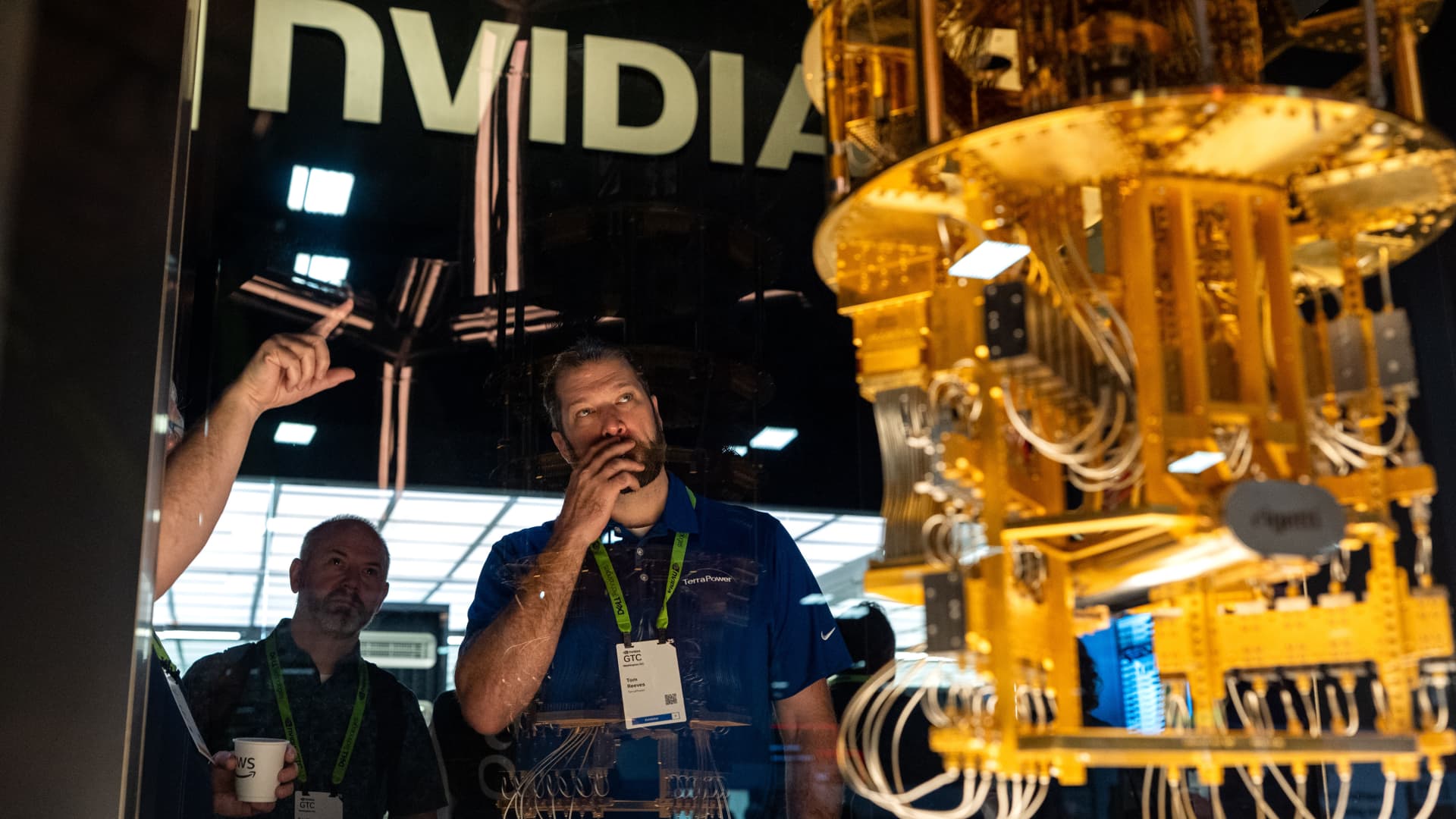
- Nvidia Model Launch: On 'World Quantum Day', Nvidia unveiled the Ising open-source model aimed at accelerating quantum computing adoption, with CEO Jensen Huang stating that AI will serve as the operating system for quantum machines, enhancing their feasibility and reliability.
- Accelerated Tech Investment: The U.S. government and tech giants like Microsoft, Alphabet, and Amazon are heavily investing in quantum computing, which is expected to drive rapid advancements in the coming years, despite the current market size being around $31 billion.
- IonQ Milestone: IonQ announced the successful linking of two remote quantum computers, calling it a 'foundational technical milestone', and secured a contract with the Defense Advanced Research Projects Agency, further solidifying its leadership position in the quantum computing space.
See More

Quantum Computing Stocks Surge Following Nvidia's AI Announcement
- Stock Surge: This week, shares of IonQ and D-Wave Quantum skyrocketed by 50%, while Quantum Computing and Rigetti Computing saw gains of over 20%, reflecting strong market confidence in the future of quantum computing.
- Nvidia's Model Launch: On 'World Quantum Day', Nvidia unveiled the Ising open-source AI model aimed at accelerating quantum computing adoption, with CEO Jensen Huang stating that AI is crucial for making quantum computing practical, potentially transforming the operation of quantum machines.
- Investment Surge: The U.S. government and tech giants like Microsoft, Alphabet, and Amazon are heavily investing in quantum computing, and although the market remains small at around $31 billion, its transformative potential in areas like drug discovery has garnered significant attention.
- Technical Milestone: IonQ announced it successfully linked two remote quantum computers, marking an important technical milestone, and secured a contract with the Defense Advanced Research Projects Agency, further solidifying its position in the quantum computing sector.
See More

Nvidia's Quantum Partner Selection Analysis

- Quantum Partner Selection: Nvidia has identified preferred quantum partners, yet investors have not fully priced in these signals, indicating that the market has yet to recognize INFQ's potential value.
- INFQ vs. RGTI Comparison: Citron Research highlights that INFQ plays calibration and decoding roles within Nvidia's quantum framework, while Rigetti lacks a similar selection, with INFQ trading at a discount, revealing a valuation gap between the two.
- Strong Financial Position: Infleqtion boasts a cash reserve of $550 million and a zero-debt structure, with expectations for rapid organic growth in 2025 and expanding commercial engagements with the government, showcasing its competitive edge in the quantum sector.
- Analyst Rating Upgrade: Citi analyst Atif Malik initiated coverage of Infleqtion with a 'Buy' rating and a $20 price target, suggesting a 59% upside, indicating that Infleqtion stands out in the quantum industry due to its revenue generation and real-world technology applications.
See More
D-Wave Quantum Stock Rises 3.41% Amid Renewed Interest in Quantum AI
- Stock Increase: D-Wave Quantum's stock rose 3.41% to $21.52, driven by renewed interest in quantum applications linked to Nvidia's new open-source AI models and comments from the CEO at the Semafor World Economy conference, indicating a resurgence in market focus on quantum computing.
- Surge in Trading Volume: The trading volume reached 84.3 million shares, approximately 195% higher than the three-month average of 28.6 million shares, suggesting a significant increase in investor interest in the quantum computing sector, which may indicate future revenue growth momentum.
- Industry Dynamics: Following Nvidia's launch of its Ising open model family, quantum computing companies have gained investor attention, with D-Wave's CEO highlighting the advantages of quantum technology in energy efficiency and revenue growth, challenging Nvidia's dominance in the GPU-AI space.
- Acquisition Impact: After D-Wave's $550 million acquisition of Quantum Circuits earlier this year, investors will closely monitor its revenue growth, although the Motley Fool analyst team did not include it in their current list of top investment stocks, reflecting a cautious market sentiment regarding its future performance.
See More
D-Wave Quantum Stock Rises 3.41% Amid Renewed Interest
- Stock Price Increase: D-Wave Quantum (QBTS) saw a 3.41% rise in stock price, closing at $21.52, reflecting renewed market interest in quantum computing applications, particularly following Nvidia's launch of new open-source AI models, indicating increased investor confidence in the sector.
- Surge in Trading Volume: Today's trading volume reached 84.3 million shares, approximately 195% higher than the three-month average of 28.6 million shares, suggesting a significant uptick in market interest for D-Wave, which may signal future revenue growth potential.
- Industry Dynamics: D-Wave's CEO highlighted the energy efficiency and rapid revenue growth of quantum technology at the Semafor World Economy conference, challenging Nvidia's dominance in the GPU-AI space, which further attracted investor attention.
- Acquisition Impact: Following D-Wave's $550 million acquisition of Quantum Circuits earlier this year, market expectations for its future growth have intensified, leading investors to closely monitor subsequent revenue performance.
See More
D-Wave Quantum Stock Rises 3.41% Following Nvidia AI Boost
- Stock Price Surge: D-Wave Quantum's stock closed at $21.52, up 3.41%, primarily driven by renewed interest in quantum applications linked to Nvidia's new open-source AI models, indicating potential revenue growth momentum for the company.
- Volume Spike: Trading volume reached 84.3 million shares, approximately 195% higher than the three-month average of 28.6 million shares, reflecting a significant increase in investor interest in the quantum computing sector, which may impact short-term stock volatility.
- CEO Comments Draw Attention: D-Wave's CEO highlighted the energy efficiency and rapid revenue growth of quantum technology at the Semafor World Economy conference, challenging Nvidia's dominance in the GPU-AI space, thereby attracting investor focus.
- Acquisition Impact: Following D-Wave's $550 million acquisition of Quantum Circuits earlier this year, investors will closely monitor revenue growth trends to assess the long-term impact of the acquisition on the company's development.
See More
Quantum Computing Stocks Surge Amid Nvidia's AI Models Launch
- Stock Surge: Since the beginning of the week, shares of IonQ and D-Wave Quantum have skyrocketed by 50%, while Rigetti Computing and Quantum Computing have each surged over 20%, reflecting strong market enthusiasm and investment in quantum computing.
- Nvidia Model Launch: On 'World Quantum Day', Nvidia unveiled the Ising open-source model aimed at accelerating quantum computing adoption, with CEO Jensen Huang stating that AI will serve as the operating system for quantum machines, enhancing their feasibility and reliability.
- Accelerated Tech Investment: The U.S. government and tech giants like Microsoft, Alphabet, and Amazon are heavily investing in quantum computing, which is expected to drive rapid advancements in the coming years, despite the current market size being around $31 billion.
- IonQ Milestone: IonQ announced the successful linking of two remote quantum computers, calling it a 'foundational technical milestone', and secured a contract with the Defense Advanced Research Projects Agency, further solidifying its leadership position in the quantum computing space.
See More
Quantum Computing Stocks Surge Following Nvidia's AI Announcement
- Stock Surge: This week, shares of IonQ and D-Wave Quantum skyrocketed by 50%, while Quantum Computing and Rigetti Computing saw gains of over 20%, reflecting strong market confidence in the future of quantum computing.
- Nvidia's Model Launch: On 'World Quantum Day', Nvidia unveiled the Ising open-source AI model aimed at accelerating quantum computing adoption, with CEO Jensen Huang stating that AI is crucial for making quantum computing practical, potentially transforming the operation of quantum machines.
- Investment Surge: The U.S. government and tech giants like Microsoft, Alphabet, and Amazon are heavily investing in quantum computing, and although the market remains small at around $31 billion, its transformative potential in areas like drug discovery has garnered significant attention.
- Technical Milestone: IonQ announced it successfully linked two remote quantum computers, marking an important technical milestone, and secured a contract with the Defense Advanced Research Projects Agency, further solidifying its position in the quantum computing sector.
See More
Nvidia's Quantum Partner Selection Analysis
- Quantum Partner Selection: Nvidia has identified preferred quantum partners, yet investors have not fully priced in these signals, indicating that the market has yet to recognize INFQ's potential value.
- INFQ vs. RGTI Comparison: Citron Research highlights that INFQ plays calibration and decoding roles within Nvidia's quantum framework, while Rigetti lacks a similar selection, with INFQ trading at a discount, revealing a valuation gap between the two.
- Strong Financial Position: Infleqtion boasts a cash reserve of $550 million and a zero-debt structure, with expectations for rapid organic growth in 2025 and expanding commercial engagements with the government, showcasing its competitive edge in the quantum sector.
- Analyst Rating Upgrade: Citi analyst Atif Malik initiated coverage of Infleqtion with a 'Buy' rating and a $20 price target, suggesting a 59% upside, indicating that Infleqtion stands out in the quantum industry due to its revenue generation and real-world technology applications.
See More