Nancy Pelosi and Tom Lee Unite on 11 Stock Selections: A Few May Surprise You


Nancy Pelosi's Stock Trading: Former Speaker Nancy Pelosi's stock trading activities, particularly in technology stocks, have drawn scrutiny due to their timing and performance, often outperforming the market. Her husband, Paul Pelosi, is believed to handle the investment decisions.
Fundstrat Granny Shots ETF: The Fundstrat Granny Shots US Large Cap ETF, launched in November 2024, includes 39 stocks based on specific investment themes, with 11 stocks in common with Pelosi's investment portfolio.
Common Stocks in Portfolio: Notable stocks shared between Pelosi's portfolio and the Fundstrat ETF include Broadcom, Alphabet, American Express, and Apple, among others, with significant transactions disclosed by Pelosi over the years.
Investment Strategy: Pelosi's investment strategy often involves large transactions in the technology sector, focusing on stocks that align with key themes identified by the Granny Shots ETF, such as cybersecurity and energy recovery.
Trade with 70% Backtested Accuracy
Analyst Views on VST

About VST
About the author


2026 Investment Opportunities: Analyzing ServiceNow's Potential


- Long-Term Investment Strategy: Amidst the volatility of the stock market in 2026, investors are encouraged to focus on stocks that can compound over years rather than those that fluctuate in the short term, highlighting a preference for stable investments.
- ServiceNow Position Increase: The author has recently doubled their position in ServiceNow, indicating strong confidence in the company's future growth potential, which may attract more investor interest.
- Video Content Sharing: The video analyzes three stocks that could potentially double over the next few years, providing investors with insights into market opportunities and facilitating the dissemination of information.
- Market Dynamics Observation: The stock price data as of May 22, 2026, serves as a foundation for analysis, reflecting the market's focus on companies like ServiceNow, which could influence investor decision-making.

S&P 500 Index Hits Record High Amidst Strong Market Trends


- Market Uptrend: The S&P 500 rose 0.13% on Tuesday, marking its ninth consecutive day of gains, the longest streak since last May, and is up 20% from March lows, indicating a robust market recovery.
- Job Data Focus: ADP is set to release May payroll numbers on Wednesday, with economists expecting a gain of 110,000 jobs, slightly above April's 109,000, as investors watch for implications on the Fed's policy direction.
- Tech Stock Surge: HPE shares soared 19.5% on Tuesday, the largest jump since its 2015 spin-off, driven by strong AI-related demand, and are up 133% year-to-date, reflecting robust market demand and investor confidence.
- Cryptocurrency Decline: Bitcoin fell below $70,000, hitting its lowest level since April, alongside Ethereum dropping below $2,000, showcasing the volatility in the crypto market and cautious investor sentiment.

Market Rises but Some Stocks Remain Undervalued


- Market Divergence: While the overall market continues to rise, many stocks remain in the red year-to-date, indicating a divergence that investors should monitor for potential opportunities.
- Undervalued Stock Insight: Toast (TOST) is highlighted as a stock under pressure due to the software sell-off in 2026, with its current valuation appearing attractive, potentially offering a rebound opportunity for investors.
- Investor Focus: As market sentiment shifts, many undervalued stocks may attract investor attention, making it crucial to seek value investment opportunities in the current economic climate.
- Video Content Preview: The video will delve into four stocks perceived as undervalued by the market, aiding investors in identifying potential investment opportunities and encouraging subscriptions for more market insights.

Valuation Analysis of U.S. Utility Stocks

- Valuation Overview: Among U.S. utility stocks with market caps over $10 billion, Vistra, Oklo, and Constellation Energy are rated as the most expensive with an F valuation grade, indicating significant overvaluation risks that may impact investor confidence.
- Valuation Metrics Analysis: The valuation grades are based on a combination of metrics such as P/E, PEG, price-to-sales, and price-to-cash flow, reflecting the competitive pressures these companies face in both current and forward estimates, which could influence market dynamics.
- NextEra Energy Performance: NextEra Energy holds a D- valuation grade, indicating a relatively better position within the utility sector, which may attract investors looking for stable returns despite the overall high valuation concerns.
- Oklo's Market Dynamics: Although Oklo has an F valuation grade, its selection by the Department of Energy for advanced discussions in the surplus plutonium program suggests potential growth opportunities in advanced energy projects, which could offset current valuation concerns.

Rising Risks of U.S. Economic Recession


- Recession Prediction Challenges: The last official U.S. recession occurred in early 2020, and although the GDP contracted for two consecutive quarters in 2022, the National Bureau of Economic Research (NBER) did not classify it as a recession due to a healthy labor market and robust consumer spending, indicating economic resilience.
- Market Overvaluation Risks: The S&P 500 is trading near all-time highs with a price-to-earnings ratio of 33, prompting investors to be cautious of a potential market crash, especially given the backdrop of inflation, rising interest rates, and geopolitical crises that could trigger a new recession.
- Investment Strategy Adjustments: Investors are advised to trim holdings in high-growth sectors like technology and energy, reallocating funds into defensive sectors such as consumer staples, healthcare, and utilities to mitigate macroeconomic pressures while ensuring stable dividend income.
- Fixed-Income Investment Allocation: Increasing the allocation to fixed-income investments like T-bills and investment-grade bonds is recommended; while these low-risk investments may not yield higher returns than stocks, they preserve capital and provide a steady income stream, ensuring sufficient liquidity for retirement.
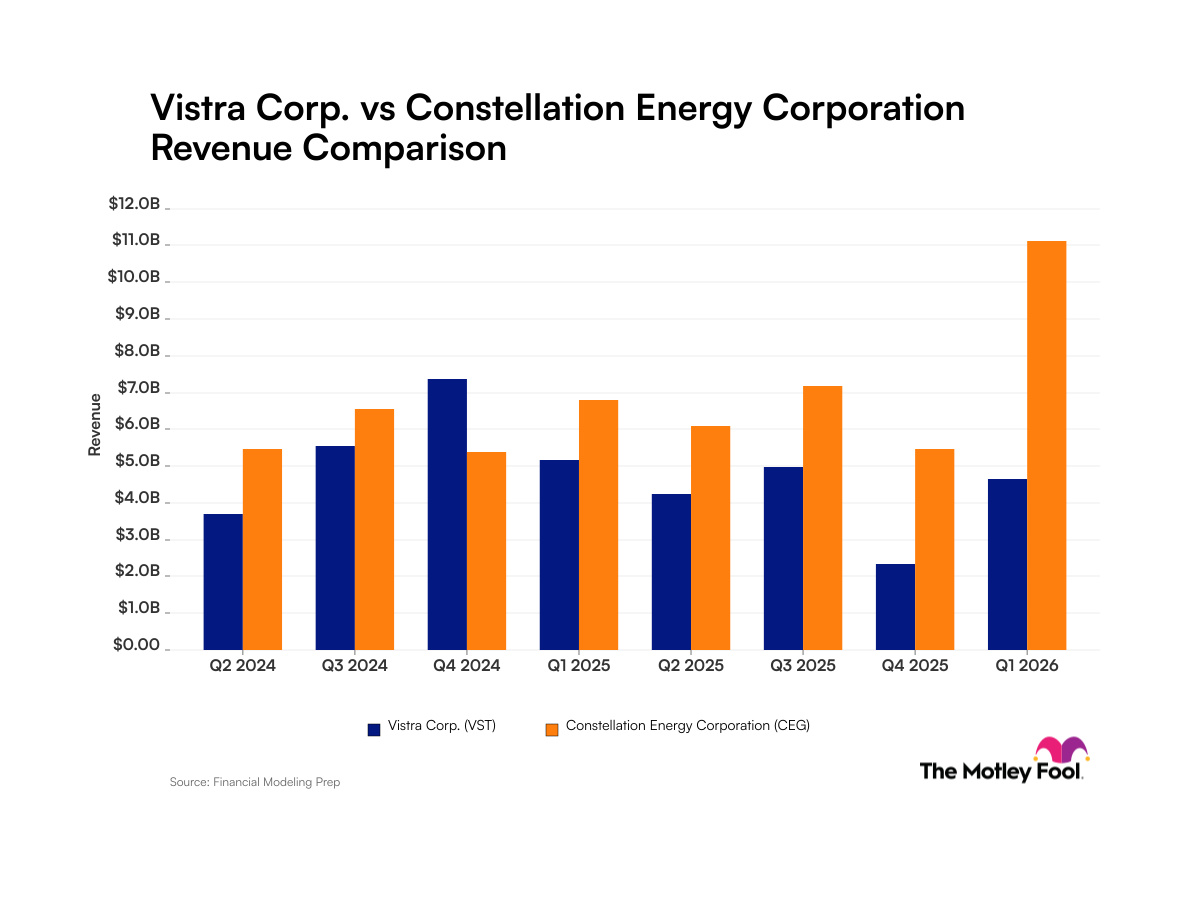
Vistra and Constellation Energy Revenue Analysis

- Revenue Volatility Management: Vistra achieved a net income margin of approximately 22% in Q1 2026 by integrating retail electricity and power generation, although its revenue fluctuates due to the use of energy derivatives, demonstrating its adaptability and risk management strategies in the market.
- New Revenue Highs: Constellation Energy reported $11.1 billion in revenue for Q1 2026 with a net income margin of about 14%, significantly enhancing its market position and generation capacity through the acquisition of Calpine, a leader in natural gas and geothermal generation.
- Competitive Market Dynamics: Both Vistra and Constellation Energy are pursuing similar growth strategies, with Vistra agreeing to acquire Cogentrix for $4 billion to add 5.5 GW of natural gas capacity, which is expected to narrow the gap between the two companies and enhance market competitiveness.
- Generation Capacity Integration: Post-merger, Constellation and Vistra will have generation capacities nearing 60 GW and 50 GW respectively, serving 2.5 million customers, highlighting their significance and growth potential in the U.S. energy market.
2026 Investment Opportunities: Analyzing ServiceNow's Potential
- Long-Term Investment Strategy: Amidst the volatility of the stock market in 2026, investors are encouraged to focus on stocks that can compound over years rather than those that fluctuate in the short term, highlighting a preference for stable investments.
- ServiceNow Position Increase: The author has recently doubled their position in ServiceNow, indicating strong confidence in the company's future growth potential, which may attract more investor interest.
- Video Content Sharing: The video analyzes three stocks that could potentially double over the next few years, providing investors with insights into market opportunities and facilitating the dissemination of information.
- Market Dynamics Observation: The stock price data as of May 22, 2026, serves as a foundation for analysis, reflecting the market's focus on companies like ServiceNow, which could influence investor decision-making.
S&P 500 Index Hits Record High Amidst Strong Market Trends
- Market Uptrend: The S&P 500 rose 0.13% on Tuesday, marking its ninth consecutive day of gains, the longest streak since last May, and is up 20% from March lows, indicating a robust market recovery.
- Job Data Focus: ADP is set to release May payroll numbers on Wednesday, with economists expecting a gain of 110,000 jobs, slightly above April's 109,000, as investors watch for implications on the Fed's policy direction.
- Tech Stock Surge: HPE shares soared 19.5% on Tuesday, the largest jump since its 2015 spin-off, driven by strong AI-related demand, and are up 133% year-to-date, reflecting robust market demand and investor confidence.
- Cryptocurrency Decline: Bitcoin fell below $70,000, hitting its lowest level since April, alongside Ethereum dropping below $2,000, showcasing the volatility in the crypto market and cautious investor sentiment.
Market Rises but Some Stocks Remain Undervalued
- Market Divergence: While the overall market continues to rise, many stocks remain in the red year-to-date, indicating a divergence that investors should monitor for potential opportunities.
- Undervalued Stock Insight: Toast (TOST) is highlighted as a stock under pressure due to the software sell-off in 2026, with its current valuation appearing attractive, potentially offering a rebound opportunity for investors.
- Investor Focus: As market sentiment shifts, many undervalued stocks may attract investor attention, making it crucial to seek value investment opportunities in the current economic climate.
- Video Content Preview: The video will delve into four stocks perceived as undervalued by the market, aiding investors in identifying potential investment opportunities and encouraging subscriptions for more market insights.
Valuation Analysis of U.S. Utility Stocks
- Valuation Overview: Among U.S. utility stocks with market caps over $10 billion, Vistra, Oklo, and Constellation Energy are rated as the most expensive with an F valuation grade, indicating significant overvaluation risks that may impact investor confidence.
- Valuation Metrics Analysis: The valuation grades are based on a combination of metrics such as P/E, PEG, price-to-sales, and price-to-cash flow, reflecting the competitive pressures these companies face in both current and forward estimates, which could influence market dynamics.
- NextEra Energy Performance: NextEra Energy holds a D- valuation grade, indicating a relatively better position within the utility sector, which may attract investors looking for stable returns despite the overall high valuation concerns.
- Oklo's Market Dynamics: Although Oklo has an F valuation grade, its selection by the Department of Energy for advanced discussions in the surplus plutonium program suggests potential growth opportunities in advanced energy projects, which could offset current valuation concerns.
Rising Risks of U.S. Economic Recession
- Recession Prediction Challenges: The last official U.S. recession occurred in early 2020, and although the GDP contracted for two consecutive quarters in 2022, the National Bureau of Economic Research (NBER) did not classify it as a recession due to a healthy labor market and robust consumer spending, indicating economic resilience.
- Market Overvaluation Risks: The S&P 500 is trading near all-time highs with a price-to-earnings ratio of 33, prompting investors to be cautious of a potential market crash, especially given the backdrop of inflation, rising interest rates, and geopolitical crises that could trigger a new recession.
- Investment Strategy Adjustments: Investors are advised to trim holdings in high-growth sectors like technology and energy, reallocating funds into defensive sectors such as consumer staples, healthcare, and utilities to mitigate macroeconomic pressures while ensuring stable dividend income.
- Fixed-Income Investment Allocation: Increasing the allocation to fixed-income investments like T-bills and investment-grade bonds is recommended; while these low-risk investments may not yield higher returns than stocks, they preserve capital and provide a steady income stream, ensuring sufficient liquidity for retirement.
Vistra and Constellation Energy Revenue Analysis
- Revenue Volatility Management: Vistra achieved a net income margin of approximately 22% in Q1 2026 by integrating retail electricity and power generation, although its revenue fluctuates due to the use of energy derivatives, demonstrating its adaptability and risk management strategies in the market.
- New Revenue Highs: Constellation Energy reported $11.1 billion in revenue for Q1 2026 with a net income margin of about 14%, significantly enhancing its market position and generation capacity through the acquisition of Calpine, a leader in natural gas and geothermal generation.
- Competitive Market Dynamics: Both Vistra and Constellation Energy are pursuing similar growth strategies, with Vistra agreeing to acquire Cogentrix for $4 billion to add 5.5 GW of natural gas capacity, which is expected to narrow the gap between the two companies and enhance market competitiveness.
- Generation Capacity Integration: Post-merger, Constellation and Vistra will have generation capacities nearing 60 GW and 50 GW respectively, serving 2.5 million customers, highlighting their significance and growth potential in the U.S. energy market.