ARM Shares Surge in Premarket Trading: Analyst Suggests Even a Small Portion of Meta's Capital Expenditure Could Significantly Impact Revenue


Meta's Involvement in AI CPU Platform: Analysts highlighted Meta's role in the new AGI server CPU platform, which is expected to shift Arm's revenue model from royalty licensing to selling finished silicon, targeting agentic AI workloads that require significantly more CPU cores.
Stock Market Reaction: Shares of Arm Holdings surged by 10% in premarket trading following the announcement, indicating strong investor interest in the potential revenue opportunities tied to Meta's involvement in AI infrastructure.
Strategic Shift for Arm: Arm's new strategy positions the company between hyperscaler-built processors and traditional enterprise server chips, aiming to fill a market gap in server CPU offerings, particularly for agent-driven data centers.
Competitive Landscape and Future Outlook: Despite a positive outlook, analysts noted uncertainties regarding commercialization timing and competition from established players like Intel and AMD, emphasizing the need for third-party benchmarks to validate Arm's performance claims in real-world workloads.
Trade with 70% Backtested Accuracy
Analyst Views on ARM

About ARM
About the author


Arm Holdings Sees Significant Growth in CPU Market Share

- Market Share Increase: Arm Holdings has achieved approximately 50% market share in the data center CPU sector, driven by the widespread adoption of its efficient Arm architecture by top hyperscalers like Nvidia and Amazon, which is expected to further solidify its market position.
- Revenue Growth Potential: Arm anticipates that its first-party chip business will generate $15 billion in sales by 2031, potentially yielding $7.5 billion in gross profit, significantly surpassing its current royalty revenue model and demonstrating the success of its strategic transformation.
- Future Market Expectations: Arm projects that the data center CPU market will reach $100 billion by 2031, doubling from $50 billion in 2026, reflecting the rapid growth in AI compute demand, which is further driving the need for CPUs.
- Valuation Challenges: Despite Arm's stock tripling in value since the beginning of the year, the current price-to-earnings ratio of 159 presents a risk of overvaluation for investors, as management's 2031 earnings guidance indicates substantial future growth potential, but high valuations may limit further stock price increases.

Arm Holdings' Surge in Data Center CPU Market
- Market Share Growth: Arm Holdings has achieved a 50% market share in the data center CPU market, driven by the widespread adoption of its efficient Arm architecture by top hyperscalers like Nvidia and Amazon, indicating a strong competitive position.
- Revenue Growth Expectations: Arm anticipates that its proprietary chip sales will reach $15 billion by 2031, potentially generating $7.5 billion in gross profit, showcasing significant growth potential compared to its total gross profit of $4.8 billion in 2025.
- Surge in CPU Demand: With the rise of agentic AI, the demand for CPUs is expected to shift from the current 1:4 CPU to GPU ratio to 1:1 in the future, further driving market demand for Arm's offerings and strengthening its business foundation.
- Valuation Challenges: Despite Arm's stock tripling in value since the beginning of the year, its current P/E ratio stands at 159, presenting a challenge for investors as the high valuation raises concerns about the feasibility of another tripling in stock price, even with substantial growth potential ahead.

Arm Holdings' Rise in Data Center CPU Market

- Market Share Growth: Arm Holdings has captured approximately 50% of the data center CPU market, bolstered by the widespread adoption of its efficient Arm architecture by top hyperscalers like Nvidia and Amazon, indicating a significant shift in competitive dynamics.
- Revenue Growth Outlook: Arm anticipates that its direct chip sales will reach $15 billion by 2031, potentially generating $7.5 billion in gross profit, showcasing a remarkable growth trajectory compared to its gross profit of $4.8 billion in 2025, reflecting strong future demand.
- Surging CPU Demand: As agentic AI workloads increase, the CPU-to-GPU ratio may shift from 1:4 to 1:1, highlighting the value of Arm's designs in meeting this demand, which further enhances its market position.
- Valuation Concerns: Despite Arm's stock tripling in value since the beginning of the year, its current P/E ratio stands at 159, prompting investors to carefully evaluate whether this high valuation is justified, especially given the disparity between the company's growth potential and market expectations.

Comparative Growth Analysis of Qualcomm and Arm
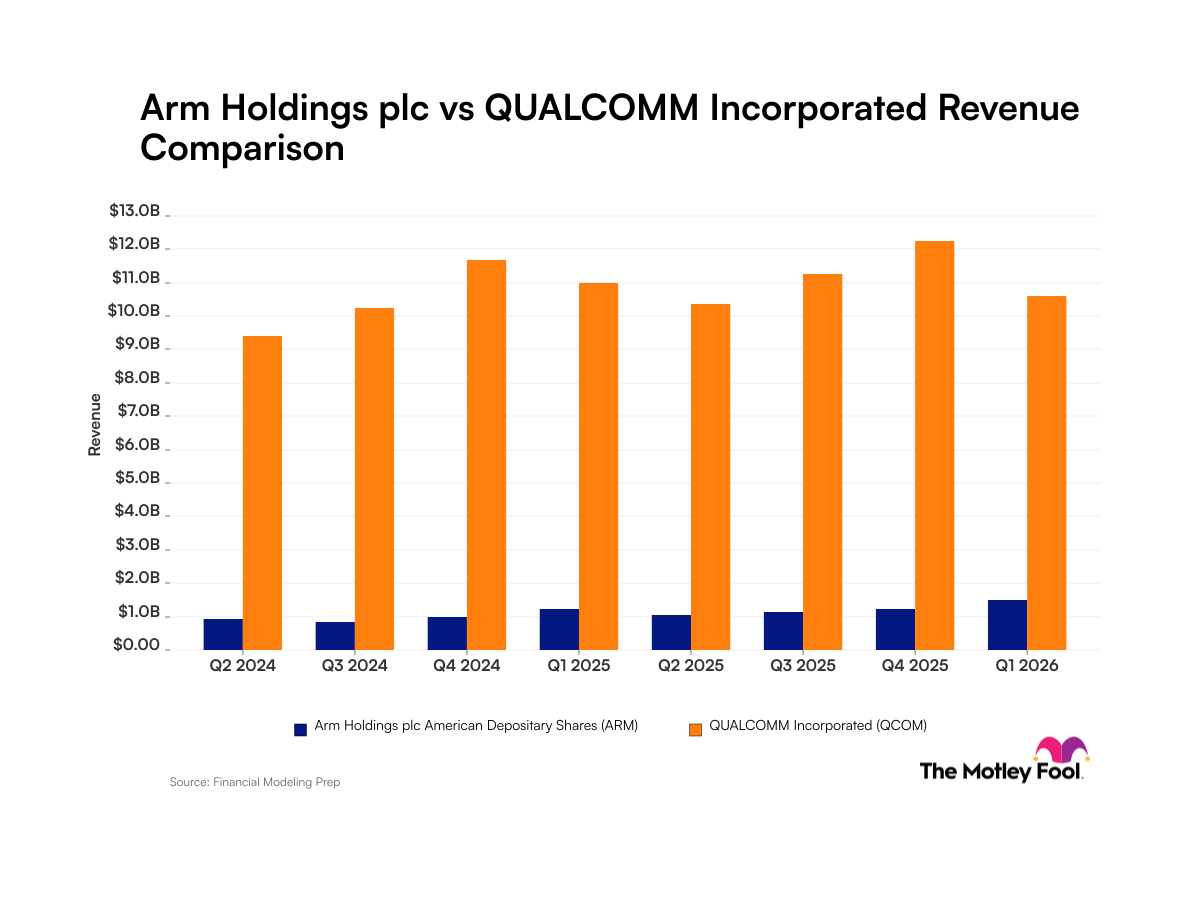
- Revenue Growth Comparison: Arm achieved a 20% year-over-year growth in Q1 2026, while Qualcomm's revenue fell by 3.5%, indicating Arm's stronger growth potential in the market, which may attract investor interest in its future performance.
- Profitability Analysis: Arm's net income margin stands at 21%, while Qualcomm boasts nearly 70%, indicating Qualcomm's strong profitability; however, its slowing revenue growth may impact long-term investment appeal.
- Market Transformation Strategy: Qualcomm is shifting focus from the handset market to sectors like automotive, IoT, and data centers, and if its AI strategy is successfully implemented, it could accelerate revenue growth and narrow the gap with Arm.
- Investor Focus: Despite Arm's stock rising nearly 600% over the past three years, Qualcomm's growth is also noteworthy, especially during its transformation, prompting investors to closely monitor its performance in AI and consumer devices.
AI Drives Growth Opportunities for Arm and Qualcomm
- Arm Revenue Growth: In Q1 2026, Arm's revenue grew 20% year-over-year to $1.5 billion, driven by its licensing and royalty-based business model, resulting in a healthy 21% net income margin, indicating strong market demand and profitability.
- Qualcomm Revenue Fluctuations: Despite Qualcomm's net income margin nearing 70% in Q1, its revenue fell 3.5% year-over-year, reflecting challenges in its strategic shift from the handset market to automotive, IoT, and data center segments, necessitating close monitoring of future growth potential.
- Market Competition Analysis: Over the past three years, Arm's stock has surged nearly 600%, compared to Qualcomm's approximately 123% return, highlighting Arm's increasing competitiveness in the semiconductor industry, particularly in automotive and AI applications.
- Future Outlook: As Qualcomm adjusts its product lineup to seize opportunities in data centers and AI-driven consumer devices, it will be crucial to observe whether it can accelerate revenue growth in the coming years while Arm continues to expand its market share.

Stocks Hit Record Highs Again, Driven by Tech Gains


- Market Performance: Last week, the S&P 500 and Nasdaq Composite rose over 1% and 2%, respectively, marking the S&P 500's ninth consecutive week of gains and the Nasdaq's eighth out of the last nine weeks, reflecting strong investor confidence in the market.
- Tech Stock Surge: Snowflake's quarterly earnings exceeded expectations and included a $6 billion AI compute deal with Amazon, leading to a more than 36% single-day stock price increase, which reignited enthusiasm across the tech sector and boosted stocks like Dell and Broadcom significantly.
- Cybersecurity Stock Volatility: Zscaler's disappointing earnings report resulted in its worst single-day performance, negatively impacting peers CrowdStrike and Palo Alto Networks; however, Okta's strong earnings report led to a 30% stock price jump, indicating ongoing demand in the cybersecurity sector.
- Middle East Situation's Market Impact: Despite mixed signals from the Middle East, rumors of peace progress between Iran and the U.S. spurred market gains, although the White House dismissed the reports, investor optimism still supported the stock market's upward trajectory.
Arm Holdings Sees Significant Growth in CPU Market Share
- Market Share Increase: Arm Holdings has achieved approximately 50% market share in the data center CPU sector, driven by the widespread adoption of its efficient Arm architecture by top hyperscalers like Nvidia and Amazon, which is expected to further solidify its market position.
- Revenue Growth Potential: Arm anticipates that its first-party chip business will generate $15 billion in sales by 2031, potentially yielding $7.5 billion in gross profit, significantly surpassing its current royalty revenue model and demonstrating the success of its strategic transformation.
- Future Market Expectations: Arm projects that the data center CPU market will reach $100 billion by 2031, doubling from $50 billion in 2026, reflecting the rapid growth in AI compute demand, which is further driving the need for CPUs.
- Valuation Challenges: Despite Arm's stock tripling in value since the beginning of the year, the current price-to-earnings ratio of 159 presents a risk of overvaluation for investors, as management's 2031 earnings guidance indicates substantial future growth potential, but high valuations may limit further stock price increases.
Arm Holdings' Surge in Data Center CPU Market
- Market Share Growth: Arm Holdings has achieved a 50% market share in the data center CPU market, driven by the widespread adoption of its efficient Arm architecture by top hyperscalers like Nvidia and Amazon, indicating a strong competitive position.
- Revenue Growth Expectations: Arm anticipates that its proprietary chip sales will reach $15 billion by 2031, potentially generating $7.5 billion in gross profit, showcasing significant growth potential compared to its total gross profit of $4.8 billion in 2025.
- Surge in CPU Demand: With the rise of agentic AI, the demand for CPUs is expected to shift from the current 1:4 CPU to GPU ratio to 1:1 in the future, further driving market demand for Arm's offerings and strengthening its business foundation.
- Valuation Challenges: Despite Arm's stock tripling in value since the beginning of the year, its current P/E ratio stands at 159, presenting a challenge for investors as the high valuation raises concerns about the feasibility of another tripling in stock price, even with substantial growth potential ahead.
Arm Holdings' Rise in Data Center CPU Market
- Market Share Growth: Arm Holdings has captured approximately 50% of the data center CPU market, bolstered by the widespread adoption of its efficient Arm architecture by top hyperscalers like Nvidia and Amazon, indicating a significant shift in competitive dynamics.
- Revenue Growth Outlook: Arm anticipates that its direct chip sales will reach $15 billion by 2031, potentially generating $7.5 billion in gross profit, showcasing a remarkable growth trajectory compared to its gross profit of $4.8 billion in 2025, reflecting strong future demand.
- Surging CPU Demand: As agentic AI workloads increase, the CPU-to-GPU ratio may shift from 1:4 to 1:1, highlighting the value of Arm's designs in meeting this demand, which further enhances its market position.
- Valuation Concerns: Despite Arm's stock tripling in value since the beginning of the year, its current P/E ratio stands at 159, prompting investors to carefully evaluate whether this high valuation is justified, especially given the disparity between the company's growth potential and market expectations.
Comparative Growth Analysis of Qualcomm and Arm
- Revenue Growth Comparison: Arm achieved a 20% year-over-year growth in Q1 2026, while Qualcomm's revenue fell by 3.5%, indicating Arm's stronger growth potential in the market, which may attract investor interest in its future performance.
- Profitability Analysis: Arm's net income margin stands at 21%, while Qualcomm boasts nearly 70%, indicating Qualcomm's strong profitability; however, its slowing revenue growth may impact long-term investment appeal.
- Market Transformation Strategy: Qualcomm is shifting focus from the handset market to sectors like automotive, IoT, and data centers, and if its AI strategy is successfully implemented, it could accelerate revenue growth and narrow the gap with Arm.
- Investor Focus: Despite Arm's stock rising nearly 600% over the past three years, Qualcomm's growth is also noteworthy, especially during its transformation, prompting investors to closely monitor its performance in AI and consumer devices.
AI Drives Growth Opportunities for Arm and Qualcomm
- Arm Revenue Growth: In Q1 2026, Arm's revenue grew 20% year-over-year to $1.5 billion, driven by its licensing and royalty-based business model, resulting in a healthy 21% net income margin, indicating strong market demand and profitability.
- Qualcomm Revenue Fluctuations: Despite Qualcomm's net income margin nearing 70% in Q1, its revenue fell 3.5% year-over-year, reflecting challenges in its strategic shift from the handset market to automotive, IoT, and data center segments, necessitating close monitoring of future growth potential.
- Market Competition Analysis: Over the past three years, Arm's stock has surged nearly 600%, compared to Qualcomm's approximately 123% return, highlighting Arm's increasing competitiveness in the semiconductor industry, particularly in automotive and AI applications.
- Future Outlook: As Qualcomm adjusts its product lineup to seize opportunities in data centers and AI-driven consumer devices, it will be crucial to observe whether it can accelerate revenue growth in the coming years while Arm continues to expand its market share.
Stocks Hit Record Highs Again, Driven by Tech Gains
- Market Performance: Last week, the S&P 500 and Nasdaq Composite rose over 1% and 2%, respectively, marking the S&P 500's ninth consecutive week of gains and the Nasdaq's eighth out of the last nine weeks, reflecting strong investor confidence in the market.
- Tech Stock Surge: Snowflake's quarterly earnings exceeded expectations and included a $6 billion AI compute deal with Amazon, leading to a more than 36% single-day stock price increase, which reignited enthusiasm across the tech sector and boosted stocks like Dell and Broadcom significantly.
- Cybersecurity Stock Volatility: Zscaler's disappointing earnings report resulted in its worst single-day performance, negatively impacting peers CrowdStrike and Palo Alto Networks; however, Okta's strong earnings report led to a 30% stock price jump, indicating ongoing demand in the cybersecurity sector.
- Middle East Situation's Market Impact: Despite mixed signals from the Middle East, rumors of peace progress between Iran and the U.S. spurred market gains, although the White House dismissed the reports, investor optimism still supported the stock market's upward trajectory.