Wipro (WIT) to Announce Q3 Earnings on January 16, Forecasting $2.6B Revenue
Written by Emily J. Thompson, Senior Investment Analyst
Updated: Jan 15 2026
0mins
Should l Buy WIT?
Source: seekingalpha
- Earnings Announcement: Wipro is set to release its Q3 earnings on January 16 before market open, with a consensus EPS estimate of $0.04, indicating stable profitability year-over-year.
- Revenue Forecast: Analysts project Wipro's Q3 revenue at $2.6 billion, reflecting a slight decline of 0.4% year-over-year, highlighting challenges in a competitive market.
- Performance Beat Record: Over the past two years, Wipro has beaten EPS and revenue estimates 63% of the time, demonstrating resilience in its financial performance amidst market fluctuations.
- Estimate Revisions: In the last three months, Wipro's EPS estimates saw one upward revision and no downward adjustments, while revenue estimates experienced five upward revisions and one downward, indicating market confidence in the company's future outlook.
Trade with 70% Backtested Accuracy
Stop guessing "Should I Buy WIT?" and start using high-conviction signals backed by rigorous historical data.
Sign up today to access powerful investing tools and make smarter, data-driven decisions.
Analyst Views on WIT
About WIT
Wipro Limited is a technology services and consulting company. The Company operates through two segments: Information Technology (IT) Services, and IT Products. IT Services segment provides a range of IT and IT enabled services which include digital strategy advisory, customer centric design, technology consulting, IT consulting, custom application design, re-engineering and maintenance, systems integration, package implementation, cloud and infrastructure services, business process services, cloud, mobility and analytics services, research and development and hardware and software design. The IT Products segment provides a range of third-party IT products, which allows it to offer IT system integration services. These products include computing, platforms and storage, networking solutions, and software products. Its services include Applications, Artificial Intelligence, Business Process, Cloud, Consulting, Data & Analytics, Digital Experiences, Engineering, and Sustainability.
About the author

Emily J. Thompson
Emily J. Thompson, a Chartered Financial Analyst (CFA) with 12 years in investment research, graduated with honors from the Wharton School. Specializing in industrial and technology stocks, she provides in-depth analysis for Intellectia’s earnings and market brief reports.

Applied Computing Partners with Wipro and Databricks to Accelerate Energy Transition

- Strategic Partnership Highlights: Applied Computing has formed a strategic partnership with Wipro and Databricks to leverage the physics-informed AI platform Orbital, aimed at helping energy operators in the Middle East, India, and Southeast Asia improve efficiency, reduce emissions, and accelerate the energy transition.
- AI System Deployment: Wipro will collaborate with Applied Computing to deploy Orbital in complex, mission-critical environments, ensuring that AI systems are explainable and verifiable, enabling energy operators to embed AI directly into daily operations and move beyond pilot projects.
- Multi-Modal Model Advantages: The partnership utilizes multi-modal foundation models that process time-series sensor data and physics simulations, allowing operators to leverage the full spectrum of operational data to optimize economic and environmental objectives, thereby enhancing decision-making efficiency.
- Initial Deployment Plans: Initial deployments will focus on downstream refining and petrochemical operations, addressing complexity and scale challenges to validate the effectiveness of AI optimization solutions, benchmarked against industry standards with a focus on margin improvement, emissions reduction, and energy efficiency gains.
See More

US Depositary Receipts Plummet Sharply


- Market Performance Decline: On Friday, Asian equities traded in the US saw a significant drop in American Depositary Receipts (ADRs), reflecting investor concerns about market outlook, which could lead to capital outflows and diminished market confidence.
- Investor Sentiment Weakens: Heightened global economic uncertainty has negatively impacted investor confidence in Asian companies, potentially resulting in reduced trading volumes in the coming weeks, thereby affecting overall market liquidity.
- Sector Impact Notable: The decline in ADRs significantly affects sectors such as technology and consumer goods, which may face negative repercussions on their financing capabilities and market valuations, further exacerbating market volatility.
- Uncertain Future Outlook: With the ongoing low market sentiment, analysts anticipate more volatility in the short term, urging investors to exercise caution in response to potential market risks.
See More

Congressional Democrats Demand Revocation of India’s Russian Oil Waiver


- Waiver Controversy: The U.S. Treasury issued a 30-day sanctions waiver allowing Indian refiners to purchase Russian oil, which Congressional Democrats labeled as 'dangerous and self-defeating,' potentially empowering adversaries.
- Rising Energy Prices: Lawmakers warned that allowing India to buy Russian oil could exacerbate soaring U.S. energy prices while enabling Russia to profit from previously sanctioned reserves, undermining U.S. strategic interests in the Middle East.
- Short-term Price Stabilization: Energy Secretary Chris Wright defended the waiver as 'pragmatic,' asserting it redirects Russian oil from China to India, which could help stabilize prices in the short term despite concerns over intelligence sharing with Iran.
- Impact of U.S.-India Trade Deal: Last month, President Trump announced a significant trade deal with India that reduced tariffs on Indian goods and committed India to import at least $500 billion in U.S. products over five years, which is expected to gradually shift supply chains and benefit U.S. multinationals.
See More

Wipro Limited Misses Revenue Estimates in Q3 2026
- Disappointing Earnings: Wipro reported $2.62 billion in revenue for Q3 2026, reflecting a 0.6% year-over-year growth but missing expectations by $7.73 million, indicating pressure in a competitive market.
- Cautious Ratings: Jefferies analyst Akshat Agarwal maintained a Sell rating on February 24 with a price target of INR180, while Geojit Research held a Hold rating with a target of INR227 on February 20, reflecting market caution regarding future performance.
- Contract Value Growth: Despite challenges, Wipro successfully closed $3.3 billion in total contract value and $871 million in large deal bookings during the quarter, showcasing its competitiveness and market demand in large projects.
- Cautious Future Outlook: Management expects Q4 2026 revenue to range between $2.64 billion and $2.69 billion, indicating a growth forecast of 0% to 2% in constant currency terms, reflecting uncertainty in the future market environment.
See More

Implications of the 2028 Global Intelligence Crisis on India's IT Sector
- Export Sector Crisis: Citrini Research's report indicates that if AI capabilities continue to improve, India's $200 billion annual IT services export could collapse, directly impacting the country's current account surplus and potentially leading to an 18% depreciation of the rupee within four months.
- Loss of Competitive Advantage: The report emphasizes that the core competitive edge of India's IT services sector lies in low-cost developers, but this advantage will evaporate with advancements in AI technology, forcing companies to reassess the viability of outsourcing models.
- Shift to In-House Development: Following breakthroughs in agentic coding tools in 2025, enterprises can develop mid-market SaaS products internally in weeks, significantly reducing the demand for large offshore IT contracts and impacting future growth in India's IT sector.
- IMF Involvement: As IT exports decline, the International Monetary Fund may initiate preliminary discussions with New Delhi in the first quarter of 2028, indicating increased pressure on the Indian economy and the need for measures to address potential crises.
See More
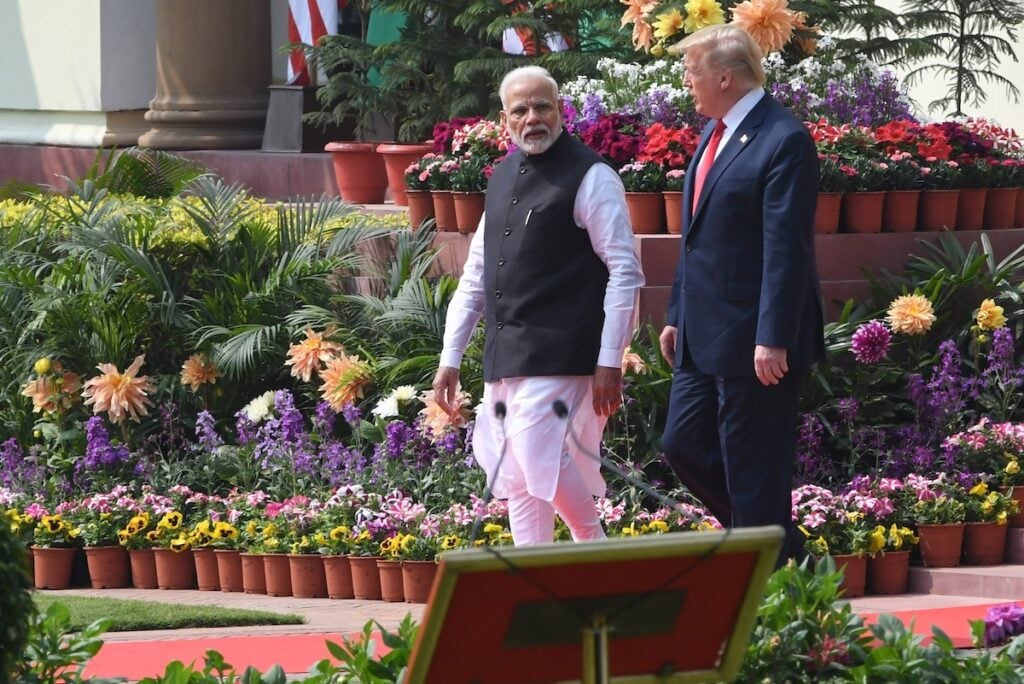
Major U.S.-India Trade Agreement Announced
- Tariff Reductions: Trump announced a U.S.-India trade agreement that eliminates trade barriers for India and reduces U.S. tariffs on Indian goods from 25% to 18%, significantly enhancing trade relations between the two nations.
- Oil Procurement Agreement: The deal ends the 25% punitive tariff imposed due to India's purchases of Russian oil, with Trump stating that India will cease buying Russian oil and increase imports from the U.S. and potentially Venezuela.
- India's Purchasing Commitment: Prime Minister Modi committed to purchasing over $500 billion worth of American products across energy, technology, agriculture, and coal sectors, indicating India's strong interest in U.S. markets and collaboration.
- Improvement in Trade Relations: This agreement is expected to alleviate trade tensions caused by U.S. tariffs of up to 50% on Indian goods, while India is also exploring a free trade deal with the EU to further diversify its international trade relationships.
See More
Applied Computing Partners with Wipro and Databricks to Accelerate Energy Transition
- Strategic Partnership Highlights: Applied Computing has formed a strategic partnership with Wipro and Databricks to leverage the physics-informed AI platform Orbital, aimed at helping energy operators in the Middle East, India, and Southeast Asia improve efficiency, reduce emissions, and accelerate the energy transition.
- AI System Deployment: Wipro will collaborate with Applied Computing to deploy Orbital in complex, mission-critical environments, ensuring that AI systems are explainable and verifiable, enabling energy operators to embed AI directly into daily operations and move beyond pilot projects.
- Multi-Modal Model Advantages: The partnership utilizes multi-modal foundation models that process time-series sensor data and physics simulations, allowing operators to leverage the full spectrum of operational data to optimize economic and environmental objectives, thereby enhancing decision-making efficiency.
- Initial Deployment Plans: Initial deployments will focus on downstream refining and petrochemical operations, addressing complexity and scale challenges to validate the effectiveness of AI optimization solutions, benchmarked against industry standards with a focus on margin improvement, emissions reduction, and energy efficiency gains.
See More
US Depositary Receipts Plummet Sharply
- Market Performance Decline: On Friday, Asian equities traded in the US saw a significant drop in American Depositary Receipts (ADRs), reflecting investor concerns about market outlook, which could lead to capital outflows and diminished market confidence.
- Investor Sentiment Weakens: Heightened global economic uncertainty has negatively impacted investor confidence in Asian companies, potentially resulting in reduced trading volumes in the coming weeks, thereby affecting overall market liquidity.
- Sector Impact Notable: The decline in ADRs significantly affects sectors such as technology and consumer goods, which may face negative repercussions on their financing capabilities and market valuations, further exacerbating market volatility.
- Uncertain Future Outlook: With the ongoing low market sentiment, analysts anticipate more volatility in the short term, urging investors to exercise caution in response to potential market risks.
See More
Congressional Democrats Demand Revocation of India’s Russian Oil Waiver
- Waiver Controversy: The U.S. Treasury issued a 30-day sanctions waiver allowing Indian refiners to purchase Russian oil, which Congressional Democrats labeled as 'dangerous and self-defeating,' potentially empowering adversaries.
- Rising Energy Prices: Lawmakers warned that allowing India to buy Russian oil could exacerbate soaring U.S. energy prices while enabling Russia to profit from previously sanctioned reserves, undermining U.S. strategic interests in the Middle East.
- Short-term Price Stabilization: Energy Secretary Chris Wright defended the waiver as 'pragmatic,' asserting it redirects Russian oil from China to India, which could help stabilize prices in the short term despite concerns over intelligence sharing with Iran.
- Impact of U.S.-India Trade Deal: Last month, President Trump announced a significant trade deal with India that reduced tariffs on Indian goods and committed India to import at least $500 billion in U.S. products over five years, which is expected to gradually shift supply chains and benefit U.S. multinationals.
See More
Wipro Limited Misses Revenue Estimates in Q3 2026
- Disappointing Earnings: Wipro reported $2.62 billion in revenue for Q3 2026, reflecting a 0.6% year-over-year growth but missing expectations by $7.73 million, indicating pressure in a competitive market.
- Cautious Ratings: Jefferies analyst Akshat Agarwal maintained a Sell rating on February 24 with a price target of INR180, while Geojit Research held a Hold rating with a target of INR227 on February 20, reflecting market caution regarding future performance.
- Contract Value Growth: Despite challenges, Wipro successfully closed $3.3 billion in total contract value and $871 million in large deal bookings during the quarter, showcasing its competitiveness and market demand in large projects.
- Cautious Future Outlook: Management expects Q4 2026 revenue to range between $2.64 billion and $2.69 billion, indicating a growth forecast of 0% to 2% in constant currency terms, reflecting uncertainty in the future market environment.
See More
Implications of the 2028 Global Intelligence Crisis on India's IT Sector
- Export Sector Crisis: Citrini Research's report indicates that if AI capabilities continue to improve, India's $200 billion annual IT services export could collapse, directly impacting the country's current account surplus and potentially leading to an 18% depreciation of the rupee within four months.
- Loss of Competitive Advantage: The report emphasizes that the core competitive edge of India's IT services sector lies in low-cost developers, but this advantage will evaporate with advancements in AI technology, forcing companies to reassess the viability of outsourcing models.
- Shift to In-House Development: Following breakthroughs in agentic coding tools in 2025, enterprises can develop mid-market SaaS products internally in weeks, significantly reducing the demand for large offshore IT contracts and impacting future growth in India's IT sector.
- IMF Involvement: As IT exports decline, the International Monetary Fund may initiate preliminary discussions with New Delhi in the first quarter of 2028, indicating increased pressure on the Indian economy and the need for measures to address potential crises.
See More
Major U.S.-India Trade Agreement Announced
- Tariff Reductions: Trump announced a U.S.-India trade agreement that eliminates trade barriers for India and reduces U.S. tariffs on Indian goods from 25% to 18%, significantly enhancing trade relations between the two nations.
- Oil Procurement Agreement: The deal ends the 25% punitive tariff imposed due to India's purchases of Russian oil, with Trump stating that India will cease buying Russian oil and increase imports from the U.S. and potentially Venezuela.
- India's Purchasing Commitment: Prime Minister Modi committed to purchasing over $500 billion worth of American products across energy, technology, agriculture, and coal sectors, indicating India's strong interest in U.S. markets and collaboration.
- Improvement in Trade Relations: This agreement is expected to alleviate trade tensions caused by U.S. tariffs of up to 50% on Indian goods, while India is also exploring a free trade deal with the EU to further diversify its international trade relationships.
See More