UPS Invests $48 Million in Temperature-Controlled Facilities
Written by Emily J. Thompson, Senior Investment Analyst
Updated: 3 days ago
0mins
Source: Fool
- Business Transformation Investment: UPS has announced a $48 million investment in 27 temperature-controlled facilities to meet the rising demand for low-temperature medication transport, particularly GLP-1 weight-loss drugs, thereby enhancing its market share and profit margins in the healthcare sector.
- Customer Focus Strategy: The company is shifting from low-margin high-volume customers to high-margin clients, which has led to a decline in overall revenue; however, revenue per package is increasing, indicating early signs of success, with management projecting a turnaround inflection point in the second half of 2026.
- Market Reaction and Dividends: Despite UPS's stock price dropping 50% from its 2022 peak, its 6% dividend yield reflects investor concerns about the turnaround, while also indicating market expectations for future growth potential.
- Long-term Strategic Significance: By investing in temperature-controlled facilities, UPS is not only enhancing service quality but also laying the groundwork for future growth, particularly in high-margin opportunities within the healthcare sector, signaling a potential shift from business contraction to expansion.
Trade with 70% Backtested Accuracy
Stop guessing "Should I Buy UPS?" and start using high-conviction signals backed by rigorous historical data.
Sign up today to access powerful investing tools and make smarter, data-driven decisions.
Analyst Views on UPS
Wall Street analysts forecast UPS stock price to fall
19 Analyst Rating
9 Buy
9 Hold
1 Sell
Moderate Buy
Current: 110.020

Low
80.00
Averages
107.06
High
126.00
Current: 110.020
Low
80.00
Averages
107.06
High
126.00
About UPS
United Parcel Service, Inc. is a global package delivery and logistics provider. Its U.S. Domestic Package segment offers a full spectrum of air and ground package transportation services. Its air portfolio offers time-definite, same-day, next-day, two-day and three-day delivery alternatives as well as air cargo services. Its ground network enables customers to ship using its day-definite ground service. Ground Saver provides residential ground service for customers with non-urgent, lightweight residential shipments. Its International Package segment consists of small package operations in Europe, Middle East and Africa, Canada and Latin America and Asia. It offers a selection of guaranteed day and time-definite international transportation services supported by its brokerage capabilities that facilitate cross-border clearance for international shipments. Its supply chain solutions consist of customized third-party logistics and specialized cold chain transportation solutions.
About the author

Emily J. Thompson
Emily J. Thompson, a Chartered Financial Analyst (CFA) with 12 years in investment research, graduated with honors from the Wharton School. Specializing in industrial and technology stocks, she provides in-depth analysis for Intellectia’s earnings and market brief reports.
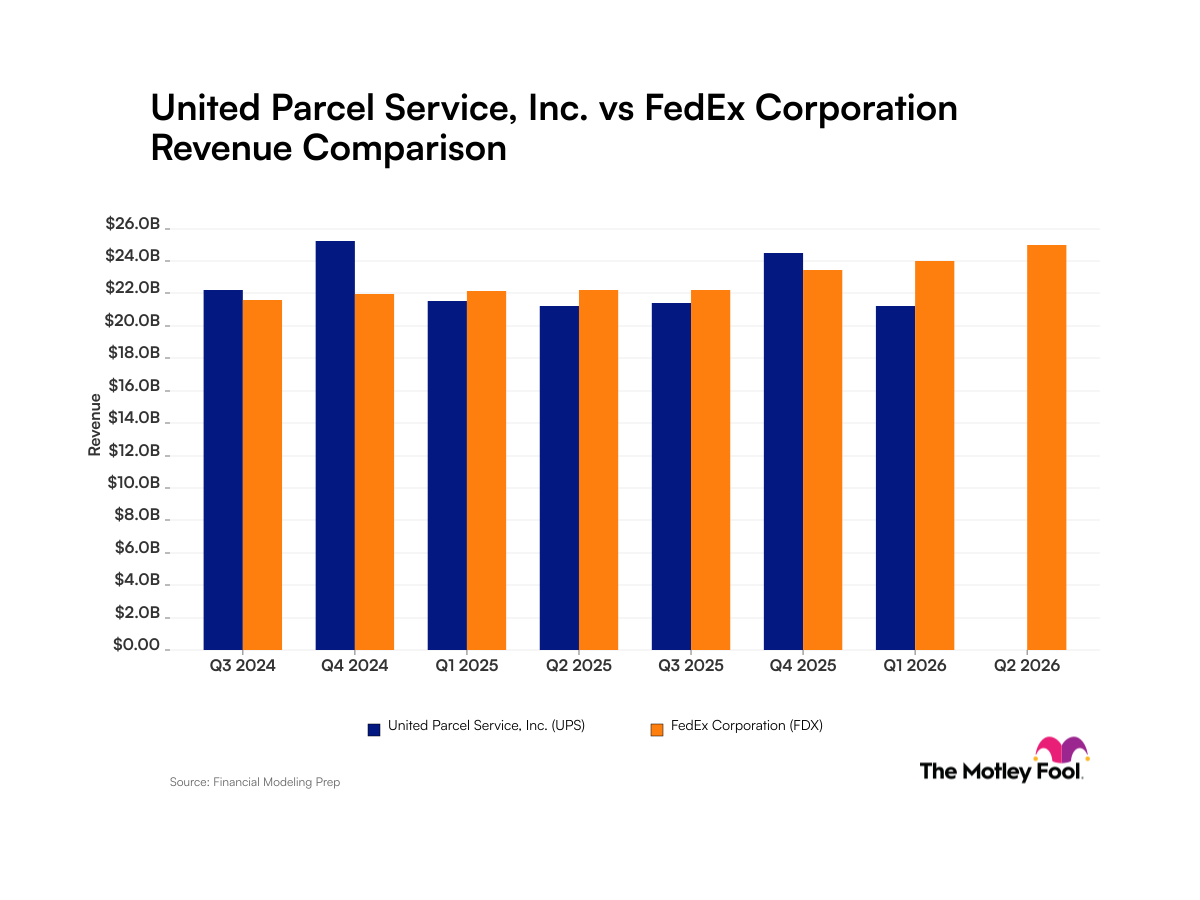
Analysis of Revenue Fluctuations for UPS and FedEx

- UPS Revenue Fluctuations: UPS reported a 4% net income margin for Q1 2026 while planning to close additional distribution centers; despite significant revenue from Amazon, the partnership was cut due to low margins, leading to increased quarterly revenue volatility and impacting overall profitability.
- FedEx Growth Momentum: FedEx achieved $94.7 billion in revenue for the fiscal year ending May 31, 2026, a notable increase from $87.9 billion the previous year, with an expected year-over-year growth of approximately 11% in the next fiscal year, indicating strong competitive positioning and expansion potential.
- Industry Comparison: UPS focuses on margin protection due to higher union costs, limiting revenue growth, while FedEx prioritizes volume growth to expand sales, highlighting significant strategic differences between the two companies.
- Market Dynamics Impact: UPS's revenue fluctuations are closely tied to its strategy of cutting low-margin business, while FedEx's spin-off of its freight division may further drive revenue growth, reflecting differing strategies in responding to market changes.
See More

FedEx vs UPS: Revenue Trends Analysis
- Revenue Growth Comparison: FedEx has consistently achieved revenue growth over the past eight quarters, reporting $94.7 billion for fiscal year 2026, an 8% increase from $87.9 billion the previous year, demonstrating its stable business expansion capabilities.
- UPS Volatile Performance: In contrast, UPS experienced significant quarterly fluctuations during the same period, with a net income margin of 4% for Q1 2026, as it reduced its low-margin partnership with Amazon, leading to unstable revenue and impacting overall profitability.
- Strategic Market Differences: FedEx prioritizes volume growth, expecting approximately 11% year-over-year growth in the next fiscal year, while UPS focuses on margin protection due to higher union costs, limiting its revenue growth potential.
- Investor Considerations: Analysts advise investors to consider the impact of UPS's reduced collaboration with Amazon on its revenue before investing, while FedEx's spin-off of its freight business may further enhance its market share.
See More

Multiple Companies Face Dividend Cut Risks


- Dividend Cut Risks: According to Wolfe Research, several companies are at risk of cutting dividends, particularly those with high debt levels and payout ratios exceeding 80%, which could directly impact income investors' cash flow.
- Whirlpool's Dividend Suspension: Whirlpool announced in May that it would suspend its dividend to pay down debt and navigate what it termed a 'recession-level industry decline,' reflecting the company's strategy under financial pressure, which may affect shareholder confidence.
- PepsiCo's Dividend Increase: Despite increasing its dividend in June, PepsiCo, with a 4.14% yield, appeared on Wolfe's screen, and its second-quarter earnings report is expected this Thursday, with analysts maintaining an optimistic outlook, indicating market confidence in its stability.
- UPS's Turnaround Plan: United Parcel Service (UPS) currently has a 5.95% dividend yield and aims for $3 billion in annual cost savings by 2026; despite challenges, its stock has risen 11% year-to-date, reflecting market recognition of its turnaround efforts.
See More

UPS Invests $48 Million to Upgrade Facilities
- Strategic Investment: UPS plans to invest $48 million in 27 temperature-controlled facilities to meet the growing demand for low-temperature medication transport, particularly GLP-1 weight-loss drugs, highlighting the company's strategic focus on the healthcare sector.
- Business Transformation: Despite a 50% drop in stock price from its 2022 peak, UPS is undergoing a massive business overhaul aimed at enhancing operational efficiency through modernization, although this may lead to short-term revenue declines and increased costs.
- Customer Focus: UPS is shifting from low-margin customers to high-margin ones, particularly in the healthcare sector, which is expected to yield higher profit margins and growth opportunities, reflecting the company's emphasis on future profitability.
- Market Reaction: Although investors remain cautious about UPS's turnaround, resulting in a high 6% dividend yield, the $48 million investment indicates a long-term strategic effort towards growth, potentially leading to a business inflection point in the second half of 2026.
See More
UPS Invests $48 Million in Temperature-Controlled Facilities
- Business Transformation Investment: UPS has announced a $48 million investment in 27 temperature-controlled facilities to meet the rising demand for low-temperature medication transport, particularly GLP-1 weight-loss drugs, thereby enhancing its market share and profit margins in the healthcare sector.
- Customer Focus Strategy: The company is shifting from low-margin high-volume customers to high-margin clients, which has led to a decline in overall revenue; however, revenue per package is increasing, indicating early signs of success, with management projecting a turnaround inflection point in the second half of 2026.
- Market Reaction and Dividends: Despite UPS's stock price dropping 50% from its 2022 peak, its 6% dividend yield reflects investor concerns about the turnaround, while also indicating market expectations for future growth potential.
- Long-term Strategic Significance: By investing in temperature-controlled facilities, UPS is not only enhancing service quality but also laying the groundwork for future growth, particularly in high-margin opportunities within the healthcare sector, signaling a potential shift from business contraction to expansion.
See More

Jim Cramer Increases FedEx Holdings

- Increased Holdings: Jim Cramer's Charitable Trust purchased 130 shares of FedEx shortly after the market opened, raising its total holdings to 230 shares and increasing its portfolio weight from 0.75% to 1.75%, reflecting confidence in FedEx's future performance.
- Earnings Beat: FedEx's latest earnings report exceeded analyst expectations, with both revenue and adjusted earnings per share (EPS) performing well, although management's guidance was complicated by the company's restructuring, impacting investor assessments.
- Future Outlook: FedEx guided for adjusted EPS in the range of $16.90 to $18.10 for calendar year 2026, slightly below some analysts' expectations, yet management anticipates a 20% year-over-year growth during the transition period, showcasing strong business momentum.
- Margin Impact: CEO Raj Subramaniam noted that excluding fuel surcharges would have led to year-over-year margin increases, despite the surcharges negatively affecting profits and making reported results appear softer than their true nature.
See More
Analysis of Revenue Fluctuations for UPS and FedEx
- UPS Revenue Fluctuations: UPS reported a 4% net income margin for Q1 2026 while planning to close additional distribution centers; despite significant revenue from Amazon, the partnership was cut due to low margins, leading to increased quarterly revenue volatility and impacting overall profitability.
- FedEx Growth Momentum: FedEx achieved $94.7 billion in revenue for the fiscal year ending May 31, 2026, a notable increase from $87.9 billion the previous year, with an expected year-over-year growth of approximately 11% in the next fiscal year, indicating strong competitive positioning and expansion potential.
- Industry Comparison: UPS focuses on margin protection due to higher union costs, limiting revenue growth, while FedEx prioritizes volume growth to expand sales, highlighting significant strategic differences between the two companies.
- Market Dynamics Impact: UPS's revenue fluctuations are closely tied to its strategy of cutting low-margin business, while FedEx's spin-off of its freight division may further drive revenue growth, reflecting differing strategies in responding to market changes.
See More
FedEx vs UPS: Revenue Trends Analysis
- Revenue Growth Comparison: FedEx has consistently achieved revenue growth over the past eight quarters, reporting $94.7 billion for fiscal year 2026, an 8% increase from $87.9 billion the previous year, demonstrating its stable business expansion capabilities.
- UPS Volatile Performance: In contrast, UPS experienced significant quarterly fluctuations during the same period, with a net income margin of 4% for Q1 2026, as it reduced its low-margin partnership with Amazon, leading to unstable revenue and impacting overall profitability.
- Strategic Market Differences: FedEx prioritizes volume growth, expecting approximately 11% year-over-year growth in the next fiscal year, while UPS focuses on margin protection due to higher union costs, limiting its revenue growth potential.
- Investor Considerations: Analysts advise investors to consider the impact of UPS's reduced collaboration with Amazon on its revenue before investing, while FedEx's spin-off of its freight business may further enhance its market share.
See More
Multiple Companies Face Dividend Cut Risks
- Dividend Cut Risks: According to Wolfe Research, several companies are at risk of cutting dividends, particularly those with high debt levels and payout ratios exceeding 80%, which could directly impact income investors' cash flow.
- Whirlpool's Dividend Suspension: Whirlpool announced in May that it would suspend its dividend to pay down debt and navigate what it termed a 'recession-level industry decline,' reflecting the company's strategy under financial pressure, which may affect shareholder confidence.
- PepsiCo's Dividend Increase: Despite increasing its dividend in June, PepsiCo, with a 4.14% yield, appeared on Wolfe's screen, and its second-quarter earnings report is expected this Thursday, with analysts maintaining an optimistic outlook, indicating market confidence in its stability.
- UPS's Turnaround Plan: United Parcel Service (UPS) currently has a 5.95% dividend yield and aims for $3 billion in annual cost savings by 2026; despite challenges, its stock has risen 11% year-to-date, reflecting market recognition of its turnaround efforts.
See More
UPS Invests $48 Million to Upgrade Facilities
- Strategic Investment: UPS plans to invest $48 million in 27 temperature-controlled facilities to meet the growing demand for low-temperature medication transport, particularly GLP-1 weight-loss drugs, highlighting the company's strategic focus on the healthcare sector.
- Business Transformation: Despite a 50% drop in stock price from its 2022 peak, UPS is undergoing a massive business overhaul aimed at enhancing operational efficiency through modernization, although this may lead to short-term revenue declines and increased costs.
- Customer Focus: UPS is shifting from low-margin customers to high-margin ones, particularly in the healthcare sector, which is expected to yield higher profit margins and growth opportunities, reflecting the company's emphasis on future profitability.
- Market Reaction: Although investors remain cautious about UPS's turnaround, resulting in a high 6% dividend yield, the $48 million investment indicates a long-term strategic effort towards growth, potentially leading to a business inflection point in the second half of 2026.
See More
UPS Invests $48 Million in Temperature-Controlled Facilities
- Business Transformation Investment: UPS has announced a $48 million investment in 27 temperature-controlled facilities to meet the rising demand for low-temperature medication transport, particularly GLP-1 weight-loss drugs, thereby enhancing its market share and profit margins in the healthcare sector.
- Customer Focus Strategy: The company is shifting from low-margin high-volume customers to high-margin clients, which has led to a decline in overall revenue; however, revenue per package is increasing, indicating early signs of success, with management projecting a turnaround inflection point in the second half of 2026.
- Market Reaction and Dividends: Despite UPS's stock price dropping 50% from its 2022 peak, its 6% dividend yield reflects investor concerns about the turnaround, while also indicating market expectations for future growth potential.
- Long-term Strategic Significance: By investing in temperature-controlled facilities, UPS is not only enhancing service quality but also laying the groundwork for future growth, particularly in high-margin opportunities within the healthcare sector, signaling a potential shift from business contraction to expansion.
See More
Jim Cramer Increases FedEx Holdings
- Increased Holdings: Jim Cramer's Charitable Trust purchased 130 shares of FedEx shortly after the market opened, raising its total holdings to 230 shares and increasing its portfolio weight from 0.75% to 1.75%, reflecting confidence in FedEx's future performance.
- Earnings Beat: FedEx's latest earnings report exceeded analyst expectations, with both revenue and adjusted earnings per share (EPS) performing well, although management's guidance was complicated by the company's restructuring, impacting investor assessments.
- Future Outlook: FedEx guided for adjusted EPS in the range of $16.90 to $18.10 for calendar year 2026, slightly below some analysts' expectations, yet management anticipates a 20% year-over-year growth during the transition period, showcasing strong business momentum.
- Margin Impact: CEO Raj Subramaniam noted that excluding fuel surcharges would have led to year-over-year margin increases, despite the surcharges negatively affecting profits and making reported results appear softer than their true nature.
See More