Nvidia Launches Open-Source Quantum AI Model Ising
Written by Emily J. Thompson, Senior Investment Analyst
Updated: Apr 14 2026
0mins
Source: seekingalpha
- Quantum Computing Model Launch: Nvidia has introduced the Ising series of open-source AI models aimed at enhancing quantum computing capabilities, marking the company's innovative leadership in the quantum computing sector and is expected to drive rapid market growth.
- AI and Quantum Integration: Founder Jensen Huang stated that AI will serve as the operating system for quantum machines, transforming fragile qubits into scalable quantum-GPU systems through the Ising model, significantly enhancing the practicality of quantum computing.
- Automated Calibration Technology: The Ising Calibration model can rapidly interpret measurements from quantum processors, reducing calibration time from days to hours, thereby improving the efficiency and reliability of quantum computing, attracting interest from numerous enterprises and academic institutions.
- Broad Market Prospects: Nvidia anticipates that the quantum computing market will exceed $11 billion by 2030, and with the launch of the Ising model, the company's strategic positioning in this emerging field will provide strong momentum for future growth.
Trade with 70% Backtested Accuracy
Stop guessing "Should I Buy NVDA?" and start using high-conviction signals backed by rigorous historical data.
Sign up today to access powerful investing tools and make smarter, data-driven decisions.
Analyst Views on NVDA
Wall Street analysts forecast NVDA stock price to rise
41 Analyst Rating
39 Buy
1 Hold
1 Sell
Strong Buy
Current: 204.650

Low
200.00
Averages
264.97
High
352.00
Current: 204.650
Low
200.00
Averages
264.97
High
352.00
About NVDA
NVIDIA Corporation is an artificial intelligence (AI) infrastructure company. The Company is engaged in accelerated computing to help solve the challenging computational problems. Its segments include Compute & Networking and Graphics. The Compute & Networking segment includes its Data Center accelerated computing and networking platforms and AI solutions and software, and automotive platforms and autonomous and electric vehicle solutions, including software. The Graphics segment includes GeForce GPUs for gaming and personal computers (PCs), and Quadro/NVIDIA RTX GPUs for enterprise workstation graphics. Its technology stack includes the foundational NVIDIA CUDA development platform that runs on all NVIDIA GPUs, as well as hundreds of domain-specific software libraries, frameworks, algorithms, software development kits (SDKs), and application programming interfaces (APIs). Its platforms address four markets, which include Data Center, Gaming, Professional Visualization, and Automotive.
About the author

Emily J. Thompson
Emily J. Thompson, a Chartered Financial Analyst (CFA) with 12 years in investment research, graduated with honors from the Wharton School. Specializing in industrial and technology stocks, she provides in-depth analysis for Intellectia’s earnings and market brief reports.
Nvidia Launches Vera CPU Platform, Tapping into $200 Billion Market

- Market Opportunity Expansion: Nvidia's newly launched Vera CPU platform is purpose-built for emerging agentic AI technology, expected to unlock a $200 billion market, significantly enhancing its competitive position in AI infrastructure.
- Comprehensive Product Offering: The Vera CPU, combined with Nvidia's GPUs, networking, and CUDA software, creates a complete ecosystem that allows the company to capture incremental value from each AI deployment, thereby increasing customer loyalty.
- Optimistic Revenue Projections: CFO Colette Kress stated that total CPU revenue is expected to reach nearly $20 billion this year, indicating that the Vera CPU is already being viewed as a strong alternative for AI infrastructure build-outs.
- Accelerated Strategic Transformation: The introduction of the Vera CPU marks Nvidia's evolution from a GPU supplier to a full-stack AI infrastructure provider, enhancing its market share and customer attachment rates in AI data centers.
See More

Nvidia Plans to Raise $20 Billion in Debt Market
- Large Financing Plan: Nvidia is planning to raise approximately $20 billion through the debt market, indicating the company's confidence in future growth and potentially supporting its expansion in AI and data center sectors.
- Positive Market Reaction: Nvidia's stock showed stability during afternoon trading on June 15, 2026, suggesting investor approval of the financing plan, which may further drive stock price appreciation.
- Diverse Use of Funds: The proceeds from this financing are expected to be allocated towards R&D, acquisitions, and infrastructure investments, aimed at strengthening the company's position in the competitive semiconductor market and enhancing long-term profitability.
- Strategic Implications: By raising funds, Nvidia can accelerate technological innovation and maintain a competitive edge in a rapidly changing market environment, further solidifying its market share in AI and high-performance computing.
See More
Nvidia's Bullish Outlook on Marvell's Future Potential
- Market Outlook: Nvidia CEO Jensen Huang asserts that Marvell could become the next trillion-dollar company, and while its current market cap is $270 billion, achieving this milestone would yield substantial returns for investors.
- Stock Surge: Since Huang's comments in early June, Marvell's stock has skyrocketed over 40%, prompting investors to consider whether this surge has fully captured the stock's near-term upside potential.
- Product Line Competition: Marvell's networking hardware and ASIC products are gaining traction in the AI sector, and while Nvidia's endorsement enhances Marvell's market position, it also poses a direct competitive threat to Nvidia's core business.
- Financial Performance Analysis: Marvell's revenue grew 28% year-over-year in Q1, which, although strong, is slow for the AI industry; however, projected growth rates of 41% for 2026 raise questions about its current forward P/E ratio of 76 being justified.
See More
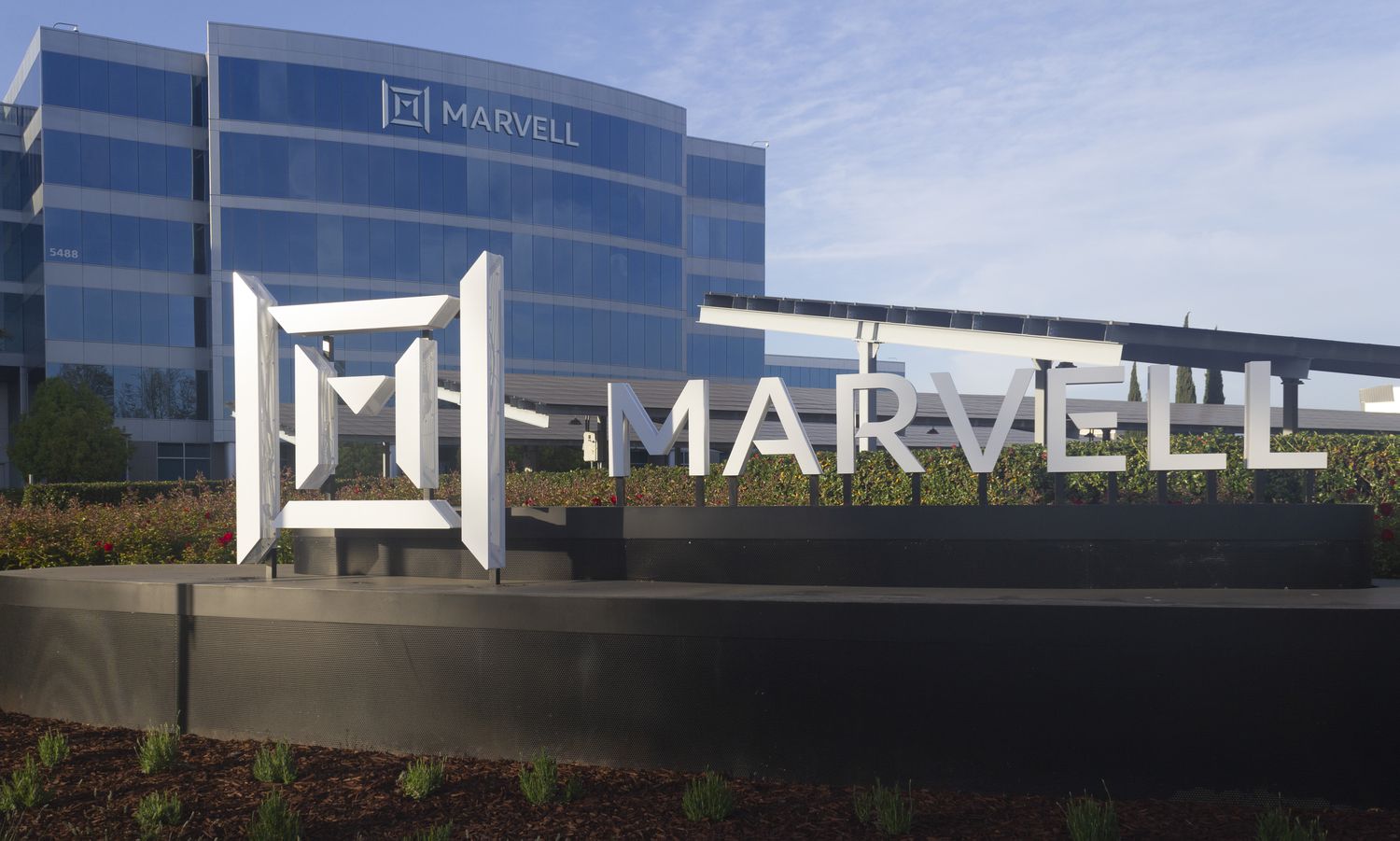
Marvell and Nvidia Partnership Shows Promising Growth Potential
- Optimistic Market Outlook: Nvidia CEO Jensen Huang expressed strong optimism about Marvell's future, suggesting it could become the next trillion-dollar company, despite its current market cap of $270 billion, indicating high market expectations for its growth.
- Stock Surge: Following Huang's positive remarks in early June, Marvell's stock has skyrocketed over 40%, reflecting investor confidence in its future growth, yet raising questions about whether the stock's near-term upside has been fully realized.
- Product Line Strength: Marvell's networking and connectivity hardware, along with its ASIC designs, are gaining attention from AI investors, as Nvidia ensures compatibility with Marvell's solutions, highlighting potential collaboration in data centers while also hinting at competitive threats to Nvidia.
- Growth Expectations: Although Marvell's revenue rose 28% year-over-year in Q1, this growth rate appears slow for the AI sector, with projections of 41% revenue growth in 2026 and 45% in 2027, suggesting that its future growth potential still requires further validation.
See More

MACOM Technology Solutions Sees Strong Growth


- Earnings Surge: MACOM reported quarterly revenue of $289 million, reflecting a 9% sequential increase and a 22% year-over-year growth, indicating robust demand in the data center and industrial defense sectors, thereby solidifying its market position.
- Guidance Upgrade: Management raised the annual growth outlook for the data center segment from 35%-40% to over 60%, with Q3 revenue guidance set between $331 million and $339 million, significantly above the $299.81 million consensus, highlighting strong market demand and future growth potential.
- Strong Orders: The reported 1.5x book-to-bill ratio indicates that for every $1 of product shipped, MACOM secured $1.50 in new orders, demonstrating that demand is far outpacing current sales and signaling strong visibility into future revenue growth.
- Optimistic Market Outlook: With the acceleration of AI data center construction, demand for MACOM's connectivity components is surging, and the company expects overall revenue growth of approximately 30%, further reinforcing its leadership in high-tech military equipment and cloud computing sectors.
See More

Stocks Rebound, Intel Shares Hit All-Time High

- Market Rebound: Stocks rose on Thursday as the Federal Reserve hinted at a possible rate hike this year, leading to a market rebound, with technology stocks leading the charge and the semiconductor ETF gaining over 6%, reflecting strong investor confidence in tech.
- Intel's Stock Surge: Intel shares jumped 8% to an all-time high on Thursday after President Trump announced that Apple would collaborate with the chipmaker to design and manufacture chips, which, although unconfirmed by Intel, bolstered market confidence in the company's turnaround strategy.
- Qnity's Strong Performance: Qnity's stock rose 7% on Thursday, extending its gains to over 100% this year, as investors increasingly recognize the company's role in enhancing semiconductor performance through advanced materials technology, suggesting further valuation expansion as it gains tech analyst coverage.
- Rapid Fire Recap: Stocks mentioned in Thursday's rapid-fire segment included FedEx, Pfizer, Accenture, and Salesforce, indicating a diversified investment focus, with Jim Cramer's charitable trust holding positions in AAPL, INTC, NVDA, and Q.
See More
Nvidia Launches Vera CPU Platform, Tapping into $200 Billion Market
- Market Opportunity Expansion: Nvidia's newly launched Vera CPU platform is purpose-built for emerging agentic AI technology, expected to unlock a $200 billion market, significantly enhancing its competitive position in AI infrastructure.
- Comprehensive Product Offering: The Vera CPU, combined with Nvidia's GPUs, networking, and CUDA software, creates a complete ecosystem that allows the company to capture incremental value from each AI deployment, thereby increasing customer loyalty.
- Optimistic Revenue Projections: CFO Colette Kress stated that total CPU revenue is expected to reach nearly $20 billion this year, indicating that the Vera CPU is already being viewed as a strong alternative for AI infrastructure build-outs.
- Accelerated Strategic Transformation: The introduction of the Vera CPU marks Nvidia's evolution from a GPU supplier to a full-stack AI infrastructure provider, enhancing its market share and customer attachment rates in AI data centers.
See More
Nvidia Plans to Raise $20 Billion in Debt Market
- Large Financing Plan: Nvidia is planning to raise approximately $20 billion through the debt market, indicating the company's confidence in future growth and potentially supporting its expansion in AI and data center sectors.
- Positive Market Reaction: Nvidia's stock showed stability during afternoon trading on June 15, 2026, suggesting investor approval of the financing plan, which may further drive stock price appreciation.
- Diverse Use of Funds: The proceeds from this financing are expected to be allocated towards R&D, acquisitions, and infrastructure investments, aimed at strengthening the company's position in the competitive semiconductor market and enhancing long-term profitability.
- Strategic Implications: By raising funds, Nvidia can accelerate technological innovation and maintain a competitive edge in a rapidly changing market environment, further solidifying its market share in AI and high-performance computing.
See More
Nvidia's Bullish Outlook on Marvell's Future Potential
- Market Outlook: Nvidia CEO Jensen Huang asserts that Marvell could become the next trillion-dollar company, and while its current market cap is $270 billion, achieving this milestone would yield substantial returns for investors.
- Stock Surge: Since Huang's comments in early June, Marvell's stock has skyrocketed over 40%, prompting investors to consider whether this surge has fully captured the stock's near-term upside potential.
- Product Line Competition: Marvell's networking hardware and ASIC products are gaining traction in the AI sector, and while Nvidia's endorsement enhances Marvell's market position, it also poses a direct competitive threat to Nvidia's core business.
- Financial Performance Analysis: Marvell's revenue grew 28% year-over-year in Q1, which, although strong, is slow for the AI industry; however, projected growth rates of 41% for 2026 raise questions about its current forward P/E ratio of 76 being justified.
See More
Marvell and Nvidia Partnership Shows Promising Growth Potential
- Optimistic Market Outlook: Nvidia CEO Jensen Huang expressed strong optimism about Marvell's future, suggesting it could become the next trillion-dollar company, despite its current market cap of $270 billion, indicating high market expectations for its growth.
- Stock Surge: Following Huang's positive remarks in early June, Marvell's stock has skyrocketed over 40%, reflecting investor confidence in its future growth, yet raising questions about whether the stock's near-term upside has been fully realized.
- Product Line Strength: Marvell's networking and connectivity hardware, along with its ASIC designs, are gaining attention from AI investors, as Nvidia ensures compatibility with Marvell's solutions, highlighting potential collaboration in data centers while also hinting at competitive threats to Nvidia.
- Growth Expectations: Although Marvell's revenue rose 28% year-over-year in Q1, this growth rate appears slow for the AI sector, with projections of 41% revenue growth in 2026 and 45% in 2027, suggesting that its future growth potential still requires further validation.
See More
MACOM Technology Solutions Sees Strong Growth
- Earnings Surge: MACOM reported quarterly revenue of $289 million, reflecting a 9% sequential increase and a 22% year-over-year growth, indicating robust demand in the data center and industrial defense sectors, thereby solidifying its market position.
- Guidance Upgrade: Management raised the annual growth outlook for the data center segment from 35%-40% to over 60%, with Q3 revenue guidance set between $331 million and $339 million, significantly above the $299.81 million consensus, highlighting strong market demand and future growth potential.
- Strong Orders: The reported 1.5x book-to-bill ratio indicates that for every $1 of product shipped, MACOM secured $1.50 in new orders, demonstrating that demand is far outpacing current sales and signaling strong visibility into future revenue growth.
- Optimistic Market Outlook: With the acceleration of AI data center construction, demand for MACOM's connectivity components is surging, and the company expects overall revenue growth of approximately 30%, further reinforcing its leadership in high-tech military equipment and cloud computing sectors.
See More
Stocks Rebound, Intel Shares Hit All-Time High
- Market Rebound: Stocks rose on Thursday as the Federal Reserve hinted at a possible rate hike this year, leading to a market rebound, with technology stocks leading the charge and the semiconductor ETF gaining over 6%, reflecting strong investor confidence in tech.
- Intel's Stock Surge: Intel shares jumped 8% to an all-time high on Thursday after President Trump announced that Apple would collaborate with the chipmaker to design and manufacture chips, which, although unconfirmed by Intel, bolstered market confidence in the company's turnaround strategy.
- Qnity's Strong Performance: Qnity's stock rose 7% on Thursday, extending its gains to over 100% this year, as investors increasingly recognize the company's role in enhancing semiconductor performance through advanced materials technology, suggesting further valuation expansion as it gains tech analyst coverage.
- Rapid Fire Recap: Stocks mentioned in Thursday's rapid-fire segment included FedEx, Pfizer, Accenture, and Salesforce, indicating a diversified investment focus, with Jim Cramer's charitable trust holding positions in AAPL, INTC, NVDA, and Q.
See More