Serve Robotics Uplists to Nasdaq, Poised for Significant Growth
Written by Emily J. Thompson, Senior Investment Analyst
Updated: 3 days ago
0mins
Should l Buy SERV?
Source: Fool
- Successful Uplisting: Serve Robotics successfully uplisted from the OTC market to Nasdaq on April 18, 2024, with an IPO price of $4.00 per share and an opening price of $4.75, indicating strong market confidence in its future development.
- Stock Price Surge: Although currently trading around $9, the stock reached an all-time high of $22.92 on December 26, 2024, reflecting optimistic expectations from investors regarding its long-term growth potential.
- Robot Fleet Expansion: Serve operated approximately 100 robots in 2024 but is expected to expand its fleet to 2,000 robots by 2025, primarily delivering to Uber Eats and DoorDash, showcasing rapid growth in the food delivery market.
- Revenue Growth: Serve's revenue skyrocketed from $2.7 million in 2024 to $25.9 million in 2025, with projections to reach $131.5 million by 2028, indicating strong growth potential in the rapidly expanding delivery robot market.
Trade with 70% Backtested Accuracy
Stop guessing "Should I Buy SERV?" and start using high-conviction signals backed by rigorous historical data.
Sign up today to access powerful investing tools and make smarter, data-driven decisions.
Analyst Views on SERV
Wall Street analysts forecast SERV stock price to rise
5 Analyst Rating
5 Buy
0 Hold
0 Sell
Strong Buy
Current: 9.080

Low
15.00
Averages
20.00
High
26.00
Current: 9.080
Low
15.00
Averages
20.00
High
26.00
About SERV
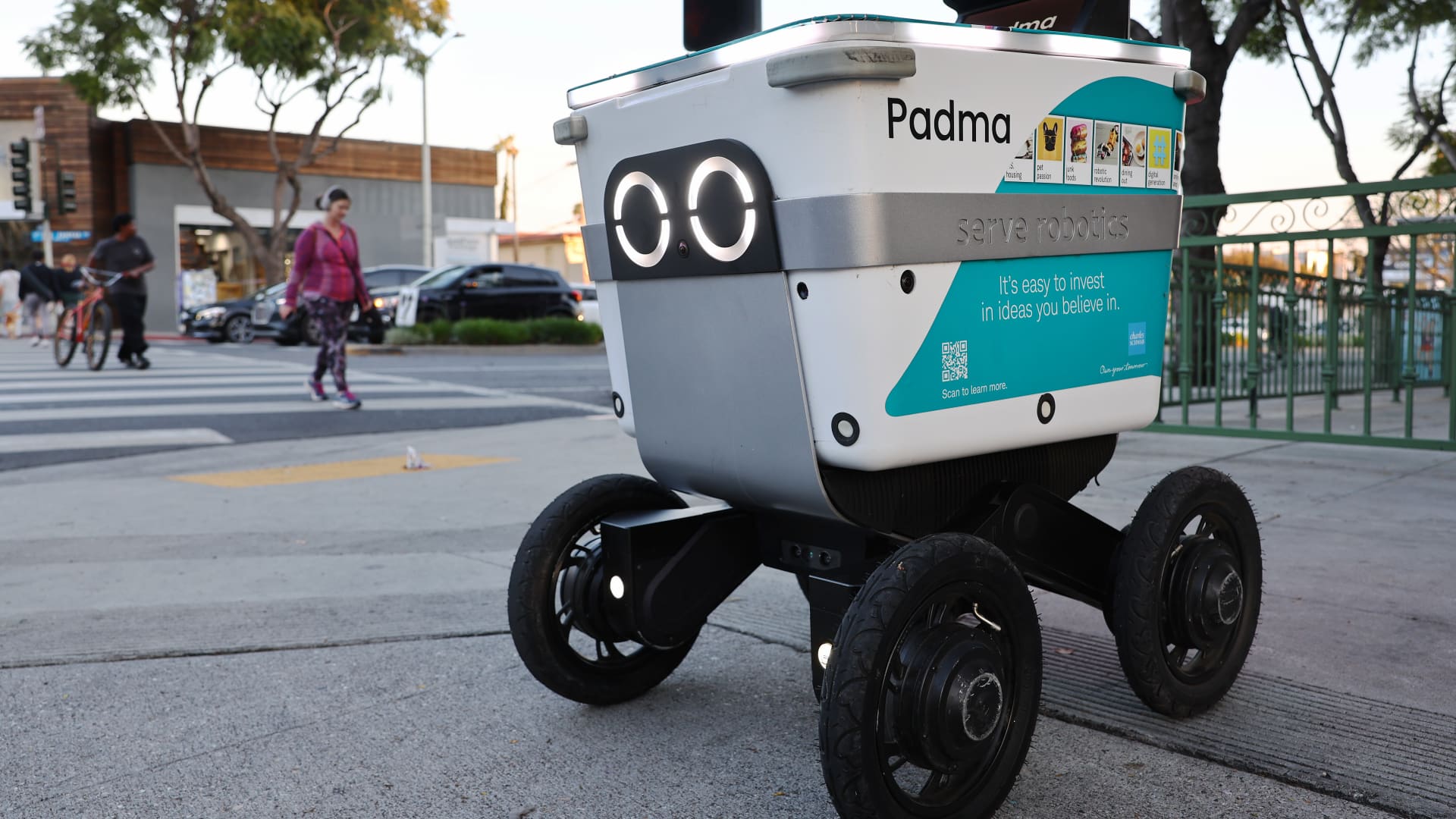
Serve Robotics, Inc. is engaged in developing next generation robots for last-mile delivery services. The Company designs, develops and operates low-emission robots on its artificial intelligence (AI)-powered robotics mobility platform that serves people in public spaces, starting with food delivery. The Company’s fleet consists of over 100 robots. It has platform-level integrations with Uber Eats, which allows serve robots to provide real-time presence and status updates on those platforms and receive requests to perform deliveries with respect to customer orders placed on those platforms as needed. Its capabilities include automatic emergency braking, vehicle collision avoidance, and fail-safe mechanical braking. It uses AI methodologies to design, train and deploy a host of models on serve robots and these models are used to perform a variety of tasks, including identification of sidewalk surfaces, intersections, traffic signals, obstacles, pedestrians and vehicles, and others.
About the author

Emily J. Thompson
Emily J. Thompson, a Chartered Financial Analyst (CFA) with 12 years in investment research, graduated with honors from the Wharton School. Specializing in industrial and technology stocks, she provides in-depth analysis for Intellectia’s earnings and market brief reports.

Serve Robotics Faces Stock Price Pressure Amid Growth Potential

- Poor Market Performance: Serve Robotics' stock has fallen nearly 13% in 2026 trading and is down approximately 49% from its 52-week high, indicating market concerns about its future growth and potentially impacting investor confidence.
- Sales Growth Potential: Despite posting only about $2.7 million in sales last year, Serve Robotics has a market capitalization of roughly $688 million, reflecting market expectations for rapid sales growth and highlighting investor interest in automation and AI trends.
- Future Sales Guidance: The company is guiding for sales of approximately $26 million this year, which still appears relatively small in the context of its valuation, but supports expectations for a rapid revenue ramp, indicating that the company is still in the early stages of expansion.
- High-Risk Investment: Serve Robotics is viewed as a speculative, high-risk bet; while it may not suit a substantial subset of investors, it could be a worthwhile opportunity for those willing to embrace high levels of risk and uncertainty in hopes of benefiting from automation and AI trends.
See More

Serve Robotics Uplists to Nasdaq, Poised for Significant Growth

- Successful Uplisting: Serve Robotics successfully uplisted from the OTC market to Nasdaq on April 18, 2024, with an IPO price of $4.00 per share and an opening price of $4.75, indicating strong market confidence in its future development.
- Stock Price Surge: Although currently trading around $9, the stock reached an all-time high of $22.92 on December 26, 2024, reflecting optimistic expectations from investors regarding its long-term growth potential.
- Robot Fleet Expansion: Serve operated approximately 100 robots in 2024 but is expected to expand its fleet to 2,000 robots by 2025, primarily delivering to Uber Eats and DoorDash, showcasing rapid growth in the food delivery market.
- Revenue Growth: Serve's revenue skyrocketed from $2.7 million in 2024 to $25.9 million in 2025, with projections to reach $131.5 million by 2028, indicating strong growth potential in the rapidly expanding delivery robot market.
See More

Market Competition Analysis of Uber and DoorDash

- Uber User Base: Over 200 million people use Uber's platform monthly for ride-hailing, food delivery, and freight services, indicating its strong market presence, with future growth likely driven by autonomous technology advancements.
- DoorDash Market Share: DoorDash holds over 60% market share in the U.S. food delivery sector and has expanded into over 40 countries, showcasing its robust growth and diversification strategy in the global market.
- Investment in Autonomous Technology: Uber has signed agreements with over 20 companies to develop self-driving vehicles, which could significantly reduce its $85.4 billion driver expenses, thereby boosting revenue and profitability while enhancing competitive positioning.
- Financial Performance Comparison: In 2025, Uber reported total revenue of $52 billion, while DoorDash generated $13.7 billion; despite DoorDash's higher growth rate, Uber's potential in the autonomous sector makes it a more attractive long-term investment.
See More

Uber vs. DoorDash: Future Competition in Autonomous Delivery
- Uber's Market Potential: With over 200 million users monthly, Uber achieved a record $193.4 billion in gross bookings in 2025, and despite paying out $85.4 billion to drivers, the deployment of autonomous technology could significantly boost its revenue and profits, further solidifying its market leadership.
- Strategic Importance of Autonomy: By signing agreements with over 20 self-driving companies, Uber aims to enhance operational efficiency and provide 24/7 service, potentially capturing more bookings and driving long-term growth by reducing reliance on human drivers.
- DoorDash's Market Advantage: Dominating over 60% of the U.S. food delivery market, DoorDash generated $13.7 billion in total revenue in 2025, up 28% year-over-year, and the launch of its self-driving robot Dot is expected to further reduce operational costs.
- Financial Performance Comparison: DoorDash reported a net income of $935 million, a staggering 660% increase, while Uber's price-to-sales ratio stands at 3.2, significantly lower than DoorDash's 5.4, indicating Uber's greater potential in the future autonomous market and a more attractive valuation.
See More
AI Sparks Potential Blue-Collar Renaissance Amid Job Disruption Fears


- Blue-Collar Employment Revival: Oppenheimer analysts suggest that while AI may rapidly displace white-collar jobs, it could simultaneously drive demand for blue-collar roles, particularly in manufacturing, with employment projected to remain below pre-pandemic levels by 2026.
- Investment Theme Analysis: Oppenheimer outlined five investable themes, including the physical-to-digital connection, emphasizing the value of sensors and data pipelines, with companies in this space expected to benefit from automation trends, including Aeva Technologies and Tesla.
- Automation Tools Opportunity: The analysts identified automation tools that can reskill transitioning workforces, recommending companies like Caterpillar and Rockwell Automation, which enhance worksite experiences through task automation and AI agents.
- Autonomous Systems Development: Oppenheimer also highlighted companies supporting autonomous physical systems, such as Mobileye Global and Aurora Innovation, noting that as fully autonomous solutions are commercialized, human roles will still be essential for remote monitoring and maintenance to ensure safety and problem resolution.
See More

Serve Robotics Poised for Major Growth in Delivery Market

- Significant Market Potential: Serve Robotics predicts that the last-mile logistics market will reach $450 billion by 2030, indicating the strategic importance of its positioning in the robotic delivery sector.
- Rapid Robot Deployment: So far, Serve has deployed 2,000 of its latest Gen 3 robots within the Uber Eats and DoorDash networks, covering 110 neighborhoods across 20 major U.S. cities, showcasing its ability to expand quickly.
- Financial Performance Fluctuations: Although revenue reached $2.65 million in 2025, a 46% increase, the company still faced a net loss of $101 million, highlighting challenges in cost management during its expansion phase.
- Optimistic Future Outlook: Serve anticipates revenue growth to $26 million in 2026, which would lower its price-to-sales ratio to 25, indicating long-term investment potential, but short-term market volatility remains a concern.
See More
Serve Robotics Faces Stock Price Pressure Amid Growth Potential
- Poor Market Performance: Serve Robotics' stock has fallen nearly 13% in 2026 trading and is down approximately 49% from its 52-week high, indicating market concerns about its future growth and potentially impacting investor confidence.
- Sales Growth Potential: Despite posting only about $2.7 million in sales last year, Serve Robotics has a market capitalization of roughly $688 million, reflecting market expectations for rapid sales growth and highlighting investor interest in automation and AI trends.
- Future Sales Guidance: The company is guiding for sales of approximately $26 million this year, which still appears relatively small in the context of its valuation, but supports expectations for a rapid revenue ramp, indicating that the company is still in the early stages of expansion.
- High-Risk Investment: Serve Robotics is viewed as a speculative, high-risk bet; while it may not suit a substantial subset of investors, it could be a worthwhile opportunity for those willing to embrace high levels of risk and uncertainty in hopes of benefiting from automation and AI trends.
See More
Serve Robotics Uplists to Nasdaq, Poised for Significant Growth
- Successful Uplisting: Serve Robotics successfully uplisted from the OTC market to Nasdaq on April 18, 2024, with an IPO price of $4.00 per share and an opening price of $4.75, indicating strong market confidence in its future development.
- Stock Price Surge: Although currently trading around $9, the stock reached an all-time high of $22.92 on December 26, 2024, reflecting optimistic expectations from investors regarding its long-term growth potential.
- Robot Fleet Expansion: Serve operated approximately 100 robots in 2024 but is expected to expand its fleet to 2,000 robots by 2025, primarily delivering to Uber Eats and DoorDash, showcasing rapid growth in the food delivery market.
- Revenue Growth: Serve's revenue skyrocketed from $2.7 million in 2024 to $25.9 million in 2025, with projections to reach $131.5 million by 2028, indicating strong growth potential in the rapidly expanding delivery robot market.
See More
Market Competition Analysis of Uber and DoorDash
- Uber User Base: Over 200 million people use Uber's platform monthly for ride-hailing, food delivery, and freight services, indicating its strong market presence, with future growth likely driven by autonomous technology advancements.
- DoorDash Market Share: DoorDash holds over 60% market share in the U.S. food delivery sector and has expanded into over 40 countries, showcasing its robust growth and diversification strategy in the global market.
- Investment in Autonomous Technology: Uber has signed agreements with over 20 companies to develop self-driving vehicles, which could significantly reduce its $85.4 billion driver expenses, thereby boosting revenue and profitability while enhancing competitive positioning.
- Financial Performance Comparison: In 2025, Uber reported total revenue of $52 billion, while DoorDash generated $13.7 billion; despite DoorDash's higher growth rate, Uber's potential in the autonomous sector makes it a more attractive long-term investment.
See More
Uber vs. DoorDash: Future Competition in Autonomous Delivery
- Uber's Market Potential: With over 200 million users monthly, Uber achieved a record $193.4 billion in gross bookings in 2025, and despite paying out $85.4 billion to drivers, the deployment of autonomous technology could significantly boost its revenue and profits, further solidifying its market leadership.
- Strategic Importance of Autonomy: By signing agreements with over 20 self-driving companies, Uber aims to enhance operational efficiency and provide 24/7 service, potentially capturing more bookings and driving long-term growth by reducing reliance on human drivers.
- DoorDash's Market Advantage: Dominating over 60% of the U.S. food delivery market, DoorDash generated $13.7 billion in total revenue in 2025, up 28% year-over-year, and the launch of its self-driving robot Dot is expected to further reduce operational costs.
- Financial Performance Comparison: DoorDash reported a net income of $935 million, a staggering 660% increase, while Uber's price-to-sales ratio stands at 3.2, significantly lower than DoorDash's 5.4, indicating Uber's greater potential in the future autonomous market and a more attractive valuation.
See More
AI Sparks Potential Blue-Collar Renaissance Amid Job Disruption Fears
- Blue-Collar Employment Revival: Oppenheimer analysts suggest that while AI may rapidly displace white-collar jobs, it could simultaneously drive demand for blue-collar roles, particularly in manufacturing, with employment projected to remain below pre-pandemic levels by 2026.
- Investment Theme Analysis: Oppenheimer outlined five investable themes, including the physical-to-digital connection, emphasizing the value of sensors and data pipelines, with companies in this space expected to benefit from automation trends, including Aeva Technologies and Tesla.
- Automation Tools Opportunity: The analysts identified automation tools that can reskill transitioning workforces, recommending companies like Caterpillar and Rockwell Automation, which enhance worksite experiences through task automation and AI agents.
- Autonomous Systems Development: Oppenheimer also highlighted companies supporting autonomous physical systems, such as Mobileye Global and Aurora Innovation, noting that as fully autonomous solutions are commercialized, human roles will still be essential for remote monitoring and maintenance to ensure safety and problem resolution.
See More
Serve Robotics Poised for Major Growth in Delivery Market
- Significant Market Potential: Serve Robotics predicts that the last-mile logistics market will reach $450 billion by 2030, indicating the strategic importance of its positioning in the robotic delivery sector.
- Rapid Robot Deployment: So far, Serve has deployed 2,000 of its latest Gen 3 robots within the Uber Eats and DoorDash networks, covering 110 neighborhoods across 20 major U.S. cities, showcasing its ability to expand quickly.
- Financial Performance Fluctuations: Although revenue reached $2.65 million in 2025, a 46% increase, the company still faced a net loss of $101 million, highlighting challenges in cost management during its expansion phase.
- Optimistic Future Outlook: Serve anticipates revenue growth to $26 million in 2026, which would lower its price-to-sales ratio to 25, indicating long-term investment potential, but short-term market volatility remains a concern.
See More