Samsung Smart Glasses Set to Launch, Challenging Market Leader
Written by Emily J. Thompson, Senior Investment Analyst
Updated: Mar 06 2026
0mins


Source: CNBC
- Market Competition Intensifies: Samsung's upcoming smart glasses will feature an 'eye-level' camera and connect to smartphones, aiming to challenge Meta's Ray-Ban glasses, which hold an 82% global market share, showcasing Samsung's ambition in the wearable tech space.
- Deepening Tech Collaboration: Since 2023, Samsung has partnered with Qualcomm and Google to develop the operating system and hardware for mixed-reality technology, with the Galaxy XR headset launched last year, indicating ongoing investment and innovation in the XR sector.
- AI Applications Drive Demand: The advancement of AI applications like Google Gemini and ChatGPT has further fueled the market potential for smart glasses, as device makers explore user interaction with AI assistants through glasses, enhancing user experience and functionality.
- Clear Industry Goals: Samsung executives stated the aim to launch industry-targeted smart glasses this year, reflecting the company's focus on the smart glasses market and its keen insight into future technology trends.
Trade with 70% Backtested Accuracy
Stop guessing "Should I Buy QCOM?" and start using high-conviction signals backed by rigorous historical data.
Sign up today to access powerful investing tools and make smarter, data-driven decisions.
Analyst Views on QCOM
Wall Street analysts forecast QCOM stock price to fall
16 Analyst Rating
10 Buy
5 Hold
1 Sell
Moderate Buy
Current: 213.410

Low
165.00
Averages
197.14
High
225.00
Current: 213.410
Low
165.00
Averages
197.14
High
225.00
About QCOM
Qualcomm Incorporated is engaged in the development and commercialization of foundational technologies for the wireless industry, including third generation (3G), fourth generation (4G) and fifth generation (5G) wireless connectivity, and high-performance and low-power computing, including on-device artificial intelligence. Its segments include Qualcomm CDMA Technologies (QCT), Qualcomm Technology Licensing (QTL) and Qualcomm Strategic Initiatives. QCT develops and supplies integrated circuits and system software based on 3G/4G/5G and other technologies, including radio frequency front-end, digital cockpit and advanced driver assistance and automated driving, Internet of things including consumer electronic devices, industrial devices and edge networking products. QTL grants licenses or otherwise provides rights to use portions of its intellectual property portfolio that includes certain patent rights essential to and/or useful in the manufacture and sale of certain wireless products.
About the author

Emily J. Thompson
Emily J. Thompson, a Chartered Financial Analyst (CFA) with 12 years in investment research, graduated with honors from the Wharton School. Specializing in industrial and technology stocks, she provides in-depth analysis for Intellectia’s earnings and market brief reports.

Arm Holdings Leads AI Inference Market Growth


- Market Potential: Deloitte forecasts that by 2026, inference workloads will account for two-thirds of AI computing power, with the inference-focused AI chip market expected to reach $50 billion this year, indicating strong growth potential that has attracted numerous chipmakers.
- Technological Advantage: Arm Holdings focuses on energy-efficient chip designs, making its architecture a choice for major companies like Nvidia, which anticipates its Vera CPU could unlock a $20 billion market opportunity, further solidifying Arm's leadership in the AI inference sector.
- Diversified Revenue Model: Arm earns upfront licensing fees and royalties on each chip sold, with expectations that royalty revenue from its AI-focused Armv9 architecture will grow at a 20% CAGR from 2026 to 2031, showcasing robust profitability and market demand.
- Optimistic Future Outlook: Arm projects overall revenue to reach $25 billion by 2031, a more than fivefold increase from the $4.7 billion recorded in the past twelve months, while non-GAAP earnings per share are expected to exceed $9.00, highlighting its strong growth potential in the semiconductor industry.
See More

Intel vs Qualcomm: Revenue Trends and AI Impact

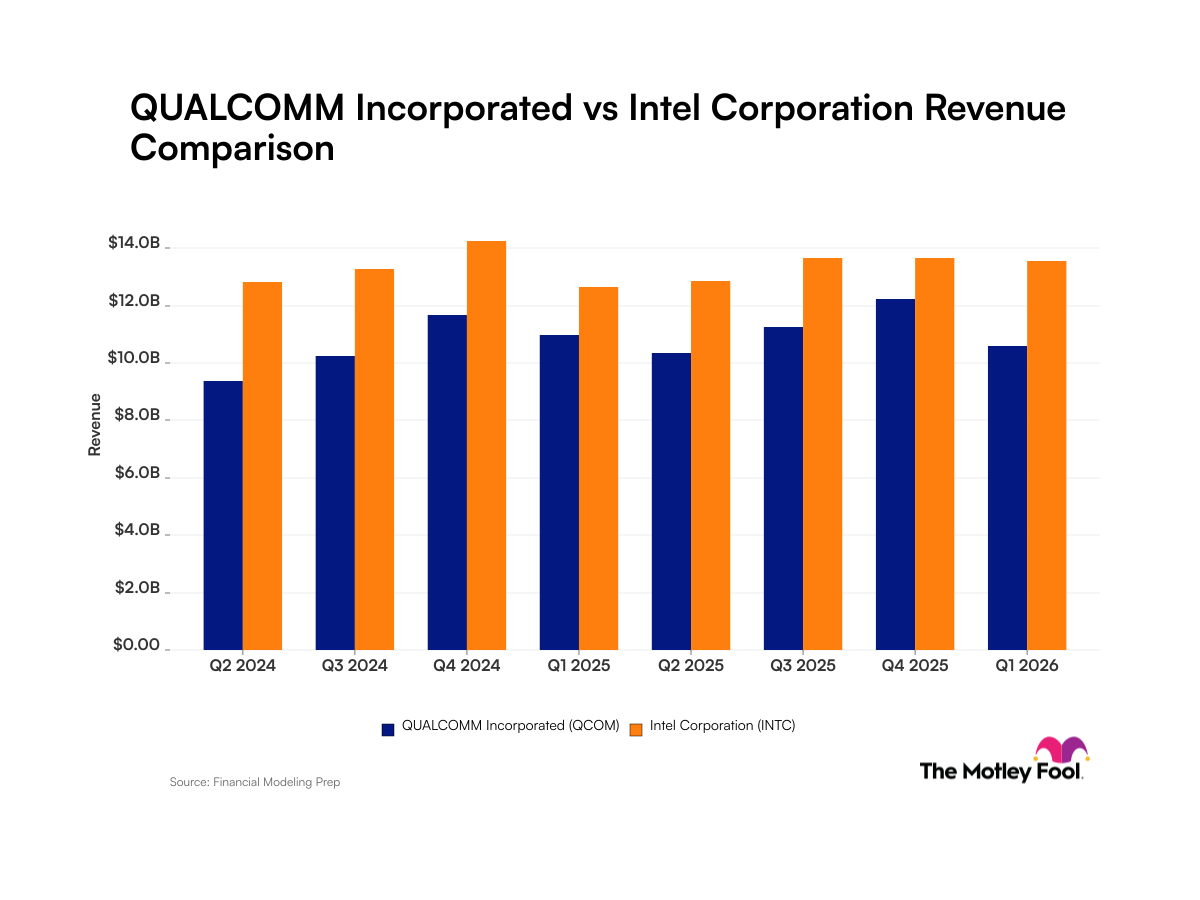
- Revenue Gap Analysis: Intel has consistently maintained a revenue lead over Qualcomm in recent quarters, although both companies have experienced noticeable revenue fluctuations over the past two years, prompting investors to watch whether this revenue gap will remain stable or begin to narrow.
- Qualcomm's Financial Performance: Qualcomm reported a net income margin of about 70% for the quarter ended March 29, 2026, but its fiscal Q2 sales of $10.6 billion represented a 3% year-over-year decline, with handset segment revenue plunging 13% to $6 billion, indicating challenges in its transition to AI.
- Intel's Growth Potential: Intel's revenue rose 7% year-over-year to $13.6 billion for the fiscal quarter ended March 28, 2026, and it forecasts Q2 sales of at least $13.8 billion, signaling a resurgence in investor confidence regarding its AI prospects.
- Market Reaction and Investment Advice: Despite Qualcomm's shares reaching a 52-week high of $247.90 on May 11, investors should be cautious as it was not included in The Motley Fool's recommended best stocks list, while Intel's stock rebounded due to high-profile deals like its partnership with Google.
See More
Qualcomm and Intel Revenue Analysis
- Qualcomm Revenue Trend: Qualcomm reported $10.6 billion in Q1 2026, reflecting a 3% year-over-year decline, yet its pivot towards AI sparked investor enthusiasm, driving shares to a 52-week high of $247.90 on May 11, indicating strong future growth expectations.
- Intel Collaboration Outlook: Intel's multi-year partnership with Google aims to develop next-gen cloud infrastructure, with Q1 2026 revenue rising 7% year-over-year to $13.6 billion, and Q2 sales projected to be at least $13.8 billion, signaling renewed investor confidence in its AI prospects.
- Market Reaction Analysis: Despite Qualcomm's handset revenue declining 13% year-over-year to $6 billion, its stock surged due to AI transition, reflecting a positive market response and investor confidence in future growth potential.
- Importance of Revenue: Revenue serves as a foundational metric for businesses, revealing their ability to attract customers and grow overall business volume, which is crucial for retail investors to assess a company's competitive position and growth potential.
See More

US Stocks Close Higher as Market Sentiment Improves


- Market Recovery: The S&P 500 rose by 0.37% and the Nasdaq 100 by 0.42%, with the Dow Jones Industrial Average hitting an all-time high, reflecting optimism about a potential US-Iran peace deal that could boost investor confidence.
- Consumer Sentiment Decline: The University of Michigan's consumer sentiment index was revised down to a record low of 44.8, below the expected 48.2, indicating growing concerns among consumers about the economic outlook, which may impact future spending.
- Rising Inflation Expectations: The 1-year inflation expectations for May were revised upward to 4.8%, exceeding the expected 4.6%, potentially prompting the Federal Reserve to consider interest rate hikes in upcoming meetings, which could pressure the stock market.
- Tech Stocks Lead Gains: Workday's stock surged over 5% after reporting Q1 adjusted EPS of $2.66, surpassing expectations, highlighting strong performance in the software sector and potentially attracting more investor interest in tech stocks.
See More
Qualcomm Shares Surge 75% Amid AI Chip Partnerships

- Stock Surge: Qualcomm's shares have surged 75% over the past month, with a 12% increase on Friday alone, reflecting market recognition of its increasingly pivotal role in the physical AI sector, driving the stock to record highs.
- Partnership with OpenAI: Qualcomm is collaborating with OpenAI to develop an AI chip aimed at launching a new AI-driven device, with analyst Ivan Feinseth stating that this will restore Qualcomm's former glory and lead the connected device revolution.
- Automotive Business Growth: Qualcomm's automotive revenue climbed 38% year-over-year to $1.3 billion, with over 1 million vehicles already utilizing its processors, showcasing strong growth potential in the smart automotive sector.
- New Data Center Chip Business: Qualcomm's upcoming AI200 and AI250 data center chips are set to launch later this year, providing custom AI accelerators that will offer more programmable computing capabilities for large hyperscale data centers, further expanding the company's business scope.
See More

Qualcomm Shares Surge 12% Amid AI Chip Partnerships and Automotive Deals
- Stock Surge: Qualcomm shares jumped 12% on Friday and have risen 75% over the past month, reflecting market recognition of its increasingly pivotal role in the physical AI sector, with the stock reaching record highs.
- Automotive Partnerships: Qualcomm announced a deal with Stellantis to utilize its Snapdragon processors in vehicles, enhancing unified computing power across the entire vehicle and expected to improve driving experiences and accelerate automotive intelligence.
- AI Chip Development: Qualcomm is partnering with OpenAI to develop an AI chip aimed at launching a phone with an AI-based operating system, with analysts believing this will restore Qualcomm's former glory and lead the connected device revolution.
- Expansion into New Business: The upcoming AI200 and AI250 data center chips are set to launch later this year, offering more programmable AI accelerators than Nvidia's offerings, further extending Qualcomm's influence in the data center market.
See More
Arm Holdings Leads AI Inference Market Growth
- Market Potential: Deloitte forecasts that by 2026, inference workloads will account for two-thirds of AI computing power, with the inference-focused AI chip market expected to reach $50 billion this year, indicating strong growth potential that has attracted numerous chipmakers.
- Technological Advantage: Arm Holdings focuses on energy-efficient chip designs, making its architecture a choice for major companies like Nvidia, which anticipates its Vera CPU could unlock a $20 billion market opportunity, further solidifying Arm's leadership in the AI inference sector.
- Diversified Revenue Model: Arm earns upfront licensing fees and royalties on each chip sold, with expectations that royalty revenue from its AI-focused Armv9 architecture will grow at a 20% CAGR from 2026 to 2031, showcasing robust profitability and market demand.
- Optimistic Future Outlook: Arm projects overall revenue to reach $25 billion by 2031, a more than fivefold increase from the $4.7 billion recorded in the past twelve months, while non-GAAP earnings per share are expected to exceed $9.00, highlighting its strong growth potential in the semiconductor industry.
See More
Intel vs Qualcomm: Revenue Trends and AI Impact
- Revenue Gap Analysis: Intel has consistently maintained a revenue lead over Qualcomm in recent quarters, although both companies have experienced noticeable revenue fluctuations over the past two years, prompting investors to watch whether this revenue gap will remain stable or begin to narrow.
- Qualcomm's Financial Performance: Qualcomm reported a net income margin of about 70% for the quarter ended March 29, 2026, but its fiscal Q2 sales of $10.6 billion represented a 3% year-over-year decline, with handset segment revenue plunging 13% to $6 billion, indicating challenges in its transition to AI.
- Intel's Growth Potential: Intel's revenue rose 7% year-over-year to $13.6 billion for the fiscal quarter ended March 28, 2026, and it forecasts Q2 sales of at least $13.8 billion, signaling a resurgence in investor confidence regarding its AI prospects.
- Market Reaction and Investment Advice: Despite Qualcomm's shares reaching a 52-week high of $247.90 on May 11, investors should be cautious as it was not included in The Motley Fool's recommended best stocks list, while Intel's stock rebounded due to high-profile deals like its partnership with Google.
See More
Qualcomm and Intel Revenue Analysis
- Qualcomm Revenue Trend: Qualcomm reported $10.6 billion in Q1 2026, reflecting a 3% year-over-year decline, yet its pivot towards AI sparked investor enthusiasm, driving shares to a 52-week high of $247.90 on May 11, indicating strong future growth expectations.
- Intel Collaboration Outlook: Intel's multi-year partnership with Google aims to develop next-gen cloud infrastructure, with Q1 2026 revenue rising 7% year-over-year to $13.6 billion, and Q2 sales projected to be at least $13.8 billion, signaling renewed investor confidence in its AI prospects.
- Market Reaction Analysis: Despite Qualcomm's handset revenue declining 13% year-over-year to $6 billion, its stock surged due to AI transition, reflecting a positive market response and investor confidence in future growth potential.
- Importance of Revenue: Revenue serves as a foundational metric for businesses, revealing their ability to attract customers and grow overall business volume, which is crucial for retail investors to assess a company's competitive position and growth potential.
See More
US Stocks Close Higher as Market Sentiment Improves
- Market Recovery: The S&P 500 rose by 0.37% and the Nasdaq 100 by 0.42%, with the Dow Jones Industrial Average hitting an all-time high, reflecting optimism about a potential US-Iran peace deal that could boost investor confidence.
- Consumer Sentiment Decline: The University of Michigan's consumer sentiment index was revised down to a record low of 44.8, below the expected 48.2, indicating growing concerns among consumers about the economic outlook, which may impact future spending.
- Rising Inflation Expectations: The 1-year inflation expectations for May were revised upward to 4.8%, exceeding the expected 4.6%, potentially prompting the Federal Reserve to consider interest rate hikes in upcoming meetings, which could pressure the stock market.
- Tech Stocks Lead Gains: Workday's stock surged over 5% after reporting Q1 adjusted EPS of $2.66, surpassing expectations, highlighting strong performance in the software sector and potentially attracting more investor interest in tech stocks.
See More
Qualcomm Shares Surge 75% Amid AI Chip Partnerships
- Stock Surge: Qualcomm's shares have surged 75% over the past month, with a 12% increase on Friday alone, reflecting market recognition of its increasingly pivotal role in the physical AI sector, driving the stock to record highs.
- Partnership with OpenAI: Qualcomm is collaborating with OpenAI to develop an AI chip aimed at launching a new AI-driven device, with analyst Ivan Feinseth stating that this will restore Qualcomm's former glory and lead the connected device revolution.
- Automotive Business Growth: Qualcomm's automotive revenue climbed 38% year-over-year to $1.3 billion, with over 1 million vehicles already utilizing its processors, showcasing strong growth potential in the smart automotive sector.
- New Data Center Chip Business: Qualcomm's upcoming AI200 and AI250 data center chips are set to launch later this year, providing custom AI accelerators that will offer more programmable computing capabilities for large hyperscale data centers, further expanding the company's business scope.
See More
Qualcomm Shares Surge 12% Amid AI Chip Partnerships and Automotive Deals
- Stock Surge: Qualcomm shares jumped 12% on Friday and have risen 75% over the past month, reflecting market recognition of its increasingly pivotal role in the physical AI sector, with the stock reaching record highs.
- Automotive Partnerships: Qualcomm announced a deal with Stellantis to utilize its Snapdragon processors in vehicles, enhancing unified computing power across the entire vehicle and expected to improve driving experiences and accelerate automotive intelligence.
- AI Chip Development: Qualcomm is partnering with OpenAI to develop an AI chip aimed at launching a phone with an AI-based operating system, with analysts believing this will restore Qualcomm's former glory and lead the connected device revolution.
- Expansion into New Business: The upcoming AI200 and AI250 data center chips are set to launch later this year, offering more programmable AI accelerators than Nvidia's offerings, further extending Qualcomm's influence in the data center market.
See More