Lotus CEO Expresses Skepticism on Solid-State Battery Commercialization
Written by Emily J. Thompson, Senior Investment Analyst
Updated: May 14 2026
0mins
Source: CNBC
- Uncertain Future for Solid-State Batteries: Lotus CEO Qingfeng Feng expressed at the FT Future of the Car summit that the commercialization of solid-state batteries may take 3 to 10 years, as the technology is not yet mature enough for mass production despite being touted as the 'holy grail' for EVs.
- Geely's Leadership in R&D: Feng highlighted that Geely is leading the development of solid-state battery technologies by establishing a dedicated R&D center, actively tracking and developing related technologies, which underscores its strategic positioning in the EV sector.
- Ongoing Technical Challenges: While solid-state batteries offer advantages in safety and charging speed, issues such as high production costs and battery swelling remain unresolved, hindering their market adoption and application.
- Shift Towards Semi-Solid Batteries: Some automakers are favoring the development of semi-solid-state batteries, which combine solid and liquid electrolytes, potentially offering a better balance of performance and cost, reflecting the industry's cautious stance towards solid-state battery technology.
Trade with 70% Backtested Accuracy
Stop guessing "Should I Buy LOT?" and start using high-conviction signals backed by rigorous historical data.
Sign up today to access powerful investing tools and make smarter, data-driven decisions.
Analyst Views on LOT
About LOT
Lotus Technology Inc is a company mainly engaged in the design, development, manufacturing and sales of luxury electric vehicles. The Company is mainly engaged in providing luxury lifestyle battery electric vehicles, focusing on electrification, digitalization, intelligence and other automotive technologies. The Company designs, develops and sells luxury lifestyle cars (non-sports cars for everyday use) under the iconic British brand Lotus. The Company operates in China, the UK and the EU market.
About the author

Emily J. Thompson
Emily J. Thompson, a Chartered Financial Analyst (CFA) with 12 years in investment research, graduated with honors from the Wharton School. Specializing in industrial and technology stocks, she provides in-depth analysis for Intellectia’s earnings and market brief reports.

Lotus Technology Appoints New Chairman of the Board

- Board Changes: Lotus Technology Inc. appointed Joe Quan Zhang as the new chairman of the board effective June 3, 2026, succeeding Daniel Donghui Li, who resigned for personal reasons on May 31, 2026, marking a significant shift in the company's governance structure.
- Strategic Growth Phase: This leadership change coincides with Lotus Tech's execution of its Focus 2030 strategy aimed at enhancing global competitiveness and transitioning to a more flexible sustainable business model, indicating the company's pursuit of new growth opportunities in a rapidly changing market.
- Leadership Experience: Zhang, who serves as Vice President and CFO of Geely Holding Group, brings over a decade of global executive leadership experience, and his expertise in strategic management and corporate finance is expected to provide crucial support for Lotus Tech's future development.
- Acknowledgment of Former Chairman: CEO Qingfeng Feng expressed gratitude for Daniel Li's exceptional contributions to the company's development, highlighting his strategic vision and steady leadership as foundational to the company's progress, reflecting the company's respect for leadership transitions.
See More
Lotus Unveils Eletre X Hybrid SUV with Supercar Performance
- Extended Range Capability: The Eletre X boasts a WLTP range exceeding 1,200 km, with an electric-only range of up to 350 km, utilizing a 900V architecture and a 70 kWh battery, which enhances user convenience and confidence for long-distance driving without frequent charging.
- Ultra-Fast Charging Technology: This model supports charging from 20% to 80% in just 9 minutes on a 350 kW DC charger, making it one of the fastest charging electrified vehicles on the market, significantly improving user experience and reducing range anxiety.
- Outstanding Performance: With 952 PS and 935 Nm of torque, the Eletre X accelerates from 0 to 100 km/h in just 3.3 seconds, ensuring consistent high performance across various driving conditions, thereby reinforcing Lotus's position in the high-performance automotive market.
- Innovative Hybrid Architecture: The Eletre X features Lotus's proprietary X-Hybrid technology, blending electric and internal combustion engine power to provide flexible range options, aligning with Lotus's Focus 2030 strategy aimed at meeting consumer demands for both high performance and long-range capabilities.
See More

Lotus Ventures into the U.S. Market

- Brand Background: Lotus is renowned for its lightweight sports cars and has gained attention through its roles in James Bond films, having navigated financial challenges while maintaining a presence in the global automotive market.
- Market Strategy: As a Chinese-owned car brand, Lotus is attempting to carve out a niche in the U.S. market, leveraging its unique brand identity and sports car technology to attract American consumers.
- Competitive Advantage: The lightweight design and high-performance characteristics of Lotus cars provide a technological edge in the fiercely competitive sports car market, catering to consumers with high demands for speed and handling performance.
- Future Outlook: By entering the U.S. market, Lotus aims not only to enhance brand recognition but also to achieve sales growth, further solidifying its position in the global market.
See More

Mercedes-Benz Faces Potential U.S. Market Ban Under New Legislation

- Legislative Risk Intensifies: The Motor Vehicle Modernization Act of 2026, currently under consideration in Congress, could ban Mercedes-Benz from manufacturing or selling new vehicles in the U.S. due to its largest shareholder being the state-owned Chinese company BAIC, which holds a 9.98% stake, significantly impacting its U.S. operations.
- Ownership Structure Constraints: The bill stipulates that any automaker with direct or indirect equity interest from a foreign adversary government will be barred from operating in the U.S., placing Mercedes-Benz at risk of being banned and potentially losing market share in the U.S.
- Competitive Market Pressure: If enacted, the legislation will restrict Chinese automakers' access to the U.S. market; despite Mercedes-Benz employing over 11,000 people and operating two assembly plants in the U.S., its future market position will be severely tested, potentially affecting its global strategic positioning.
- Insufficient Lobbying Efforts: Mercedes-Benz has engaged in minimal lobbying in the U.S. in recent years, and while it lobbies through various automotive trade associations, the lack of effective policy influence in the current legislative environment may expose it to greater market uncertainties.
See More
Globex Mining Updates on Berrigan Mine Exploration Progress
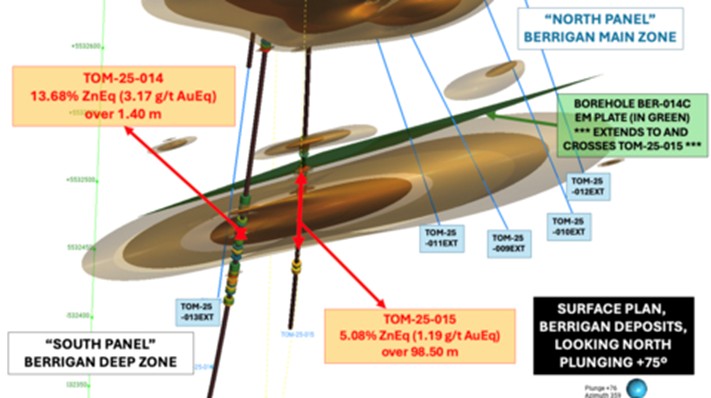
- Significant Drilling Results: Phase 1 drilling at the Berrigan Mine revealed mineralization with 5.08% ZnEq in hole TOM-25-014 and 24.85% ZnEq in TOM-25-015, indicating substantial mineral potential that could drive future resource development.
- Expansion Drilling Plan: Phase 2 drilling will focus on extending holes TOM-25-009 to TOM-25-013 to evaluate the newly discovered Berrigan Deep zone, which is expected to further confirm the depth extension of mineralized zones, enhancing the project's economic viability.
- Geological Exploration Activities: TomaGold has launched a large-scale ground prospecting campaign aimed at evaluating high-priority historical mineralized showings acquired from Chibougamau Independent Mines, which could significantly increase overall resource potential.
- Advanced Geophysical Surveys: The company plans to conduct UTEM and AMT geophysical surveys over a corridor measuring approximately 4 km by 2 km to identify new mineralized structures and potential deep extensions, further optimizing exploration strategies in the mining area.
See More
Chibougamau Independent Mines Updates Berrigan Mine Exploration Progress
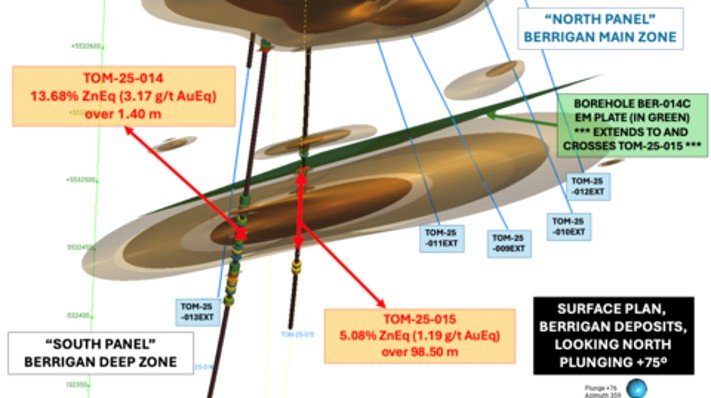
- Significant Drilling Results: Tomagold's drilling at the Berrigan Mine has intersected mineralization with up to 24.85% ZnEq, indicating substantial mineral potential in the area, which could lead to significant economic benefits for Chibougamau Independent Mines.
- New Area Development: Phase 2 drilling focuses on extending holes TOM-25-009 to TOM-25-013 to evaluate the potential of the newly discovered Berrigan Deep zone, which is expected to enhance the resource base of the mine.
- Geological Exploration Activities: Tomagold has launched a large-scale ground prospecting campaign covering strategic option properties from Chibougamau Independent Mines, aiming to assess historical mineralized showings that have not undergone rigorous follow-up, potentially providing new opportunities for future mineral development.
- Electromagnetic Survey Plans: The company plans to conduct borehole electromagnetic (BHEM) surveys in several drill holes to identify potential deep extensions of mineralization, alongside a large-scale surface geophysical (UTEM) survey to optimize structural understanding and identify new high-potential drill targets.
See More
Lotus Technology Appoints New Chairman of the Board
- Board Changes: Lotus Technology Inc. appointed Joe Quan Zhang as the new chairman of the board effective June 3, 2026, succeeding Daniel Donghui Li, who resigned for personal reasons on May 31, 2026, marking a significant shift in the company's governance structure.
- Strategic Growth Phase: This leadership change coincides with Lotus Tech's execution of its Focus 2030 strategy aimed at enhancing global competitiveness and transitioning to a more flexible sustainable business model, indicating the company's pursuit of new growth opportunities in a rapidly changing market.
- Leadership Experience: Zhang, who serves as Vice President and CFO of Geely Holding Group, brings over a decade of global executive leadership experience, and his expertise in strategic management and corporate finance is expected to provide crucial support for Lotus Tech's future development.
- Acknowledgment of Former Chairman: CEO Qingfeng Feng expressed gratitude for Daniel Li's exceptional contributions to the company's development, highlighting his strategic vision and steady leadership as foundational to the company's progress, reflecting the company's respect for leadership transitions.
See More
Lotus Unveils Eletre X Hybrid SUV with Supercar Performance
- Extended Range Capability: The Eletre X boasts a WLTP range exceeding 1,200 km, with an electric-only range of up to 350 km, utilizing a 900V architecture and a 70 kWh battery, which enhances user convenience and confidence for long-distance driving without frequent charging.
- Ultra-Fast Charging Technology: This model supports charging from 20% to 80% in just 9 minutes on a 350 kW DC charger, making it one of the fastest charging electrified vehicles on the market, significantly improving user experience and reducing range anxiety.
- Outstanding Performance: With 952 PS and 935 Nm of torque, the Eletre X accelerates from 0 to 100 km/h in just 3.3 seconds, ensuring consistent high performance across various driving conditions, thereby reinforcing Lotus's position in the high-performance automotive market.
- Innovative Hybrid Architecture: The Eletre X features Lotus's proprietary X-Hybrid technology, blending electric and internal combustion engine power to provide flexible range options, aligning with Lotus's Focus 2030 strategy aimed at meeting consumer demands for both high performance and long-range capabilities.
See More
Lotus Ventures into the U.S. Market
- Brand Background: Lotus is renowned for its lightweight sports cars and has gained attention through its roles in James Bond films, having navigated financial challenges while maintaining a presence in the global automotive market.
- Market Strategy: As a Chinese-owned car brand, Lotus is attempting to carve out a niche in the U.S. market, leveraging its unique brand identity and sports car technology to attract American consumers.
- Competitive Advantage: The lightweight design and high-performance characteristics of Lotus cars provide a technological edge in the fiercely competitive sports car market, catering to consumers with high demands for speed and handling performance.
- Future Outlook: By entering the U.S. market, Lotus aims not only to enhance brand recognition but also to achieve sales growth, further solidifying its position in the global market.
See More
Mercedes-Benz Faces Potential U.S. Market Ban Under New Legislation
- Legislative Risk Intensifies: The Motor Vehicle Modernization Act of 2026, currently under consideration in Congress, could ban Mercedes-Benz from manufacturing or selling new vehicles in the U.S. due to its largest shareholder being the state-owned Chinese company BAIC, which holds a 9.98% stake, significantly impacting its U.S. operations.
- Ownership Structure Constraints: The bill stipulates that any automaker with direct or indirect equity interest from a foreign adversary government will be barred from operating in the U.S., placing Mercedes-Benz at risk of being banned and potentially losing market share in the U.S.
- Competitive Market Pressure: If enacted, the legislation will restrict Chinese automakers' access to the U.S. market; despite Mercedes-Benz employing over 11,000 people and operating two assembly plants in the U.S., its future market position will be severely tested, potentially affecting its global strategic positioning.
- Insufficient Lobbying Efforts: Mercedes-Benz has engaged in minimal lobbying in the U.S. in recent years, and while it lobbies through various automotive trade associations, the lack of effective policy influence in the current legislative environment may expose it to greater market uncertainties.
See More
Globex Mining Updates on Berrigan Mine Exploration Progress
- Significant Drilling Results: Phase 1 drilling at the Berrigan Mine revealed mineralization with 5.08% ZnEq in hole TOM-25-014 and 24.85% ZnEq in TOM-25-015, indicating substantial mineral potential that could drive future resource development.
- Expansion Drilling Plan: Phase 2 drilling will focus on extending holes TOM-25-009 to TOM-25-013 to evaluate the newly discovered Berrigan Deep zone, which is expected to further confirm the depth extension of mineralized zones, enhancing the project's economic viability.
- Geological Exploration Activities: TomaGold has launched a large-scale ground prospecting campaign aimed at evaluating high-priority historical mineralized showings acquired from Chibougamau Independent Mines, which could significantly increase overall resource potential.
- Advanced Geophysical Surveys: The company plans to conduct UTEM and AMT geophysical surveys over a corridor measuring approximately 4 km by 2 km to identify new mineralized structures and potential deep extensions, further optimizing exploration strategies in the mining area.
See More
Chibougamau Independent Mines Updates Berrigan Mine Exploration Progress
- Significant Drilling Results: Tomagold's drilling at the Berrigan Mine has intersected mineralization with up to 24.85% ZnEq, indicating substantial mineral potential in the area, which could lead to significant economic benefits for Chibougamau Independent Mines.
- New Area Development: Phase 2 drilling focuses on extending holes TOM-25-009 to TOM-25-013 to evaluate the potential of the newly discovered Berrigan Deep zone, which is expected to enhance the resource base of the mine.
- Geological Exploration Activities: Tomagold has launched a large-scale ground prospecting campaign covering strategic option properties from Chibougamau Independent Mines, aiming to assess historical mineralized showings that have not undergone rigorous follow-up, potentially providing new opportunities for future mineral development.
- Electromagnetic Survey Plans: The company plans to conduct borehole electromagnetic (BHEM) surveys in several drill holes to identify potential deep extensions of mineralization, alongside a large-scale surface geophysical (UTEM) survey to optimize structural understanding and identify new high-potential drill targets.
See More