
Key Takeaway
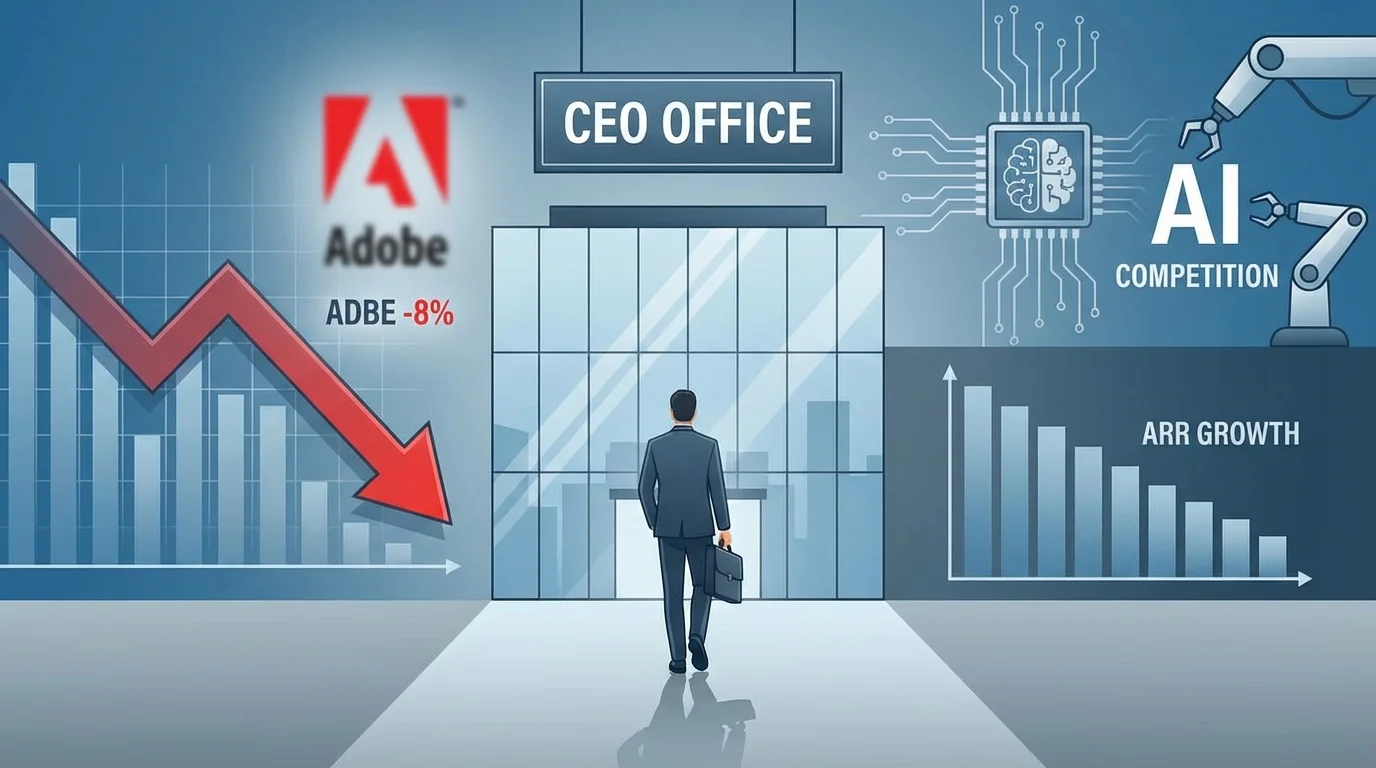
Adobe's stock plummeted nearly 8% in pre-market trading following its Q1 2026 earnings report, despite the creative software giant delivering results that exceeded Wall Street expectations on both revenue and earnings per share. This seemingly paradoxical market reaction reveals investor concerns that extend far beyond quarterly financial performance, touching on leadership transitions, competitive threats from generative AI, and questions about the company's long-term growth trajectory.
For the quarter ending February 2026, Adobe reported revenue of $6.40 billion, representing a solid 12% year-over-year increase, alongside non-GAAP diluted EPS of $6.06. The company generated record operating cash flow of $2.96 billion and provided guidance for Q2 revenue of $6.46 billion at the midpoint, slightly ahead of analyst estimates. By traditional metrics, this was a strong quarter that should have rewarded shareholders.
However, markets focused on three concerning developments that overshadowed the headline numbers. First and most significant, longtime CEO Shantanu Narayen announced his departure after leading the company through its transformation to a subscription-based business model. Second, Adobe's Annual Recurring Revenue (ARR) growth slowed to 10.9%, raising questions about momentum in the core subscription business. Third, the company maintained unchanged full-year guidance despite the Q1 beat, suggesting management may be seeing challenges ahead that investors hadn't fully priced in.
The stock's violent reaction—it had already declined 23% year-to-date heading into earnings—reflects deep-seated anxiety about Adobe's position in an increasingly AI-driven creative landscape. While the company has made significant investments in integrating generative AI through its Firefly platform, investors worry whether these efforts can defend against AI-native competitors that threaten to disrupt Photoshop, Illustrator, and Premiere Pro. For a stock that once traded at premium multiples based on predictable growth, the uncertainty is proving costly.
Ready to analyze stocks facing disruptive technology transitions? Sign up for Intellectia.AI and access our AI-powered screening tools that help identify companies navigating competitive threats while maintaining strong fundamentals.

The Earnings Paradox: Beating Estimates but Losing Investors
Adobe's Q1 2026 financial performance, by any objective measure, was strong. Revenue of $6.40 billion represented a 12% year-over-year increase, comfortably ahead of analyst expectations. Non-GAAP diluted EPS of $6.06 demonstrated the company's ability to convert sales into profits efficiently. Record operating cash flow of $2.96 billion highlighted the strength of the subscription business model that Narayen championed during his tenure.
The company's guidance also suggested continued momentum. Adobe projected Q2 revenue of $6.46 billion at the midpoint, roughly 0.5% above Wall Street's consensus estimate. For the full fiscal year 2026, management maintained confidence in delivering over 10% ending ARR growth with total revenue between $25.90 billion and $26.10 billion. These figures suggested a business executing well on its operational objectives.
Yet the stock market responded with a sell-off that pushed shares down approximately 8% in pre-market trading and extended declines through the regular session. Adobe's battered shares fell another 6% on Friday following the CEO announcement, continuing a downward trend that has seen the stock plunge over 44% from its 52-week high. The market is clearly pricing in concerns that go well beyond quarterly financial performance.
This disconnect between earnings results and stock performance illustrates a fundamental truth about equity markets: investors value companies based on future expectations rather than past performance. When Adobe maintained unchanged full-year guidance despite beating Q1 estimates, it signaled to the market that the company doesn't expect accelerating growth in coming quarters. For a stock that had historically traded at premium valuations based on consistent outperformance, this moderation was enough to trigger significant multiple compression.
Leadership Transition: CEO Narayen's Departure Creates Uncertainty
The announcement that Shantanu Narayen will step down as CEO after nearly two decades at the helm introduced a significant element of uncertainty that markets found difficult to digest. Narayen led Adobe through one of the most successful business model transitions in technology history, pivoting the company from perpetual software licenses to a recurring subscription model that fundamentally transformed its financial profile and market valuation.
Under Narayen's leadership, Adobe's annual revenue grew from roughly $3 billion to over $25 billion, while the stock delivered extraordinary returns for long-term shareholders. The subscription transition, completed through the introduction of Creative Cloud, eliminated the boom-and-bust cycles of traditional software sales and created the predictable recurring revenue stream that justified Adobe's premium valuation. His departure raises questions about whether the next leadership team can navigate the next major transition—integrating generative AI—equally successfully.
The timing of the announcement, coinciding with earnings rather than as a separate planned transition, surprised investors and amplified concerns. CEO transitions are inherently uncertain periods for any company, as new leaders bring different strategic priorities, organizational approaches, and capital allocation philosophies. For Adobe, which faces the critical challenge of defending its market position against AI-native competitors, this leadership uncertainty comes at a particularly inopportune moment.
Analysts have expressed concern that the transition could disrupt Adobe's AI strategy execution at a critical juncture. Morgan Stanley's Keith Weiss, who slashed Adobe's price target following the earnings report, cited the leadership change as a factor amplifying existing competitive concerns. The incoming CEO will need to demonstrate quickly that they can maintain innovation momentum while navigating competitive threats that Narayen's team had only begun to address.
The AI Threat: Can Firefly Defend Adobe's Creative Empire?
Perhaps the most significant factor weighing on Adobe's stock is investor anxiety about generative AI's potential to disrupt the creative software market that Adobe has dominated for decades. Since the start of 2026, Adobe has plunged 26% as Wall Street questions whether its creative software empire can withstand the generative AI revolution. The concern is that AI-native tools could erode demand for Photoshop, Illustrator, and Premiere Pro by enabling non-professionals to create content that previously required specialized skills and expensive software.
Adobe has not been idle in the face of this threat. The company invested heavily in its Firefly generative AI platform, integrating AI capabilities directly into its creative suite. Adobe claims AI-first ARR more than tripled year over year, suggesting early adoption of these capabilities. The company has also emphasized that its AI models are trained on licensed content, addressing copyright concerns that have plagued competitors using scraped internet data.
However, investors remain skeptical about whether Adobe's defensive AI integration can match the innovation pace of AI-native competitors. Companies like Canva, Figma, and various generative AI startups are building creative tools from the ground up with AI at their core, rather than bolting AI features onto legacy applications. These competitors can move faster, price more aggressively, and target user segments that Adobe's premium-priced suite may struggle to reach.
The competitive landscape extends beyond direct creative tool competitors to include tech giants like Microsoft and Google, which are integrating generative AI into their productivity suites. As AI capabilities become commoditized and embedded in tools users already have, Adobe's ability to maintain premium pricing for specialized creative software faces its most significant challenge in decades. The market is repricing Adobe stock to reflect this uncertainty, compressing multiples until the competitive dynamics become clearer.
Slowing ARR Growth: Subscription Momentum Decelerates
Adobe's transition to a subscription-based business model under Narayen was transformational, creating predictable recurring revenue that justified premium valuations. However, the Q1 2026 results showed ARR growth slowing to 10.9%, down from previous quarters and below the rate that had supported Adobe's historically high valuation multiples. This deceleration raises questions about market saturation and competitive pressure.
The slowing growth is particularly concerning given Adobe's unchanged full-year guidance. Companies that exceed Q1 expectations typically raise full-year guidance unless they see headwinds developing in subsequent quarters. Adobe's decision to maintain prior guidance despite the beat suggests management may be seeing competitive pressures or market saturation that will limit growth acceleration through the remainder of the fiscal year.
Want professional analysis of subscription business models facing disruption? Try Intellectia.AI's AI Stock Picker—our platform analyzes companies based on recurring revenue trends, competitive positioning, and valuation metrics to identify opportunities in transition periods.
The ARR deceleration coincides with broader trends in the software industry as companies emerge from the pandemic-era digital transformation boom. Many enterprises that rapidly adopted creative and productivity software during lockdowns are now scrutinizing their software spend more carefully. Adobe's premium pricing, historically justified by its market-leading position, may face increasing pressure as CFOs look for cost savings and alternative solutions become more viable.
For investors, the combination of slowing ARR growth and competitive AI threats creates a challenging narrative. Adobe's business model transition to subscriptions was successful precisely because it created high switching costs and predictable revenue. If AI competitors can deliver comparable creative capabilities at lower price points or with more modern interfaces, those switching costs may erode faster than Adobe can adapt its offerings. The ARR deceleration could be an early warning sign of this competitive pressure materializing.
Analyst Reactions: Downgrades and Price Target Cuts
The market's negative reaction to Adobe's earnings was amplified by analyst downgrades and price target cuts that validated investor concerns. Morgan Stanley's Keith Weiss, a prominent software analyst, slashed Adobe's price target following the earnings report, citing the combination of CEO transition uncertainty and AI competition concerns. This downgrade from a well-respected analyst reinforced the negative sentiment already pressuring the stock.
The analyst community has been increasingly divided on Adobe's prospects throughout 2026. While some maintain that Adobe's entrenched position in creative workflows and early AI investments will allow it to defend its market position, others see the company facing an existential threat from generative AI that could erode the very foundation of its business model. The Q1 results and CEO transition appear to have shifted sentiment decisively toward the bearish camp.
Retail investor sentiment has also turned sharply negative. According to Stocktwits data, Adobe saw a 1,542% surge in retail messages over a 24-hour period following the earnings release, with sentiment overwhelmingly bearish. The combination of professional analyst downgrades and retail investor panic selling created a feedback loop that amplified the stock's decline beyond what fundamentals alone might justify.
For contrarian investors, the extreme negativity could eventually create a buying opportunity if Adobe can demonstrate that its AI strategy is working and the competitive threats are manageable. However, the path to that demonstration requires time and evidence that may not be available for several quarters. In the meantime, the stock appears likely to remain under pressure as investors wait for clarity on the leadership transition and competitive positioning.
Is Adobe a Buy on the Dip?
The dramatic decline in Adobe's stock price—down 44% from its 52-week high and 26% year-to-date—raises the question of whether the selloff has created a buying opportunity for long-term investors. The bull case centers on Adobe's entrenched position in creative workflows, strong cash flow generation, and early AI investments through Firefly. If the company can successfully navigate the competitive transition, the current price may represent a significant discount to intrinsic value.
Forbes argues that the two primary drivers of Adobe's year-to-date decline—AI competition concerns and the CEO transition—are legitimate uncertainties but have not yet been reflected in the company's financial performance. Adobe continues to grow revenue at double-digit rates, generate substantial free cash flow, and maintain strong gross margins. The subscription model creates predictable revenue that provides visibility even during periods of transition.
However, the bear case is equally compelling. The combination of slowing ARR growth, leadership uncertainty, and competitive threats from generative AI creates a challenging environment that could persist for multiple quarters. Adobe's historically premium valuation multiple may not be justified if growth continues decelerating and competitive pressure intensifies. Investors buying the dip need conviction that Adobe can defend its market position while successfully integrating AI capabilities.
For most investors, the prudent approach may be to wait for greater clarity on the leadership transition and competitive dynamics before establishing positions. Adobe's Q1 results suggest the business remains healthy operationally, but the stock's valuation multiple will likely remain under pressure until investors gain confidence that the company can thrive in an AI-driven creative landscape. The dip may prove attractive for patient investors with high conviction, but catching falling knives in the technology sector has historically been a dangerous strategy.
Conclusion: Navigating Adobe's Uncertain Transition
Adobe's stock drop following Q1 2026 earnings reflects investor concerns that transcend quarterly financial performance. The combination of CEO Narayen's departure, slowing ARR growth, and mounting competitive pressure from generative AI has created uncertainty that markets are pricing aggressively. While the company's operational results remain strong, the path to maintaining its historical growth trajectory and market position appears less certain than in previous years.
For investors, Adobe represents a case study in how quickly market sentiment can shift for technology companies facing disruptive transitions. A stock that traded at premium multiples based on predictable subscription revenue and dominant market position is now being repriced for competitive uncertainty and leadership transition risk. Whether this repricing represents an overreaction or appropriate risk adjustment will become clearer over the coming quarters as Adobe's AI strategy matures and new leadership establishes its priorities.
The broader lesson for technology investors is that even dominant market leaders with strong fundamentals can face rapid valuation compression when disruptive technologies threaten their core business models. Adobe's experience in 2026 serves as a reminder that competitive moats can erode quickly in the technology sector, and companies must continuously innovate to maintain their market positions. For Adobe specifically, the coming quarters will determine whether it can successfully navigate this transition or whether the current stock decline is merely the beginning of a longer-term repricing.
Ready to analyze stocks facing technology disruption? Start your free trial with Intellectia.AI and unlock AI-powered analysis that helps identify companies navigating competitive transitions while maintaining strong fundamentals. Our platform provides the data-driven insights you need to make informed investment decisions during periods of uncertainty.