
Key Takeaway
Tesla has announced its most ambitious spending plan in history, committing over $25 billion in capital expenditures for 2026—a nearly threefold increase from the previous year. This massive investment signals the company's decisive pivot from traditional automotive manufacturing toward artificial intelligence, autonomous vehicles, and humanoid robotics. While the strategy could position Tesla as a leader in multiple trillion-dollar markets, investors are grappling with the risks of such unprecedented spending at a time when the core automotive business faces mounting competition and margin pressure.
The announcement came during Tesla's Q1 2026 earnings call, where CFO Vaibhav Taneja revealed the elevated spending target after the company delivered stronger-than-expected financial results. Tesla reported non-GAAP earnings of $0.41 per share on $22.38 billion in revenue, representing a 16% year-over-year growth rate that exceeded Wall Street estimates. More impressively, the company generated $1.4 billion in free cash flow and now holds $44.7 billion in cash and investments, providing substantial liquidity to fund its ambitious transformation.
However, the market's reaction was telling. Tesla shares initially surged nearly 4% in after-hours trading following the earnings beat, only to reverse sharply when the magnitude of the spending plan became clear. This price action reflects the fundamental tension facing Tesla investors: the company is betting its future on technologies that remain largely unproven at commercial scale, even as its traditional automotive business faces intensifying competition from both established manufacturers and emerging Chinese rivals.
Understanding the $25 Billion CapEx Plan
The $25 billion capital expenditure plan represents a dramatic escalation from Tesla's previous guidance of $20 billion for 2026 and nearly triples the $8.5 billion spent in 2025. This spending surge reflects what management describes as a "very big capital investment phase" that will extend over the next several years as Tesla executes its transformation strategy.
The allocation spans multiple ambitious initiatives. Tesla is ramping production across six factory locations simultaneously, building out its proprietary Cortex AI compute infrastructure, expanding battery materials production, and investing heavily in manufacturing equipment for its next-generation products. The company has also confirmed plans to build a dedicated chip fabrication facility in Austin, Texas, reducing its dependence on external semiconductor suppliers at a time when geopolitical tensions threaten global chip supply chains.
The scale of this investment becomes clearer when compared to Tesla's historical spending patterns. The company's cumulative capital expenditures since its IPO total approximately $45 billion, meaning Tesla plans to spend more than half of its lifetime investment in a single year. This concentration of spending reflects the compressed timeline Musk has set for achieving breakthroughs in autonomy and robotics.
For investors evaluating the plan, the critical question centers on execution risk versus opportunity cost. If Tesla successfully commercializes autonomous vehicles and humanoid robots, the $25 billion investment could generate returns measured in trillions. However, failure to deliver on these promises would leave the company overcapitalized in unproductive assets while competitors capture market share in traditional automotive segments.
The Optimus Robot Opportunity
Among the most ambitious components of Tesla's investment plan is the scaling of Optimus, the company's humanoid robot program. Tesla has confirmed that Optimus production will begin in July 2026, with the $25 billion CapEx plan including substantial manufacturing equipment for robot assembly lines.
The economics of humanoid robotics represent a potentially transformative market opportunity. Musk has previously suggested that Optimus could eventually be produced at volumes exceeding Tesla's vehicle business, with unit costs potentially falling below $20,000 while addressing use cases ranging from factory automation to household assistance. If achieved, this would position Tesla to capture significant value in a market that Goldman Sachs estimates could reach $38 billion by 2035, with some bullish scenarios suggesting trillion-dollar market potential.
However, the technical challenges remain formidable. While Tesla has demonstrated impressive progress in robot mobility and manipulation capabilities, transitioning from prototype to mass production requires solving manufacturing problems that have eluded the robotics industry for decades. The $25 billion spending plan includes substantial investment in specialized production equipment, suggesting Tesla anticipates significant manufacturing complexity.
The competitive landscape is also intensifying rapidly. Companies including Boston Dynamics, Agility Robotics, and Figure AI are advancing their own humanoid platforms, while technology giants like Google and Amazon continue investing in robotic automation. Tesla's manufacturing expertise and vertical integration capabilities provide advantages, but the company is entering a crowded field where success is far from guaranteed.
For investors, the Optimus program represents a classic venture-style bet embedded within a public company. The potential returns are enormous, but so are the technical and commercial risks. Tesla's willingness to commit billions to this program demonstrates management's conviction, but also highlights the company's departure from its historical focus on automotive manufacturing.
Cybercab and the Robotaxi Vision
Tesla's autonomous vehicle ambitions center on Cybercab, the purpose-built robotaxi that the company plans to produce at scale beginning in 2026. The $25 billion CapEx plan includes substantial investment in Cybercab manufacturing capabilities, reflecting Tesla's belief that autonomous ride-hailing will become a major revenue contributor within the next several years.
The robotaxi market represents one of the most significant opportunities in transportation. Morgan Stanley estimates that autonomous ride-hailing could generate over $1 trillion in annual revenue globally by 2040, with early movers capturing disproportionate value through network effects and brand recognition. Tesla's integrated approach—combining vehicle manufacturing, self-driving software, and ride-hailing platform—could provide substantial cost advantages over competitors who must coordinate across multiple vendors.
However, Musk has acknowledged that meaningful robotaxi revenue is unlikely before 2027, suggesting that the substantial CapEx investments in 2026 will precede any significant revenue contribution. This timeline reflects the regulatory, technical, and operational challenges of deploying fully autonomous vehicles at scale. While Tesla's Full Self-Driving technology has demonstrated impressive capabilities, achieving the safety and reliability standards required for unsupervised operation remains an open question.
Tesla released video footage showing Cybercab vehicles rolling off production lines, demonstrating that manufacturing preparation is advancing. The vehicle features a purpose-built design optimized for autonomous operation, with no steering wheel or pedals and a simplified interior architecture that could enable significantly lower production costs than traditional vehicles.
The regulatory pathway for robotaxi deployment varies significantly across jurisdictions, adding complexity to Tesla's commercialization timeline. While some markets have established frameworks for autonomous vehicle testing and limited deployment, comprehensive regulatory approval for unsupervised operation at scale remains pending in most regions. Tesla's ability to navigate these regulatory challenges will significantly impact the returns generated by its $25 billion investment.
AI Infrastructure and the Cortex Platform
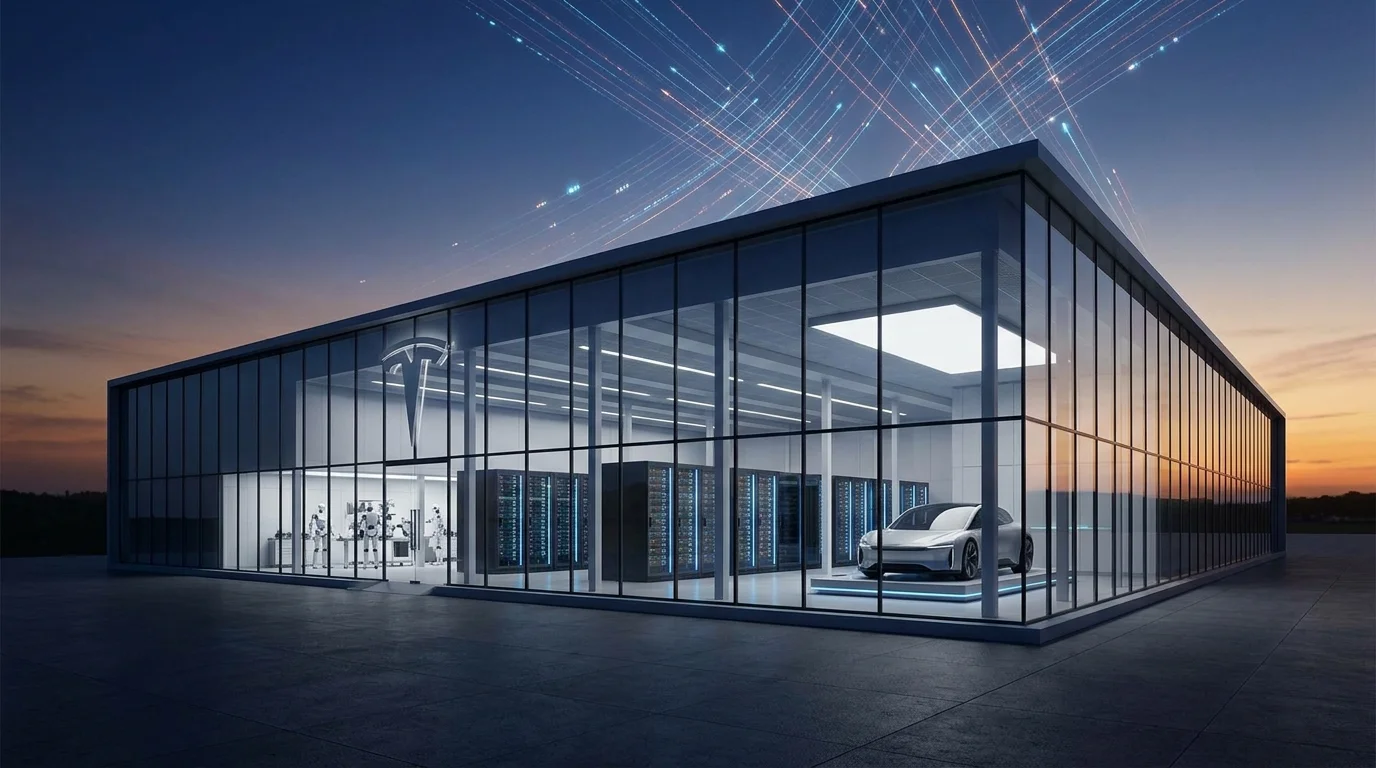
A substantial portion of Tesla's capital expenditure plan is directed toward expanding the company's AI compute infrastructure, branded as Cortex. This investment reflects the computational intensity of training and operating the neural networks that power Tesla's autonomous driving systems and future robotics applications.
Tesla has indicated that it plans to double its AI compute capacity in 2026, adding to the substantial infrastructure already deployed. This expansion includes both internal development of specialized training hardware and partnerships with leading semiconductor manufacturers for high-performance compute resources. The company has historically maintained a hybrid approach, combining internally developed AI chips with commercially available hardware from vendors like Nvidia.
The strategic rationale for this infrastructure investment centers on data and compute moats. Autonomous vehicle development benefits from both scale of real-world driving data and the computational resources to train increasingly sophisticated models. By investing aggressively in AI infrastructure, Tesla aims to maintain its position at the frontier of autonomous driving technology while building capabilities that can be applied to robotics and other AI applications.
The cost structure of AI development has increased dramatically across the technology industry, with leading companies investing tens of billions annually in compute infrastructure. Tesla's $25 billion CapEx plan positions the company to remain competitive in this arms race, though questions remain about whether the returns on AI investment will justify the escalating costs.
For investors, the AI infrastructure investment represents both an opportunity and a risk. If Tesla successfully develops market-leading autonomous driving and robotics capabilities, the AI investments will generate substantial returns. However, if competitors achieve similar or superior capabilities with less investment, Tesla's aggressive spending could compress returns and strain financial performance.
Financial Implications and Investor Concerns
The $25 billion capital expenditure plan represents a fundamental shift in Tesla's financial profile, transforming the company from a cash-generating automotive manufacturer to a capital-intensive technology development platform. This shift has significant implications for valuation metrics, cash flow projections, and investor returns.
Tesla's strong balance sheet provides substantial runway for this investment program. With $44.7 billion in cash and investments and $1.4 billion in quarterly free cash flow, the company can fund the $25 billion CapEx plan without immediate need for external financing. However, sustained spending at this level would eventually require either substantially increased profitability or additional capital raising if the company continues investing at similar rates beyond 2026.
The market's negative reaction to the CapEx announcement reflects concerns about the risk-adjusted returns on these investments. Tesla's core automotive business faces intensifying competition, with Chinese manufacturers offering compelling electric vehicles at price points that pressure Tesla's margins. While the company reported improved profitability in Q1 2026, some analysts note that near-zero profit margins on vehicle sales raise questions about the sustainability of automotive cash flows.
Management's communication strategy around the spending plan has emphasized the transformational potential of AI and robotics while acknowledging the multi-year timeline before these investments generate meaningful revenue. This framing positions Tesla as a technology company making long-term bets rather than an automotive manufacturer optimizing for near-term profitability, a narrative that resonates with some investors while concerning others.
The valuation implications are complex. If Tesla successfully executes its AI and robotics strategy, the company's addressable market expands dramatically, potentially justifying current or higher valuations. However, execution failures or competitive pressures could leave the company overvalued relative to its automotive fundamentals, with billions invested in unproductive assets.
Competitive Landscape and Strategic Positioning
Tesla's $25 billion investment plan must be evaluated in the context of a rapidly evolving competitive landscape. The company faces different competitive dynamics in each of its target markets, with varying degrees of established competition and technical barriers to entry.
In autonomous vehicles, Tesla competes against technology companies including Waymo, which has already deployed commercial robotaxi services in select markets, and established automotive manufacturers partnering with AI specialists. Tesla's integrated approach provides potential cost advantages, but competitors may achieve faster regulatory approval through more conservative deployment strategies.
The humanoid robotics market is earlier in its development, with no established leaders having achieved mass production. Tesla enters this market with significant manufacturing capabilities and AI expertise, but faces competition from specialized robotics companies and technology giants with substantial AI research capabilities.
In AI infrastructure, Tesla competes for compute resources and talent against the largest technology companies globally. The company's ability to attract and retain top AI researchers will significantly impact its development timelines and technical capabilities. Tesla's mission-driven culture and Musk's public profile provide recruiting advantages, but compensation competition from well-funded technology giants remains intense.
Tesla's vertical integration strategy—developing hardware, software, and manufacturing capabilities internally—differs from competitors who often specialize in specific value chain segments. This approach provides potential coordination benefits and cost advantages at scale, but also concentrates risk and requires expertise across multiple technical domains.
Conclusion: A Defining Bet on the Future
Tesla's $25 billion capital expenditure plan for 2026 represents one of the most ambitious corporate transformation strategies in modern business history. The company's willingness to commit resources at this scale demonstrates management's conviction that AI, autonomous vehicles, and robotics will fundamentally reshape transportation, manufacturing, and daily life over the coming decade.
For investors, the investment plan presents a high-stakes bet with binary potential outcomes. Successful execution could establish Tesla as a dominant player across multiple trillion-dollar markets, generating returns that justify significant near-term investment and elevated valuations. Conversely, technical setbacks, competitive pressures, or regulatory obstacles could leave the company with substantial capital invested in capabilities that fail to achieve commercial scale.
The coming years will reveal whether Tesla's aggressive investment strategy positions the company for transformative growth or represents an expensive miscalculation. What remains clear is that Musk and Tesla's leadership team are betting the company's future on technologies that remain largely unproven at commercial scale, accepting substantial risk in pursuit of equally substantial rewards.
For investors considering Tesla stock, understanding this transformation is essential. The company is no longer simply an automotive manufacturer but a technology platform making massive bets on the future of AI and robotics. Whether these bets succeed will determine Tesla's trajectory for the next decade and beyond.
Ready to track Tesla's transformation and identify other promising investment opportunities? Try our AI-powered stock analysis tools at https://intellectia.ai/features/ai-stock-picker to stay ahead of market trends and make informed investment decisions. Our advanced screening capabilities help you identify companies positioning for future growth across emerging technology sectors.