
Key Takeaway
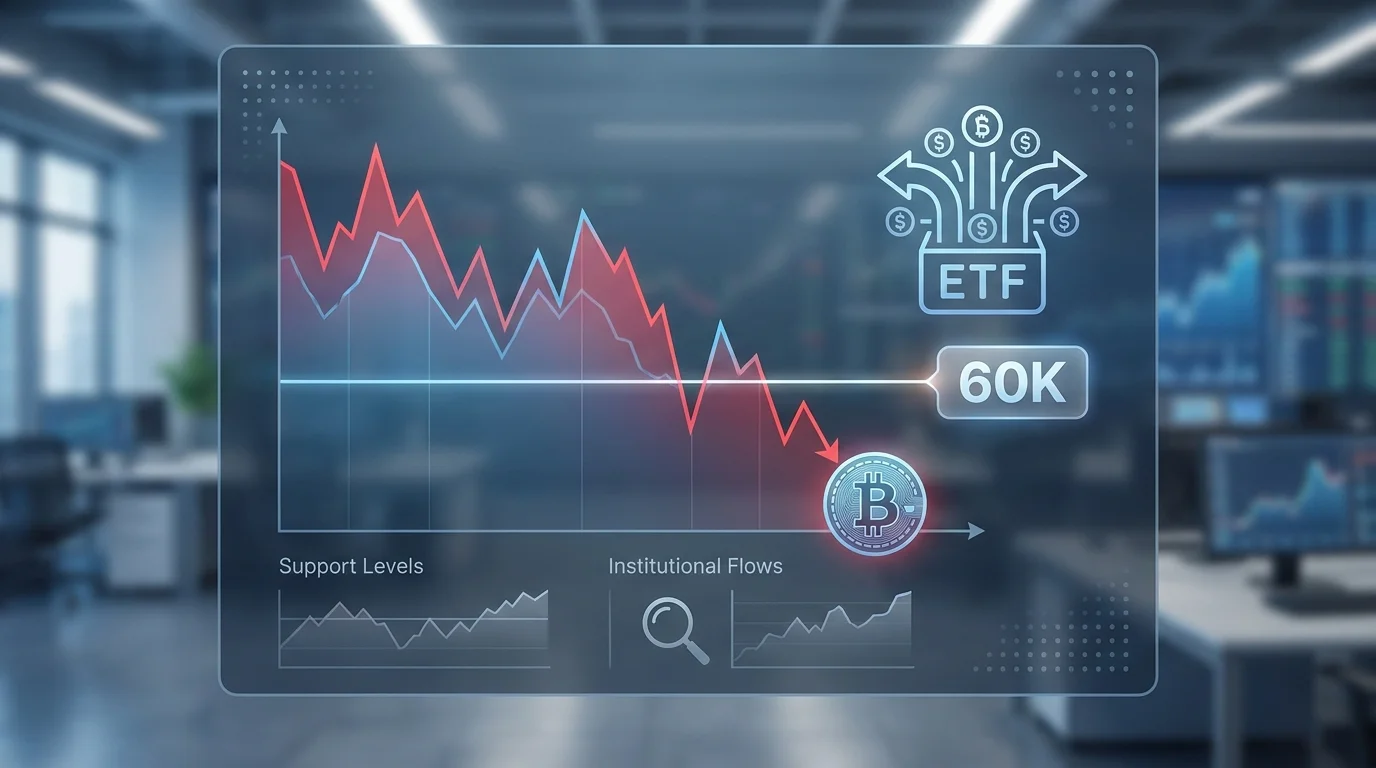
Bitcoin's dramatic breakdown below the $60,000 psychological level in July 2026 represents one of the most significant technical breaches in the cryptocurrency's recent history. The selloff, which pushed BTC to a 21-month low near $58,000, was driven by a perfect storm of institutional outflows, macroeconomic headwinds, and deteriorating market sentiment. U.S. spot Bitcoin ETFs recorded approximately $4.5 billion in net outflows during June 2026 alone, with BlackRock's IBIT accounting for roughly 75% of these redemptions. This institutional exodus fundamentally altered market dynamics, transforming ETFs from a consistent demand driver into a persistent source of selling pressure.
The Crypto Fear & Greed Index plunged to 11, indicating extreme fear across the market. While such sentiment readings often precede contrarian buying opportunities, the structural nature of ETF outflows suggests that any recovery may require a sustained return to positive fund flows rather than a simple sentiment reversal. For investors navigating this turbulent environment, understanding the mechanics behind the crash and identifying key technical support levels becomes essential for making informed decisions.

The $4.5 Billion Exodus: Understanding Bitcoin ETF Outflows
The scale of institutional selling through ETF channels in June 2026 was unprecedented in the short history of spot Bitcoin investment products. According to data compiled from Bloomberg and SoSoValue, the $4.5 billion in net outflows surpassed the previous record of $3.56 billion set in February 2025, establishing a new benchmark for institutional disengagement from Bitcoin exposure. This figure becomes even more significant when considering that cumulative net inflows into Bitcoin ETFs had reached $59.34 billion before this correction, meaning the June outflows erased nearly 10% of total historical inflows in a single month.
The concentration of selling within BlackRock's IBIT product tells a particularly important story about who was selling and why. As the largest Bitcoin ETF by assets under management, IBIT had become the preferred vehicle for institutional allocation to Bitcoin. The fact that approximately $3 billion exited this single product suggests that hedge funds, family offices, and other sophisticated investors were systematically reducing their Bitcoin exposure rather than retail investors panic-selling. This distinction matters because institutional selling tends to be more persistent and price-insensitive than retail-driven volatility.
Several factors converged to trigger this institutional exodus. The Federal Reserve's decision to maintain interest rates at elevated levels, with new chair Kevin Warsh removing expectations for rate cuts in 2026, fundamentally changed the opportunity cost equation for Bitcoin. When risk-free yields remain attractive, non-yielding assets like Bitcoin face natural headwinds. Additionally, geopolitical tensions surrounding the Strait of Hormuz and ongoing U.S.-Iran disputes created a risk-off environment that typically favors traditional safe havens over digital assets.
Technical Analysis: Critical Support Levels to Watch
With Bitcoin trading below $60,000 for the first time since late 2024, technical traders are closely monitoring several key price zones that could determine the next major move. The breakdown below $60,000 was particularly significant because this level had served as reliable support throughout multiple tests earlier in 2026, attracting buyers on each approach. When such well-defended levels fail, the resulting technical damage often leads to accelerated selling as stop-losses trigger and momentum strategies flip from long to short.
The $58,000-$57,500 zone represents the immediate area of interest, as this is where Bitcoin found temporary stabilization after the initial breakdown. This range aligns with the 200-week moving average, a long-term trend indicator that has historically provided support during major corrections. However, the speed with which this level was tested suggests that it may not offer durable support if selling pressure continues.
Below $57,500, the $55,000 level emerges as the next significant psychological and technical support zone. This round-number level also corresponds to previous consolidation areas from early 2024 and could attract buyers looking for value opportunities. A breakdown below $55,000 would open the door to a deeper correction toward the $50,000-$52,000 range, which represents the final major support before a potential retest of 2023 levels.
For any recovery to gain credibility, Bitcoin would need to reclaim the $60,000-$62,000 zone, which has now flipped from support to resistance. This area is critical because it represents the breakdown point, and failures to reclaim broken support often lead to further downside. Traders should watch for volume confirmation on any move back above $60,000, as low-volume bounces within bear markets frequently fail and create new selling opportunities.
Institutional Behavior: What Strategy's Moves Signal
MicroStrategy, now operating under the name Strategy (MSTR), has long served as a proxy for institutional Bitcoin conviction. The company's aggressive accumulation strategy, championed by Michael Saylor, transformed it into the largest corporate Bitcoin treasury holder globally. However, developments in mid-2026 have introduced uncertainty about this institutional bellwether's continued commitment to the asset.
Strategy's stock has declined approximately 45% year-to-date, trading at a market capitalization below the value of its Bitcoin holdings. This negative premium, with an mNAV of 0.72, indicates that equity investors are assigning a discount to the company's Bitcoin exposure, possibly anticipating forced selling or impairment charges. The situation became more concerning when Strategy disclosed its first Bitcoin sale since 2022, disposing of 32 BTC to cover dividend obligations. While numerically insignificant, the symbolic importance of this transaction cannot be overstated.
The company's newly approved Digital Credit Capital Framework potentially authorizes significant Bitcoin sales to enhance liquidity and preserve long-term value. If executed, such sales would remove one of the market's most visible and consistent demand signals. Strategy's accumulation has historically provided a floor for Bitcoin prices during corrections, as investors anticipated that any significant dip would trigger additional corporate buying. The removal of this backstop fundamentally alters market psychology.
For investors monitoring institutional sentiment, Strategy's future actions will provide important signals about whether this correction represents a temporary pause in institutional adoption or a more fundamental reassessment of Bitcoin's role in corporate treasuries. The company's quarterly disclosures and any additional sales announcements should be treated as market-moving events given its outsized influence on sentiment.
Macroeconomic Context: Why Bitcoin Behaves Like a Risk Asset
Bitcoin's correlation with traditional risk assets has increased significantly during 2026, challenging the narrative of digital gold and portfolio diversification. When the Federal Reserve maintained rates at 3.75% in June and signaled that rate hikes rather than cuts were more likely, Bitcoin responded like a high-beta technology stock rather than an uncorrelated store of value. This behavior reflects the reality that much of Bitcoin's institutional demand has come from investors seeking exposure to a new asset class rather than those seeking inflation protection or crisis hedging.
The U.S. Personal Consumption Expenditures price index running at 4.1% creates a challenging environment for non-yielding assets. When real yields on Treasury securities remain positive and attractive, assets that generate no income face natural headwinds. Bitcoin's investment case has historically relied on price appreciation rather than yield, making it particularly vulnerable during periods when capital preservation becomes a priority for investors.

Geopolitical factors have also contributed to the risk-off environment pressuring Bitcoin. The ongoing tensions in the Middle East, particularly disputes over the Strait of Hormuz shipping routes, have created uncertainty in global energy markets and broader risk sentiment. While some Bitcoin advocates have argued that digital assets should benefit from geopolitical instability as an alternative to traditional financial systems, the actual market behavior suggests that Bitcoin remains firmly in the risk asset category during crisis periods.
For investors considering Bitcoin allocation, understanding this correlation dynamic is essential. The asset may offer diversification benefits during normal market conditions, but during periods of acute risk aversion, Bitcoin has demonstrated a tendency to decline alongside other speculative investments. Portfolio construction should account for this correlation rather than assuming Bitcoin will provide protection during equity drawdowns.
Sentiment Analysis: Extreme Fear and Contrarian Opportunities
The Crypto Fear & Greed Index reading of 11 places current market sentiment firmly in the extreme fear category. This sentiment gauge, which aggregates data from volatility, market momentum, social media, surveys, Bitcoin dominance, and Google Trends, suggests that market participants are positioned for further downside. Historically, extreme fear readings have often marked local bottoms or at least preceded significant relief rallies.
However, sentiment indicators alone should not drive investment decisions. The structural nature of ETF outflows creates a different dynamic than previous corrections driven primarily by retail panic selling. When institutions redeem ETF shares, the resulting selling pressure tends to be more persistent and less responsive to short-term sentiment shifts. A sustained recovery likely requires either a fundamental catalyst that changes the macroeconomic outlook or a stabilization of ETF flows that removes the persistent selling pressure.
Contrarian investors might view the current environment as an opportunity to accumulate Bitcoin at prices not seen since late 2024. The logic follows that institutional selling, while painful in the short term, ultimately transfers Bitcoin from weak hands to strong hands. If the long-term investment thesis remains intact, periods of extreme fear historically reward patient accumulation.
That said, contrarian strategies require appropriate time horizons and risk tolerance. Bitcoin could remain under pressure for an extended period if ETF outflows continue and macroeconomic conditions do not improve. Dollar-cost averaging rather than lump-sum deployment may be more appropriate for investors seeking to build positions during this uncertain period. The key is maintaining conviction through volatility while managing position sizes to account for the possibility of further downside.
The Road Ahead: Scenarios for Bitcoin's Recovery
Several potential paths exist for Bitcoin from current levels, each dependent on different combinations of technical, fundamental, and macroeconomic factors. The most optimistic scenario involves a swift stabilization of ETF flows as institutional investors complete their repositioning, combined with a dovish pivot from the Federal Reserve that restores risk appetite. In this scenario, Bitcoin could reclaim $60,000 relatively quickly and potentially challenge previous highs by year-end.
A more protracted consolidation scenario seems equally plausible, with Bitcoin trading in a range between $50,000 and $60,000 while the market digests the supply overhang from ETF redemptions. This scenario would test the patience of both long-term holders and recent entrants, potentially creating a base from which a more sustainable recovery could emerge. Historical patterns suggest that extended consolidation periods often precede the strongest bull market phases.

The bearish scenario involves a breakdown below $50,000 that triggers a deeper correction toward the $40,000-$45,000 range. This outcome would likely require a continuation of ETF outflows, further deterioration in macroeconomic conditions, and potentially negative regulatory developments. While not the base case for most analysts, the possibility of such a move should inform position sizing and risk management decisions.
For investors seeking to navigate this uncertainty, tools that provide real-time analysis of market conditions become increasingly valuable. Intellectia AI's AI-powered screener can help identify optimal entry points based on technical indicators and market sentiment, while the AI stock picker offers data-driven insights for cryptocurrency allocation decisions within a broader portfolio context.
Conclusion
Bitcoin's crash below $60,000 in July 2026 represents a significant technical and psychological setback for the cryptocurrency market. The $4.5 billion in ETF outflows during June fundamentally altered market dynamics, transforming the institutional adoption narrative from a demand driver into a source of selling pressure. With the Crypto Fear & Greed Index at extreme fear levels and key technical supports being tested, investors face a critical decision point about whether this correction represents a buying opportunity or the beginning of a more extended bear market.
The path forward likely depends on three key factors: the stabilization of ETF flows, the Federal Reserve's policy trajectory, and Bitcoin's ability to maintain support at current levels. While the long-term investment thesis for Bitcoin remains intact for many believers, the short-term technical picture suggests caution until clearer signs of accumulation emerge. Investors should consider their time horizons, risk tolerance, and portfolio allocation when evaluating opportunities in this challenging environment.
For those seeking to enhance their cryptocurrency analysis capabilities, Intellectia AI offers advanced tools for market screening, technical analysis, and portfolio optimization. Whether you're looking to identify optimal entry points during this correction or manage risk in volatile conditions, AI-powered insights can provide a valuable edge in navigating the cryptocurrency markets. Sign up today to access professional-grade analysis tools and stay ahead of market movements.