

TSMC CEO: Talent Shortage is the Biggest Challenge
Written by Emily J. Thompson, Senior Investment Analyst
Updated: 1 hour ago
0mins
Source: Newsfilter
- Talent Shortage Issue: TSMC CEO C.C. Wei stated that while facing shortages of water, electricity, and land, the most critical issue for the company remains the lack of talent, emphasizing the need for enhanced training to retain more workers, particularly in rural Pingtung.
- Water Resource Management Plan: Wei mentioned that Taiwan's President Lai Ching-te has informed him of plans to connect the island's reservoirs, which will help alleviate future water shortages and enhance production stability.
- Government Talent Attraction Measures: Lai stated that the government is working to attract and retain foreign talent, particularly by easing work permit application processes to support the development of the tech industry.
- Growing Semiconductor Demand: Wei pointed out that semiconductors have become inseparable from all sectors, with demand expected to continue growing, reinforcing Taiwan's critical position in the global semiconductor industry.
Trade with 70% Backtested Accuracy
Stop guessing "Should I Buy NVDA?" and start using high-conviction signals backed by rigorous historical data.
Sign up today to access powerful investing tools and make smarter, data-driven decisions.
Analyst Views on NVDA
Wall Street analysts forecast NVDA stock price to rise
41 Analyst Rating
39 Buy
1 Hold
1 Sell
Strong Buy
Current: 200.420

Low
200.00
Averages
264.97
High
352.00
Current: 200.420
Low
200.00
Averages
264.97
High
352.00
About NVDA
NVIDIA Corporation is an artificial intelligence (AI) infrastructure company. The Company is engaged in accelerated computing to help solve the challenging computational problems. Its segments include Compute & Networking and Graphics. The Compute & Networking segment includes its Data Center accelerated computing and networking platforms and AI solutions and software, and automotive platforms and autonomous and electric vehicle solutions, including software. The Graphics segment includes GeForce GPUs for gaming and personal computers (PCs), and Quadro/NVIDIA RTX GPUs for enterprise workstation graphics. Its technology stack includes the foundational NVIDIA CUDA development platform that runs on all NVIDIA GPUs, as well as hundreds of domain-specific software libraries, frameworks, algorithms, software development kits (SDKs), and application programming interfaces (APIs). Its platforms address four markets, which include Data Center, Gaming, Professional Visualization, and Automotive.
About the author

Emily J. Thompson
Emily J. Thompson, a Chartered Financial Analyst (CFA) with 12 years in investment research, graduated with honors from the Wharton School. Specializing in industrial and technology stocks, she provides in-depth analysis for Intellectia’s earnings and market brief reports.

Nvidia's AI Boom Yields Massive Returns for Shareholders

- Significant Revenue Growth: Nvidia reported a record revenue of $81.6 billion for Q1 of fiscal 2027, marking an 85% year-over-year increase and a 20% quarter-over-quarter rise, indicating robust financial performance driven by its AI initiatives.
- Surge in Data Center Revenue: The company's data center revenue skyrocketed by 92% year-over-year to $75.2 billion, reflecting relentless demand for its Blackwell and Vera Rubin AI chips, thereby solidifying its dominant position in the data center GPU market.
- Cash Flow and Shareholder Returns: Nvidia generated $50.3 billion in operating cash flow and $48.5 billion in free cash flow in Q1, despite a 58% increase in R&D spending to $6.3 billion, and plans to return over 50% of free cash flow to shareholders, potentially distributing up to $110 billion over the next two years.
- Massive Dividend Increase: The company raised its quarterly dividend from $0.01 to $0.25 per share, a 25-fold increase, resulting in a dividend yield of approximately 0.5%, which not only showcases its strong cash generation capabilities but also underscores its commitment to shareholders and confidence in future growth.
See More
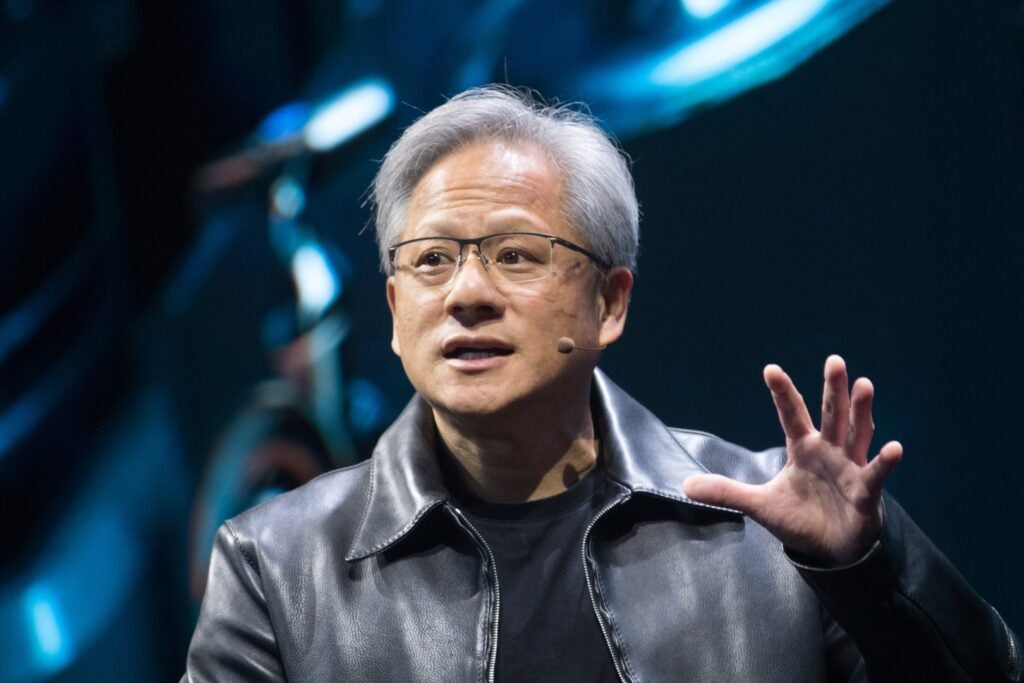
Nvidia's Shareholder Return Plan Significantly Enhanced
- Market Dominance: Nvidia's GPUs command a 95% share in the gaming market while expanding applications in AI and cloud computing, driving the company's market cap to $5 trillion, making it the world's most valuable company.
- Strong Financial Performance: In Q1 of fiscal 2027, Nvidia reported an 85% year-over-year revenue increase to $81.6 billion, with a gross margin of 74.9%, leading to a 140% surge in adjusted EPS to $1.87, showcasing robust AI-driven demand.
- Cash Flow Growth: Nvidia generated operating cash flow of $50.3 billion and free cash flow of $48.5 billion, despite a 58% increase in R&D spending to $6.3 billion, demonstrating strong cash generation capabilities while continuing to invest.
- Shareholder Return Plan: Nvidia plans to return over 50% of its free cash flow to shareholders, potentially distributing up to $110 billion over the next two years, significantly enhancing shareholder value through buybacks or increased dividends.
See More

Nvidia Launches Vera Processors to Revive Chinese Market

- New Product Launch: Nvidia has announced that its new Vera central processors will be available for Chinese clients to order as soon as August, marking a rapid pivot in the company’s strategy to revive its fortunes in China, which have declined due to stalled shipments of the H200 chip.
- Intensified Market Competition: The introduction of the Vera chip places Nvidia in direct competition with major CPU manufacturers like Intel and AMD, particularly in the supply of server CPUs for AI data centers, as Nvidia's market share in China has effectively fallen to zero.
- Initial Order Feedback: A major Chinese cloud company plans to order over 300 servers, each equipped with two Vera CPUs, although the final order will depend on testing results, indicating initial interest in the Vera chip from the market.
- Revenue Expectations: Nvidia anticipates generating approximately $20 billion in revenue from Vera chip sales by the end of this fiscal year, reflecting the company's confidence in the new product and its strategic positioning amid the global shift in AI computing demands.
See More
National Security Reshapes Semiconductor Landscape

- Investor Evaluation Shift: National security, advanced chip manufacturing, and shifting global supply chains are reshaping how investors assess semiconductor leaders, leading to increased market focus on these companies.
- Intel's Strong Performance: Intel (INTC) saw a 9.27% stock price increase, reflecting market recognition of its strategic positioning in national security and advanced manufacturing, potentially enhancing its market share.
- TSMC's Market Response: TSMC (TSM) experienced a 2.93% stock price rise, indicating investor confidence in its critical role in global supply chain restructuring, which may drive future order growth.
- Nvidia's Continued Growth: Nvidia (NVDA) stock increased by 2.30%, suggesting that its leadership in advanced chip technology is receiving positive market feedback, potentially facilitating its expansion into emerging markets.
See More

Nokia Positioned for Growth Amid AI Surge

- Market Recovery: Nokia (NOK) shares rose by 5.67%, reaching a current price of $14.16 with a market cap of $79 billion, indicating market recognition of its growth potential, particularly driven by AI advancements.
- Revenue Growth Outlook: Although the 2025 revenue forecast stands at €19.9 billion, reflecting only a 3% increase from 2024, Nokia anticipates a fivefold increase in global internet traffic by 2034, underscoring its future market significance.
- AI Partnership Prospects: Nokia's collaboration with Nvidia aims to develop AI-powered radio access network technology, which, while not yielding immediate benefits, lays the groundwork for future 6G networks and could significantly enhance the company's competitive edge in the long run.
- Industry Challenges and Opportunities: Despite the current competitive and slow-growing telecom market, Nokia's application of AI technology enables effective management of the increasing data traffic, positioning the company favorably for future market opportunities.
See More
U.S. Strategic Support for Semiconductor Industry Explained
- National Security Perspective: The U.S. views chips as a crucial element of national security, thus supporting companies like Intel and TSMC is not only an economic strategy but also a necessary measure to safeguard national interests, reflecting the reshaping of global supply chains.
- Investor Focus Areas: Despite favorable policy conditions for the semiconductor industry, investors must still monitor Intel's execution, margins, and fab utilization, as these factors will directly impact the company's market performance and investment returns.
- Industry Leader Evaluation: The interplay of national security, advanced chip manufacturing, and shifting global supply chains is reshaping how investors evaluate semiconductor leaders, with Intel, TSMC, and Nvidia's performance in this new environment becoming key indicators.
- Investment Advisory Caution: Although analysts have identified ten potential stocks, Intel was not among them, prompting investors to carefully assess its future performance, especially in comparison to other high-return stocks.
See More
Nvidia's AI Boom Yields Massive Returns for Shareholders
- Significant Revenue Growth: Nvidia reported a record revenue of $81.6 billion for Q1 of fiscal 2027, marking an 85% year-over-year increase and a 20% quarter-over-quarter rise, indicating robust financial performance driven by its AI initiatives.
- Surge in Data Center Revenue: The company's data center revenue skyrocketed by 92% year-over-year to $75.2 billion, reflecting relentless demand for its Blackwell and Vera Rubin AI chips, thereby solidifying its dominant position in the data center GPU market.
- Cash Flow and Shareholder Returns: Nvidia generated $50.3 billion in operating cash flow and $48.5 billion in free cash flow in Q1, despite a 58% increase in R&D spending to $6.3 billion, and plans to return over 50% of free cash flow to shareholders, potentially distributing up to $110 billion over the next two years.
- Massive Dividend Increase: The company raised its quarterly dividend from $0.01 to $0.25 per share, a 25-fold increase, resulting in a dividend yield of approximately 0.5%, which not only showcases its strong cash generation capabilities but also underscores its commitment to shareholders and confidence in future growth.
See More
Nvidia's Shareholder Return Plan Significantly Enhanced
- Market Dominance: Nvidia's GPUs command a 95% share in the gaming market while expanding applications in AI and cloud computing, driving the company's market cap to $5 trillion, making it the world's most valuable company.
- Strong Financial Performance: In Q1 of fiscal 2027, Nvidia reported an 85% year-over-year revenue increase to $81.6 billion, with a gross margin of 74.9%, leading to a 140% surge in adjusted EPS to $1.87, showcasing robust AI-driven demand.
- Cash Flow Growth: Nvidia generated operating cash flow of $50.3 billion and free cash flow of $48.5 billion, despite a 58% increase in R&D spending to $6.3 billion, demonstrating strong cash generation capabilities while continuing to invest.
- Shareholder Return Plan: Nvidia plans to return over 50% of its free cash flow to shareholders, potentially distributing up to $110 billion over the next two years, significantly enhancing shareholder value through buybacks or increased dividends.
See More
Nvidia Launches Vera Processors to Revive Chinese Market
- New Product Launch: Nvidia has announced that its new Vera central processors will be available for Chinese clients to order as soon as August, marking a rapid pivot in the company’s strategy to revive its fortunes in China, which have declined due to stalled shipments of the H200 chip.
- Intensified Market Competition: The introduction of the Vera chip places Nvidia in direct competition with major CPU manufacturers like Intel and AMD, particularly in the supply of server CPUs for AI data centers, as Nvidia's market share in China has effectively fallen to zero.
- Initial Order Feedback: A major Chinese cloud company plans to order over 300 servers, each equipped with two Vera CPUs, although the final order will depend on testing results, indicating initial interest in the Vera chip from the market.
- Revenue Expectations: Nvidia anticipates generating approximately $20 billion in revenue from Vera chip sales by the end of this fiscal year, reflecting the company's confidence in the new product and its strategic positioning amid the global shift in AI computing demands.
See More
National Security Reshapes Semiconductor Landscape
- Investor Evaluation Shift: National security, advanced chip manufacturing, and shifting global supply chains are reshaping how investors assess semiconductor leaders, leading to increased market focus on these companies.
- Intel's Strong Performance: Intel (INTC) saw a 9.27% stock price increase, reflecting market recognition of its strategic positioning in national security and advanced manufacturing, potentially enhancing its market share.
- TSMC's Market Response: TSMC (TSM) experienced a 2.93% stock price rise, indicating investor confidence in its critical role in global supply chain restructuring, which may drive future order growth.
- Nvidia's Continued Growth: Nvidia (NVDA) stock increased by 2.30%, suggesting that its leadership in advanced chip technology is receiving positive market feedback, potentially facilitating its expansion into emerging markets.
See More
Nokia Positioned for Growth Amid AI Surge
- Market Recovery: Nokia (NOK) shares rose by 5.67%, reaching a current price of $14.16 with a market cap of $79 billion, indicating market recognition of its growth potential, particularly driven by AI advancements.
- Revenue Growth Outlook: Although the 2025 revenue forecast stands at €19.9 billion, reflecting only a 3% increase from 2024, Nokia anticipates a fivefold increase in global internet traffic by 2034, underscoring its future market significance.
- AI Partnership Prospects: Nokia's collaboration with Nvidia aims to develop AI-powered radio access network technology, which, while not yielding immediate benefits, lays the groundwork for future 6G networks and could significantly enhance the company's competitive edge in the long run.
- Industry Challenges and Opportunities: Despite the current competitive and slow-growing telecom market, Nokia's application of AI technology enables effective management of the increasing data traffic, positioning the company favorably for future market opportunities.
See More
U.S. Strategic Support for Semiconductor Industry Explained
- National Security Perspective: The U.S. views chips as a crucial element of national security, thus supporting companies like Intel and TSMC is not only an economic strategy but also a necessary measure to safeguard national interests, reflecting the reshaping of global supply chains.
- Investor Focus Areas: Despite favorable policy conditions for the semiconductor industry, investors must still monitor Intel's execution, margins, and fab utilization, as these factors will directly impact the company's market performance and investment returns.
- Industry Leader Evaluation: The interplay of national security, advanced chip manufacturing, and shifting global supply chains is reshaping how investors evaluate semiconductor leaders, with Intel, TSMC, and Nvidia's performance in this new environment becoming key indicators.
- Investment Advisory Caution: Although analysts have identified ten potential stocks, Intel was not among them, prompting investors to carefully assess its future performance, especially in comparison to other high-return stocks.
See More




