Nvidia's Shareholder Return Plan Significantly Enhanced
Written by Emily J. Thompson, Senior Investment Analyst
Updated: 1 hour ago
0mins
Source: Fool
- Market Dominance: Nvidia's GPUs command a 95% share in the gaming market while expanding applications in AI and cloud computing, driving the company's market cap to $5 trillion, making it the world's most valuable company.
- Strong Financial Performance: In Q1 of fiscal 2027, Nvidia reported an 85% year-over-year revenue increase to $81.6 billion, with a gross margin of 74.9%, leading to a 140% surge in adjusted EPS to $1.87, showcasing robust AI-driven demand.
- Cash Flow Growth: Nvidia generated operating cash flow of $50.3 billion and free cash flow of $48.5 billion, despite a 58% increase in R&D spending to $6.3 billion, demonstrating strong cash generation capabilities while continuing to invest.
- Shareholder Return Plan: Nvidia plans to return over 50% of its free cash flow to shareholders, potentially distributing up to $110 billion over the next two years, significantly enhancing shareholder value through buybacks or increased dividends.
Trade with 70% Backtested Accuracy
Stop guessing "Should I Buy NVDA?" and start using high-conviction signals backed by rigorous historical data.
Sign up today to access powerful investing tools and make smarter, data-driven decisions.
Analyst Views on NVDA
Wall Street analysts forecast NVDA stock price to rise
41 Analyst Rating
39 Buy
1 Hold
1 Sell
Strong Buy
Current: 208.190

Low
200.00
Averages
264.97
High
352.00
Current: 208.190
Low
200.00
Averages
264.97
High
352.00
About NVDA
NVIDIA Corporation is an artificial intelligence (AI) infrastructure company. The Company is engaged in accelerated computing to help solve the challenging computational problems. Its segments include Compute & Networking and Graphics. The Compute & Networking segment includes its Data Center accelerated computing and networking platforms and AI solutions and software, and automotive platforms and autonomous and electric vehicle solutions, including software. The Graphics segment includes GeForce GPUs for gaming and personal computers (PCs), and Quadro/NVIDIA RTX GPUs for enterprise workstation graphics. Its technology stack includes the foundational NVIDIA CUDA development platform that runs on all NVIDIA GPUs, as well as hundreds of domain-specific software libraries, frameworks, algorithms, software development kits (SDKs), and application programming interfaces (APIs). Its platforms address four markets, which include Data Center, Gaming, Professional Visualization, and Automotive.
About the author

Emily J. Thompson
Emily J. Thompson, a Chartered Financial Analyst (CFA) with 12 years in investment research, graduated with honors from the Wharton School. Specializing in industrial and technology stocks, she provides in-depth analysis for Intellectia’s earnings and market brief reports.
Nvidia's AI Boom Yields Massive Returns for Shareholders

- Significant Revenue Growth: Nvidia reported a record revenue of $81.6 billion for Q1 of fiscal 2027, marking an 85% year-over-year increase and a 20% quarter-over-quarter rise, indicating robust financial performance driven by its AI initiatives.
- Surge in Data Center Revenue: The company's data center revenue skyrocketed by 92% year-over-year to $75.2 billion, reflecting relentless demand for its Blackwell and Vera Rubin AI chips, thereby solidifying its dominant position in the data center GPU market.
- Cash Flow and Shareholder Returns: Nvidia generated $50.3 billion in operating cash flow and $48.5 billion in free cash flow in Q1, despite a 58% increase in R&D spending to $6.3 billion, and plans to return over 50% of free cash flow to shareholders, potentially distributing up to $110 billion over the next two years.
- Massive Dividend Increase: The company raised its quarterly dividend from $0.01 to $0.25 per share, a 25-fold increase, resulting in a dividend yield of approximately 0.5%, which not only showcases its strong cash generation capabilities but also underscores its commitment to shareholders and confidence in future growth.
See More
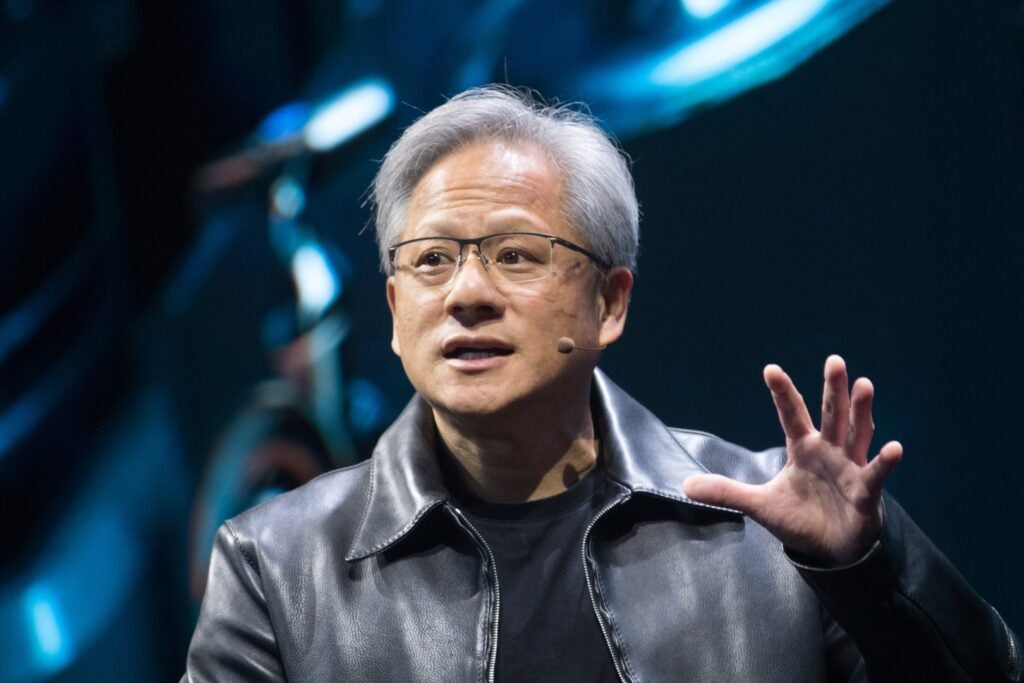
Nvidia's Shareholder Return Plan Significantly Enhanced
- Market Dominance: Nvidia's GPUs command a 95% share in the gaming market while expanding applications in AI and cloud computing, driving the company's market cap to $5 trillion, making it the world's most valuable company.
- Strong Financial Performance: In Q1 of fiscal 2027, Nvidia reported an 85% year-over-year revenue increase to $81.6 billion, with a gross margin of 74.9%, leading to a 140% surge in adjusted EPS to $1.87, showcasing robust AI-driven demand.
- Cash Flow Growth: Nvidia generated operating cash flow of $50.3 billion and free cash flow of $48.5 billion, despite a 58% increase in R&D spending to $6.3 billion, demonstrating strong cash generation capabilities while continuing to invest.
- Shareholder Return Plan: Nvidia plans to return over 50% of its free cash flow to shareholders, potentially distributing up to $110 billion over the next two years, significantly enhancing shareholder value through buybacks or increased dividends.
See More

Apple's Siri Update Set to Generate Billions in Revenue

- Upgrade Incentives: Apple's new Siri AI features are exclusive to iPhone 15 Pro and newer models, likely prompting a significant number of users to upgrade their devices, which could drive tens of billions in sales growth over the coming years among the current 1.5 billion iPhone users.
- Surge in Services Revenue: While most AI tools are offered for free, Apple will impose usage limits on advanced features, requiring users to subscribe to iCloud+ for expanded access, which is expected to add $15 billion to $20 billion annually to Apple's services revenue, further solidifying its position in the AI services market.
- Mixed Market Reaction: Despite a stock price increase on launch day, the subsequent drop indicates mixed market reactions to the new features, prompting investors to carefully assess Apple's long-term strategy and potential returns in the AI sector.
- Steady Strategic Positioning: Apple's cautious approach in the AI space suggests that as the iPhone upgrade cycle unfolds, sales of its flagship product will see significant growth, while iCloud+ may evolve into a more comprehensive AI service platform, enhancing user engagement and loyalty.
See More
Analysis of Broadcom vs Nvidia in AI Chip Competition

- Market Performance Comparison: Broadcom has had a solid 2026, with over a 13% increase year-to-date, but has seen a 20% drop post-earnings announcement, indicating market concerns about its future growth, especially against Nvidia.
- Revenue Growth Discrepancy: Nvidia's revenue rose 85% year-over-year in Q1 FY2027, while Broadcom's overall revenue grew by 48%; however, Broadcom's AI semiconductor segment grew at an impressive 143%, with projections of 200% growth next quarter, highlighting its potential in niche markets.
- Pricing and Market Share: Although Broadcom's AI chip business is rapidly expanding, it still needs to execute effectively to gain market share, as its forward P/E ratio remains higher than Nvidia's, reflecting investor caution regarding Broadcom's future performance.
- Investment Outlook Assessment: Despite Broadcom's potential in AI, Nvidia is viewed as the more attractive investment due to its strong industry partnerships and faster growth rate, while Broadcom is considered another solid AI investment opportunity.
See More
Nvidia and Broadcom Compete for Data Center Dominance
- Market Competition: Nvidia's revenue growth in the data center market reached 85%, significantly outpacing Broadcom's 48% overall revenue increase, highlighting its strong performance amid surging AI demand and reinforcing its industry leadership.
- AI Chip Business Growth: Broadcom's AI semiconductor revenue grew at a pace of 143%, with projections for 200% growth next quarter, indicating the market potential of its custom AI chip business for specific workloads, although its overall performance still lags behind Nvidia.
- Valuation Discrepancy: Despite a significant stock price correction, Broadcom's forward P/E ratio remains higher than Nvidia's, reflecting market expectations for its AI chip business; however, Nvidia's deep industry partnerships make it a more attractive investment choice.
- Investment Recommendation: While Broadcom shows strong performance in AI, Nvidia is still considered the better investment choice, particularly given its sustained market leadership and robust growth potential, prompting investors to exercise caution in their selections.
See More
Analysis of Investment Choices in Robotics and Automation


- Return Comparison: As of May 30, the ARK Autonomous Technology & Robotics ETF delivered a 79.99% return over the past year, significantly outperforming the Invesco QQQ ETF's 42.71%, indicating that investments focused on robotics and automation may yield higher short-term gains.
- Holding Structure Analysis: The ARK ETF holds 40 stocks, with the top five accounting for 37%, including Tesla at 10.34%, suggesting that the fund's concentrated investments in specific sectors may pose high risks but also potential high rewards.
- Long-Term Performance Evaluation: Despite the ARK fund's strong recent performance, the Invesco QQQ ETF has achieved an annualized return of 21.8% since its inception in 2014, demonstrating its stability and reliability for long-term investors.
- Fee and Diversification Considerations: The ARK fund charges a management fee of 0.75%, while the Invesco QQQ's fee is only 0.18%, making the latter more attractive in terms of cost efficiency, and its 102-stock diversification also reduces investment risk.
See More
Nvidia's AI Boom Yields Massive Returns for Shareholders
- Significant Revenue Growth: Nvidia reported a record revenue of $81.6 billion for Q1 of fiscal 2027, marking an 85% year-over-year increase and a 20% quarter-over-quarter rise, indicating robust financial performance driven by its AI initiatives.
- Surge in Data Center Revenue: The company's data center revenue skyrocketed by 92% year-over-year to $75.2 billion, reflecting relentless demand for its Blackwell and Vera Rubin AI chips, thereby solidifying its dominant position in the data center GPU market.
- Cash Flow and Shareholder Returns: Nvidia generated $50.3 billion in operating cash flow and $48.5 billion in free cash flow in Q1, despite a 58% increase in R&D spending to $6.3 billion, and plans to return over 50% of free cash flow to shareholders, potentially distributing up to $110 billion over the next two years.
- Massive Dividend Increase: The company raised its quarterly dividend from $0.01 to $0.25 per share, a 25-fold increase, resulting in a dividend yield of approximately 0.5%, which not only showcases its strong cash generation capabilities but also underscores its commitment to shareholders and confidence in future growth.
See More
Nvidia's Shareholder Return Plan Significantly Enhanced
- Market Dominance: Nvidia's GPUs command a 95% share in the gaming market while expanding applications in AI and cloud computing, driving the company's market cap to $5 trillion, making it the world's most valuable company.
- Strong Financial Performance: In Q1 of fiscal 2027, Nvidia reported an 85% year-over-year revenue increase to $81.6 billion, with a gross margin of 74.9%, leading to a 140% surge in adjusted EPS to $1.87, showcasing robust AI-driven demand.
- Cash Flow Growth: Nvidia generated operating cash flow of $50.3 billion and free cash flow of $48.5 billion, despite a 58% increase in R&D spending to $6.3 billion, demonstrating strong cash generation capabilities while continuing to invest.
- Shareholder Return Plan: Nvidia plans to return over 50% of its free cash flow to shareholders, potentially distributing up to $110 billion over the next two years, significantly enhancing shareholder value through buybacks or increased dividends.
See More
Apple's Siri Update Set to Generate Billions in Revenue
- Upgrade Incentives: Apple's new Siri AI features are exclusive to iPhone 15 Pro and newer models, likely prompting a significant number of users to upgrade their devices, which could drive tens of billions in sales growth over the coming years among the current 1.5 billion iPhone users.
- Surge in Services Revenue: While most AI tools are offered for free, Apple will impose usage limits on advanced features, requiring users to subscribe to iCloud+ for expanded access, which is expected to add $15 billion to $20 billion annually to Apple's services revenue, further solidifying its position in the AI services market.
- Mixed Market Reaction: Despite a stock price increase on launch day, the subsequent drop indicates mixed market reactions to the new features, prompting investors to carefully assess Apple's long-term strategy and potential returns in the AI sector.
- Steady Strategic Positioning: Apple's cautious approach in the AI space suggests that as the iPhone upgrade cycle unfolds, sales of its flagship product will see significant growth, while iCloud+ may evolve into a more comprehensive AI service platform, enhancing user engagement and loyalty.
See More
Analysis of Broadcom vs Nvidia in AI Chip Competition
- Market Performance Comparison: Broadcom has had a solid 2026, with over a 13% increase year-to-date, but has seen a 20% drop post-earnings announcement, indicating market concerns about its future growth, especially against Nvidia.
- Revenue Growth Discrepancy: Nvidia's revenue rose 85% year-over-year in Q1 FY2027, while Broadcom's overall revenue grew by 48%; however, Broadcom's AI semiconductor segment grew at an impressive 143%, with projections of 200% growth next quarter, highlighting its potential in niche markets.
- Pricing and Market Share: Although Broadcom's AI chip business is rapidly expanding, it still needs to execute effectively to gain market share, as its forward P/E ratio remains higher than Nvidia's, reflecting investor caution regarding Broadcom's future performance.
- Investment Outlook Assessment: Despite Broadcom's potential in AI, Nvidia is viewed as the more attractive investment due to its strong industry partnerships and faster growth rate, while Broadcom is considered another solid AI investment opportunity.
See More
Nvidia and Broadcom Compete for Data Center Dominance
- Market Competition: Nvidia's revenue growth in the data center market reached 85%, significantly outpacing Broadcom's 48% overall revenue increase, highlighting its strong performance amid surging AI demand and reinforcing its industry leadership.
- AI Chip Business Growth: Broadcom's AI semiconductor revenue grew at a pace of 143%, with projections for 200% growth next quarter, indicating the market potential of its custom AI chip business for specific workloads, although its overall performance still lags behind Nvidia.
- Valuation Discrepancy: Despite a significant stock price correction, Broadcom's forward P/E ratio remains higher than Nvidia's, reflecting market expectations for its AI chip business; however, Nvidia's deep industry partnerships make it a more attractive investment choice.
- Investment Recommendation: While Broadcom shows strong performance in AI, Nvidia is still considered the better investment choice, particularly given its sustained market leadership and robust growth potential, prompting investors to exercise caution in their selections.
See More
Analysis of Investment Choices in Robotics and Automation
- Return Comparison: As of May 30, the ARK Autonomous Technology & Robotics ETF delivered a 79.99% return over the past year, significantly outperforming the Invesco QQQ ETF's 42.71%, indicating that investments focused on robotics and automation may yield higher short-term gains.
- Holding Structure Analysis: The ARK ETF holds 40 stocks, with the top five accounting for 37%, including Tesla at 10.34%, suggesting that the fund's concentrated investments in specific sectors may pose high risks but also potential high rewards.
- Long-Term Performance Evaluation: Despite the ARK fund's strong recent performance, the Invesco QQQ ETF has achieved an annualized return of 21.8% since its inception in 2014, demonstrating its stability and reliability for long-term investors.
- Fee and Diversification Considerations: The ARK fund charges a management fee of 0.75%, while the Invesco QQQ's fee is only 0.18%, making the latter more attractive in terms of cost efficiency, and its 102-stock diversification also reduces investment risk.
See More