Comparing Growth Prospects: Amazon vs. MercadoLibre
Written by Emily J. Thompson, Senior Investment Analyst
Updated: 3 days ago
0mins

Source: Yahoo Finance
- Amazon's AI Potential: Amazon's AI platform Bedrock is utilized by 80% of Fortune 100 companies, with customer spending increasing by 170% year-over-year in Q1, showcasing its robust growth potential in AI, which further drives a 28% year-over-year growth in cloud revenue, enhancing market competitiveness.
- MercadoLibre's Market Opportunity: MercadoLibre achieved a 46% year-over-year revenue growth in Q1, and after lowering the free shipping threshold in Brazil, gross merchandise volume grew by 38% year-over-year, indicating strong growth momentum and significant market potential in Latin America.
- Investor Confidence Rebound: Amazon's stock price has risen 15% this year, reflecting a renewed market recognition of its capital expenditures and AI investments, indicating the company's advantageous position in the rapidly growing AI market and boosting investor confidence.
- MercadoLibre's Long-Term Strategy: Despite recent stock price declines, MercadoLibre's monthly active users increased by 29% year-over-year, and its credit portfolio grew by 87%, highlighting its potential in the fintech sector, which is expected to attract more investor attention in the future.
Trade with 70% Backtested Accuracy
Stop guessing "Should I Buy AMZN?" and start using high-conviction signals backed by rigorous historical data.
Sign up today to access powerful investing tools and make smarter, data-driven decisions.
Analyst Views on AMZN
Wall Street analysts forecast AMZN stock price to rise
44 Analyst Rating
41 Buy
3 Hold
0 Sell
Strong Buy
Current: 274.000

Low
175.00
Averages
280.01
High
325.00
Current: 274.000
Low
175.00
Averages
280.01
High
325.00
About AMZN
Amazon.com, Inc. provides a range of products and services to customers. The products offered through its stores include merchandise and content it has purchased for resale and products offered by third-party sellers. The Company’s segments include North America, International and Amazon Web Services (AWS). It serves consumers through its online and physical stores and focuses on selection, price, and convenience. Customers access its offerings through its websites, mobile apps, Alexa, devices, streaming, and physically visiting its stores. It also manufactures and sells electronic devices, including Kindle, Fire tablet, Fire TV, Echo, Ring, Blink, and eero, and develops and produces media content. It serves developers and enterprises of all sizes, including start-ups, government agencies, and academic institutions, through AWS, which offers a set of on-demand technology services, including compute, storage, database, analytics, and machine learning, and other services.
About the author

Emily J. Thompson
Emily J. Thompson, a Chartered Financial Analyst (CFA) with 12 years in investment research, graduated with honors from the Wharton School. Specializing in industrial and technology stocks, she provides in-depth analysis for Intellectia’s earnings and market brief reports.

Amazon Faces Market Pressure After Blue Origin Launchpad Explosion

- Launch Schedule Disruption: The explosion at Cape Canaveral severely damaged the launchpad, impacting Amazon's plan to deploy 48 low-Earth orbit satellites, which may delay its deployment timeline and affect its competitiveness in the global market.
- Increased Market Competition: With SpaceX's Starlink already far ahead in satellite deployments, any delay for Amazon will slow its progress in high-value markets, intensifying competitive pressures in the low-Earth orbit satellite sector.
- Limited Financial Impact: Analysts note that while the incident may not have immediate financial repercussions for Amazon, the increased schedule risk and launch diversification concerns could negatively affect market perceptions and stock performance.
- Increased Dependency: Amazon had counted on up to 24 New Glenn launches to support its satellite constellation rollout, and the explosion may force it to rely on other, generally more expensive launch service providers like ULA and Ariane, increasing operational costs.
See More

Valuation Analysis of the Magnificent Seven Tech Giants


- Nvidia's Market Position: As the leader in the GPU market, Nvidia has benefited from the AI boom over the past three years, and despite its forward P/E of 23.8, it remains the second cheapest among the Magnificent Seven, indicating significant future growth potential.
- Microsoft's Capital Expenditure: Microsoft plans to invest $190 billion in capital expenditures in 2026, primarily to support its cloud computing and AI businesses; although the market remains skeptical about its future performance, its forward P/E of 24.5 suggests investment value.
- Meta Platforms' User Growth: With a forward P/E of about 19.3, Meta faces pressures from declining daily active users and increased capital expenditures, yet its vast user ecosystem and AI-driven advertising business provide strong growth potential.
- Long-Term Investment Outlook: While the forward P/E ratio is a crucial metric for assessing stock value, Nvidia, Microsoft, and Meta still demonstrate robust long-term investment prospects due to their innovative capabilities and competitive advantages.
See More

Financial Comparison Between Amazon and Microsoft
- Revenue Comparison: Amazon reported total revenue of $181.5 billion, reflecting a 17% year-over-year increase, while Microsoft achieved $82.9 billion, with an 18% growth, indicating strong performances from both companies despite Amazon's higher total revenue.
- Cloud Growth: Amazon's AWS generated $37.6 billion in sales during Q1, marking a 28% year-over-year increase, while Microsoft's cloud revenue also rose 29% to $54.5 billion, highlighting the intensifying competition in the AI sector between the two giants.
- Profit Margin Discrepancy: Amazon's net income margin stands at 17%, significantly lower than Microsoft's 38%, which reflects Microsoft's superior cost control and profitability, potentially influencing investor perceptions of both companies' long-term viability.
- Market Share Competition: While Amazon leads in cloud computing market share, Microsoft's AI business saw an impressive annual revenue run rate increase of 123%, showcasing its potential in technological innovation and market adaptability, prompting investors to monitor future market dynamics.
See More
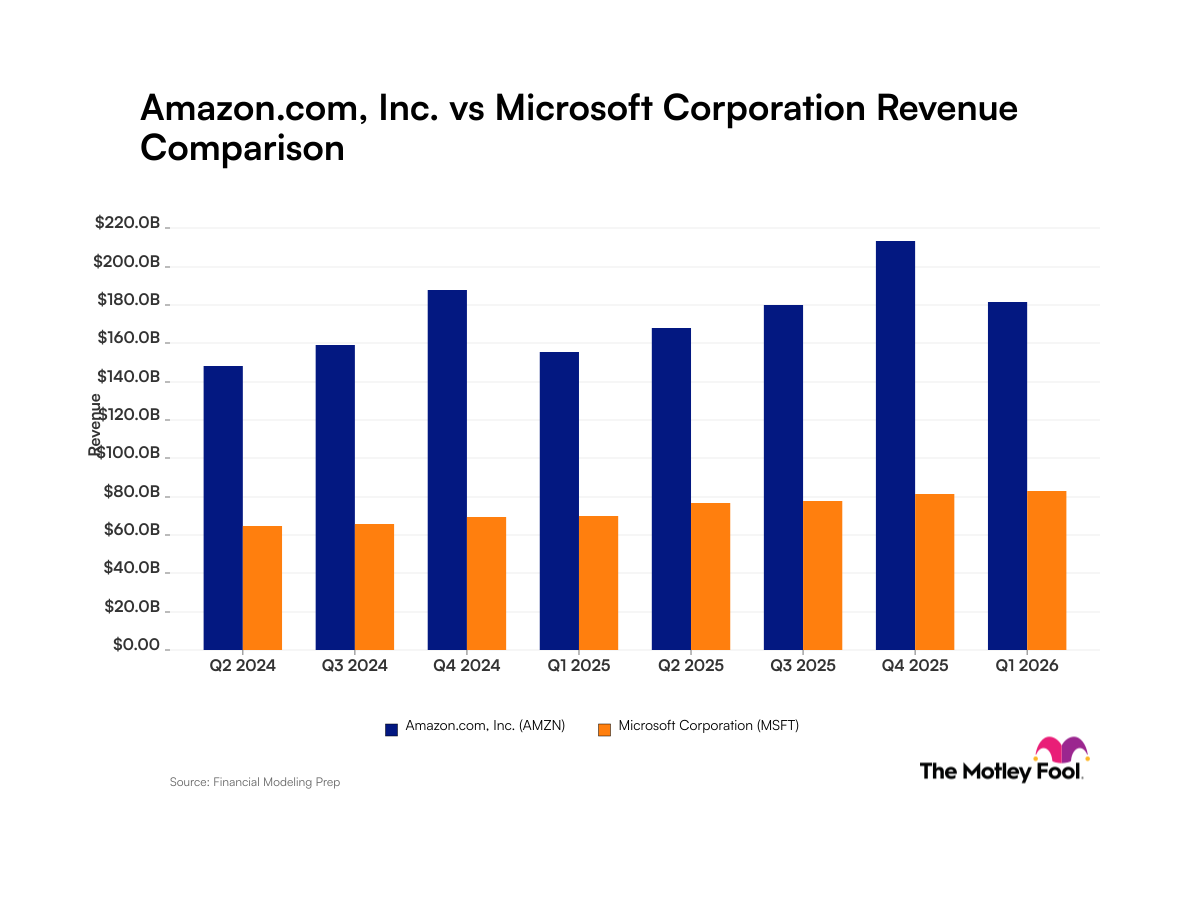
Amazon and Microsoft Quarterly Revenue Analysis
- Amazon Revenue Growth: In Q1 2026, Amazon reported revenue of $181.5 billion, a 17% year-over-year increase, with its cloud computing segment, AWS, achieving sales of $37.6 billion, reflecting a robust 28% growth year-over-year, underscoring its strong demand in the AI sector and market leadership.
- Microsoft Steady Revenue: Microsoft generated $82.9 billion in revenue for Q1 2026, marking an 18% year-over-year increase, with its AI business experiencing a remarkable annual revenue run rate increase of 123%, indicating its competitiveness in the rapidly evolving cloud computing market, particularly with cloud revenue rising 29% to $54.5 billion.
- Market Competition Landscape: Amazon and Microsoft are in fierce competition within the cloud computing sector, with Amazon leading in market share while Microsoft follows closely, both investing heavily in AI products to meet the surging customer demand, thereby driving overall revenue growth.
- Strategic Investments and Future Outlook: Both Amazon and Microsoft have made significant investments in AI infrastructure, with Amazon's AWS upgrades supporting rapid growth in its cloud business, while Microsoft's AI segment also shows strong growth potential, attracting investor interest in the future trajectories of both companies.
See More

Amazon's Layoffs Signal Cloud Expansion Strategy
- Layoff Scale and Impact: Amazon laid off 16,000 employees in January 2023, primarily affecting AWS, retail operations, Prime Video, and HR, as part of its goal to cut 30,000 jobs, demonstrating its commitment to optimizing resource allocation.
- AWS Market Position: According to Canalys, AWS controls nearly one-third of the global cloud infrastructure market, and despite layoffs, it remains Amazon's core profit engine, supporting the expansion of its lower-margin retail business, indicating its strong competitive advantage.
- Future Investment Plans: Amazon plans to increase its capital expenditures from $131.8 billion in 2025 to $200 billion in 2026, signaling its intent to expand cloud and AI infrastructure, suggesting that the layoffs are aimed at more efficient resource utilization rather than downsizing.
- AI Market Strategy: AWS not only provides infrastructure for top AI companies but also develops its own AI tools and custom chips, and the layoffs reflect Amazon's confidence in its AI-driven automation capabilities, indicating potential advantages in future market competition.
See More

Amazon's Layoffs and AI Strategy Shift
- Layoff Scale: Amazon has cut approximately 30,000 positions since last October, with 16,000 layoffs occurring this January primarily in AWS and other divisions, aimed at enhancing operational efficiency and reducing costs.
- AWS Market Position: AWS controls nearly a third of the global cloud infrastructure market, with net sales growing at a 23% CAGR from 2020 to 2025, and operating margins increasing from 29.8% to 35.4%, underscoring its strategic importance as Amazon's core profit engine.
- AI Investment Plans: Despite the layoffs, Amazon plans to increase its capital expenditures from $131.8 billion in 2025 to $200 billion in 2026, indicating a commitment to expanding its cloud and AI infrastructure while enhancing operational efficiency through AI tools.
- Long-term Growth Confidence: The layoffs at Amazon are not a sign of weakness but rather a demonstration of confidence in its AI-driven automation capabilities, indicating the company's strategy to maintain a competitive edge in a rapidly evolving market.
See More
Amazon Faces Market Pressure After Blue Origin Launchpad Explosion
- Launch Schedule Disruption: The explosion at Cape Canaveral severely damaged the launchpad, impacting Amazon's plan to deploy 48 low-Earth orbit satellites, which may delay its deployment timeline and affect its competitiveness in the global market.
- Increased Market Competition: With SpaceX's Starlink already far ahead in satellite deployments, any delay for Amazon will slow its progress in high-value markets, intensifying competitive pressures in the low-Earth orbit satellite sector.
- Limited Financial Impact: Analysts note that while the incident may not have immediate financial repercussions for Amazon, the increased schedule risk and launch diversification concerns could negatively affect market perceptions and stock performance.
- Increased Dependency: Amazon had counted on up to 24 New Glenn launches to support its satellite constellation rollout, and the explosion may force it to rely on other, generally more expensive launch service providers like ULA and Ariane, increasing operational costs.
See More
Valuation Analysis of the Magnificent Seven Tech Giants
- Nvidia's Market Position: As the leader in the GPU market, Nvidia has benefited from the AI boom over the past three years, and despite its forward P/E of 23.8, it remains the second cheapest among the Magnificent Seven, indicating significant future growth potential.
- Microsoft's Capital Expenditure: Microsoft plans to invest $190 billion in capital expenditures in 2026, primarily to support its cloud computing and AI businesses; although the market remains skeptical about its future performance, its forward P/E of 24.5 suggests investment value.
- Meta Platforms' User Growth: With a forward P/E of about 19.3, Meta faces pressures from declining daily active users and increased capital expenditures, yet its vast user ecosystem and AI-driven advertising business provide strong growth potential.
- Long-Term Investment Outlook: While the forward P/E ratio is a crucial metric for assessing stock value, Nvidia, Microsoft, and Meta still demonstrate robust long-term investment prospects due to their innovative capabilities and competitive advantages.
See More
Financial Comparison Between Amazon and Microsoft
- Revenue Comparison: Amazon reported total revenue of $181.5 billion, reflecting a 17% year-over-year increase, while Microsoft achieved $82.9 billion, with an 18% growth, indicating strong performances from both companies despite Amazon's higher total revenue.
- Cloud Growth: Amazon's AWS generated $37.6 billion in sales during Q1, marking a 28% year-over-year increase, while Microsoft's cloud revenue also rose 29% to $54.5 billion, highlighting the intensifying competition in the AI sector between the two giants.
- Profit Margin Discrepancy: Amazon's net income margin stands at 17%, significantly lower than Microsoft's 38%, which reflects Microsoft's superior cost control and profitability, potentially influencing investor perceptions of both companies' long-term viability.
- Market Share Competition: While Amazon leads in cloud computing market share, Microsoft's AI business saw an impressive annual revenue run rate increase of 123%, showcasing its potential in technological innovation and market adaptability, prompting investors to monitor future market dynamics.
See More
Amazon and Microsoft Quarterly Revenue Analysis
- Amazon Revenue Growth: In Q1 2026, Amazon reported revenue of $181.5 billion, a 17% year-over-year increase, with its cloud computing segment, AWS, achieving sales of $37.6 billion, reflecting a robust 28% growth year-over-year, underscoring its strong demand in the AI sector and market leadership.
- Microsoft Steady Revenue: Microsoft generated $82.9 billion in revenue for Q1 2026, marking an 18% year-over-year increase, with its AI business experiencing a remarkable annual revenue run rate increase of 123%, indicating its competitiveness in the rapidly evolving cloud computing market, particularly with cloud revenue rising 29% to $54.5 billion.
- Market Competition Landscape: Amazon and Microsoft are in fierce competition within the cloud computing sector, with Amazon leading in market share while Microsoft follows closely, both investing heavily in AI products to meet the surging customer demand, thereby driving overall revenue growth.
- Strategic Investments and Future Outlook: Both Amazon and Microsoft have made significant investments in AI infrastructure, with Amazon's AWS upgrades supporting rapid growth in its cloud business, while Microsoft's AI segment also shows strong growth potential, attracting investor interest in the future trajectories of both companies.
See More
Amazon's Layoffs Signal Cloud Expansion Strategy
- Layoff Scale and Impact: Amazon laid off 16,000 employees in January 2023, primarily affecting AWS, retail operations, Prime Video, and HR, as part of its goal to cut 30,000 jobs, demonstrating its commitment to optimizing resource allocation.
- AWS Market Position: According to Canalys, AWS controls nearly one-third of the global cloud infrastructure market, and despite layoffs, it remains Amazon's core profit engine, supporting the expansion of its lower-margin retail business, indicating its strong competitive advantage.
- Future Investment Plans: Amazon plans to increase its capital expenditures from $131.8 billion in 2025 to $200 billion in 2026, signaling its intent to expand cloud and AI infrastructure, suggesting that the layoffs are aimed at more efficient resource utilization rather than downsizing.
- AI Market Strategy: AWS not only provides infrastructure for top AI companies but also develops its own AI tools and custom chips, and the layoffs reflect Amazon's confidence in its AI-driven automation capabilities, indicating potential advantages in future market competition.
See More
Amazon's Layoffs and AI Strategy Shift
- Layoff Scale: Amazon has cut approximately 30,000 positions since last October, with 16,000 layoffs occurring this January primarily in AWS and other divisions, aimed at enhancing operational efficiency and reducing costs.
- AWS Market Position: AWS controls nearly a third of the global cloud infrastructure market, with net sales growing at a 23% CAGR from 2020 to 2025, and operating margins increasing from 29.8% to 35.4%, underscoring its strategic importance as Amazon's core profit engine.
- AI Investment Plans: Despite the layoffs, Amazon plans to increase its capital expenditures from $131.8 billion in 2025 to $200 billion in 2026, indicating a commitment to expanding its cloud and AI infrastructure while enhancing operational efficiency through AI tools.
- Long-term Growth Confidence: The layoffs at Amazon are not a sign of weakness but rather a demonstration of confidence in its AI-driven automation capabilities, indicating the company's strategy to maintain a competitive edge in a rapidly evolving market.
See More