Analyst Lowers Salesforce Price Target Amid AI Concerns
Written by Emily J. Thompson, Senior Investment Analyst
Updated: 43 minutes ago
0mins
Source: NASDAQ.COM
- Price Target Reduction: Analyst Karl Keirstead from UBS lowered Salesforce's price target from $200 to $185 per share while maintaining a neutral rating, resulting in a more than 2% drop in Salesforce's stock price, indicating market concerns about its future performance.
- AI Disruption Fears: Investor fears regarding potential AI disruption of traditional software persist, particularly as legacy companies like Salesforce face competition from emerging AI technologies, contributing to a negative sentiment in the market.
- Strong Performance: Despite challenges, Salesforce reported a beat-and-raise performance in its final earnings release for fiscal year 2025, followed by a fourth quarter that exceeded analyst expectations with double-digit growth in both revenue and profits, showcasing its proactive approach to technological innovation.
- Poor Market Reaction: Although Salesforce's efforts in AI are seen as forward-thinking, the market's response has not reflected the company's potential, as the neutral rating from analysts failed to boost investor confidence, leading to a lackluster stock performance.
Trade with 70% Backtested Accuracy
Stop guessing "Should I Buy CRM?" and start using high-conviction signals backed by rigorous historical data.
Sign up today to access powerful investing tools and make smarter, data-driven decisions.
Analyst Views on CRM
Wall Street analysts forecast CRM stock price to rise
39 Analyst Rating
29 Buy
9 Hold
1 Sell
Moderate Buy
Current: 180.100

Low
223.00
Averages
326.40
High
405.00
Current: 180.100
Low
223.00
Averages
326.40
High
405.00
About CRM
Salesforce, Inc. is a customer relationship management (CRM) technology company. Its artificial intelligence (AI) powered Agentforce 360 Platform offers sales, service, marketing, commerce, collaboration, data management, integration, analytics, and information technology (IT) service solutions. It enables customers to build and deploy digital labor for employees and customers, leveraging autonomous AI agents across business functions. Its service offerings include Agentforce Sales, Agentforce Service, Agentforce 360 Platform, Slack and Others. The Agentforce Sales provides sales capabilities and tools built for organizations across prospecting, sales engagement, team collaboration, sales analytics and AI, sales programs, sales performance, partner management, and revenue and orders. The Agentforce Service provides field service solutions that enable companies to connect service agents, dispatchers and mobile employees through platform to schedule, dispatch and manage jobs.
About the author

Emily J. Thompson
Emily J. Thompson, a Chartered Financial Analyst (CFA) with 12 years in investment research, graduated with honors from the Wharton School. Specializing in industrial and technology stocks, she provides in-depth analysis for Intellectia’s earnings and market brief reports.

Analyst Lowers Salesforce Price Target Amid AI Concerns


- Price Target Reduction: Analyst Karl Keirstead from UBS lowered Salesforce's price target from $200 to $185 per share while maintaining a neutral rating, resulting in a more than 2% drop in Salesforce's stock price, indicating market concerns about its future performance.
- AI Disruption Fears: Investor fears regarding potential AI disruption of traditional software persist, particularly as legacy companies like Salesforce face competition from emerging AI technologies, contributing to a negative sentiment in the market.
- Strong Performance: Despite challenges, Salesforce reported a beat-and-raise performance in its final earnings release for fiscal year 2025, followed by a fourth quarter that exceeded analyst expectations with double-digit growth in both revenue and profits, showcasing its proactive approach to technological innovation.
- Poor Market Reaction: Although Salesforce's efforts in AI are seen as forward-thinking, the market's response has not reflected the company's potential, as the neutral rating from analysts failed to boost investor confidence, leading to a lackluster stock performance.
See More

Salesforce Stock Drops After Analyst Cuts Price Target
- Price Target Cut: Analyst Karl Keirstead from UBS lowered Salesforce's price target from $200 to $185 while maintaining a neutral rating, resulting in a more than 2% drop in Salesforce's stock price.
- Market Sentiment Impact: Amid increased volatility in legacy software stocks, investor fears regarding potential AI disruption to traditional software solutions continue to dampen Salesforce's market performance.
- Strong Performance: Despite market pressures, Salesforce exceeded analyst expectations in both the third and fourth quarters of fiscal 2025, demonstrating its forward-thinking approach in AI and achieving double-digit growth in revenue and profits.
- Undervalued Potential: The launch of Salesforce's Agentforce AI solution highlights its proactive stance on technological innovation, suggesting that despite market misperceptions, the company remains a strong competitor in its segment.
See More

US Stocks Edge Up as Economic Data Shows Stability


- Economic Stability: US weekly initial unemployment claims fell by 3,000 to 209,000, close to the expected 210,000, indicating stability in the labor market and boosting investor confidence in economic recovery.
- Manufacturing Expansion: The May S&P manufacturing PMI unexpectedly rose by 0.8 to 55.3, surpassing expectations of 53.8, marking the strongest pace of expansion in four years, which could drive investment and growth in related sectors.
- Oil Price Volatility: WTI crude oil prices retreated after an initial 4% gain, influenced by market reactions to the situation in Iran, highlighting the uncertainty in the energy market that may impact the overall economy.
- Corporate Earnings Performance: So far, 83% of the 466 S&P 500 companies have beaten earnings estimates, with Q1 earnings projected to climb 12% year-over-year, providing support for the stock market despite a slowdown in the tech sector.
See More

US Stock Market Pressured by Rising Oil Prices Amid Iran Tensions
- Oil Price Surge Impacts Market: The S&P 500 index fell 0.35%, the Dow Jones Industrial Average dropped 0.11%, and the Nasdaq 100 index decreased 0.51% as crude oil prices rose over 2% due to tensions between the US and Iran, indicating market concerns over potential energy supply disruptions.
- Mixed Economic Data: Initial US weekly unemployment claims fell by 3,000 to 209,000, close to expectations, while the May Philadelphia Fed business outlook survey unexpectedly dropped to -0.4, reflecting uncertainty in economic recovery that could affect investor confidence.
- Weak Performance in Tech Stocks: Nvidia's earnings beat expectations but its stock fell over 1% amid rising competition, and Intuit plummeted more than 19% due to revenue falling short of forecasts, highlighting challenges within the tech sector.
- International Market Volatility: Overseas markets showed mixed results, with the Euro Stoxx 50 down 0.02%, China's Shanghai Composite falling 2.04%, while Japan's Nikkei index rose 3.14%, reflecting global economic uncertainty and divergent investor sentiment.
See More

US Stock Indices Decline as Oil Prices Surge


- Oil Price Surge Affects Markets: Crude oil prices jumped over 3% due to doubts about a US-Iran peace deal, leading the S&P 500 to decline by 0.44%, the Dow Jones by 0.47%, and the Nasdaq 100 by 0.49%, indicating market sensitivity to geopolitical risks.
- Mixed Economic Data: Initial US weekly unemployment claims fell by 3,000 to 209,000, close to the expected 210,000, while the May Philadelphia Fed business outlook unexpectedly dropped by 27.1 to -0.4, reflecting uncertainty in economic recovery that could impact investor confidence.
- Divergent Tech Stock Performance: Nvidia's earnings report exceeded expectations, yet its stock fell by 0.60% amid rising competition, highlighting the challenges tech companies face in sustaining growth in a highly competitive environment.
- International Market Volatility: Overseas stock markets showed mixed results, with the Euro Stoxx 50 down 0.52% and Japan's Nikkei up 3.14%, reflecting varying responses to economic conditions across different regions, which may influence investors' asset allocation strategies.
See More
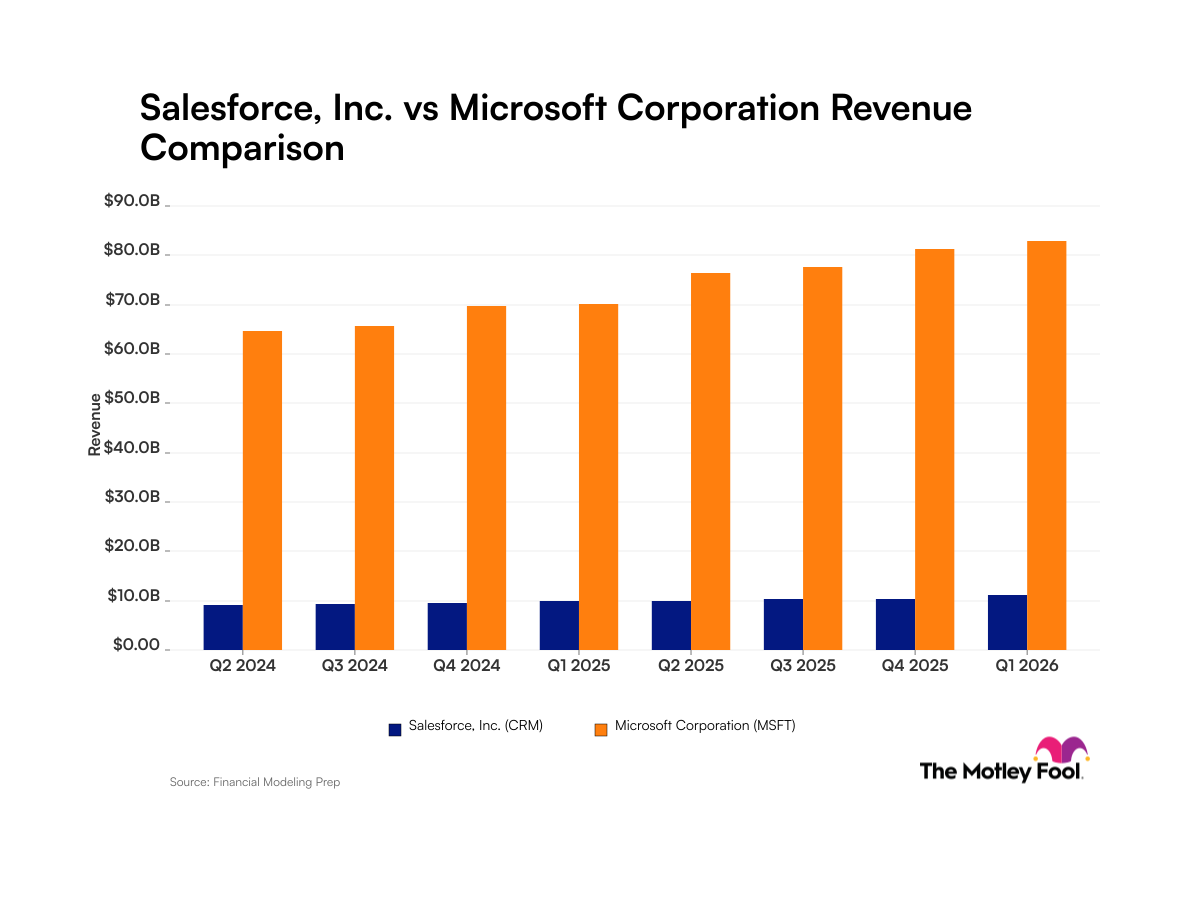
Salesforce and Microsoft Revenue Analysis

- Salesforce Revenue Growth: Salesforce reported a revenue of $41.5 billion for the fiscal year 2026, marking a 10% year-over-year increase, with projections for fiscal 2027 sales between $45.8 billion and $46.2 billion, indicating resilience against AI competition and boosting investor confidence.
- Microsoft Financial Performance: Microsoft achieved sales of $82.9 billion in its fiscal third quarter ending March 31, 2026, reflecting an 18% year-over-year growth, and despite concerns over capital expenditures, the strong growth suggests necessary infrastructure expansion to meet AI demand.
- Net Margin Comparison: Salesforce reported a net income margin of approximately 17% for the quarter ending January 31, 2026, while Microsoft achieved about 38% for the quarter ending March 31, 2026, highlighting a significant disparity in profitability between the two companies.
- Market Valuation Analysis: Salesforce's forward price-to-earnings ratio stands at 14, near a low point over the past year, indicating attractive stock valuation, while Microsoft's forward P/E ratio of 22, though not as cheap as Salesforce, is still lower than a year ago, suggesting it also presents investment value.
See More
Analyst Lowers Salesforce Price Target Amid AI Concerns
- Price Target Reduction: Analyst Karl Keirstead from UBS lowered Salesforce's price target from $200 to $185 per share while maintaining a neutral rating, resulting in a more than 2% drop in Salesforce's stock price, indicating market concerns about its future performance.
- AI Disruption Fears: Investor fears regarding potential AI disruption of traditional software persist, particularly as legacy companies like Salesforce face competition from emerging AI technologies, contributing to a negative sentiment in the market.
- Strong Performance: Despite challenges, Salesforce reported a beat-and-raise performance in its final earnings release for fiscal year 2025, followed by a fourth quarter that exceeded analyst expectations with double-digit growth in both revenue and profits, showcasing its proactive approach to technological innovation.
- Poor Market Reaction: Although Salesforce's efforts in AI are seen as forward-thinking, the market's response has not reflected the company's potential, as the neutral rating from analysts failed to boost investor confidence, leading to a lackluster stock performance.
See More
Salesforce Stock Drops After Analyst Cuts Price Target
- Price Target Cut: Analyst Karl Keirstead from UBS lowered Salesforce's price target from $200 to $185 while maintaining a neutral rating, resulting in a more than 2% drop in Salesforce's stock price.
- Market Sentiment Impact: Amid increased volatility in legacy software stocks, investor fears regarding potential AI disruption to traditional software solutions continue to dampen Salesforce's market performance.
- Strong Performance: Despite market pressures, Salesforce exceeded analyst expectations in both the third and fourth quarters of fiscal 2025, demonstrating its forward-thinking approach in AI and achieving double-digit growth in revenue and profits.
- Undervalued Potential: The launch of Salesforce's Agentforce AI solution highlights its proactive stance on technological innovation, suggesting that despite market misperceptions, the company remains a strong competitor in its segment.
See More
US Stocks Edge Up as Economic Data Shows Stability
- Economic Stability: US weekly initial unemployment claims fell by 3,000 to 209,000, close to the expected 210,000, indicating stability in the labor market and boosting investor confidence in economic recovery.
- Manufacturing Expansion: The May S&P manufacturing PMI unexpectedly rose by 0.8 to 55.3, surpassing expectations of 53.8, marking the strongest pace of expansion in four years, which could drive investment and growth in related sectors.
- Oil Price Volatility: WTI crude oil prices retreated after an initial 4% gain, influenced by market reactions to the situation in Iran, highlighting the uncertainty in the energy market that may impact the overall economy.
- Corporate Earnings Performance: So far, 83% of the 466 S&P 500 companies have beaten earnings estimates, with Q1 earnings projected to climb 12% year-over-year, providing support for the stock market despite a slowdown in the tech sector.
See More
US Stock Market Pressured by Rising Oil Prices Amid Iran Tensions
- Oil Price Surge Impacts Market: The S&P 500 index fell 0.35%, the Dow Jones Industrial Average dropped 0.11%, and the Nasdaq 100 index decreased 0.51% as crude oil prices rose over 2% due to tensions between the US and Iran, indicating market concerns over potential energy supply disruptions.
- Mixed Economic Data: Initial US weekly unemployment claims fell by 3,000 to 209,000, close to expectations, while the May Philadelphia Fed business outlook survey unexpectedly dropped to -0.4, reflecting uncertainty in economic recovery that could affect investor confidence.
- Weak Performance in Tech Stocks: Nvidia's earnings beat expectations but its stock fell over 1% amid rising competition, and Intuit plummeted more than 19% due to revenue falling short of forecasts, highlighting challenges within the tech sector.
- International Market Volatility: Overseas markets showed mixed results, with the Euro Stoxx 50 down 0.02%, China's Shanghai Composite falling 2.04%, while Japan's Nikkei index rose 3.14%, reflecting global economic uncertainty and divergent investor sentiment.
See More
US Stock Indices Decline as Oil Prices Surge
- Oil Price Surge Affects Markets: Crude oil prices jumped over 3% due to doubts about a US-Iran peace deal, leading the S&P 500 to decline by 0.44%, the Dow Jones by 0.47%, and the Nasdaq 100 by 0.49%, indicating market sensitivity to geopolitical risks.
- Mixed Economic Data: Initial US weekly unemployment claims fell by 3,000 to 209,000, close to the expected 210,000, while the May Philadelphia Fed business outlook unexpectedly dropped by 27.1 to -0.4, reflecting uncertainty in economic recovery that could impact investor confidence.
- Divergent Tech Stock Performance: Nvidia's earnings report exceeded expectations, yet its stock fell by 0.60% amid rising competition, highlighting the challenges tech companies face in sustaining growth in a highly competitive environment.
- International Market Volatility: Overseas stock markets showed mixed results, with the Euro Stoxx 50 down 0.52% and Japan's Nikkei up 3.14%, reflecting varying responses to economic conditions across different regions, which may influence investors' asset allocation strategies.
See More
Salesforce and Microsoft Revenue Analysis
- Salesforce Revenue Growth: Salesforce reported a revenue of $41.5 billion for the fiscal year 2026, marking a 10% year-over-year increase, with projections for fiscal 2027 sales between $45.8 billion and $46.2 billion, indicating resilience against AI competition and boosting investor confidence.
- Microsoft Financial Performance: Microsoft achieved sales of $82.9 billion in its fiscal third quarter ending March 31, 2026, reflecting an 18% year-over-year growth, and despite concerns over capital expenditures, the strong growth suggests necessary infrastructure expansion to meet AI demand.
- Net Margin Comparison: Salesforce reported a net income margin of approximately 17% for the quarter ending January 31, 2026, while Microsoft achieved about 38% for the quarter ending March 31, 2026, highlighting a significant disparity in profitability between the two companies.
- Market Valuation Analysis: Salesforce's forward price-to-earnings ratio stands at 14, near a low point over the past year, indicating attractive stock valuation, while Microsoft's forward P/E ratio of 22, though not as cheap as Salesforce, is still lower than a year ago, suggesting it also presents investment value.
See More