AMD's 2026 Success Factors: Data Center CPUs and Customer Adoption
Written by Emily J. Thompson, Senior Investment Analyst
Updated: Jan 15 2026
0mins


Source: Benzinga
- Data Center CPU Growth: AMD's CPUs are viewed as the 'cash engine,' expected to benefit from tight supply and strong hyperscaler demand, driving server CPU growth over 50%, thereby providing operational leverage.
- Importance of Helios Testing: Helios, as a shipment test using real customer deployments, will determine whether AMD can transition from a component supplier to a full platform vendor, impacting its market position.
- Customer Adoption Strategy: AMD does not need to surpass Nvidia but requires major customers like Microsoft, Meta, Oracle, and Tesla to adopt procurement rules that avoid single-vendor setups, making AMD part of the default architecture and enhancing its competitive stance.
- Global Compute Demand Forecast: AMD CEO Lisa Su predicts a massive increase in global compute demand, entering the 'yottascale' era of computing, necessitating unprecedented expansion of global computing capacity, further driving company growth.
Trade with 70% Backtested Accuracy
Stop guessing "Should I Buy AMD?" and start using high-conviction signals backed by rigorous historical data.
Sign up today to access powerful investing tools and make smarter, data-driven decisions.
Analyst Views on AMD
Wall Street analysts forecast AMD stock price to fall
33 Analyst Rating
25 Buy
8 Hold
0 Sell
Strong Buy
Current: 490.330

Low
210.00
Averages
289.13
High
377.00
Current: 490.330
Low
210.00
Averages
289.13
High
377.00
About AMD
Advanced Micro Devices, Inc. is a global semiconductor company. The Company is focused on high-performance computing and artificial intelligence (AI). Its segments include Data Center, Client and Gaming, and Embedded. Data Center segment includes AI accelerators, microprocessors (CPUs) for servers, graphics processing units (GPUs), accelerated processing units (APUs), data processing units (DPUs), Field Programmable Gate Arrays (FPGAs), and Adaptive system-on-Chip (SoC) products for data centers. Client and Gaming segment includes CPUs, APUs, chipsets for desktops and notebooks, discrete GPUs, and semi-custom SoC products and development services. Embedded segment includes embedded CPUs, APUs, FPGAs, system on modules (SOMs), and Adaptive SoC products. It markets and sells its products under the AMD trademark. Its products include AMD EPYC, AMD Ryzen, AMD Ryzen PRO, Virtex UltraScale+, among others.
About the author

Emily J. Thompson
Emily J. Thompson, a Chartered Financial Analyst (CFA) with 12 years in investment research, graduated with honors from the Wharton School. Specializing in industrial and technology stocks, she provides in-depth analysis for Intellectia’s earnings and market brief reports.
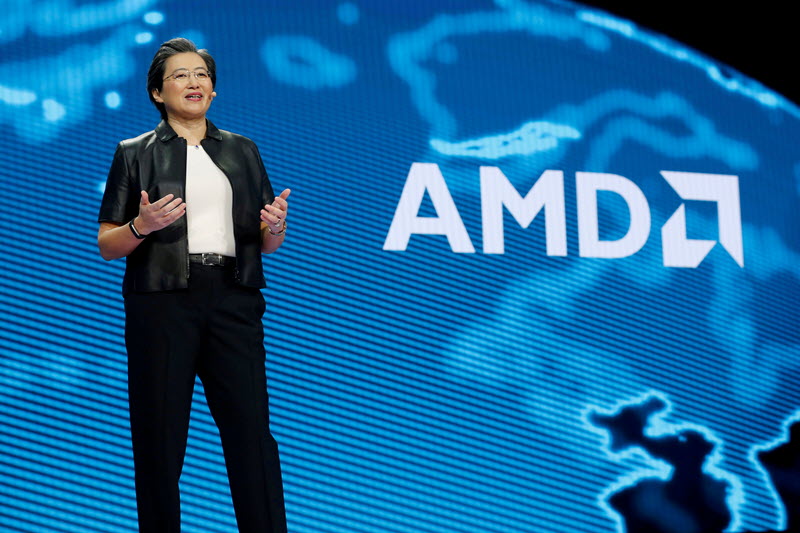
AMD Shares Surge Due to AI Data Center Demand

- Significant Revenue Growth: AMD's first-quarter revenue surged 38% year-over-year to $10.25 billion, primarily driven by a 57% increase in its data center segment to $5.8 billion, reflecting strong demand in the AI market and the company's competitive position in this sector.
- Margin Improvement: Although AMD's gross margin rose by 300 basis points to 53%, it remains significantly lower than Nvidia's 74.9%, indicating challenges in profitability within its product mix that could impact long-term competitiveness.
- Market Uncertainty: Despite AMD's crucial role in AI infrastructure, a slowdown in large language model (LLM) development could reduce demand for its data center hardware, potentially negatively affecting its stock price, prompting investors to exercise caution.
- High Valuation Risks: With a forward P/E ratio of 74 compared to the Nasdaq-100's 27, AMD's stock appears overvalued, suggesting that investors should carefully assess the sustainability of current data center spending before making investment decisions.
See More

Tech Stocks Retreat as DraftKings Soars on SEC Filing


- Semiconductor Stocks Decline: The VanEck Semiconductor ETF fell 5% as the tech sell-off intensified, with AMD and Nvidia dropping 8% and nearly 3% respectively, indicating a waning market confidence in the semiconductor sector that could impact future investment decisions.
- DraftKings Strong Growth: DraftKings' Predictions offering saw a 24% month-over-month increase to $1.3 billion in May, with annualized total volume traded rising 34% to $3.1 billion, showcasing robust performance in the sports betting market that may attract more investor interest.
- Apple Stock Retreats: Despite unveiling new AI software at its Worldwide Developers Conference, Apple's stock dropped over 3%, reflecting market reactions that fell short of expectations, potentially affecting the company's short-term market performance.
- Nuvalent Acquisition Agreement: GSK announced a $10.6 billion agreement to acquire Nuvalent, leading to a 39% surge in Nuvalent's shares, which not only boosts its market value but may also enhance GSK's competitive position in the biopharmaceutical sector.
See More

US Stock Market Volatility Amid Falling WTI Crude Prices


- Mixed Market Performance: The S&P 500 index fell by 0.28%, while the Dow Jones Industrial Average rose by 0.19%, and the Nasdaq 100 index dropped by 0.80%, indicating a divergence in market sentiment, particularly with weakness in chipmakers and software stocks weighing on the broader market.
- Crude Oil Price Decline: WTI crude oil prices plunged over 3% to a one-week low, primarily due to the ceasefire agreement between Iran and Israel, leading to expectations of further declines in oil prices that could impact the profitability outlook for energy stocks.
- Positive Economic Data: The US trade deficit narrowed to $55.9 billion in April, better than the expected $56.1 billion, while existing home sales in May rose by 3.2% month-over-month to 4.17 million, indicating resilience in the housing market that may provide support for stocks.
- Company Movements: United Natural Foods saw its stock drop over 12% after reporting Q3 net sales below expectations, while Nuvalent's stock surged over 38% following GSK's agreement to acquire the company for $10.6 billion, reflecting varied market reactions to company fundamentals.
See More
Can AMD's Stock Maintain Its Bull Run?
- Strong Data Center Demand: AMD's first-quarter revenue surged 38% year-over-year to $10.25 billion, with the data center segment contributing $5.8 billion, a 57% increase, indicating sustained strong demand for AI hardware that drives positive operational results.
- Margin Improvement: The company's gross margin rose modestly by 300 basis points to 53%, although still lower than Nvidia's 74.9%, this increase reflects AMD's competitive position and improvement in profitability within the AI market.
- Diversification Advantage: Unlike Nvidia, which relies heavily on data center sales, AMD's data center segment accounts for only 57% of total revenue, with a healthy mix of GPUs, CPUs, and networking equipment, reducing dependence on any single product and enhancing market resilience.
- Market Uncertainty: Despite AMD's favorable position as an infrastructure provider, a slowdown in LLM development could impact demand for its data center hardware, potentially putting pressure on stock prices, prompting investors to carefully assess future market dynamics.
See More
Comparative Analysis of QQQ and SCHG ETFs

- Investment Performance: The Invesco QQQ ETF has achieved a remarkable 625% return over the past decade and approximately 1,600% since its inception in 1999, demonstrating strong performance amid the tech stock and AI boom, despite facing multiple market fluctuations.
- Expense Ratio Comparison: The Schwab U.S. Large-Cap Growth ETF boasts a low expense ratio of just 0.04%, significantly lower than QQQ's 0.18%, which enhances SCHG's cost-effectiveness for long-term investors who prioritize fees.
- Portfolio Structure Differences: QQQ's top holdings are heavily weighted in tech stocks at 67%, compared to 45% for SCHG, indicating that SCHG's diversified structure may provide a risk mitigation advantage during market volatility.
- Future Growth Potential: While QQQ has shown exceptional short-term performance, SCHG's diversified investment strategy and lower expense ratio position it as a more attractive investment choice in the current market environment, especially as tech stocks may face potential pullbacks.
See More

Comparative Analysis of Invesco QQQ ETF and SCHG
- Fund Performance Comparison: The Invesco QQQ ETF has achieved a remarkable 625% return over the past decade and approximately 1,600% since its inception in 1999, demonstrating strong performance in tech stocks despite market fluctuations.
- Investment Strategy Differences: The Schwab U.S. Large-Cap Growth ETF employs a fundamentally driven approach with an expense ratio of just 0.04%, providing a short-term advantage, particularly in the context of strong tech stock performance.
- Overlap and Differences: There is about a 62% overlap between the two funds, with Invesco QQQ ETF having a significantly higher allocation to tech stocks, which has driven its year-to-date performance; however, SCHG's diversified strategy may offer better risk management in the future.
- Market Outlook Assessment: Despite QQQ's impressive performance, analysts suggest that its heavy reliance on certain tech stocks may not be sustainable, while SCHG's diversified portfolio and low-cost structure make it more attractive in the current market environment.
See More
AMD Shares Surge Due to AI Data Center Demand
- Significant Revenue Growth: AMD's first-quarter revenue surged 38% year-over-year to $10.25 billion, primarily driven by a 57% increase in its data center segment to $5.8 billion, reflecting strong demand in the AI market and the company's competitive position in this sector.
- Margin Improvement: Although AMD's gross margin rose by 300 basis points to 53%, it remains significantly lower than Nvidia's 74.9%, indicating challenges in profitability within its product mix that could impact long-term competitiveness.
- Market Uncertainty: Despite AMD's crucial role in AI infrastructure, a slowdown in large language model (LLM) development could reduce demand for its data center hardware, potentially negatively affecting its stock price, prompting investors to exercise caution.
- High Valuation Risks: With a forward P/E ratio of 74 compared to the Nasdaq-100's 27, AMD's stock appears overvalued, suggesting that investors should carefully assess the sustainability of current data center spending before making investment decisions.
See More
Tech Stocks Retreat as DraftKings Soars on SEC Filing
- Semiconductor Stocks Decline: The VanEck Semiconductor ETF fell 5% as the tech sell-off intensified, with AMD and Nvidia dropping 8% and nearly 3% respectively, indicating a waning market confidence in the semiconductor sector that could impact future investment decisions.
- DraftKings Strong Growth: DraftKings' Predictions offering saw a 24% month-over-month increase to $1.3 billion in May, with annualized total volume traded rising 34% to $3.1 billion, showcasing robust performance in the sports betting market that may attract more investor interest.
- Apple Stock Retreats: Despite unveiling new AI software at its Worldwide Developers Conference, Apple's stock dropped over 3%, reflecting market reactions that fell short of expectations, potentially affecting the company's short-term market performance.
- Nuvalent Acquisition Agreement: GSK announced a $10.6 billion agreement to acquire Nuvalent, leading to a 39% surge in Nuvalent's shares, which not only boosts its market value but may also enhance GSK's competitive position in the biopharmaceutical sector.
See More
US Stock Market Volatility Amid Falling WTI Crude Prices
- Mixed Market Performance: The S&P 500 index fell by 0.28%, while the Dow Jones Industrial Average rose by 0.19%, and the Nasdaq 100 index dropped by 0.80%, indicating a divergence in market sentiment, particularly with weakness in chipmakers and software stocks weighing on the broader market.
- Crude Oil Price Decline: WTI crude oil prices plunged over 3% to a one-week low, primarily due to the ceasefire agreement between Iran and Israel, leading to expectations of further declines in oil prices that could impact the profitability outlook for energy stocks.
- Positive Economic Data: The US trade deficit narrowed to $55.9 billion in April, better than the expected $56.1 billion, while existing home sales in May rose by 3.2% month-over-month to 4.17 million, indicating resilience in the housing market that may provide support for stocks.
- Company Movements: United Natural Foods saw its stock drop over 12% after reporting Q3 net sales below expectations, while Nuvalent's stock surged over 38% following GSK's agreement to acquire the company for $10.6 billion, reflecting varied market reactions to company fundamentals.
See More
Can AMD's Stock Maintain Its Bull Run?
- Strong Data Center Demand: AMD's first-quarter revenue surged 38% year-over-year to $10.25 billion, with the data center segment contributing $5.8 billion, a 57% increase, indicating sustained strong demand for AI hardware that drives positive operational results.
- Margin Improvement: The company's gross margin rose modestly by 300 basis points to 53%, although still lower than Nvidia's 74.9%, this increase reflects AMD's competitive position and improvement in profitability within the AI market.
- Diversification Advantage: Unlike Nvidia, which relies heavily on data center sales, AMD's data center segment accounts for only 57% of total revenue, with a healthy mix of GPUs, CPUs, and networking equipment, reducing dependence on any single product and enhancing market resilience.
- Market Uncertainty: Despite AMD's favorable position as an infrastructure provider, a slowdown in LLM development could impact demand for its data center hardware, potentially putting pressure on stock prices, prompting investors to carefully assess future market dynamics.
See More
Comparative Analysis of QQQ and SCHG ETFs
- Investment Performance: The Invesco QQQ ETF has achieved a remarkable 625% return over the past decade and approximately 1,600% since its inception in 1999, demonstrating strong performance amid the tech stock and AI boom, despite facing multiple market fluctuations.
- Expense Ratio Comparison: The Schwab U.S. Large-Cap Growth ETF boasts a low expense ratio of just 0.04%, significantly lower than QQQ's 0.18%, which enhances SCHG's cost-effectiveness for long-term investors who prioritize fees.
- Portfolio Structure Differences: QQQ's top holdings are heavily weighted in tech stocks at 67%, compared to 45% for SCHG, indicating that SCHG's diversified structure may provide a risk mitigation advantage during market volatility.
- Future Growth Potential: While QQQ has shown exceptional short-term performance, SCHG's diversified investment strategy and lower expense ratio position it as a more attractive investment choice in the current market environment, especially as tech stocks may face potential pullbacks.
See More
Comparative Analysis of Invesco QQQ ETF and SCHG
- Fund Performance Comparison: The Invesco QQQ ETF has achieved a remarkable 625% return over the past decade and approximately 1,600% since its inception in 1999, demonstrating strong performance in tech stocks despite market fluctuations.
- Investment Strategy Differences: The Schwab U.S. Large-Cap Growth ETF employs a fundamentally driven approach with an expense ratio of just 0.04%, providing a short-term advantage, particularly in the context of strong tech stock performance.
- Overlap and Differences: There is about a 62% overlap between the two funds, with Invesco QQQ ETF having a significantly higher allocation to tech stocks, which has driven its year-to-date performance; however, SCHG's diversified strategy may offer better risk management in the future.
- Market Outlook Assessment: Despite QQQ's impressive performance, analysts suggest that its heavy reliance on certain tech stocks may not be sustainable, while SCHG's diversified portfolio and low-cost structure make it more attractive in the current market environment.
See More