TTM Tech (TTMI) Q1 2026 Earnings Transcript
Written by Emily J. Thompson, Senior Investment Analyst
Updated: Apr 30 2026
0mins
Source: NASDAQ.COM
Trade with 70% Backtested Accuracy
Stop guessing "Should I Buy TTMI?" and start using high-conviction signals backed by rigorous historical data.
Sign up today to access powerful investing tools and make smarter, data-driven decisions.
Analyst Views on TTMI
Wall Street analysts forecast TTMI stock price to fall
4 Analyst Rating
4 Buy
0 Hold
0 Sell
Strong Buy
Current: 184.840

Low
72.00
Averages
80.75
High
91.00
Current: 184.840
Low
72.00
Averages
80.75
High
91.00
About TTMI
TTM Technologies, Inc. is a global manufacturer of technology solutions including mission systems, radio frequency (RF) components and RF microwave/microelectronic assemblies, and technologically advanced printed circuit boards (PCB). The A&D segment consists of PCBs, value-added assemblies, microelectronics, RF/microwave components and assemblies, and integrated mission systems. Its products support surveillance, intelligence, communications, and other critical missions for customers in the aerospace and defense industry. Commercial segment consists of PCBs using customer-supplied engineering and design plans supporting customers in the automotive, medical, industrial, and instrumentation, networking, and data center computing end markets. RF&S Components segment consists of TTM designed RF components for commercial customers in the telecommunications, industrial, and instrumentation markets, as well as commercial off-the-shelf components for certain aerospace and defense customers.
About the author

Emily J. Thompson
Emily J. Thompson, a Chartered Financial Analyst (CFA) with 12 years in investment research, graduated with honors from the Wharton School. Specializing in industrial and technology stocks, she provides in-depth analysis for Intellectia’s earnings and market brief reports.

TTM Technologies Secures $1 Billion Financing
- Financing Structure Optimization: TTM Technologies has completed a $1 billion cash flow senior secured revolver and a repriced $400 million senior secured Term Loan B, aimed at enhancing financial flexibility to support strategic initiatives, which is expected to boost shareholder value in 2026.
- Improved Loan Terms: The new Term Loan B is priced at SOFR+1.75%, a reduction of 50 basis points from prior commitments, anticipated to provide significant cash interest savings, thereby improving overall financial health.
- Increased Credit Capacity: The new revolving credit facility has a maximum availability of $1 billion, replacing the previous $300 million asset-based lending, demonstrating TTM's proactive adjustments in capital structure and enhancing its competitive position in the market.
- Support for Long-term Growth: Through this financing, TTM has optimized its capital structure, and combined with healthy operational performance, aims to support sustainable growth in the future, ensuring its leading position in the technology product manufacturing sector.
See More

TTM Technologies Secures $1B Credit Facility for Growth
- Liquidity Enhancement: TTM Technologies has successfully closed a $1B senior secured revolving credit facility and repriced and upsized a $400M Term Loan B, significantly strengthening the company's liquidity and providing greater flexibility for strategic growth initiatives.
- Loan Structure Optimization: The new Term Loan B totals $400M and matures in May 2030, while the new multi-currency revolving credit facility offers up to $1B in borrowing capacity and matures in May 2031, replacing the previous $150M U.S. ABL facility and $150M Asia ABL facility.
- Support for Strategic Growth: This financing not only enhances TTM's financial flexibility but also supports its strategic growth plans in AI data centers, defense electronics, and space sectors, which are expected to drive future business expansion.
- Future Revenue Projections: TTM projects Q2 2026 revenue between $930M and $970M, while raising its 2026 capex to $300M-$320M, reflecting the company's confidence in future growth opportunities.
See More

U.S. Faces Challenges in PCB Manufacturing Amid AI Boom


- National Security Risks: The U.S. Defense Department mandates that most purchases come from domestic factories due to the potential for circuit boards to be compromised, which could lead to missile failures, highlighting the risks of dependency on Chinese PCBs.
- Dramatic Market Share Decline: The U.S. share of the PCB market has plummeted from 30% to just 4%, placing immense pressure on companies like TTM and Sanmina to meet the surging demand from AI and defense sectors.
- Soaring Prices: PCB prices surged by 40% in just one month due to supply chain disruptions from Middle Eastern conflicts, with TTM planning to raise prices by 5% to 25%, intensifying market competition.
- Legislative Support: U.S. Congress is considering legislation that offers a 25% tax credit and $3 billion in grants to incentivize AI companies to purchase American-made PCBs, aiming to enhance domestic manufacturing capabilities to counter Chinese competition.
See More
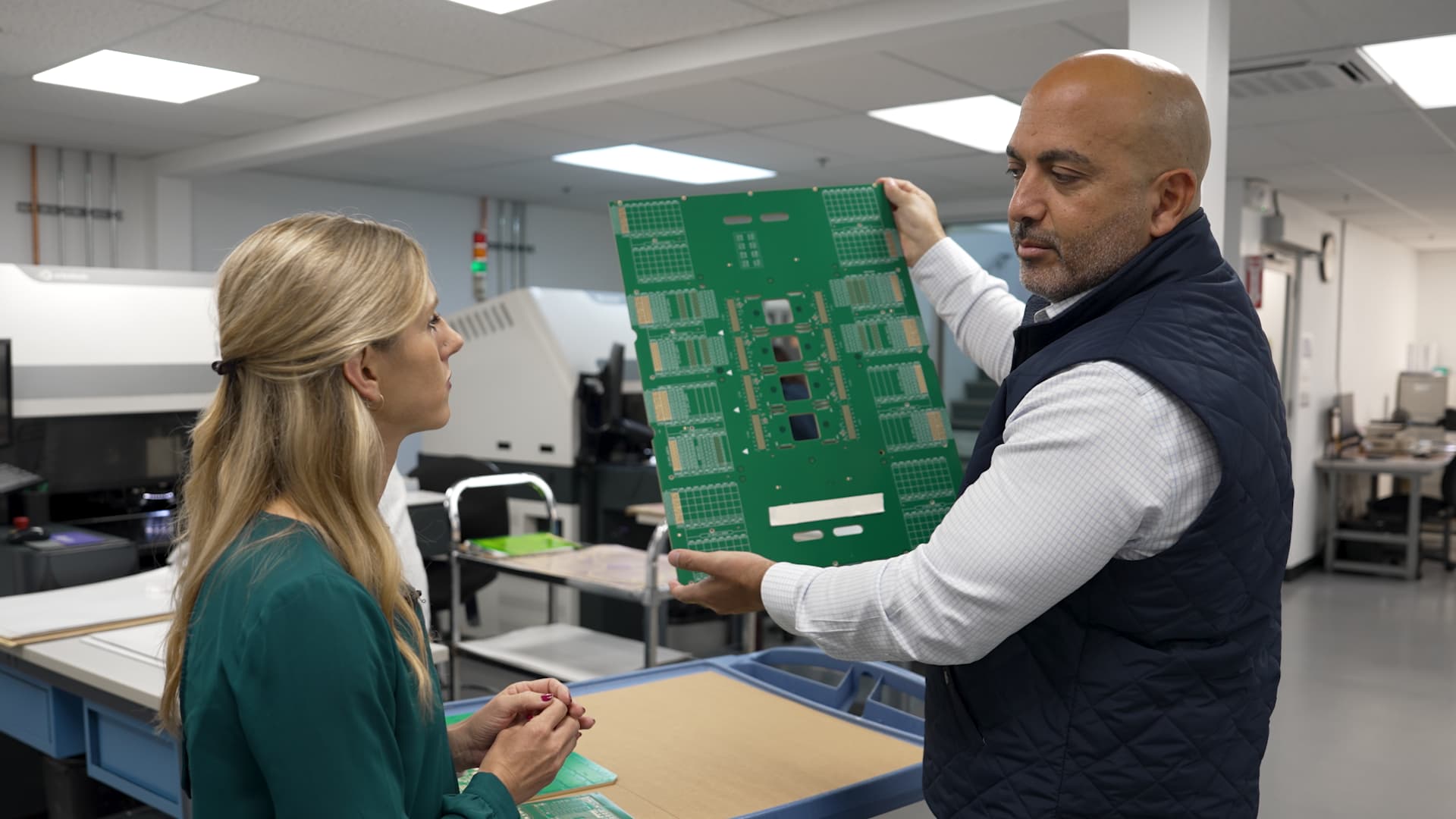
U.S. Circuit Board Dependence on China Raises Security Concerns

- National Security Risks: The U.S. Defense Department mandates that most purchases come from domestic factories to mitigate risks of malicious components in circuit boards, highlighting significant national security concerns amid escalating U.S.-China AI competition.
- Declining Market Share: The U.S. share of printed circuit board (PCB) production has plummeted from 30% to just 4%, significantly diminishing America's competitive edge in the global PCB market and increasing reliance on Chinese manufacturing.
- Price Surge Trend: PCB prices surged by 40% in just one month due to supply chain disruptions from Middle Eastern conflicts, placing TTM Technologies and Sanmina under dual pressure from military and commercial demands, resulting in substantial stock price increases over the past year.
- Domestic Production Expansion: TTM is rapidly expanding its production capabilities in New York and Wisconsin to meet the rising demands of AI and defense, with plans to add more factories in the coming years, thereby enhancing the U.S.'s position in global PCB manufacturing.
See More

Broadcom's Earnings Outlook Positive, Stock Rises

- Strong Earnings Expectations: Broadcom is projected to report second-quarter earnings per share of $2.40 and revenue of $22.13 billion, with analysts believing these estimates are beatable, potentially driving growth across the chip sector.
- Outstanding Stock Performance: Broadcom's stock has surged 40% in 2026, significantly outperforming Nvidia's 15% increase, indicating strong market confidence in its future performance, with an expected 8% volatility post-earnings release.
- AI Revenue Potential: According to a sales note from Morgan Stanley, Broadcom's AI revenues are expected to range between $150 billion and $200 billion in 2027, with approximately $105 billion from ASICs, reflecting robust demand in the AI sector.
- Strategic Partnerships: Broadcom's collaborations with Alphabet and Anthropic are set to enhance the development of its custom AI chips, with analysts noting that revenues from these deals will be closely correlated, showcasing deep mutual investment in the AI landscape.
See More

Five Stocks Added to Zacks Rank #1 (Strong Buy) List

- Earnings Estimate Increase: Pagaya Technologies Ltd. (PGY) has seen its current year earnings estimate rise by 12.2% over the last 60 days, indicating the effectiveness of its product-focused strategy, which could drive stock price appreciation and enhance market confidence.
- Significant Growth Outlook: TTM Technologies, Inc. (TTMI) has experienced a 27.5% increase in its current year earnings estimate over the past 60 days, reflecting strong demand in the printed circuit board manufacturing sector, which is expected to boost overall company performance.
- Fintech Potential: Green Dot Corporation (GDOT) has seen a 12.8% increase in its current year earnings estimate over the last 60 days, showcasing its ongoing innovation and market expansion capabilities in the fintech space, likely attracting more investor interest.
- Strong Energy Sector Performance: Occidental Petroleum Corporation (OXY) has had its current year earnings estimate raised by 67.2% over the past 60 days, demonstrating robust performance in oil and gas development, which could lead to significant shareholder returns.
See More
TTM Technologies Secures $1 Billion Financing
- Financing Structure Optimization: TTM Technologies has completed a $1 billion cash flow senior secured revolver and a repriced $400 million senior secured Term Loan B, aimed at enhancing financial flexibility to support strategic initiatives, which is expected to boost shareholder value in 2026.
- Improved Loan Terms: The new Term Loan B is priced at SOFR+1.75%, a reduction of 50 basis points from prior commitments, anticipated to provide significant cash interest savings, thereby improving overall financial health.
- Increased Credit Capacity: The new revolving credit facility has a maximum availability of $1 billion, replacing the previous $300 million asset-based lending, demonstrating TTM's proactive adjustments in capital structure and enhancing its competitive position in the market.
- Support for Long-term Growth: Through this financing, TTM has optimized its capital structure, and combined with healthy operational performance, aims to support sustainable growth in the future, ensuring its leading position in the technology product manufacturing sector.
See More
TTM Technologies Secures $1B Credit Facility for Growth
- Liquidity Enhancement: TTM Technologies has successfully closed a $1B senior secured revolving credit facility and repriced and upsized a $400M Term Loan B, significantly strengthening the company's liquidity and providing greater flexibility for strategic growth initiatives.
- Loan Structure Optimization: The new Term Loan B totals $400M and matures in May 2030, while the new multi-currency revolving credit facility offers up to $1B in borrowing capacity and matures in May 2031, replacing the previous $150M U.S. ABL facility and $150M Asia ABL facility.
- Support for Strategic Growth: This financing not only enhances TTM's financial flexibility but also supports its strategic growth plans in AI data centers, defense electronics, and space sectors, which are expected to drive future business expansion.
- Future Revenue Projections: TTM projects Q2 2026 revenue between $930M and $970M, while raising its 2026 capex to $300M-$320M, reflecting the company's confidence in future growth opportunities.
See More
U.S. Faces Challenges in PCB Manufacturing Amid AI Boom
- National Security Risks: The U.S. Defense Department mandates that most purchases come from domestic factories due to the potential for circuit boards to be compromised, which could lead to missile failures, highlighting the risks of dependency on Chinese PCBs.
- Dramatic Market Share Decline: The U.S. share of the PCB market has plummeted from 30% to just 4%, placing immense pressure on companies like TTM and Sanmina to meet the surging demand from AI and defense sectors.
- Soaring Prices: PCB prices surged by 40% in just one month due to supply chain disruptions from Middle Eastern conflicts, with TTM planning to raise prices by 5% to 25%, intensifying market competition.
- Legislative Support: U.S. Congress is considering legislation that offers a 25% tax credit and $3 billion in grants to incentivize AI companies to purchase American-made PCBs, aiming to enhance domestic manufacturing capabilities to counter Chinese competition.
See More
U.S. Circuit Board Dependence on China Raises Security Concerns
- National Security Risks: The U.S. Defense Department mandates that most purchases come from domestic factories to mitigate risks of malicious components in circuit boards, highlighting significant national security concerns amid escalating U.S.-China AI competition.
- Declining Market Share: The U.S. share of printed circuit board (PCB) production has plummeted from 30% to just 4%, significantly diminishing America's competitive edge in the global PCB market and increasing reliance on Chinese manufacturing.
- Price Surge Trend: PCB prices surged by 40% in just one month due to supply chain disruptions from Middle Eastern conflicts, placing TTM Technologies and Sanmina under dual pressure from military and commercial demands, resulting in substantial stock price increases over the past year.
- Domestic Production Expansion: TTM is rapidly expanding its production capabilities in New York and Wisconsin to meet the rising demands of AI and defense, with plans to add more factories in the coming years, thereby enhancing the U.S.'s position in global PCB manufacturing.
See More
Broadcom's Earnings Outlook Positive, Stock Rises
- Strong Earnings Expectations: Broadcom is projected to report second-quarter earnings per share of $2.40 and revenue of $22.13 billion, with analysts believing these estimates are beatable, potentially driving growth across the chip sector.
- Outstanding Stock Performance: Broadcom's stock has surged 40% in 2026, significantly outperforming Nvidia's 15% increase, indicating strong market confidence in its future performance, with an expected 8% volatility post-earnings release.
- AI Revenue Potential: According to a sales note from Morgan Stanley, Broadcom's AI revenues are expected to range between $150 billion and $200 billion in 2027, with approximately $105 billion from ASICs, reflecting robust demand in the AI sector.
- Strategic Partnerships: Broadcom's collaborations with Alphabet and Anthropic are set to enhance the development of its custom AI chips, with analysts noting that revenues from these deals will be closely correlated, showcasing deep mutual investment in the AI landscape.
See More
Five Stocks Added to Zacks Rank #1 (Strong Buy) List
- Earnings Estimate Increase: Pagaya Technologies Ltd. (PGY) has seen its current year earnings estimate rise by 12.2% over the last 60 days, indicating the effectiveness of its product-focused strategy, which could drive stock price appreciation and enhance market confidence.
- Significant Growth Outlook: TTM Technologies, Inc. (TTMI) has experienced a 27.5% increase in its current year earnings estimate over the past 60 days, reflecting strong demand in the printed circuit board manufacturing sector, which is expected to boost overall company performance.
- Fintech Potential: Green Dot Corporation (GDOT) has seen a 12.8% increase in its current year earnings estimate over the last 60 days, showcasing its ongoing innovation and market expansion capabilities in the fintech space, likely attracting more investor interest.
- Strong Energy Sector Performance: Occidental Petroleum Corporation (OXY) has had its current year earnings estimate raised by 67.2% over the past 60 days, demonstrating robust performance in oil and gas development, which could lead to significant shareholder returns.
See More