Surging Memory Demand Drives Chip Stocks Soaring
Written by Emily J. Thompson, Senior Investment Analyst
Updated: 5 hours ago
0mins

Source: Fool
- Memory Market Supercycle: The insatiable demand for memory has led to a supercycle, with memory chip stocks like Micron and Sandisk soaring approximately 800% and 4,600% over the past year, indicating a transformative shift driven by AI's urgent need for high-speed memory.
- Rambus Growth Outlook: Rambus is poised to benefit from the increasing demand for AI, with a current P/E ratio of 48, yet analysts project an average annual earnings growth of over 19% over the next three to five years, providing long-term growth potential for investors.
- Lam Research Market Opportunity: Lam Research plays a crucial role in semiconductor manufacturing, with the global semiconductor memory market expected to grow from $171 billion to $447 billion, driving the company's revenue growth at an annualized rate of 21% over the next three to five years.
- Teradyne Business Boom: Teradyne experienced an 87% year-over-year revenue growth in Q1, with approximately 70% of its revenue coming from AI, projecting a significant leap in revenue from $3.19 billion to $4.47 billion over the next two years, showcasing strong market demand and growth potential.
Trade with 70% Backtested Accuracy
Stop guessing "Should I Buy RMBS?" and start using high-conviction signals backed by rigorous historical data.
Sign up today to access powerful investing tools and make smarter, data-driven decisions.
Analyst Views on RMBS
Wall Street analysts forecast RMBS stock price to fall
6 Analyst Rating
4 Buy
1 Hold
1 Sell
Moderate Buy
Current: 130.100

Low
83.00
Averages
107.40
High
130.00
Current: 130.100
Low
83.00
Averages
107.40
High
130.00
About RMBS
Rambus Inc. is a global semiconductor company dedicated to enabling data centers and artificial intelligence by delivering memory and security solutions that address the evolving needs of the industry. It offers a balanced and diverse portfolio of products encompassing chips and silicon intellectual property (IP). Its solutions maximize performance and security in computationally intensive systems. Its DDR memory interface chips for server memory modules enable increased bandwidth and expanded capacity in enterprise and cloud servers. Its portfolio includes DDR5 and DDR4 memory interface chipsets. Its DDR5 chipset solutions include the Registering Clock Driver, Multiplexed Registering Clock Driver, Multiplexed Data Buffer, Power Management Integrated Circuits, Serial Presence Detect Hubs, Temperature Sensors, and Client Clock Driver. Its Silicon IP includes interface and security IP solutions that move and protect data in advanced data center, government and automotive applications.
About the author

Emily J. Thompson
Emily J. Thompson, a Chartered Financial Analyst (CFA) with 12 years in investment research, graduated with honors from the Wharton School. Specializing in industrial and technology stocks, she provides in-depth analysis for Intellectia’s earnings and market brief reports.

Surging Memory Demand Drives Chip Stocks Soaring


- Memory Market Supercycle: The insatiable demand for memory has led to a supercycle, with memory chip stocks like Micron and Sandisk soaring approximately 800% and 4,600% over the past year, indicating a transformative shift driven by AI's urgent need for high-speed memory.
- Rambus Growth Outlook: Rambus is poised to benefit from the increasing demand for AI, with a current P/E ratio of 48, yet analysts project an average annual earnings growth of over 19% over the next three to five years, providing long-term growth potential for investors.
- Lam Research Market Opportunity: Lam Research plays a crucial role in semiconductor manufacturing, with the global semiconductor memory market expected to grow from $171 billion to $447 billion, driving the company's revenue growth at an annualized rate of 21% over the next three to five years.
- Teradyne Business Boom: Teradyne experienced an 87% year-over-year revenue growth in Q1, with approximately 70% of its revenue coming from AI, projecting a significant leap in revenue from $3.19 billion to $4.47 billion over the next two years, showcasing strong market demand and growth potential.
See More

Surging Memory Demand Fuels Chip Company Growth
- Memory Market Supercycle: The insatiable demand for memory has led to a supercycle, with memory chip stocks like Micron and Sandisk soaring approximately 800% and 4,600% over the past year, highlighting the critical bottleneck in AI competition and driving performance growth for related companies.
- Rambus Growth Potential: Rambus is set to benefit from ongoing AI-driven memory demand as it licenses high-end memory interface chips to top firms like Micron and SK Hynix, with analysts projecting an average earnings growth of over 19% annually over the next three to five years.
- Market Opportunities for Lam Research: As a supplier of semiconductor manufacturing equipment, Lam Research plays a crucial role in the memory market, with the global semiconductor memory market expected to grow from approximately $171 billion in 2025 to $447 billion by 2034, driving future revenue growth for the company.
- Testing Demand at Teradyne: Teradyne's revenue surged 87% year-over-year in Q1 2026, with around 70% of its revenue stemming from AI-related business, indicating strong demand in high-bandwidth memory testing and projecting about 70% revenue growth over the next two years.
See More

iShares Semiconductor ETF Declines 4%, Intel Drops 7.1%


- ETF Decline: The iShares Semiconductor ETF fell approximately 4% during Tuesday afternoon trading, indicating market concerns about the semiconductor sector, which could negatively impact investor confidence and lead to capital outflows.
- Intel's Weak Performance: Intel's shares dropped about 7.1%, reflecting the company's pressure in market competition, which may affect its future investment and R&D capabilities.
- Rambus Stock Drop: Rambus shares declined by approximately 6.4%, further exacerbating the ETF's poor performance, indicating challenges faced by the company and a weakening market demand.
- Market Sentiment Impact: The overall negative sentiment towards the semiconductor industry may prompt investors to reassess their portfolios, potentially affecting the stock prices and financing capabilities of related companies.
See More

Rambus Unveils DDR5 9600 Client Chipset for AI PCs
- Breakthrough Performance: Rambus's new DDR5 9600 Client Chipset supports memory module operations up to 9600 MT/s, significantly enhancing performance for future AI PCs and addressing the demand for high bandwidth and capacity, thereby driving a new era of intelligent and efficient computing.
- Technological Innovation: The chipset includes the Gen2 Client Clock Driver (CKD02) and PMIC5120, designed to tackle signal integrity and power management issues, ensuring stable operation at high data rates and improving the design and deployment efficiency of memory modules.
- Market Demand Response: As AI-driven workloads become increasingly prevalent, Rambus's DDR5 9600 Chipset provides a complete solution to meet growing performance demands, supporting clocked memory architectures like CUDIMM and CSODIMM, facilitating the rapid adoption of next-generation AI PCs.
- Industry Outlook: Rambus's innovations not only enhance memory bandwidth and efficiency but also provide robust support for gaming and professional content creation, expected to accelerate market penetration of AI PCs and drive technological advancements across the industry.
See More
Rambus Launches PCIe 7.0 Switch IP with TDM for AI Infrastructure
- Technological Innovation: Rambus's newly launched PCIe 7.0 Switch IP with Time Division Multiplexing (TDM) is designed to meet the escalating demands for bandwidth, latency, and scalability in AI, cloud, and high-performance computing (HPC) systems, thereby enhancing data transfer efficiency and overall system performance.
- Architectural Flexibility: This switch IP optimizes PCIe link utilization through intelligent traffic multiplexing, simplifying system design and supporting disaggregated and pooled compute architectures, which facilitates efficient handling of diverse workloads such as large-scale AI training and latency-sensitive inference.
- Market Leadership: The PCIe 7.0 Switch IP expands Rambus's industry-leading PCIe IP portfolio, which includes controllers, retimers, and debug solutions, helping customers accelerate time-to-market while meeting the stringent performance and reliability requirements of modern AI infrastructure.
- Strategic Significance: As AI infrastructure rapidly evolves, Rambus's technological innovations not only enhance system bandwidth and efficiency but also provide customers with critical capabilities for efficient data movement within complex architectures, further solidifying its leadership position in high-speed interface IP.
See More
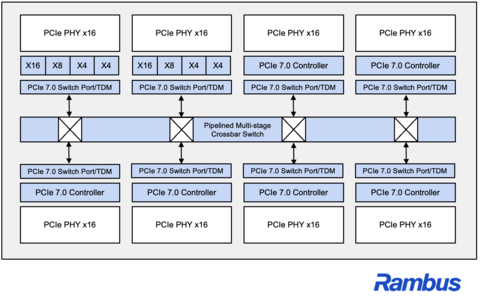
Rambus Launches PCIe 7.0 Switch IP with TDM for AI Infrastructure
- Technological Innovation: Rambus's newly launched PCIe 7.0 Switch IP with Time Division Multiplexing (TDM) addresses the escalating demands for bandwidth and latency in AI, cloud, and high-performance computing systems, thereby enhancing data transfer efficiency and managing system complexity.
- Architectural Flexibility: This switch IP supports intelligent traffic multiplexing, enabling efficient scheduling of traffic across shared links, maximizing network utilization, and accommodating diverse workloads from large-scale AI training to latency-sensitive inference, significantly boosting system performance.
- Market Leadership: The Rambus PCIe 7.0 Switch IP expands its industry-leading PCIe IP portfolio, which includes controllers, retimers, and debug solutions, helping customers accelerate time-to-market while meeting the high performance and reliability requirements of modern AI infrastructure.
- Strategic Implications: As AI infrastructure rapidly evolves, Rambus strengthens its leadership in high-speed interface IP by providing advanced PCIe switching technologies, empowering customers to tackle challenges in AI, cloud, and HPC sectors.
See More
Surging Memory Demand Drives Chip Stocks Soaring
- Memory Market Supercycle: The insatiable demand for memory has led to a supercycle, with memory chip stocks like Micron and Sandisk soaring approximately 800% and 4,600% over the past year, indicating a transformative shift driven by AI's urgent need for high-speed memory.
- Rambus Growth Outlook: Rambus is poised to benefit from the increasing demand for AI, with a current P/E ratio of 48, yet analysts project an average annual earnings growth of over 19% over the next three to five years, providing long-term growth potential for investors.
- Lam Research Market Opportunity: Lam Research plays a crucial role in semiconductor manufacturing, with the global semiconductor memory market expected to grow from $171 billion to $447 billion, driving the company's revenue growth at an annualized rate of 21% over the next three to five years.
- Teradyne Business Boom: Teradyne experienced an 87% year-over-year revenue growth in Q1, with approximately 70% of its revenue coming from AI, projecting a significant leap in revenue from $3.19 billion to $4.47 billion over the next two years, showcasing strong market demand and growth potential.
See More
Surging Memory Demand Fuels Chip Company Growth
- Memory Market Supercycle: The insatiable demand for memory has led to a supercycle, with memory chip stocks like Micron and Sandisk soaring approximately 800% and 4,600% over the past year, highlighting the critical bottleneck in AI competition and driving performance growth for related companies.
- Rambus Growth Potential: Rambus is set to benefit from ongoing AI-driven memory demand as it licenses high-end memory interface chips to top firms like Micron and SK Hynix, with analysts projecting an average earnings growth of over 19% annually over the next three to five years.
- Market Opportunities for Lam Research: As a supplier of semiconductor manufacturing equipment, Lam Research plays a crucial role in the memory market, with the global semiconductor memory market expected to grow from approximately $171 billion in 2025 to $447 billion by 2034, driving future revenue growth for the company.
- Testing Demand at Teradyne: Teradyne's revenue surged 87% year-over-year in Q1 2026, with around 70% of its revenue stemming from AI-related business, indicating strong demand in high-bandwidth memory testing and projecting about 70% revenue growth over the next two years.
See More
iShares Semiconductor ETF Declines 4%, Intel Drops 7.1%
- ETF Decline: The iShares Semiconductor ETF fell approximately 4% during Tuesday afternoon trading, indicating market concerns about the semiconductor sector, which could negatively impact investor confidence and lead to capital outflows.
- Intel's Weak Performance: Intel's shares dropped about 7.1%, reflecting the company's pressure in market competition, which may affect its future investment and R&D capabilities.
- Rambus Stock Drop: Rambus shares declined by approximately 6.4%, further exacerbating the ETF's poor performance, indicating challenges faced by the company and a weakening market demand.
- Market Sentiment Impact: The overall negative sentiment towards the semiconductor industry may prompt investors to reassess their portfolios, potentially affecting the stock prices and financing capabilities of related companies.
See More
Rambus Unveils DDR5 9600 Client Chipset for AI PCs
- Breakthrough Performance: Rambus's new DDR5 9600 Client Chipset supports memory module operations up to 9600 MT/s, significantly enhancing performance for future AI PCs and addressing the demand for high bandwidth and capacity, thereby driving a new era of intelligent and efficient computing.
- Technological Innovation: The chipset includes the Gen2 Client Clock Driver (CKD02) and PMIC5120, designed to tackle signal integrity and power management issues, ensuring stable operation at high data rates and improving the design and deployment efficiency of memory modules.
- Market Demand Response: As AI-driven workloads become increasingly prevalent, Rambus's DDR5 9600 Chipset provides a complete solution to meet growing performance demands, supporting clocked memory architectures like CUDIMM and CSODIMM, facilitating the rapid adoption of next-generation AI PCs.
- Industry Outlook: Rambus's innovations not only enhance memory bandwidth and efficiency but also provide robust support for gaming and professional content creation, expected to accelerate market penetration of AI PCs and drive technological advancements across the industry.
See More
Rambus Launches PCIe 7.0 Switch IP with TDM for AI Infrastructure
- Technological Innovation: Rambus's newly launched PCIe 7.0 Switch IP with Time Division Multiplexing (TDM) is designed to meet the escalating demands for bandwidth, latency, and scalability in AI, cloud, and high-performance computing (HPC) systems, thereby enhancing data transfer efficiency and overall system performance.
- Architectural Flexibility: This switch IP optimizes PCIe link utilization through intelligent traffic multiplexing, simplifying system design and supporting disaggregated and pooled compute architectures, which facilitates efficient handling of diverse workloads such as large-scale AI training and latency-sensitive inference.
- Market Leadership: The PCIe 7.0 Switch IP expands Rambus's industry-leading PCIe IP portfolio, which includes controllers, retimers, and debug solutions, helping customers accelerate time-to-market while meeting the stringent performance and reliability requirements of modern AI infrastructure.
- Strategic Significance: As AI infrastructure rapidly evolves, Rambus's technological innovations not only enhance system bandwidth and efficiency but also provide customers with critical capabilities for efficient data movement within complex architectures, further solidifying its leadership position in high-speed interface IP.
See More
Rambus Launches PCIe 7.0 Switch IP with TDM for AI Infrastructure
- Technological Innovation: Rambus's newly launched PCIe 7.0 Switch IP with Time Division Multiplexing (TDM) addresses the escalating demands for bandwidth and latency in AI, cloud, and high-performance computing systems, thereby enhancing data transfer efficiency and managing system complexity.
- Architectural Flexibility: This switch IP supports intelligent traffic multiplexing, enabling efficient scheduling of traffic across shared links, maximizing network utilization, and accommodating diverse workloads from large-scale AI training to latency-sensitive inference, significantly boosting system performance.
- Market Leadership: The Rambus PCIe 7.0 Switch IP expands its industry-leading PCIe IP portfolio, which includes controllers, retimers, and debug solutions, helping customers accelerate time-to-market while meeting the high performance and reliability requirements of modern AI infrastructure.
- Strategic Implications: As AI infrastructure rapidly evolves, Rambus strengthens its leadership in high-speed interface IP by providing advanced PCIe switching technologies, empowering customers to tackle challenges in AI, cloud, and HPC sectors.
See More