
Key Takeaway
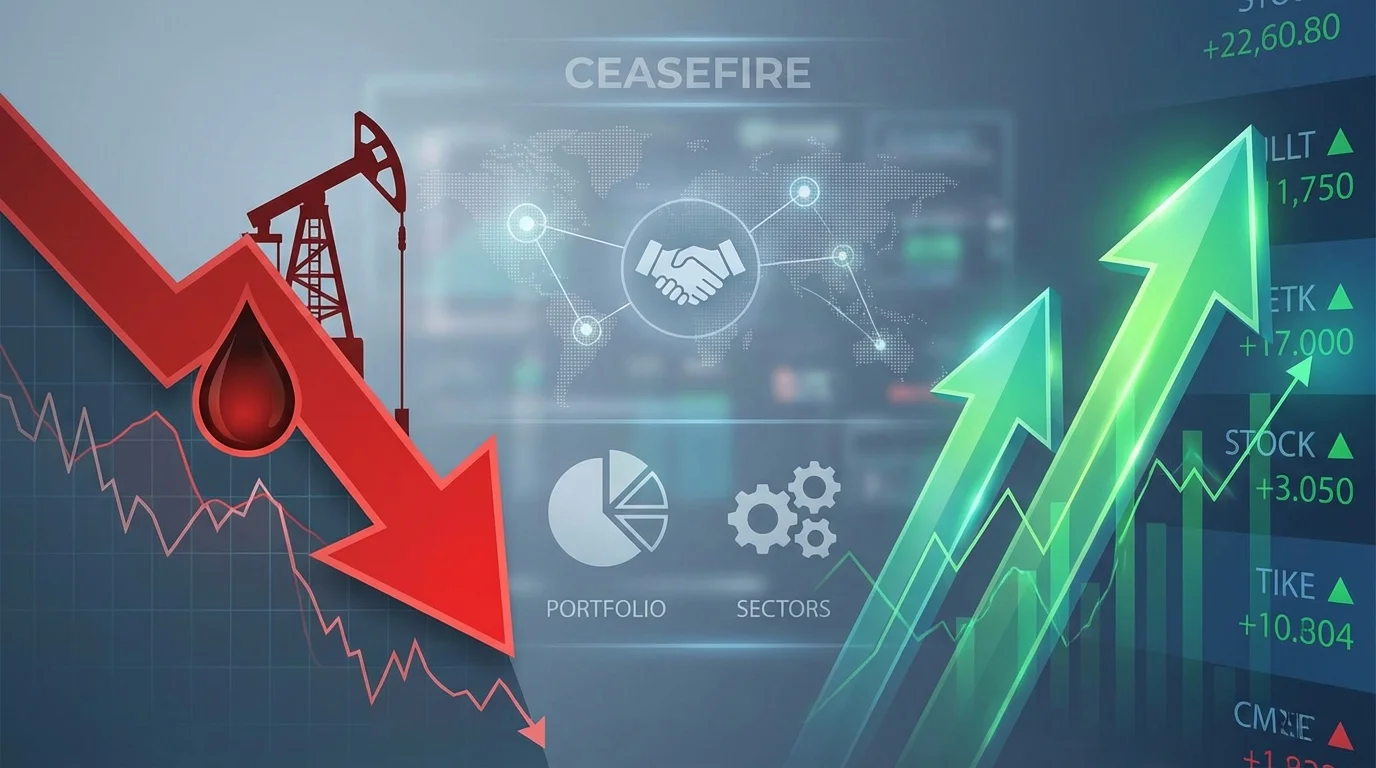
The announcement of a two-week ceasefire between the United States and Iran has sent shockwaves through global financial markets, triggering one of the most dramatic single-day moves in recent memory. Oil prices plummeted by approximately 15%, marking the steepest decline in nearly six years, while global equity markets staged a powerful relief rally with Dow futures jumping over 900 points at the open.
This development represents a significant de-escalation of geopolitical tensions that have kept investors on edge for weeks. The ceasefire agreement includes provisions for the reopening of the Strait of Hormuz, a critical chokepoint through which roughly 20% of the world's oil and natural gas normally passes. The potential resumption of oil and gas flows through this vital waterway has fundamentally altered the supply outlook for energy markets, removing the significant risk premium that had built up in crude prices since the conflict began.
For investors, this creates both immediate opportunities and longer-term strategic considerations. Sectors that have been beaten down by rising energy costs, particularly airlines and transportation companies, are experiencing significant bounces. Conversely, energy producers that had benefited from elevated oil prices are facing headwinds as the commodity pulls back from recent highs near $120 per barrel.
The Geopolitical Catalyst: Understanding the Ceasefire Agreement
Breakthrough in Middle East Tensions
The ceasefire agreement emerged after weeks of escalating rhetoric and military posturing between Washington and Tehran. President Donald Trump announced what he termed a "double-sided ceasefire" following intense diplomatic negotiations, with both sides agreeing to halt hostilities for an initial period of two weeks. This timeframe, while limited, provides a critical window for more comprehensive negotiations to take place.
The significance of this development cannot be overstated. Since the outbreak of hostilities, global markets have been pricing in substantial supply disruptions from the Middle East. Iran's effective closure of the Strait of Hormuz had forced the shutdown of at least 12 million barrels per day of oil production, representing approximately 12% of global supply. The prospect of these supplies returning to market has fundamentally shifted the supply-demand calculus for energy markets.
Market Reaction: Speed and Magnitude
Financial markets reacted with extraordinary speed to the ceasefire news. Within minutes of the announcement, Brent crude oil futures dropped from around $110 per barrel to below $100, while West Texas Intermediate crude experienced an even more dramatic decline from above $117 to trade near $100. The velocity of these moves reflected the extent to which hedge funds and speculators had built up bullish positions in anticipation of continued supply constraints.
Equity markets responded with equal force to the upside. Asian markets led the charge, with Japan's Nikkei surging more than 3% and Hong Kong's Hang Seng Index posting gains of over 4%. European markets followed suit, and U.S. stock futures indicated a massive gap higher at the Wall Street open. The broad-based nature of the rally suggested that investors were interpreting the ceasefire as reducing not just energy price pressures, but broader geopolitical risk that had been weighing on risk assets globally.
Oil Market Dynamics: From Supply Shock to Supply Relief
The Strait of Hormuz Factor
The Strait of Hormuz has long been recognized as one of the world's most critical energy chokepoints. Prior to the conflict, approximately 21 million barrels of oil per day passed through this narrow waterway, representing roughly one-fifth of global petroleum consumption. The closure of the strait by Iranian forces created an immediate and severe supply disruption that sent shockwaves through energy markets.
The risk premium embedded in oil prices during the crisis was substantial. Brent crude had surged from approximately $75 per barrel at the start of 2026 to highs near $120, representing a 60% increase driven almost entirely by supply concerns. Physical oil markets were even more stressed, with some regional benchmarks trading at premiums of $30-40 per barrel above futures prices as refiners scrambled to secure alternative supplies.
The ceasefire agreement changes this calculus dramatically. With the prospect of Hormuz reopening within days rather than months, the market must now price in the return of substantial Middle Eastern supply. This shift from scarcity back toward abundance explains the severity of the price decline, as traders who had positioned for continued shortages were forced to exit positions rapidly.
OPEC's Response and Production Policy
The oil price collapse presents significant challenges for OPEC and its allies, who had been carefully managing production levels to support prices even before the Iran crisis. Saudi Arabia, the United Arab Emirates, and other major producers had maintained disciplined output cuts despite rising prices, in part to preserve spare capacity that could be deployed in the event of supply disruptions.
Now, with Iranian supply potentially returning to market and prices falling below the fiscal breakeven levels for many OPEC members, the cartel faces difficult decisions. Saudi Arabia requires oil prices above $80 per barrel to balance its budget, while other members like Iraq and Nigeria have even higher breakeven thresholds. The organization may need to convene emergency meetings to discuss whether to deepen production cuts or allow market forces to establish a new equilibrium.
For investors in energy equities, OPEC's response will be critical in determining how far oil prices ultimately fall. If the cartel signals a willingness to defend prices through additional supply restraint, the floor for crude may be established near current levels. Conversely, a decision to maximize market share could see prices test significantly lower levels as Iranian barrels return to an already well-supplied market.
Sector Winners and Losers: Navigating the Rotation
Airlines and Transportation: The Biggest Beneficiaries
Perhaps no sector stands to benefit more from the oil price collapse than airlines. Jet fuel represents the single largest operating expense for commercial carriers, typically accounting for 25-30% of total costs. The surge in crude prices during the Iran crisis had threatened to erase the profitability improvements that carriers had achieved over the past year, with many industry analysts warning of potential fare hikes and capacity reductions.
The ceasefire-driven oil price drop provides immediate relief to airline balance sheets. For every $10 per barrel decline in crude prices, U.S. airlines collectively save approximately $3-4 billion in annual fuel costs. The 15% decline in oil prices translates to potential fuel savings of $6-8 billion industry-wide, representing a significant earnings tailwind for the sector.
Beyond airlines, the broader transportation complex benefits from lower diesel and gasoline prices. Trucking companies, railroads, and logistics providers all see margin expansion when energy costs decline. For consumers, lower gasoline prices function as a tax cut, freeing up disposable income that can support spending in other sectors of the economy.
Energy Producers: Facing the Headwinds
While the ceasefire is unequivocally positive for oil consumers, it presents significant challenges for energy producers. Exploration and production companies had seen their stock prices surge alongside crude oil during the crisis, with the Energy Select Sector SPDR Fund (XLE) outperforming the broader market by a substantial margin. The abrupt reversal in oil prices threatens to unwind much of these gains.
Integrated oil majors like ExxonMobil and Chevron are somewhat insulated from oil price volatility due to their downstream refining and marketing operations, which actually benefit from lower feedstock costs. However, their upstream production segments will see reduced cash flows, potentially impacting capital return programs and investment in new projects.
Independent producers, particularly those focused on U.S. shale developments, face more acute pressure. Many shale companies require oil prices above $60-70 per barrel to generate free cash flow after accounting for drilling and completion costs. If prices remain depressed for an extended period, these companies may be forced to curtail drilling activity, potentially impacting production growth outlooks for 2026 and beyond.
Chemicals and Materials: Margin Expansion Opportunity
The chemical industry represents another significant beneficiary of lower oil and natural gas prices. Petrochemical feedstocks derived from crude oil and natural gas liquids constitute the primary raw materials for plastic production, synthetic fibers, and numerous industrial chemicals. When energy prices decline, chemical producers experience margin expansion as product pricing remains sticky while input costs fall.
Companies like Dow Inc., LyondellBasell, and Eastman Chemical had faced margin compression during the oil price surge, as they were unable to pass through the full extent of cost increases to customers. The reverse dynamic should now apply, with these companies positioned to capture wider spreads between product prices and feedstock costs. This margin tailwind could persist for several quarters, providing earnings support even if macroeconomic conditions remain challenging.
Investment Strategy: Positioning for the Post-Ceasefire Landscape
Near-Term Trading Opportunities
The violent market moves triggered by the ceasefire announcement have created significant dislocations that active traders can potentially exploit. The most obvious trade is the continued unwinding of energy sector outperformance, with the XLE likely to underperform broad market indices as oil prices normalize.
Conversely, beaten-down consumer discretionary and transportation stocks offer compelling risk-reward for bounce trades. Airlines in particular appear oversold relative to the earnings improvement that lower fuel costs will generate. However, traders should be mindful that these sectors face fundamental challenges beyond energy costs, including labor inflation and uncertain consumer demand.
For investors with a longer time horizon, the ceasefire-related volatility may create entry points in high-quality energy companies that have been indiscriminately sold off. While the sector faces near-term headwinds, the long-term supply constraints facing the oil industry remain intact. Companies with low production costs, strong balance sheets, and disciplined capital allocation should ultimately thrive even in a lower price environment.

Long-Term Portfolio Considerations
The events of the past 24 hours underscore the importance of portfolio diversification and risk management. Investors who had concentrated positions in energy equities to capitalize on the Iran crisis have experienced significant drawdowns, highlighting the dangers of thematic investing based on geopolitical scenarios that can reverse quickly.
For long-term portfolios, the ceasefire may mark an opportunity to rebalance away from energy overweight positions that may have accumulated during the crisis. However, a complete exit from the sector may be premature, given the structural supply constraints and the potential for renewed geopolitical tensions as the two-week ceasefire period expires.
A balanced approach might involve maintaining core positions in high-quality integrated oil companies while reducing exposure to more speculative shale producers and oilfield services companies. The current volatility also presents an opportunity to add to positions in sectors like technology and healthcare that had been neglected during the energy-focused rally.
Risks and Uncertainties: What Could Go Wrong
The Ceasefire's Fragility
While markets have enthusiastically embraced the ceasefire news, investors must remain cognizant of the agreement's limitations. The two-week duration provides only a narrow window for substantive negotiations, and history suggests that temporary truces in Middle East conflicts often break down before permanent solutions can be reached.
If negotiations stall or either side violates the ceasefire terms, the risk premium in oil prices could quickly return. The market's dramatic repricing has effectively assumed a successful resolution, meaning there is significant asymmetry in the risk-reward profile. A breakdown in talks could see oil prices spike back toward recent highs, while an extension of the ceasefire may provide only limited additional downside given how far prices have already fallen.
Global Demand Concerns
Even as supply concerns ease, questions remain about the strength of global oil demand. High energy prices during the crisis acted as a drag on economic growth, particularly in energy-importing emerging markets. While lower prices provide relief, the damage to consumer confidence and spending patterns may take time to reverse.
China's economic trajectory remains particularly uncertain. As the world's largest oil importer, Chinese demand trends have outsized influence on global price formation. Recent data suggesting continued softness in Chinese manufacturing and property markets raises questions about whether demand growth will be sufficient to absorb returning Iranian supply.
Conclusion: Navigating a Rapidly Shifting Landscape
The US-Iran ceasefire has fundamentally altered the investment landscape, creating both opportunities and risks across multiple asset classes. The dramatic decline in oil prices and surge in equity markets reflect a genuine reduction in geopolitical risk, but also raise questions about whether the market has moved too far, too fast in pricing in a permanent resolution.
For investors, the key takeaway is the importance of maintaining flexibility in portfolio positioning. The events of recent weeks demonstrate how quickly market narratives can shift, and how severely concentrated bets on specific outcomes can be punished when those outcomes fail to materialize as expected.
The most prudent approach in the current environment is to avoid making dramatic portfolio shifts based on the ceasefire news alone. While some rebalancing away from energy overweights and toward sectors that benefit from lower oil prices makes sense, investors should maintain exposure to quality companies across sectors and geographies. The two-week ceasefire period provides time to assess whether this represents a genuine turning point or merely a temporary pause in an ongoing conflict.
Stay informed about the latest market developments and investment opportunities by using Intellectia's AI-powered stock screener and analysis tools. Our platform provides real-time insights into sector rotations, earnings trends, and valuation metrics to help you make more informed investment decisions. Visit our AI Screener to discover stocks positioned to benefit from the current market environment.