
Key Takeaway
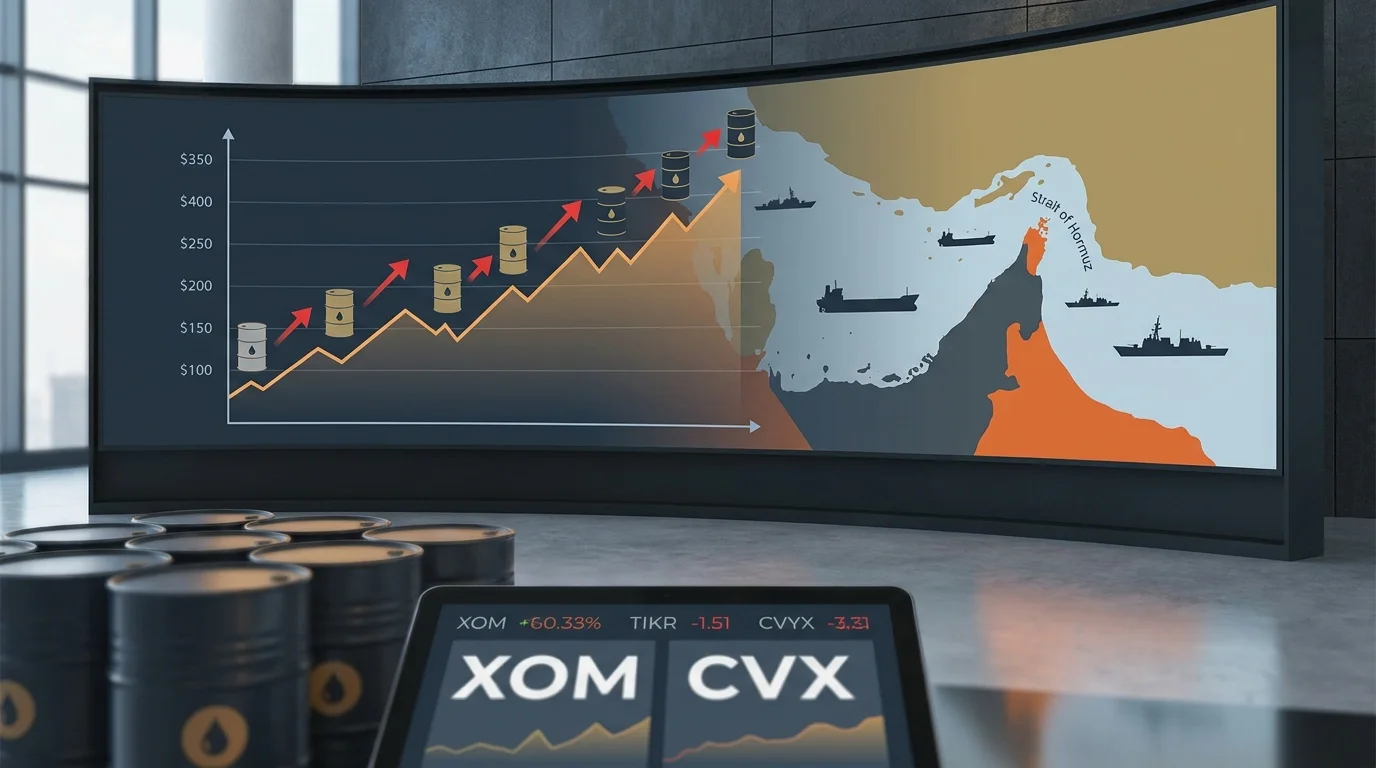
The convergence of stalled US-Iran negotiations and supply disruptions through the Strait of Hormuz has propelled Brent crude oil prices to $107.77 per barrel, representing a dramatic 57% increase compared to the same period last year. This surge is sending shockwaves through global financial markets, with the S&P 500 declining 0.6% and the Nasdaq dropping 0.9% as investors grapple with renewed inflation concerns and the potential for prolonged energy price volatility.
For investors, the current environment presents both significant risks and opportunities. While technology stocks and inflation-sensitive sectors face headwinds from higher energy costs, major oil companies like Shell have reported nearly $7 billion in quarterly profits, highlighting the divergent fortunes across the market. The US Energy Information Administration has significantly revised its supply forecasts, now projecting that the Strait of Hormuz will remain effectively closed through late May, potentially pushing oil prices another $10-12 per barrel higher before forcing meaningful concessions from either Washington or Tehran.

Looking for opportunities in this volatile market? Intellectia.ai's AI-powered stock screener helps you identify energy stocks poised to benefit from rising oil prices while flagging sectors vulnerable to inflation pressures. Our real-time analysis tracks analyst ratings, valuation metrics, and momentum indicators across global markets.
The Perfect Storm: How Oil Prices Reached $107
Geopolitical Catalysts Driving Supply Fears
The dramatic escalation in oil prices stems primarily from the breakdown in US-Iran peace negotiations, which has created unprecedented uncertainty about Middle Eastern energy supplies. Brent crude futures gained $3.56, or 3.42%, to settle at $107.77 per barrel on May 12, 2026, while US West Texas Intermediate futures closed up $4.11, or 4.19%, at $102.18 per barrel. These movements represent consecutive days of nearly 3% gains as market participants price in the risk of sustained supply disruptions.
The strategic importance of the Strait of Hormuz cannot be overstated. This narrow waterway handles approximately 20% of global petroleum consumption, and reports indicate that the de facto closure of the strait has already reduced daily supply by 3.8 million barrels. The US Energy Information Administration conceded on May 12 that earlier forecasts dramatically underestimated both the magnitude and duration of these disruptions, revising projections to reflect a much lengthier impact on global oil supplies.
Market Mechanics: Why Prices Could Climb Further
Energy analysts maintain a bullish outlook for near-term crude futures, with projections suggesting another $10-12 per barrel upside before such elevated pricing forces significant concessions from either the United States, Iran, or both parties. This assessment reflects the inelasticity of oil demand in the short term and the limited spare production capacity available to offset Middle Eastern supply losses.
The United Arab Emirates holds the majority of OPEC's spare crude capacity, but even this reserve is insufficient to fully compensate for the 3.8 million barrel daily shortfall created by the Strait of Hormuz closure. As Gulf energy exporters increasingly declare force majeure and suspend contractual obligations, the risk of a cascading supply crisis grows, with some Arab economists warning that continued fighting could ultimately drive oil prices to $150 per barrel and natural gas prices to $40 per million thermal units.
Wall Street's Response: Market Sectors in Turmoil
Technology Stocks Lead the Decline
The technology sector has borne the brunt of investor anxiety surrounding inflation and energy costs. AI hyperscalers and major chip producers, which had been leading this month's market surge, experienced significant pullbacks with Tesla, Nvidia, Amazon, and Alphabet all declining more than 1%. The sell-off was particularly pronounced in semiconductor stocks, with Micron Technology dropping 4% amid concerns about rising input costs and the potential for demand destruction in consumer electronics.
The pressure on technology valuations reflects multiple interconnected factors. Higher energy costs directly impact data center operations, which consume enormous amounts of electricity to power AI training and inference workloads. Additionally, inflation concerns raise the specter of prolonged higher interest rates, which disproportionately affect growth stocks whose valuations depend on distant future cash flows. The combination of rising input costs and tighter monetary policy creates a challenging environment for the sector that had previously driven market gains.
Energy Stocks: The Bright Spot in a Volatile Market
While broader markets struggle, energy stocks have emerged as clear beneficiaries of the oil price surge. Shell reported nearly $7 billion in first-quarter profits, capitalizing on the war-driven price appreciation. European majors including BP, Shell, and TotalEnergies collectively pocketed $22 billion in trading profits during the first three months of 2026, outperforming their American rivals Chevron and ExxonMobil thanks to substantial trading operations that monetize market volatility.
However, the picture is nuanced for US oil majors. ExxonMobil reported first-quarter earnings of $4.2 billion, down 46% from the prior year primarily due to accounting adjustments, while Chevron saw quarterly profits slide to $2.2 billion, a 37% decline year-over-year. These results highlight how American firms are more directly exposed to production losses in the Middle East, offsetting the benefits of higher crude prices. As one industry analyst noted, US companies are experiencing "stalled deliveries and supply disruptions" that have prevented them from fully capitalizing on the windfall enjoyed by their European counterparts.
Inflation Implications: The Fed's Dilemma Deepens
Sticky Inflation Data Complicates Monetary Policy
The oil price surge arrives at a particularly challenging moment for monetary policymakers. Inflation data released in May came in hotter than expected, reinforcing concerns that the Federal Reserve's efforts to tame price pressures remain incomplete. Rising energy costs threaten to rekindle inflationary forces across the economy, from transportation and manufacturing to consumer goods and services.
The inflationary transmission mechanism operates through multiple channels. Direct energy costs affect transportation and logistics, raising prices for everything from groceries to industrial materials. Indirectly, higher oil prices increase production costs across manufacturing sectors, particularly for petrochemicals, plastics, and synthetic materials. These input cost pressures often lead to broader price increases as businesses pass expenses to consumers, creating the kind of wage-price spiral that central banks fear most.
Global Economic Risks Intensify
The economic consequences extend far beyond US markets. Asian importers, particularly China as a main economic partner of many countries in the war zone, face heightened energy costs that threaten to slow economic growth. Middle Eastern economies suffer from suspended aviation and tourism, while factories worldwide face potential supply shortages that could halt production lines.
Qatar's Energy Minister Al-Kaabi has warned that Gulf energy exports may halt entirely if the war continues, which could trigger what some analysts describe as the "collapse of world economies" in an extreme scenario. Even a swift resolution would likely leave Gulf economies recovering for months, with ripple effects across global supply chains. These risks underscore why energy security has become a top priority for policymakers from Washington to Beijing, where President Trump is scheduled to meet with China's leader Xi Jinping in a summit that could help shape the future of the conflict.

Navigate market volatility with confidence. Intellectia.ai's AI stock picker analyzes thousands of data points to identify energy sector winners and inflation-resistant investments. Start your free trial today and get real-time alerts on market-moving events.
Investment Strategies for the Current Environment
Positioning for Continued Energy Volatility
Investors seeking exposure to the energy sector should consider the divergent performance between American and European oil majors. While US companies like ExxonMobil and Chevron offer exposure to rising crude prices, they also carry greater risk from Middle East production disruptions. European majors with robust trading operations, including Shell, BP, and TotalEnergies, have demonstrated superior ability to monetize price volatility while maintaining more diversified supply sources.
Beyond individual equities, exchange-traded funds focused on the energy sector provide diversified exposure while reducing company-specific risks. The United States Oil Fund (USO) offers direct exposure to WTI crude oil futures, though investors should be aware of the unique risks associated with commodity futures investments, including contango effects and roll costs. For those seeking equity-based exposure, the Energy Select Sector SPDR Fund (XLE) provides broad exposure to the S&P 500 energy sector, including integrated oil companies, equipment providers, and refiners.
Inflation Hedges and Defensive Positioning
The resurgence of inflation concerns warrants attention to assets that historically perform well in rising price environments. Treasury Inflation-Protected Securities (TIPS) provide direct inflation hedging through principal adjustments tied to the Consumer Price Index. Real estate investment trusts (REITs) with pricing power can pass increased costs to tenants, while commodity producers beyond oil—including miners and agricultural companies—may benefit from broader inflationary pressures.
For equity investors, companies with strong pricing power and minimal commodity input requirements offer defensive characteristics. Software and service businesses with recurring revenue models, pharmaceutical companies with patent-protected drugs, and financial institutions that benefit from higher interest rates may outperform in an inflationary environment. The key is identifying businesses that can maintain or expand margins even as input costs rise across the economy.
Outlook: What Investors Should Watch
Key Catalysts in the Coming Weeks
Several critical developments will determine whether oil prices stabilize at current levels or continue their ascent toward the $120-150 range feared by some analysts. The outcome of US-China summit discussions regarding the Iran conflict could signal whether diplomatic pressure increases on Tehran or if the current stalemate persists. Any indication of progress toward reopening the Strait of Hormuz would likely trigger immediate relief in oil markets, while escalation risks remain significant if negotiations fail completely.
Domestically, Federal Reserve communications will provide crucial guidance on how policymakers view the inflationary impact of energy price increases. If the Fed signals willingness to look through temporary supply shocks while maintaining focus on underlying inflation trends, equity markets may find relief. Conversely, indications that energy costs are spurring broader inflationary pressures could renew fears of additional rate hikes, putting further pressure on growth stocks.
Long-Term Energy Transition Considerations
While immediate focus centers on geopolitical risks, investors should not lose sight of longer-term structural trends in global energy markets. The current crisis highlights the continued importance of fossil fuel security even as the energy transition accelerates. Companies with strong positions in both traditional hydrocarbons and renewable energy—including European majors like Shell and TotalEnergies—may offer the most resilient business models as the world navigates a multi-decade transition to cleaner energy sources.
The debate over "drill, baby, drill" policies has gained renewed momentum in the United States, with Alaska experiencing renewed interest from oil majors including Exxon and Shell as the state becomes what some describe as the "world's hottest play" for Arctic exploration. Whether this represents a lasting shift in energy policy or a temporary response to price spikes will have significant implications for investment strategies across the sector.
Conclusion
The convergence of geopolitical conflict, supply disruptions, and inflationary pressures has created one of the most challenging market environments since the pandemic-era volatility of 2020-2021. With Brent crude above $107 and the potential for further increases to $120 or higher, investors must carefully evaluate their exposure to energy costs across portfolios. The stark divergence between technology sector struggles and energy sector profits illustrates how rapidly market leadership can shift in response to macroeconomic developments.
For those navigating these turbulent waters, the path forward requires balancing opportunistic exposure to energy sector gains with defensive positioning against potential demand destruction and continued inflationary pressures. The resolution of US-Iran tensions represents the single largest variable for near-term price direction, but even a diplomatic breakthrough would likely leave lasting impacts on global energy security policies and investment priorities.

Ready to make smarter investment decisions? Sign up for Intellectia.ai today and access our comprehensive suite of AI-powered investment tools. From real-time market analysis to personalized portfolio recommendations, we provide the insights you need to thrive in volatile markets. Don't let uncertainty hold you back—start your free trial now and discover why thousands of investors trust Intellectia.ai for their most important financial decisions.