
Key Takeaway
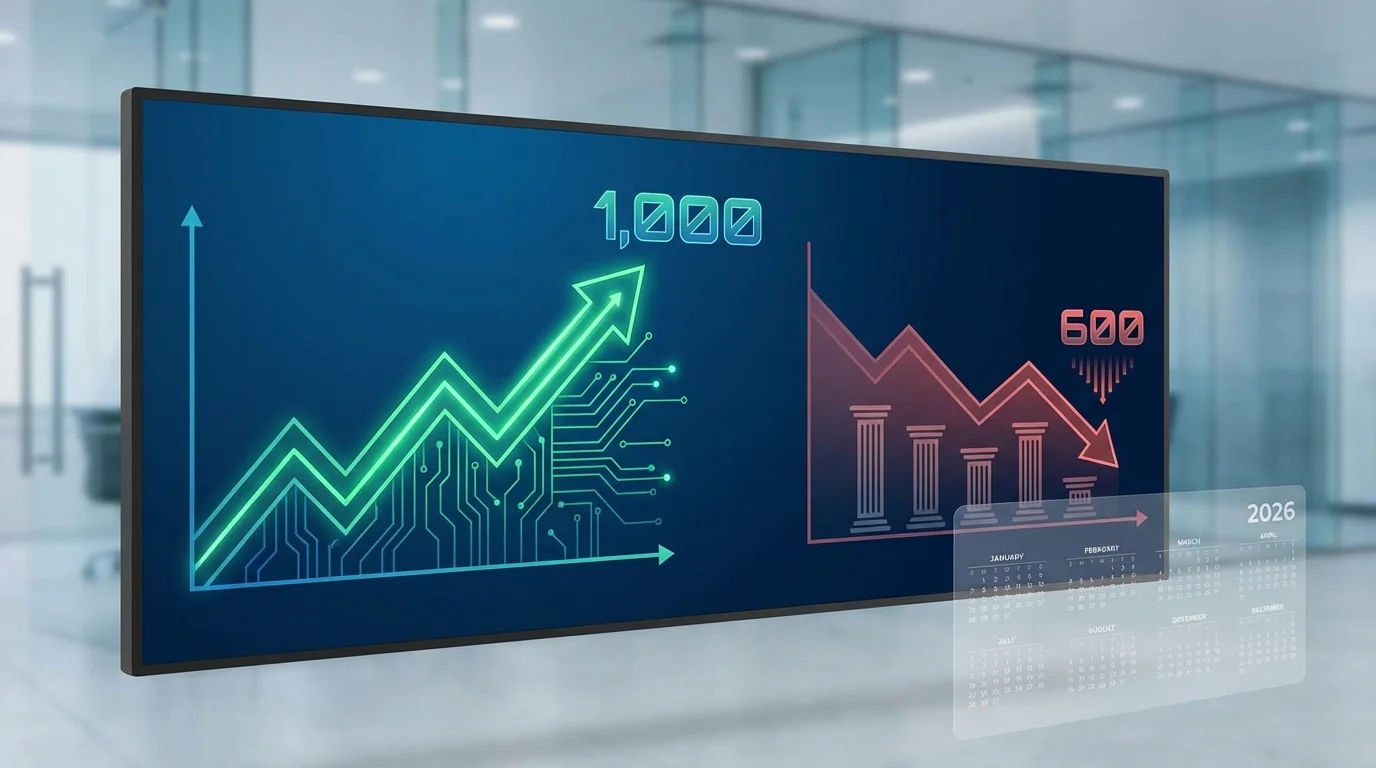
The U.S. stock market experienced a historic divergence on March 26, 2026, as Nvidia's meteoric rise past the $1,000 milestone collided with a brutal 600-point selloff in the Dow Jones Industrial Average. This dramatic split reveals a market grappling with two competing narratives: the unstoppable artificial intelligence revolution led by semiconductor giants, and growing fears that persistent inflation and Federal Reserve policy could trigger a stagflationary environment that threatens traditional industrial and financial sectors.
For investors, this divergence signals a fundamental shift in how markets are pricing risk and opportunity. While AI infrastructure spending continues to drive unprecedented demand for Nvidia's GPUs and networking solutions, broader economic indicators suggest the era of easy money has definitively ended. Understanding this divergence is crucial for portfolio positioning in what appears to be a new phase of market dynamics where sector selection matters more than overall market direction.
The AI Boom Reaches New Heights
Nvidia's ascent past $1,000 per share represents more than just a numerical milestone—it marks the definitive arrival of artificial intelligence as the primary driver of technology sector valuations. The company's stock has been propelled by what analysts describe as insatiable demand for its data center GPUs, which have become the essential infrastructure for training and deploying large language models and other AI systems. This demand shows no signs of slowing, with major technology companies continuing to announce massive capital expenditure programs focused on building out AI capabilities.
What makes Nvidia's current position particularly compelling is the company's ability to maintain pricing power in an increasingly competitive landscape. While competitors like AMD and Intel have made strides in the AI accelerator market, Nvidia's CUDA software ecosystem and established relationships with hyperscalers have created significant switching costs for customers. The company's recent quarterly results revealed revenue growth that exceeded even the most optimistic projections, with data center segment growth approaching 40% year-over-year.
Beyond GPUs, Nvidia's networking revenue has exploded, growing 263% and demonstrating that the AI opportunity extends far beyond just processing chips. As AI clusters grow larger and more complex, the networking fabric that connects thousands of GPUs becomes increasingly critical to performance. This expansion into networking, software, and services is transforming Nvidia from a semiconductor company into a comprehensive AI infrastructure provider with multiple revenue streams and higher margin profiles.
Rate Fears Trigger Broader Market Rout
While technology stocks were celebrating Nvidia's milestone, the broader market was suffering its worst session in over a year. The Dow Jones Industrial Average's 600-point decline reflected growing anxiety about Federal Reserve policy and the trajectory of inflation. The selloff was triggered by robust economic data from S&P Global's Purchasing Managers' Index, which showed stronger-than-expected economic activity that paradoxically worried investors concerned about persistent inflation pressures.
The market's reaction to positive economic data illustrates how sentiment has shifted over the past year. Where strong economic indicators were once celebrated as signs of a soft landing, they are now viewed through the lens of inflation risk and potential Federal Reserve hawkishness. According to the CME FedWatch Tool, markets are now pricing in a 20% chance that the Fed could actually raise rates in 2026, a dramatic shift from the rate-cut expectations that dominated sentiment at the beginning of the year.
This repricing of rate expectations has hit interest-rate-sensitive sectors particularly hard. Financial stocks have declined as the prospect of higher-for-longer rates raises concerns about credit quality and loan demand. Industrial companies, which had benefited from infrastructure spending and reshoring trends, are now facing headwinds from higher borrowing costs and concerns about economic growth deceleration. Even consumer discretionary stocks have come under pressure as investors worry about the impact of sustained high rates on household spending.
Stagflation Risks Loom Large
Perhaps the most concerning development for market participants is the growing discussion of stagflation—a toxic combination of stagnant economic growth and persistent inflation that creates a challenging environment for both stocks and bonds. BlackRock's downgrade of U.S. equities reflects this concern, as the world's largest asset manager adjusts its positioning for an environment where traditional portfolio construction may underperform.
The catalyst for stagflation fears has been the combination of strong economic data with persistent inflationary pressures from energy markets. Oil prices have risen sharply due to geopolitical tensions in the Middle East, with gas prices climbing approximately 30% in recent months. This energy price shock is particularly problematic because it simultaneously raises input costs for businesses while reducing disposable income for consumers, creating a squeeze that can lead to lower corporate margins and reduced economic activity.
The Federal Reserve finds itself in an increasingly difficult position. Core inflation remains above the central bank's 2% target, but raising rates further could tip an economy already facing headwinds into recession. According to a recent Reuters poll, economists now expect the Fed to keep rates on hold until September 2026, pushing back previous expectations for earlier cuts. This "higher for longer" scenario would maintain pressure on rate-sensitive sectors while potentially capping valuations for even high-growth technology companies.
What This Divergence Means for Investors
The extreme divergence between Nvidia's surge and the broader market decline offers important lessons for portfolio construction in the current environment. First, it highlights the importance of sector selection over market timing. While the overall market struggled, investors who maintained exposure to AI infrastructure through Nvidia and related semiconductor companies saw significant gains even on a down day for the broader indices.
Second, this divergence underscores the value of maintaining diversification even within equity portfolios. Investors who were overweight traditional value sectors like financials and industrials while underweight technology likely experienced significant underperformance. However, the opposite positioning—being entirely concentrated in AI stocks—carries its own risks, as valuations in the sector have reached levels that leave little room for disappointment.
Third, the market action suggests that active management may be increasingly valuable in an environment where macro factors are driving significant dispersion between sectors and individual stocks. Passive index investors are effectively forced to own both the winners and losers in this divergence, while active managers can position more precisely for the themes they believe will drive returns.
Ready to identify the next Nvidia before it hits major milestones? Intellectia.AI's AI Stock Picker analyzes thousands of data points to surface high-conviction opportunities in emerging technology trends. Whether you're looking for AI infrastructure plays or the next breakthrough application layer companies, our AI-powered screening tools can help you stay ahead of the curve.
The Fed's Dilemma and Market Implications
The Federal Reserve faces what may be its most challenging policy environment since the 1970s. On one hand, headline inflation has remained stubbornly above target, driven by energy costs and persistent service sector price pressures. On the other hand, the economy is showing signs of strain from two years of aggressive monetary tightening, with leading indicators suggesting potential deceleration in the second half of 2026.
Market pricing has shifted dramatically in response to these conflicting signals. At the beginning of 2026, futures markets were pricing in three to four rate cuts during the year. Now, those expectations have collapsed to just one cut, with some probability even assigned to a rate hike if inflation data continues to surprise to the upside. This repricing has significant implications for asset valuations, as higher discount rates reduce the present value of future cash flows.
For technology stocks like Nvidia, the rate environment presents a paradox. The company's growth prospects are driven by secular trends in AI adoption that are largely independent of interest rate cycles. However, the valuation multiples that investors are willing to pay for that growth are directly affected by rates. If the Fed is forced to keep rates higher for longer, or even raise them further, even the strongest growth stories could see multiple compression that offsets earnings growth.
Positioning for a Divergent Market
Investors navigating this complex environment should consider several key strategies. First, maintaining exposure to AI infrastructure through companies like Nvidia, AMD, and key suppliers remains compelling despite high valuations, as the secular growth trend shows no signs of abating. However, position sizing should reflect the increased risk that comes with elevated valuations and potential rate headwinds.
Second, the traditional 60/40 portfolio may face challenges in a stagflationary environment where both stocks and bonds could underperform simultaneously. Investors might consider alternative diversifiers such as commodities, real assets, or trend-following strategies that have historically performed well during inflationary periods.
Third, quality factors should be emphasized in portfolio construction. Companies with strong balance sheets, pricing power, and consistent cash flows are better positioned to weather the uncertainty of the current macro environment. This is particularly important in sectors facing headwinds from higher rates, where weaker competitors may struggle to access capital or maintain profitability.
Looking for AI stocks with strong fundamentals and reasonable valuations? Intellectia.AI's AI Screener lets you filter thousands of stocks using natural language queries to find opportunities that match your specific criteria. From growth metrics to valuation multiples, our AI-powered tools help you build conviction in your investment decisions.

Conclusion
The historic divergence between Nvidia's surge past $1,000 and the Dow's 600-point decline captures the complexity of today's investment landscape. We are witnessing a market where secular growth trends in artificial intelligence coexist with cyclical concerns about inflation, interest rates, and economic growth. For investors, success in this environment requires understanding both narratives and positioning accordingly.
Nvidia's milestone is not just a story about one company's success—it represents the recognition that AI infrastructure spending will continue regardless of the broader economic environment. Companies building AI capabilities view these investments as existential necessities, creating demand that is more resilient to economic cycles than traditional technology spending. At the same time, the broader market selloff reflects legitimate concerns about the Federal Reserve's ability to navigate a soft landing in the face of persistent inflation pressures.
The key takeaway for investors is that dispersion—both between sectors and within them—is likely to remain elevated as markets grapple with these conflicting forces. This creates both risks and opportunities. Companies that can deliver genuine growth in a challenging macro environment, like Nvidia, may continue to command premium valuations. Meanwhile, businesses exposed to interest rate sensitivity or cyclical downturns may face continued pressure regardless of their individual merits.
Ready to navigate this complex market with AI-powered insights? Sign up for Intellectia.AI today and get access to professional-grade analysis tools that help you identify winners in a divergent market. Whether you're analyzing AI infrastructure plays or searching for value in beaten-down sectors, our platform provides the data and intelligence you need to make informed investment decisions.