
Key Takeaway
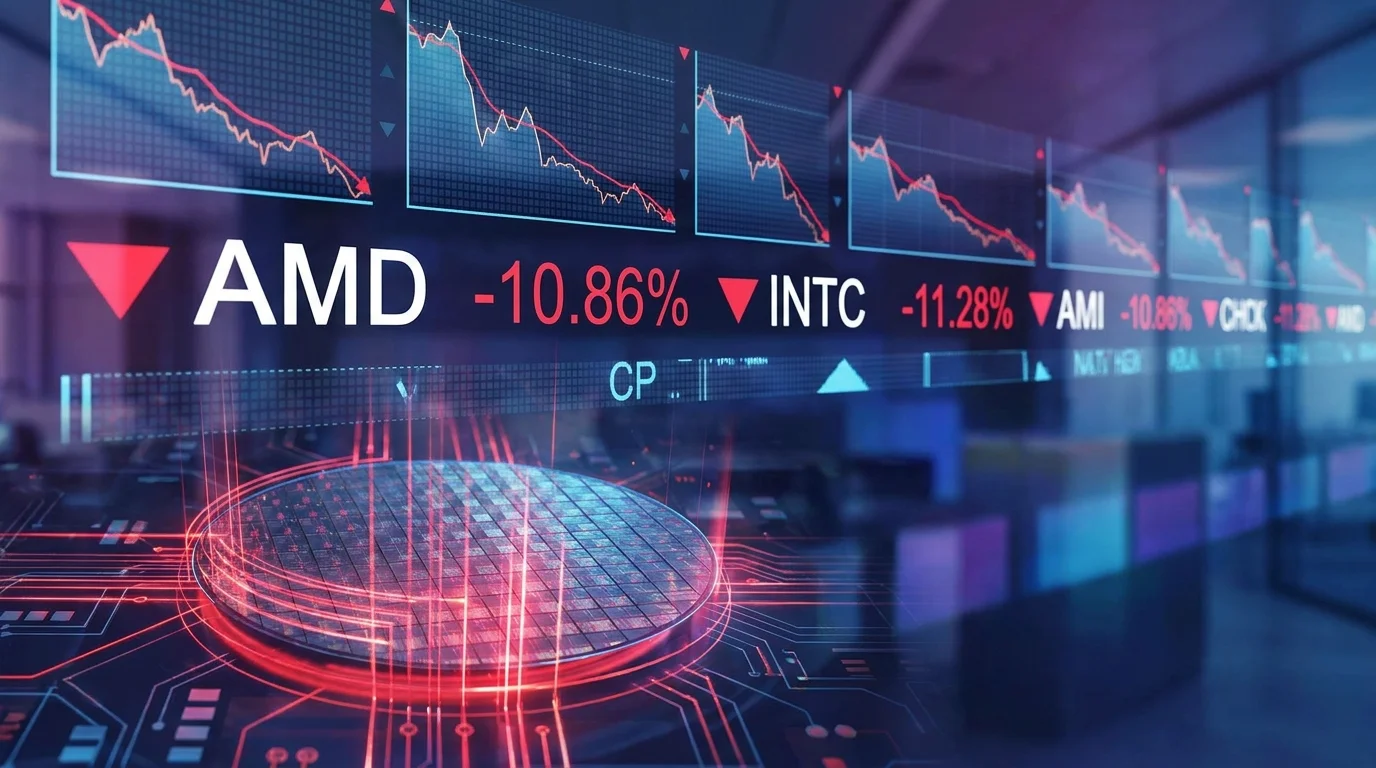
The semiconductor sector experienced its most severe pullback in years during early June 2026, with the Philadelphia Semiconductor Index (SOXX) plummeting 10% and major chipmakers suffering double-digit percentage declines. AMD shares collapsed 10.86% to $466.38, while Intel experienced an even steeper decline of 11.28%, closing at $99.17. This widespread carnage erased approximately $1.3 trillion in market value from the AI chip ecosystem, forcing investors to confront a fundamental question: is this the beginning of the end for the AI chip boom, or an attractive entry point for long-term investors?
The selloff's origins trace back to June 3, 2026, when a weaker-than-expected AI chip outlook from Broadcom triggered a domino effect across the entire semiconductor supply chain. Broadcom's decision to merely reiterate rather than raise its 2026 guidance sent shares plunging roughly 15%, instantly shattering the market's assumption that AI infrastructure spending would continue accelerating indefinitely. This single event exposed the fragility of semiconductor valuations that had reached historically stretched levels following months of relentless upward momentum.
However, beneath the surface volatility lies a more nuanced reality. The four major hyperscalers—Amazon, Google, Meta, and Microsoft—have collectively raised their AI capital expenditure budgets to an astounding $750 billion for 2026, suggesting that demand fundamentals remain robust despite short-term market turbulence. For disciplined investors willing to look beyond daily price swings, this pullback may represent a rare opportunity to acquire positions in high-quality chipmakers at significantly more reasonable valuations than those available just weeks ago.
What Triggered the Semiconductor Selloff
Understanding the catalysts behind this historic pullback requires examining both macroeconomic headwinds and sector-specific dynamics that converged to create a perfect storm for chip stocks. The market reaction was driven more by positioning adjustments than fundamental deterioration, according to Ohsung Kwon, chief equity strategist at Wells Fargo, who noted that "the semiconductor sector was way overbought."
Broadcom's Disappointing Guidance
Broadcom's earnings report served as the immediate trigger for the cascade of selling pressure that engulfed the semiconductor universe. The Palo Alto-based company, which has positioned itself as a major beneficiary of AI infrastructure buildouts, chose to maintain its 2026 guidance rather than raise expectations as analysts had anticipated. This conservative stance was interpreted by the market as evidence that AI chip demand might be plateauing sooner than expected, contradicting the narrative of perpetual exponential growth that had fueled the sector's parabolic advance.
The reaction was swift and brutal. Broadcom shares cratered approximately 15% in a single session, dragging down the entire AI chip ecosystem with it. Investors who had been paying premium valuations based on the assumption of continuously accelerating growth suddenly found themselves recalibrating their models and questioning whether they had overestimated the near-term trajectory of AI infrastructure spending.
Overbought Conditions and Positioning Flush
Technical factors exacerbated the fundamental disappointment from Broadcom. The semiconductor sector had enjoyed a blistering run to record highs in the weeks preceding the selloff, with many stocks trading at valuations that assumed flawless execution and perpetual growth acceleration. This overbought condition created a tinderbox environment where any negative catalyst could spark a violent reversal.
Hedge funds and institutional investors had accumulated massive long positions in chip stocks, making the sector vulnerable to forced liquidations once momentum shifted. As stop-loss orders triggered and algorithms amplified selling pressure, the decline became self-reinforcing, pushing prices far below levels justified by fundamentals alone. This dynamic explains why the selloff affected even high-quality companies with strong underlying businesses and robust demand outlooks.
AMD Stock Analysis: Opportunity or Trap?
Advanced Micro Devices has emerged as a focal point for investors debating whether the pullback represents a strategic buying opportunity or a value trap waiting to spring. The company's shares have been particularly volatile, reflecting the market's uncertainty about its competitive position against Nvidia in the AI accelerator market and its ability to maintain momentum in traditional CPU and GPU segments.
Strong Fundamental Execution
Despite the stock price carnage, AMD's underlying business performance remains impressive. In the first quarter of 2026, the chipmaker delivered revenue of $10.3 billion, representing a 38% year-over-year increase and an acceleration from the 34% growth recorded in the fourth quarter of 2025. This trajectory demonstrates that AMD continues gaining market share and executing effectively on its product roadmap.
The data center segment has been the primary growth engine, with AMD's EPYC server processors capturing increasing share from Intel in the cloud computing market. Meanwhile, the company's MI300 series AI accelerators have gained traction among hyperscalers seeking alternatives to Nvidia's dominant H100 and H200 offerings. While AMD remains a distant second in AI chips, its competitive positioning has improved meaningfully over the past eighteen months.
Valuation Reassessment
The critical question for prospective AMD investors is whether the stock's valuation has compressed sufficiently to compensate for the risks and uncertainties facing the business. Following the pullback, AMD shares trade at a significant discount to their recent highs, potentially offering a more attractive entry point for long-term investors who believe in the company's strategic direction.
However, valuation alone does not make a stock a buy. Investors must weigh AMD's competitive threats, including Nvidia's impending Blackwell architecture launch and Intel's aggressive pricing strategy in the server CPU market. The company also faces execution risks as it attempts to scale its AI chip business from a standing start to a material revenue contributor. Patience and selective accumulation may prove more prudent than aggressive buying at current levels.
Intel's Struggles Deepen
Intel's 11.28% decline to $99.17 reflects not merely broad sector weakness but also company-specific challenges that continue to plague the former semiconductor titan. Once the undisputed leader in chip manufacturing and design, Intel has ceded ground to competitors across virtually every major product category, raising serious questions about its long-term viability as a standalone entity.
Market Share Erosion Continues
AMD's EPYC processors have systematically dismantled Intel's dominance in the data center market, capturing an estimated 25% of server CPU shipments and an even larger share of revenue. This competitive pressure has forced Intel to discount aggressively to maintain volume, compressing margins and undermining profitability. The company's delayed manufacturing roadmap has further eroded customer confidence, with many cloud providers diversifying away from Intel as a sole supplier.
The AI accelerator market represents another area where Intel has struggled to establish meaningful traction. Despite billions in investments and multiple product generations, the company's Gaudi and Falcon Shores architectures have failed to gain significant adoption compared to Nvidia and AMD offerings. This absence from the fastest-growing segment of the semiconductor market severely limits Intel's growth prospects.
Strategic Options Narrow
Intel's mounting challenges have fueled speculation about potential strategic alternatives, including breakup scenarios or acquisition by a larger technology conglomerate. The company's manufacturing division, once a crown jewel, has become a massive cash drain as it attempts to catch up to Taiwan Semiconductor's process technology leadership. This turnaround effort requires enormous capital expenditures at a time when Intel's core product businesses are under intense pressure.
For investors, Intel represents a high-risk contrarian bet that requires conviction in new CEO Lip-Bu Tan's ability to execute a dramatic turnaround. While the stock's depressed valuation may appear attractive on traditional metrics, the company's structural challenges suggest that a "cheap" stock could become even cheaper if competitive dynamics continue deteriorating.
Nvidia's Resilience Tested
Nvidia, the unquestioned king of AI chips, has not been immune to the sector-wide selloff despite its dominant market position. The company's shares declined approximately 6% during the worst of the pullback, a relatively modest decline compared to peers that reflects investor confidence in Nvidia's fundamental competitive moat and the sustained demand for its products.
The Blackwell Transition
Nvidia's near-term outlook is dominated by the rollout of its next-generation Blackwell architecture, which promises significant performance improvements over the current Hopper generation. The company has secured massive pre-orders from hyperscalers desperate for AI training and inference capacity, creating a visible revenue runway extending well into 2027. This demand visibility provides Nvidia with a cushion that smaller competitors lack.
However, the Blackwell transition also introduces execution risks. Manufacturing complex AI accelerators at scale requires flawless coordination with Taiwan Semiconductor, which has faced its own yield challenges with advanced process nodes. Any delays or quality issues could disrupt Nvidia's revenue trajectory and provide openings for competitors to gain footholds.
Valuation Premium Defended
Nvidia continues to trade at a substantial valuation premium to the broader semiconductor sector, reflecting its unique position at the center of the AI revolution. Bulls argue that this premium is justified by the company's technology leadership, ecosystem lock-in through its CUDA software platform, and the structural growth tailwinds supporting AI infrastructure spending. Bears counter that even flawless execution cannot support current valuations indefinitely, particularly as competition intensifies and growth rates normalize.
For investors, Nvidia represents a bet on the continued expansion of AI capabilities and the company's ability to maintain its technological edge. While the stock is unlikely to repeat the extraordinary returns of 2023-2025, it may still deliver attractive risk-adjusted performance for those who believe AI infrastructure buildouts have years of growth ahead.
The AI Capex Boom Continues
Despite the recent stock market turbulence, the fundamental demand drivers supporting semiconductor spending remain remarkably robust. The four dominant hyperscalers—Amazon Web Services, Google Cloud, Microsoft Azure, and Meta Platforms—have collectively committed approximately $750 billion to capital expenditures in 2026, with the majority directed toward AI infrastructure including chips, servers, and data centers.
Hyperscaler Commitment Signals Durability
This unprecedented level of investment reflects the strategic imperative these technology giants face to develop and deploy increasingly sophisticated AI models. The competitive dynamics of the cloud computing market demand continuous infrastructure expansion, as customers gravitate toward providers offering the most capable and cost-effective AI services. No major player can afford to fall behind in this arms race without risking permanent competitive disadvantage.
The composition of this spending is particularly favorable for semiconductor companies. AI accelerators represent the highest-value components in modern data center builds, often accounting for 30-40% of total server costs. As training clusters grow larger and inference workloads expand, demand for high-performance chips should continue growing even if the rate of growth moderates from the explosive pace of 2024-2025.
Supply Chain Implications
The sustained high level of hyperscaler spending has profound implications across the semiconductor supply chain. Taiwan Semiconductor, as the primary manufacturer of advanced AI chips for Nvidia, AMD, and others, continues to operate at full capacity with lead times extending months into the future. This supply constraint provides pricing power and visibility for the entire ecosystem.
Memory manufacturers like SK Hynix and Samsung have also benefited enormously from AI-driven demand for high-bandwidth memory (HBM), a critical component in AI accelerators. The specialized packaging services required to assemble complex AI chips have created new revenue streams for companies like Amkor and ASE Holdings. These second-order beneficiaries of AI infrastructure spending offer alternative ways for investors to gain exposure to the theme at potentially more attractive valuations than the headline chip designers.
Investment Strategy: Navigating the Pullback
For investors contemplating how to position themselves following the semiconductor selloff, several strategic frameworks can guide decision-making. The appropriate approach depends on individual risk tolerance, investment horizon, and convictions about the durability of AI infrastructure spending growth.
Dollar-Cost Averaging for Long-Term Investors
Those with multi-year investment horizons who believe AI adoption will continue accelerating may view this pullback as an opportunity to initiate or add to positions in high-quality semiconductor companies. Rather than attempting to time the market bottom precisely, a disciplined dollar-cost averaging approach can help mitigate the risk of further downside while ensuring participation in any recovery.
Quality should be the primary selection criterion in this environment. Companies with strong competitive positions, healthy balance sheets, and diversified revenue streams are better positioned to weather potential volatility and emerge stronger on the other side. Nvidia and AMD fit this description, as do semiconductor equipment leaders like Applied Materials and ASML that benefit from secular trends regardless of which chip designers ultimately win market share.

Waiting for Clearer Signals
More cautious investors may prefer to wait for technical indicators to stabilize before committing fresh capital. The speed and severity of the recent selloff suggests that forced liquidations and algorithmic selling may have further to run before finding equilibrium. Waiting for signs of accumulation and base formation can help avoid catching falling knives.
Key signals to monitor include volume patterns, relative strength metrics, and options market positioning. A sustained period of reduced volatility and improving breadth across the semiconductor sector would suggest that selling pressure has exhausted itself and a more durable bottom may be forming. Patience in this environment may prove more valuable than speed.
Risks and Considerations
While the pullback has improved valuations, prospective investors must remain cognizant of the risks that could drive further downside or extend the period of underperformance for semiconductor stocks. Understanding these risks is essential for proper position sizing and risk management.
Geopolitical Tensions
The semiconductor industry operates in an increasingly complex geopolitical environment, with U.S.-China trade tensions threatening to disrupt supply chains and limit market access. Restrictions on advanced chip exports to China have already impacted revenue for companies like Nvidia and AMD, and further escalations could broaden these restrictions or trigger retaliatory measures.
Taiwan's central role in semiconductor manufacturing—Taiwan Semiconductor produces the majority of the world's most advanced chips—creates concentrated geopolitical risk that investors cannot ignore. Any scenario involving conflict or significant disruption to Taiwan's operations would have catastrophic implications for the entire technology sector.
Cyclical Downturn Potential
The semiconductor industry has historically been highly cyclical, with periods of strong demand and pricing power followed by downturns characterized by oversupply and margin compression. While AI-related demand has provided a buffer against traditional cyclicality, the industry is not immune to broader economic weakness.
A recession or significant slowdown in enterprise technology spending could reduce demand for data center chips, smartphones, and personal computers, undermining revenue across the sector. Investors must weigh the secular growth potential of AI against these cyclical risks when determining appropriate exposure levels.
Conclusion
The June 2026 semiconductor selloff represents a classic case of market overreaction to short-term concerns, creating potential opportunities for disciplined long-term investors. While the sector's valuations had undoubtedly reached stretched levels, the underlying demand drivers supporting AI infrastructure spending remain robust, with hyperscalers committing unprecedented capital to build out their capabilities.
For investors willing to look beyond daily volatility, high-quality companies like Nvidia and AMD may offer attractive entry points following the pullback. These firms possess strong competitive positions, solid balance sheets, and exposure to secular growth trends that should persist for years. However, patience and selective accumulation are warranted given the potential for further near-term volatility.
Intel presents a higher-risk contrarian opportunity for those with conviction in the company's turnaround potential, though the structural challenges facing the former industry giant suggest that caution is appropriate. Alternative exposure through semiconductor equipment companies or memory manufacturers may offer more favorable risk-reward profiles for certain investors.
Ultimately, successful navigation of this environment requires balancing conviction in the long-term AI opportunity with respect for the risks and uncertainties that remain. By focusing on quality, maintaining appropriate position sizes, and approaching the market with patience, investors can potentially capitalize on the dislocations created by this historic selloff.
Ready to identify the best semiconductor investment opportunities? Sign up for Intellectia.AI today and leverage our AI-powered stock picker to analyze chip stocks with advanced technical and fundamental screening. Our platform provides real-time insights into analyst ratings, valuation metrics, and momentum indicators to help you make informed investment decisions. Start your free trial now and discover why thousands of investors trust our AI-driven approach to navigate volatile markets.