
Key Takeaway
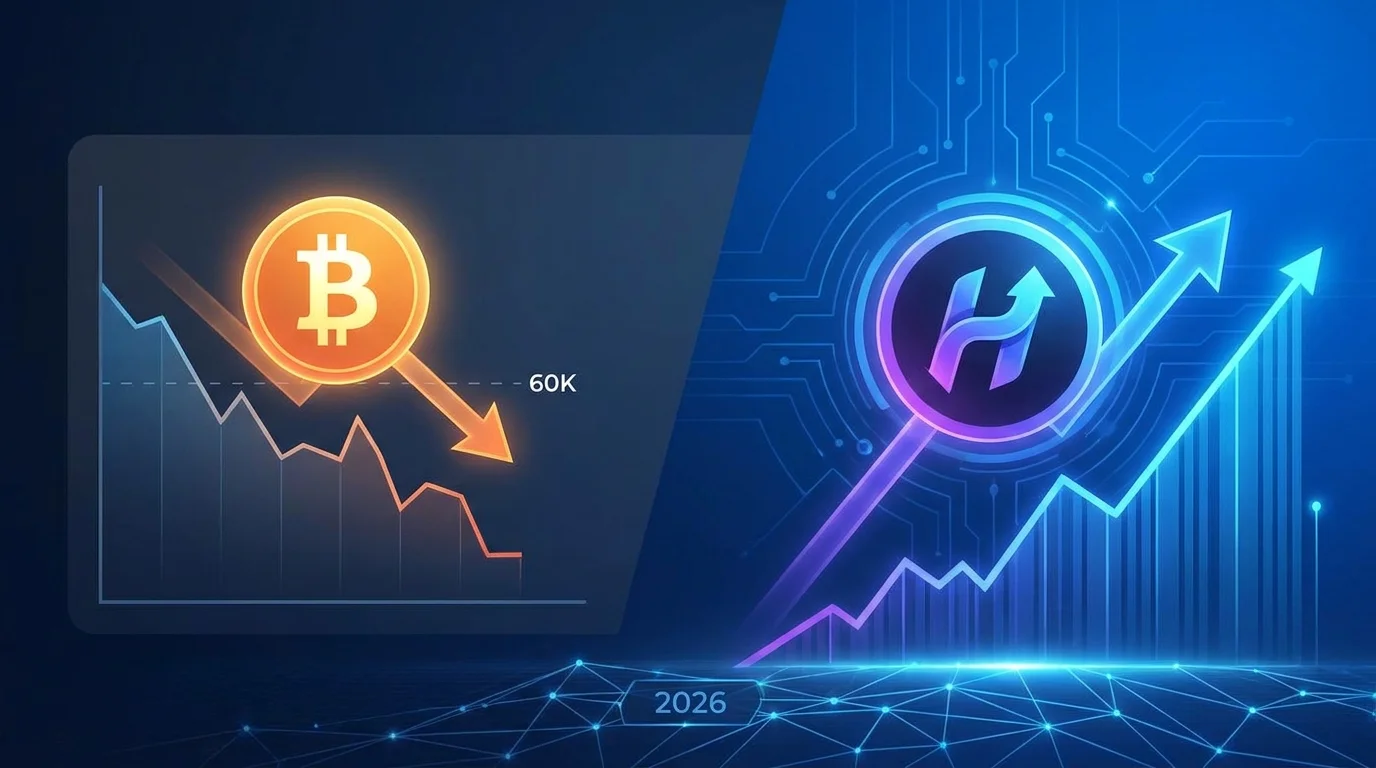
The cryptocurrency market is experiencing its most dramatic divergence in years. While Bitcoin has cratered to its lowest levels since October 2024, plunging below the psychologically critical $60,000 threshold and shedding 27% of its value in 2026 alone, a new challenger has emerged from the decentralized finance wilderness. Hyperliquid's HYPE token has defied gravity, surging approximately 160% year-to-date and reaching an all-time high of $75.52 on June 1, 2026, even as the broader crypto market bleeds.
This stark contrast signals a fundamental shift in how institutional and retail investors are approaching digital assets. The old narrative of Bitcoin as the sole crypto safe haven is being tested by high-performance decentralized exchanges that generate real revenue through trading fees and offer innovative tokenomics models. With multiple HYPE ETFs now trading from issuers like Grayscale and 21Shares, Wall Street is making its preference clear: utility and cash flow trump store-of-value narratives in the current market environment.
For investors navigating this turbulent landscape, the message is equally clear. The crypto market is maturing beyond the monoculture of Bitcoin maximalism into a diverse ecosystem where platform fundamentals, revenue generation, and regulatory compliance matter more than brand recognition. Understanding this shift and positioning accordingly could define investment success for the remainder of 2026 and beyond.
Bitcoin's Historic Collapse: Anatomy of a Crypto Crash
The Breaking Point: Sub-$60K Territory
Bitcoin's descent into bear market territory has been both swift and brutal. After starting 2026 with optimism fueled by spot ETF approvals and institutional adoption, the flagship cryptocurrency has steadily eroded value throughout the first half of the year. The breaking point came in early June when BTC breached the $60,000 level for the first time since October 2024, briefly touching an intraday low of $61,500 on June 4 before stabilizing around the $64,000 range.
The magnitude of this decline cannot be overstated. Bitcoin has now lost approximately 50% from its all-time high, wiping out hundreds of billions in market capitalization and triggering widespread liquidations across leveraged trading platforms. The 27% year-to-date decline represents one of the worst first-half performances in Bitcoin's recent history, calling into question the digital gold narrative that has sustained the asset through previous market cycles.
Multiple technical indicators suggest the selling pressure may not be exhausted. The Relative Strength Index has entered extreme oversold territory, while sentiment metrics reflect panic conditions typically associated with market capitulation. Mining operations are approaching unprofitable levels as prices near production costs, potentially forcing additional selling from miners to cover operational expenses. These factors create a precarious environment where further downside cannot be ruled out, despite the historically attractive entry points for long-term believers.
The Strategy Sale: When Michael Saylor Blinked
Perhaps no single event better encapsulates the severity of Bitcoin's current crisis than Strategy's historic decision to sell Bitcoin. Michael Saylor's company, formerly known as MicroStrategy, has built its entire corporate identity around aggressive Bitcoin accumulation, maintaining a strict never sell policy that became gospel for crypto maximalists worldwide. That changed in late May 2026 when Strategy sold 32 Bitcoins for approximately $2.5 million at an average price of $77,135 per coin.
While the absolute dollar amount was relatively modest, representing a fraction of Strategy's total holdings exceeding 500,000 BTC, the symbolic impact was seismic. Markets immediately treated the sale as a five-alarm fire, with Bitcoin dropping 3.1% to $65,391 within hours and erasing approximately $160 billion in total crypto market capitalization. The psychological damage proved far more significant than the actual coins sold.
Analysts remain divided on whether this signals a strategic pivot or merely a tactical adjustment to optimize capital structure. Citi Research maintains a bullish outlook on both Strategy and Bitcoin, arguing the sale does not change the firm's strategic outlook. However, the mere fact that Saylor felt compelled to break his own commandments has shaken confidence among retail investors who viewed Strategy's accumulation strategy as the ultimate vote of confidence in Bitcoin's long-term trajectory.
Macroeconomic Headwinds and ETF Exodus
Bitcoin's woes extend far beyond company-specific developments into the broader macroeconomic environment. Persistently sticky inflation has forced the Federal Reserve to maintain higher interest rates for longer than markets anticipated, crushing risk assets across the board. The uncertainty around when or if the Fed will begin cutting rates has created a risk-off sentiment that disproportionately impacts speculative assets like cryptocurrency.
The spot Bitcoin ETF complex, once heralded as the institutional onramp that would drive the next bull market, has become a source of selling pressure. Sustained outflows from these products have created a relentless bid-ask imbalance, with authorized participants redeeming shares and selling underlying Bitcoin to meet redemption requests. This structural selling has overwhelmed organic buying interest and created a feedback loop of declining prices.
Geopolitical tensions have added fuel to the fire. The U.S.-Iran conflict has driven inflationary concerns while suppressing risk appetite globally. As traditional safe havens like U.S. Treasuries and gold attract capital fleeing volatility, Bitcoin has failed to demonstrate the uncorrelated behavior that proponents promised. Instead, it has traded increasingly like a high-beta tech stock, amplifying market moves in both directions but offering little downside protection during risk-off episodes.
Hyperliquid's Meteoric Rise: The New Crypto Darling
Decentralized Exchange Dominance
While Bitcoin has stumbled, Hyperliquid has emerged as the undisputed champion of the 2026 crypto markets. The decentralized perpetuals exchange has captured the imagination of traders and investors alike through a combination of superior technology, transparent operations, and innovative tokenomics that directly reward token holders. Unlike traditional centralized exchanges that obscure their revenue and operations, Hyperliquid operates as a high-performance blockchain with full EVM compatibility, enabling users to verify every transaction and fee distribution in real-time.
The platform's trading infrastructure has achieved meaningful scale, rivaling centralized giants like Bybit, OKX, and Coinbase International in terms of daily volume, open interest, and total fees generated. This is no small feat for a decentralized protocol that launched just over a year ago. The ability to offer perpetual futures, spot trading, and borrowing/lending across crypto, equities, commodities, and FX markets has created a one-stop DeFi destination that attracts sophisticated traders seeking alternatives to centralized counterparts.
What truly differentiates Hyperliquid from competitors is its commitment to transparent, on-chain governance and fee-sharing mechanisms. The protocol distributes a significant portion of trading fees to HYPE token stakers, creating a direct cash flow relationship between platform success and token value. This revenue-sharing model has proven far more resilient than the speculative narratives that have sustained other crypto tokens, providing tangible utility that investors can model and value.
Wall Street Embraces HYPE: The ETF Revolution
The institutional validation of Hyperliquid's model arrived in force during May and June 2026 with the launch of multiple HYPE-focused exchange-traded products. Grayscale, the digital asset management giant, launched its Hyperliquid Staking ETF (HYPG) on June 4, 2026, offering investors exposure to HYPE token price appreciation plus staking yield generation. The fund features the lowest fee structure among U.S.-listed competitors, signaling Grayscale's confidence in the product's mass-market appeal.
21Shares entered the fray with THYP, competing directly for market share in what has become one of crypto's fastest-growing ETF categories. These products allow traditional brokerage account holders to gain exposure to HYPE without navigating the complexities of crypto wallets, private key management, or decentralized exchange interfaces. The convenience factor, combined with the ability to hold HYPE in tax-advantaged retirement accounts, has opened entirely new investor segments to the Hyperliquid ecosystem.
The performance differential between HYPE and traditional crypto assets has only accelerated institutional adoption. While Bitcoin declined 9% through May 2026 and Ethereum posted even steeper losses, HYPE gained more than 50% over the same period. This outperformance has caught the attention of hedge funds and family offices seeking alpha in a challenging macro environment. The narrative has shifted from crypto as an asset class to which crypto platforms generate sustainable competitive advantages, and Hyperliquid has made a compelling case for the latter.
Tokenomics and Sustainable Growth
Hyperliquid's fee-driven token buyback model represents a fundamental evolution in crypto economics. Unlike Bitcoin's fixed supply schedule or Ethereum's post-merge issuance mechanics, HYPE derives value from actual platform usage. Every trade on Hyperliquid generates fees, a portion of which are used to buy back and distribute tokens to stakers. This creates a direct link between trading volume and token price support, a mechanism that becomes more powerful as the platform scales.
The numbers tell a compelling story. With daily trading volumes regularly exceeding $1 billion and open interest across perpetual markets growing consistently, the fee generation machine is accelerating. The platform's HYPE token has appreciated over 1,842% since its November 2024 launch, demonstrating that investors recognize and reward sustainable business models in the crypto space. Even after hitting an all-time high of $75.52 on June 1, 2026, many analysts believe the token remains undervalued relative to the platform's growth trajectory and market share gains.
Regulatory clarity, or the prospect of it, adds another dimension to Hyperliquid's investment thesis. While the platform remains unavailable to U.S. users pending regulatory approvals, industry observers expect sufficient clarity by 2027 to open access to American retail and institutional traders. This potential catalyst represents significant untapped upside, as the U.S. market represents the largest pool of crypto capital globally. The successful launch of regulated HYPE ETFs suggests that compliance infrastructure is being built to accommodate this expansion.
The Great Divergence: What It Means for Investors
A Maturing Market with New Rules
The simultaneous collapse of Bitcoin and surge of Hyperliquid represents more than temporary price divergence, it signals the maturation of cryptocurrency as an investable asset class. The early days of crypto investing, where Bitcoin dominance meant everything and altcoins were judged primarily by their correlation to BTC, are giving way to a more nuanced market where platform fundamentals, revenue generation, and regulatory positioning drive valuations.
This evolution mirrors the development of traditional equity markets. Just as investors eventually learned to distinguish between profitable technology companies and speculative dot-com ventures during the early 2000s, crypto investors are developing the analytical frameworks to evaluate decentralized protocols based on metrics like revenue per token, user growth, and competitive moats. Hyperliquid's success demonstrates that these frameworks can identify winners even in challenging market conditions.
The implications for portfolio construction are profound. Crypto can no longer be treated as a monolithic asset class where Bitcoin allocation decisions drive overall returns. Instead, investors must approach the space with the same rigor applied to equity or fixed income portfolios, identifying specific themes, evaluating individual project merits, and constructing diversified exposure that captures the full range of opportunities while managing concentration risk.
Want to identify the next Hyperliquid before it surges 160%? Our AI-powered crypto screener analyzes on-chain metrics, revenue growth, and tokenomics to surface high-potential opportunities before they hit mainstream radar.

Risk Management in Volatile Times
The divergent paths of Bitcoin and Hyperliquid also underscore the importance of active risk management in crypto investing. Buy-and-hold strategies that worked during the 2020-2021 bull market have proven devastating in 2026, with Bitcoin investors sitting on substantial unrealized losses despite multiple generational buying opportunity moments along the way.
Successful crypto investing in the current environment requires dynamic position sizing, stop-loss discipline, and willingness to rotate capital between opportunities as market conditions evolve. The ability to identify when a narrative is breaking down, whether that's Bitcoin's never sell treasury strategy or the broader macro headwinds facing risk assets, can mean the difference between preserving capital and suffering permanent impairment.
Diversification across crypto subsectors has proven its worth during this divergence. Investors who allocated to DeFi infrastructure and exchange tokens rather than concentrating solely in layer-1 blockchain assets have captured significant outperformance while reducing overall portfolio volatility. As the market continues to evolve, maintaining exposure across multiple crypto themes, from decentralized exchanges to real-world asset tokenization to layer-2 scaling solutions, will be essential for optimizing risk-adjusted returns.
Looking for data-driven crypto picks with built-in risk management? Our AI Stock Picker combines technical analysis, on-chain data, and macro indicators to generate high-conviction crypto recommendations with clear entry and exit points.

The Road Ahead: Catalysts and Challenges
Looking forward, both Bitcoin and Hyperliquid face distinct catalysts and challenges that will determine their trajectory through the remainder of 2026. For Bitcoin, the path to recovery likely runs through macro stabilization, specifically, confidence that the Federal Reserve can achieve a soft landing without pushing the economy into recession. Should inflation cool sufficiently to enable rate cuts, the risk-on sentiment that benefits speculative assets could return quickly, potentially reversing a significant portion of 2026's losses.
However, Bitcoin also faces structural challenges that extend beyond macro conditions. The credibility damage from Strategy's sale, ongoing ETF outflows, and competition from yield-generating crypto assets all threaten to constrain upside even in favorable market environments. The digital gold narrative requires constant reinforcement through price appreciation; prolonged stagnation risks permanent capital migration to alternatives.
Hyperliquid's challenges are different but equally significant. Regulatory scrutiny of decentralized exchanges is intensifying globally, with the UK FCA issuing warnings in May 2026 about consumer protection risks. The platform's exclusion from the U.S. market limits addressable market size, while competition from other high-performance DEXs could erode market share and fee generation. Sustaining the current growth rate becomes exponentially more difficult as the base gets larger, maintaining 160% annual returns at current scale would require attracting billions in new capital.
Conclusion: Navigating Crypto's New Reality
The great crypto divergence of 2026 has revealed fundamental truths about the evolving digital asset landscape. Bitcoin's crash below $60,000 demonstrates that even the most established crypto narratives can break under sufficient macro and psychological pressure. The strategy of perpetual accumulation without regard to valuation or market conditions has been tested and found wanting in the face of rising interest rates and changing risk appetites.
Conversely, Hyperliquid's rise validates a new investment framework where crypto assets are evaluated based on their ability to generate sustainable cash flows, capture market share from traditional finance, and navigate regulatory complexities. The platform's 160% year-to-date gains were not driven by speculative mania but by verifiable metrics: growing trading volumes, increasing fees, institutional adoption through ETFs, and a tokenomics model that directly links platform success to token holder returns.
For investors, the lesson is clear: crypto has evolved beyond the simple Bitcoin binary into a complex ecosystem requiring sophisticated analysis and active management. The winners of 2026's challenging market conditions have been those who identified fundamentally sound platforms with real revenue streams, while the losers clung to narratives that no longer matched market realities.
As we navigate the second half of 2026, the divergence between legacy crypto assets and next-generation DeFi platforms may continue, or it may reverse if macro conditions shift dramatically. What remains constant is the need for rigorous analysis, risk management, and willingness to adapt strategies as the market evolves. The crypto investors who thrive will be those who treat digital assets as a mature investable universe rather than a speculative casino where hope substitutes for due diligence.
Ready to navigate crypto's new reality with confidence? Start your free trial of Intellectia AI and access institutional-grade crypto analytics, real-time market intelligence, and AI-powered investment recommendations. Whether you are analyzing Bitcoin's support levels or screening for the next Hyperliquid, our platform provides the tools you need to make informed decisions in volatile markets.
Sign up today and join thousands of investors who are replacing crypto speculation with systematic, data-driven strategies. The market has changed, make sure your approach has evolved with it.