
Key Takeaway
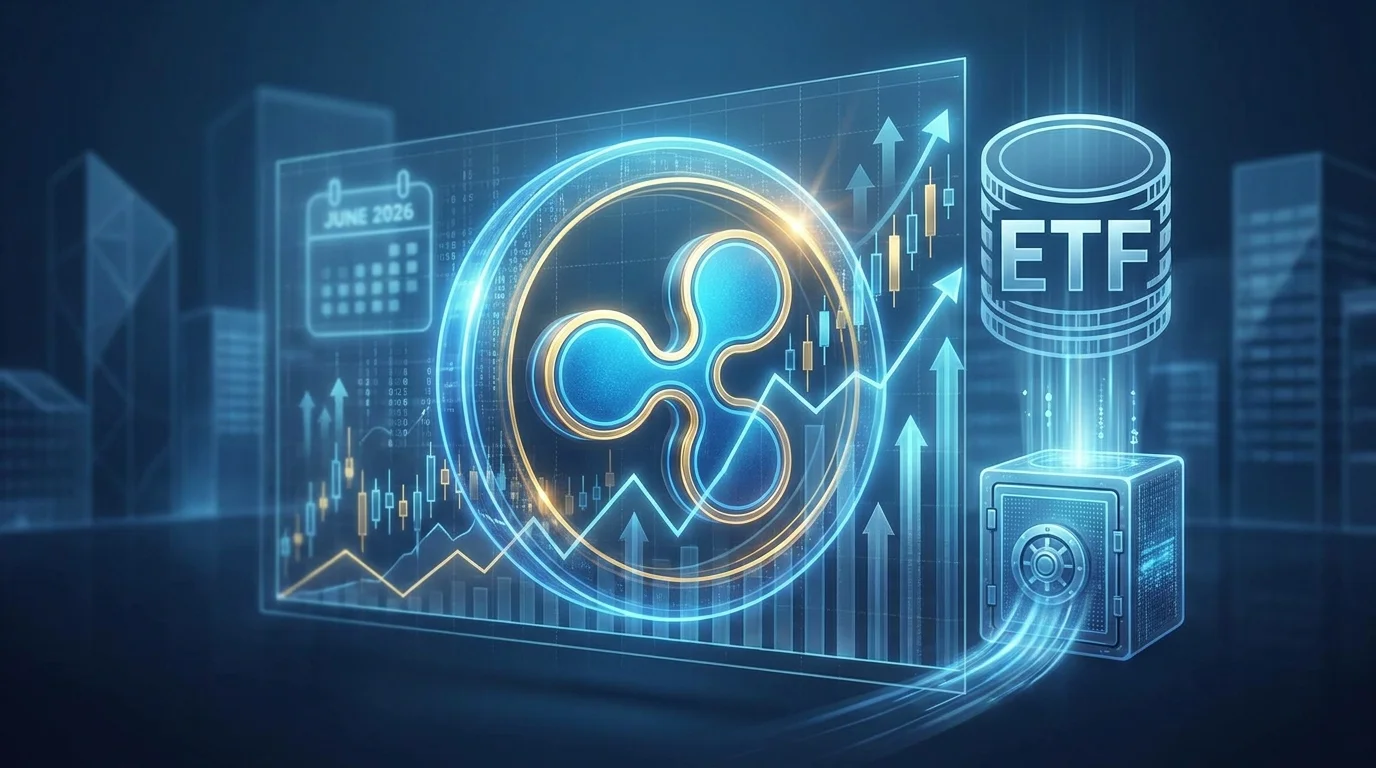
XRP enters June 2026 at a fascinating inflection point, trading around $1.16 after an extraordinary 19,699% surge that has captured the attention of institutional and retail investors alike. The convergence of spot ETF approvals, regulatory momentum through the CLARITY Act, and expanding cross-border payment partnerships has created a fundamentally different landscape for Ripple's native token than we've seen in previous cycles. However, technical indicators suggest we're at a critical decision point, with the 200-day moving average at $1.1230 serving as the key bull-bear dividing line.
Analyst forecasts for June 2026 present a wide range of scenarios, with base-case projections clustering between $1.26 and $1.46—a range that aligns closely with recent trading patterns. Yet the probability-weighted outcomes tell a more nuanced story: if the CLARITY Act clears the Senate and ETF inflows maintain their current trajectory, the median price target shifts toward $1.56, with top-decile scenarios pushing as high as $2.20. This asymmetry between downside support near $1.12 and upside potential toward $2.20 defines the risk-reward profile that traders are currently navigating.
The institutional backdrop has shifted meaningfully. With over $1.2 billion in XRP ETF assets under management and Singapore's central bank actively testing settlements on the XRP Ledger, the infrastructure for mainstream adoption is being built in real-time. However, the token's price action has remained stubbornly range-bound, creating a divergence between strengthening fundamentals and sideways technical movement that any serious XRP price analysis must address.

XRP ETF Revolution: Institutional Capital Floods In
The $1.2 Billion Milestone
The launch of spot XRP ETFs in late 2025 marked a watershed moment for institutional adoption. With over $1 billion in net inflows since inception and total AUM now exceeding $1.2 billion, these products have provided traditional investors with regulated exposure to XRP without the complexity of self-custody wallets or decentralized exchange navigation. The 7 currently active ETFs collectively hold more than 840 million XRP tokens, effectively reducing circulating supply and creating a persistent demand floor.
Grayscale's Hyperliquid Staking ETF, launched in May 2026, has already accumulated $4.5 million in assets—a noteworthy achievement for a product barely one month old. This represents more than just capital inflow; it signals growing sophistication in how institutions want to access crypto yield. The ability to earn staking rewards through a traditional brokerage account removes friction that previously kept conservative investors on the sidelines.
WisdomTree's Entry and Regulatory Tailwinds
New SEC rules approved earlier this year have streamlined the process for listing crypto funds, eliminating lengthy waiting periods that previously hampered product launches. WisdomTree's pending XRP spot ETF represents the next wave of institutional products hitting the market, with approval timelines now measured in weeks rather than months. This regulatory clarity stands in stark contrast to the uncertainty that plagued XRP during its multi-year SEC lawsuit, fundamentally altering the risk profile for institutional allocators.
The CLARITY Act, currently working through the Senate, represents the most significant potential catalyst on the horizon. Market models suggest that passage would increase the probability-weighted median price target from $1.46 to $1.56, with tail-case scenarios extending toward $2.20. The legislation's provisions for clearer digital asset classification would remove the regulatory overhang that has historically pressured XRP's valuation relative to other large-cap cryptocurrencies.
Technical Analysis: Reading the Charts
The $1.1230 Battleground
From a technical perspective, XRP's 200-day moving average at $1.1230 has emerged as the critical support level that will likely determine the token's trajectory through the remainder of 2026. This moving average has historically served as the dividing line between bull and bear markets for XRP, with sustained breaks below typically preceding extended downtrends while holds above have coincided with significant rallies.
Current positioning sees XRP trading comfortably above this threshold at approximately $1.16, though the narrow margin leaves little room for error. The sideways consolidation that has characterized recent weeks—price oscillating between $1.17 and $1.25—suggests market participants are accumulating positions while awaiting clearer directional catalysts. This pattern of consolidation above key support is often interpreted as bullish continuation formation, though confirmation requires a decisive break above resistance near $1.25.
Range-Bound Realities
The base-case scenario from quantitative models sees XRP trading between $1.26 and $1.46 through June, a range that captures roughly 60% of simulated outcomes. This sideways-bias reflects the tension between strengthening fundamentals and technical resistance that has capped rallies on multiple occasions. For traders, this implies that breakouts above $1.25 should be treated with cautious optimism until confirmed by volume and follow-through.
The divergence between XRP's weakening price action and strengthening underlying progress has become a defining characteristic of the current market environment. While ETF inflows accelerate and institutional partnerships expand, the token's price has failed to establish new highs. Understanding this disconnect requires examining both the technical factors constraining price and the fundamental developments that may eventually override them.
Bitcoin's Shadow: Market Context Matters
The Oversold Leader
Bitcoin's current positioning provides essential context for understanding XRP's price dynamics. Trading around $63,116 as of early June, BTC's Relative Strength Index has fallen to 25.97—deeply into oversold territory that historically precedes significant bounces. This technical setup suggests the broader crypto market may be approaching a local bottom, with Bitcoin potentially leading a relief rally that could lift correlated assets including XRP.
Forecasts for Bitcoin through June 2026 present a bullish tilt, with Changelly models projecting a 23% gain to $75,913 by June 10th and Bernstein maintaining their $150,000 target for year-end. The institutional adoption thesis remains intact despite recent price weakness, with consistent buying from ETFs and corporate treasuries providing underlying demand. For XRP specifically, a Bitcoin rally would likely provide the macro cover needed for an upside breakout from current ranges.
The $60,000 Line in the Sand
Prediction markets suggest a nearly 80% probability that Bitcoin will fall below $60,000 at some point in 2026—a level that would represent new yearly lows. This bearish scenario would likely drag XRP below its $1.1230 support, potentially testing the $1.00 psychological level. The correlation between large-cap cryptocurrencies remains high, meaning XRP's fate is partially tied to Bitcoin's ability to hold key technical levels.
However, the structural differences between XRP and Bitcoin—specifically XRP's regulatory clarity following the SEC lawsuit resolution and its enterprise-focused use case—suggest potential for relative outperformance if crypto markets stabilize. The ETF vehicle provides an additional demand vector that Bitcoin didn't have in previous cycles, potentially altering correlation dynamics during the next major move.
Institutional Adoption: Beyond Speculation
Singapore's Central Bank Partnership
Perhaps the most underappreciated development in XRP's fundamental picture is Singapore's central bank testing finance settlements on the XRP Ledger. This pilot program, focused on cross-border payment efficiency, represents the kind of central bank digital currency (CBDC) infrastructure deployment that Ripple has long pursued. Success in Singapore—a global financial hub—would provide a template for broader adoption across Southeast Asian banking systems.
International Finance Bank's internal presentation highlighting XRP's role in financial infrastructure marks another milestone in institutional recognition. When traditional banking institutions begin evaluating XRP not as a speculative asset but as a settlement layer technology, the addressable market expands dramatically. These developments unfold quietly compared to ETF headlines but may prove more significant for long-term value accrual.
Morgan Stanley's Crypto Lending Pivot
Morgan Stanley Wealth Management's June 5 partnership with Galaxy Digital to offer crypto lending to qualified clients represents another brick in the institutional adoption wall. The arrangement allows clients to lend crypto and receive spot ETP shares in return, with the Morgan Stanley Bitcoin Trust posting zero net redemptions during its first month—a remarkable achievement in a challenging market environment.
This infrastructure building matters for XRP because it normalizes digital asset exposure within traditional wealth management. As major brokerages become comfortable with crypto lending and ETP products, the path for XRP-specific offerings becomes smoother. The Morgan Stanley Bitcoin Trust's stability suggests that institutional vehicles can maintain capital even during market stress—a crucial proof point for risk-averse allocators.

Price Prediction Models: Parsing the Forecasts
The $1.26-$1.46 Consensus
The most reliable consensus for XRP's June 2026 price comes from scenario-weighted models that cluster between $1.26 and $1.46. This range captures the baseline expectation that current fundamentals—ETF inflows, regulatory progress, and technical support—remain intact without any major catalysts emerging. For investors with medium-term horizons, this projection suggests limited downside from current levels with modest upside potential.
The 60% probability assigned to this sideways scenario reflects the reality that crypto markets often consolidate for extended periods before making decisive moves. Given XRP's recent volatility and the broader market's uncertainty around Federal Reserve policy, a period of range-bound trading would be consistent with historical patterns following major rallies.
The $2.20 Bull Case
The more optimistic forecast of $2.20 represents the top-decile outcome if multiple catalysts align simultaneously. Required conditions include: (1) CLARITY Act passage creating regulatory certainty, (2) sustained ETF inflows accelerating rather than plateauing, (3) a broader crypto bull market lifting all assets, and (4) successful pilot programs converting to production deployments at major financial institutions.
AI model forecasts have produced even more aggressive targets, with some scenarios suggesting XRP could reach $8 under ideal conditions. However, more grounded analysis from Grok and other forecasting systems suggests that while $10-$100+ moonshot scenarios are unlikely in 2026, a move toward $2-$4 is achievable if institutional adoption continues accelerating.
The $1.12 Support Floor
On the downside, the $1.1230 level represents the critical support that must hold to maintain the bullish structure. A break below this 200-day moving average would shift the technical bias to bearish, with next support targets near $1.00 and potentially lower. The $1.00 psychological level carries particular significance as a round number that has historically attracted both buying interest and stop-loss selling.
Risk management for XRP positions should focus on this $1.12 level as the line in the sand. Sustained closes below would suggest the rally has exhausted itself and that a deeper correction is underway. Until that occurs, the technical structure favors continued consolidation with upside bias.
Competitive Landscape: XRP vs. The Field
Solana's Challenge
While XRP dominates the cross-border payment narrative, Solana has emerged as the primary challenger in the high-throughput blockchain space. With faster finality and lower transaction costs, Solana captures significant developer mindshare and retail trading volume. However, XRP's enterprise relationships and regulatory clarity provide defensive moats that Solana lacks, particularly for institutional use cases.
The two assets serve different market segments—XRP focusing on banking and payment infrastructure, Solana on DeFi and consumer applications—which allows for coexistence rather than zero-sum competition. For investors, this means XRP's success doesn't require Solana's failure, though attention metrics and capital flows do create some competitive dynamics.
Ethereum's Institutional Dominance
Ethereum's position as the default platform for institutional DeFi and tokenization remains unchallenged, with the recent approval of spot Ethereum ETFs further cementing its status. XRP's narrower focus on payments creates a different risk-reward profile—less exposure to smart contract competition but also less participation in the broader crypto innovation cycle.
For XRP to close the valuation gap with Ethereum, it will need to demonstrate that its payment-focused architecture can capture meaningful market share from traditional correspondent banking. The early signs from Singapore and other pilot programs are encouraging, but production-scale deployment remains the critical milestone.
Conclusion: Positioning for the Next Move
XRP enters June 2026 at a crossroads where technical constraints meet fundamental momentum. The token's ability to hold above $1.1230 support while ETF inflows continue and regulatory clarity improves creates an asymmetric setup with limited downside and meaningful upside if catalysts align. For investors, the current environment favors accumulation within the established range rather than chasing breakouts or panic-selling dips.
The path to $2.20 requires multiple factors to align—regulatory progress, continued institutional adoption, and favorable macro conditions—but the foundational elements are falling into place. The $1.2 billion in ETF AUM, central bank pilot programs, and Wall Street's growing comfort with crypto infrastructure all point toward a higher probability of upside resolution than current prices suggest.
For those seeking exposure to the cross-border payment disruption thesis, XRP offers a liquid, regulated vehicle with growing institutional support. The Intellectia AI Screener can help identify optimal entry points within the current range, while our AI Stock Picker provides ongoing analysis of crypto market conditions as they evolve.
The coming weeks will be pivotal as the Senate votes on the CLARITY Act and Q2 ETF flow data provides insight into whether institutional demand is accelerating or plateauing. XRP's ability to break above $1.25 resistance on volume would signal that the consolidation phase is ending and that the next leg higher is beginning. Until then, patience and disciplined position sizing remain the prudent approach for navigating this technically constrained but fundamentally promising market environment.