Tech Sector Essential for S&P 500 Breakout, but Delay Likely.


- Market Performance: U.S. stock markets, particularly the S&P 500, have been stagnant, showing little change over the past month.
- Sector Influence: Gains from sectors outside of technology are limiting the overall performance of the benchmark index.
Trade with 70% Backtested Accuracy
Analyst Views on LPLA

About LPLA
About the author


Charles Schwab Remains Unconcerned About AI; CEO Rick Wurster Discusses Current Applications.


Market Reaction: Shares of Charles Schwab and other wealth management firms declined due to concerns over the impact of artificial intelligence on the industry.
AI Developments: Investors were particularly focused on a new AI-enabled tax planning tool from fintech start-up Altruist, which heightened fears about competition.
Industry Adaptation: Despite the concerns, Charles Schwab's CEO, Rick Wurster, indicated that established firms are also leveraging AI to enhance their operations and efficiency.
Future Outlook: The ongoing developments in AI technology are prompting both challenges and opportunities for traditional wealth management companies.

Financial Services Stocks Sell-Off Due to AI Fears Creates Buying Opportunity
- Overreaction in the Market: Following Altruist's launch of a new AI tax planning tool, LPL Financial's stock dropped over 8%, Charles Schwab fell 7.4%, Raymond James declined nearly 9%, and Ameriprise slumped about 6%, reflecting market fears regarding the sustainability of wealth management fee streams and competitive dynamics.
- Analysts Optimistic for the Future: Morgan Stanley's analyst believes that despite the current sell-off being viewed as an overreaction, wealth management firms are well-positioned to leverage AI for productivity gains, especially with an impending generational wealth transfer expected to increase the number of clients seeking advisory services.
- Potential Opportunities with AI: Deutsche Bank's analyst emphasizes that AI is not a threat but a significant opportunity, noting that Charles Schwab has integrated over 220 AI use cases into its operations, which is expected to accelerate growth by enhancing client experience and enabling personalized outreach.
- Evolution Rather Than Disruption: Citizens JMP's analyst suggests that while the wealth management industry will evolve over the coming decades, there is currently no clear short-term disruption risk, highlighting that the fundamentals of the industry remain strong and the market's reaction may be overly dramatic.
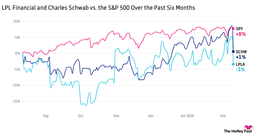
Financial Firms Hit Hard by AI Tax Tool Competition

- AI Tax Tool Impact: Altruist's new Hazel AI tax planning tool can analyze 1040 forms, pay, and account statements in minutes, significantly enhancing advisor efficiency, which led to LPL Financial and Charles Schwab shares dropping 8.3% and 7.4% respectively, highlighting the pressure traditional financial services face from AI competition.
- Cloudflare's Strong Performance: Following its 2022 recommendation, Cloudflare reported a 34% year-over-year revenue increase in Q4, with annual contract value growing nearly 50%, and forecasts close to $2.8 billion in revenue for 2026, resulting in a 14% stock price increase in after-hours trading, indicating robust market demand and investor confidence.
- Mattel's Major Decline: Mattel's stock plummeted 30% due to disappointing Q3 results, with the CEO expressing skepticism about the return of toy manufacturing to the U.S., reflecting significant challenges and a loss of market confidence for the company.
- Moderna's Vaccine Application Rejected: The FDA rejected Moderna's application for a seasonal mRNA flu vaccine, causing a 9% drop in pre-market trading, illustrating the substantial impact of regulatory hurdles on biopharmaceutical companies.

Financial Stocks Decline Amid AI Tool Concerns


- Financial Stock Volatility: Financial stocks experienced significant declines as LPL Financial dropped 8.3%, Charles Schwab fell 7.4%, and Morgan Stanley decreased by 2.4%, indicating investor concerns about AI tools potentially replacing traditional advisory firms.
- Weak Retail Sales: U.S. retail sales for December were flat month-on-month, missing the expected 0.4% increase, which reflects a lack of consumer confidence that could hinder future economic recovery and spending.
- Divergent Market Performance: While the S&P 500 fell by 0.33% and the Nasdaq Composite retreated by 0.59%, the Dow Jones Industrial Average managed a slight gain of 0.1%, suggesting a rotation into sectors that may be more insulated from AI-related pressures, potentially offering new investment opportunities.
- European Company Performance: Siemens Energy reported a 12.8% year-on-year increase in its fiscal first quarter, with net income exceeding expectations, showcasing its competitive strength, while Heineken announced plans to cut 6,000 jobs due to weak beer sales, highlighting challenges in the industry.

Financial Stocks Decline Amid AI Tool Concerns

- Financial Stock Volatility: Financial stocks experienced significant declines, with LPL Financial down 8.3%, Charles Schwab down 7.4%, and Morgan Stanley down 2.4%, as investors feared that AI tools could disrupt traditional advisory firms, indicating a shift in market sentiment towards financial services.
- Weak Retail Sales: U.S. retail sales for December were flat month-on-month, missing the expected 0.4% increase, which suggests a lack of consumer confidence that could hinder economic recovery and affect holiday spending expectations.
- Major Index Performance: Amid disappointing retail data, the S&P 500 fell 0.33% and the Nasdaq Composite dropped 0.59%, while the Dow Jones Industrial Average managed a slight gain of 0.1%, reflecting a divergence in market performance and investor focus.
- Shifting Market Sentiment: Market strategists noted a rotation into sectors that may be more insulated from the impacts of AI, suggesting a structural change in investment strategies that could influence future market dynamics.

Mixed Close for US Stocks as Retail Sales Stagnate


- Retail Sales Weakness: US December retail sales were unchanged month-over-month, falling short of the +0.4% expectation, indicating weakness in consumer spending that could lead to a downward revision in Q4 GDP, thereby impacting market confidence and economic growth outlook.
- Employment Cost Index Decline: The US Q4 employment cost index rose by +0.7% quarter-over-quarter, below the expected +0.8%, marking the smallest increase in 4.5 years, suggesting easing labor cost pressures that may influence the Fed's monetary policy decisions.
- Mixed Market Performance: The Dow Jones Industrial Average reached a new all-time high, closing up +0.10%, while the S&P 500 and Nasdaq 100 indices fell by -0.33% and -0.56%, respectively, reflecting divergent market sentiment and uncertainty.
- Focus on Upcoming Economic Data: The market will closely monitor upcoming economic data, including January nonfarm payrolls and unemployment rate, which are expected to significantly influence future monetary policy and market trends.
Charles Schwab Remains Unconcerned About AI; CEO Rick Wurster Discusses Current Applications.
Market Reaction: Shares of Charles Schwab and other wealth management firms declined due to concerns over the impact of artificial intelligence on the industry.
AI Developments: Investors were particularly focused on a new AI-enabled tax planning tool from fintech start-up Altruist, which heightened fears about competition.
Industry Adaptation: Despite the concerns, Charles Schwab's CEO, Rick Wurster, indicated that established firms are also leveraging AI to enhance their operations and efficiency.
Future Outlook: The ongoing developments in AI technology are prompting both challenges and opportunities for traditional wealth management companies.
Financial Services Stocks Sell-Off Due to AI Fears Creates Buying Opportunity
- Overreaction in the Market: Following Altruist's launch of a new AI tax planning tool, LPL Financial's stock dropped over 8%, Charles Schwab fell 7.4%, Raymond James declined nearly 9%, and Ameriprise slumped about 6%, reflecting market fears regarding the sustainability of wealth management fee streams and competitive dynamics.
- Analysts Optimistic for the Future: Morgan Stanley's analyst believes that despite the current sell-off being viewed as an overreaction, wealth management firms are well-positioned to leverage AI for productivity gains, especially with an impending generational wealth transfer expected to increase the number of clients seeking advisory services.
- Potential Opportunities with AI: Deutsche Bank's analyst emphasizes that AI is not a threat but a significant opportunity, noting that Charles Schwab has integrated over 220 AI use cases into its operations, which is expected to accelerate growth by enhancing client experience and enabling personalized outreach.
- Evolution Rather Than Disruption: Citizens JMP's analyst suggests that while the wealth management industry will evolve over the coming decades, there is currently no clear short-term disruption risk, highlighting that the fundamentals of the industry remain strong and the market's reaction may be overly dramatic.
Financial Firms Hit Hard by AI Tax Tool Competition
- AI Tax Tool Impact: Altruist's new Hazel AI tax planning tool can analyze 1040 forms, pay, and account statements in minutes, significantly enhancing advisor efficiency, which led to LPL Financial and Charles Schwab shares dropping 8.3% and 7.4% respectively, highlighting the pressure traditional financial services face from AI competition.
- Cloudflare's Strong Performance: Following its 2022 recommendation, Cloudflare reported a 34% year-over-year revenue increase in Q4, with annual contract value growing nearly 50%, and forecasts close to $2.8 billion in revenue for 2026, resulting in a 14% stock price increase in after-hours trading, indicating robust market demand and investor confidence.
- Mattel's Major Decline: Mattel's stock plummeted 30% due to disappointing Q3 results, with the CEO expressing skepticism about the return of toy manufacturing to the U.S., reflecting significant challenges and a loss of market confidence for the company.
- Moderna's Vaccine Application Rejected: The FDA rejected Moderna's application for a seasonal mRNA flu vaccine, causing a 9% drop in pre-market trading, illustrating the substantial impact of regulatory hurdles on biopharmaceutical companies.
Financial Stocks Decline Amid AI Tool Concerns
- Financial Stock Volatility: Financial stocks experienced significant declines as LPL Financial dropped 8.3%, Charles Schwab fell 7.4%, and Morgan Stanley decreased by 2.4%, indicating investor concerns about AI tools potentially replacing traditional advisory firms.
- Weak Retail Sales: U.S. retail sales for December were flat month-on-month, missing the expected 0.4% increase, which reflects a lack of consumer confidence that could hinder future economic recovery and spending.
- Divergent Market Performance: While the S&P 500 fell by 0.33% and the Nasdaq Composite retreated by 0.59%, the Dow Jones Industrial Average managed a slight gain of 0.1%, suggesting a rotation into sectors that may be more insulated from AI-related pressures, potentially offering new investment opportunities.
- European Company Performance: Siemens Energy reported a 12.8% year-on-year increase in its fiscal first quarter, with net income exceeding expectations, showcasing its competitive strength, while Heineken announced plans to cut 6,000 jobs due to weak beer sales, highlighting challenges in the industry.
Financial Stocks Decline Amid AI Tool Concerns
- Financial Stock Volatility: Financial stocks experienced significant declines, with LPL Financial down 8.3%, Charles Schwab down 7.4%, and Morgan Stanley down 2.4%, as investors feared that AI tools could disrupt traditional advisory firms, indicating a shift in market sentiment towards financial services.
- Weak Retail Sales: U.S. retail sales for December were flat month-on-month, missing the expected 0.4% increase, which suggests a lack of consumer confidence that could hinder economic recovery and affect holiday spending expectations.
- Major Index Performance: Amid disappointing retail data, the S&P 500 fell 0.33% and the Nasdaq Composite dropped 0.59%, while the Dow Jones Industrial Average managed a slight gain of 0.1%, reflecting a divergence in market performance and investor focus.
- Shifting Market Sentiment: Market strategists noted a rotation into sectors that may be more insulated from the impacts of AI, suggesting a structural change in investment strategies that could influence future market dynamics.
Mixed Close for US Stocks as Retail Sales Stagnate
- Retail Sales Weakness: US December retail sales were unchanged month-over-month, falling short of the +0.4% expectation, indicating weakness in consumer spending that could lead to a downward revision in Q4 GDP, thereby impacting market confidence and economic growth outlook.
- Employment Cost Index Decline: The US Q4 employment cost index rose by +0.7% quarter-over-quarter, below the expected +0.8%, marking the smallest increase in 4.5 years, suggesting easing labor cost pressures that may influence the Fed's monetary policy decisions.
- Mixed Market Performance: The Dow Jones Industrial Average reached a new all-time high, closing up +0.10%, while the S&P 500 and Nasdaq 100 indices fell by -0.33% and -0.56%, respectively, reflecting divergent market sentiment and uncertainty.
- Focus on Upcoming Economic Data: The market will closely monitor upcoming economic data, including January nonfarm payrolls and unemployment rate, which are expected to significantly influence future monetary policy and market trends.