Potential Sellers Show Confidence as 83% Expect to Meet Asking Prices
Written by Emily J. Thompson, Senior Investment Analyst
Updated: 2 days ago
0mins
Should l Buy NWS?
Source: PRnewswire
- Market Confidence Rebounds: According to a survey by Realtor.com®, 83% of potential sellers expect to meet or exceed their asking prices, with 46% anticipating achieving their asking price and 37% expecting more, indicating a growing confidence in property values amidst a transitioning market.
- Timing Insight: The survey reveals that 75% of potential sellers expect to sell within four months, including 27% aiming for a sale within one to two months, aligning with the current average market time of 57 days, showcasing sellers' keen awareness of market timing.
- Diverse Motivations: 41% of potential sellers are motivated by profit potential, up from 36% in 2025, while 39% are looking for more space, indicating that lifestyle changes are driving market activity and influencing seller decisions.
- Divergent Market Dynamics: While 40% of sellers view the current market as favorable for sellers, those in the South and West are more cautious, reflecting significant regional differences in market conditions, which underscores the need for sellers to be flexible in pricing and concession strategies.
Trade with 70% Backtested Accuracy
Stop guessing "Should I Buy NWS?" and start using high-conviction signals backed by rigorous historical data.
Sign up today to access powerful investing tools and make smarter, data-driven decisions.
Analyst Views on NWS
About NWS
News Corporation is a diversified media and information services company. Its Digital Real Estate Services segment consists of the Company's interest in REA Group and Move. REA Group is a digital media business specializing in property and property-related services on its Websites and mobile apps. Move is a provider of digital real estate services in the United States and primarily operates Realtor.com, a real estate information, advertising and services platform, its referral-based services, online tools and services to do-it-yourself landlords and tenants. Its Dow Jones segment includes Dow Jones, a global provider of news and business information, which distributes its content and data through a variety of media channels. Its Book Publishing segment consists of HarperCollins, a consumer book publisher with operations in 15 countries. Its News Media segment consists of News Corp Australia, News UK and the New York Post and includes The Australian, The Daily Telegraph, among others.
About the author

Emily J. Thompson
Emily J. Thompson, a Chartered Financial Analyst (CFA) with 12 years in investment research, graduated with honors from the Wharton School. Specializing in industrial and technology stocks, she provides in-depth analysis for Intellectia’s earnings and market brief reports.

Rental Savings Gap Shrinks as Homeownership Goals Remain

- Rental Advantage Decline: The monthly savings from renting has shrunk by $136 year-over-year, even as the national median rent has declined for 32 consecutive months, indicating that the competitiveness of buying costs is increasing.
- Buying Cost Analysis: In Austin, Texas, the cost of buying exceeds renting by $1,719 (126.3%), suggesting that the savings from renting can be redirected towards a down payment, facilitating families' aspirations for homeownership.
- Market Trend Observation: Although rents decreased by 1.5% year-over-year in March 2026, the decline in buying costs is more significant, with projections indicating that buying will become the more economical choice within the next decade, particularly in markets where the gap between renting and buying is widest.
- Long-term Wealth Impact: According to Realtor.com's report, households purchasing their first home by age 30 have a 22.5% higher net worth by midlife compared to those who wait until their 40s, underscoring the importance of timely home purchases.
See More

Rental Savings Shrink as Home Buying Costs Decline
- Diminishing Rental Advantage: According to Realtor.com's report, the average monthly savings from renting versus buying has shrunk by $136 year-over-year, even as national median rent has declined for 32 consecutive months, indicating that buying costs are becoming increasingly competitive.
- Increased Buying Opportunities: In Austin, Texas, the cost of buying exceeds renting by $1,719 (126.3%), providing renters with the opportunity to redirect savings towards a down payment, thus accelerating their path to homeownership.
- Market Trend Analysis: Although rents decreased by 1.5% year-over-year in March 2026, the decline in buying costs is more significant, suggesting that buying could become the more economical option within the next decade, particularly in markets where the gap between renting and buying is widest.
- Long-Term Wealth Impact: Research indicates that households purchasing their first home before age 30 have a 22.5% higher net worth by midlife compared to those who wait until their 40s, underscoring the importance of timely home purchases in the context of a narrowing rental advantage.
See More
Potential Sellers Show Confidence as 83% Expect to Meet Asking Prices
- Market Confidence Rebounds: According to a survey by Realtor.com®, 83% of potential sellers expect to meet or exceed their asking prices, with 46% anticipating achieving their asking price and 37% expecting more, indicating a growing confidence in property values amidst a transitioning market.
- Timing Insight: The survey reveals that 75% of potential sellers expect to sell within four months, including 27% aiming for a sale within one to two months, aligning with the current average market time of 57 days, showcasing sellers' keen awareness of market timing.
- Diverse Motivations: 41% of potential sellers are motivated by profit potential, up from 36% in 2025, while 39% are looking for more space, indicating that lifestyle changes are driving market activity and influencing seller decisions.
- Divergent Market Dynamics: While 40% of sellers view the current market as favorable for sellers, those in the South and West are more cautious, reflecting significant regional differences in market conditions, which underscores the need for sellers to be flexible in pricing and concession strategies.
See More
Potential Sellers Show Confidence as 83% Expect to Meet Asking Prices
- Increased Market Confidence: A survey by Realtor.com® reveals that 83% of potential sellers expect to meet or exceed their asking prices, with 46% anticipating achieving their asking price and 37% expecting more, indicating a growing confidence in home values despite a shifting market.
- Timing Strategy: The survey indicates that 75% of sellers expect to sell within four months, including 27% who aim for a sale within one to two months, aligning with the current average market time of 57 days, reflecting sellers' keen awareness of market timing.
- Diverse Motivations: 41% of potential sellers are motivated by profit potential, up from 36% in 2025, while 39% are looking for more space, highlighting the increasing influence of lifestyle changes on sellers' decisions.
- Regional Market Variability: While 40% of sellers view the current market as a sellers' market, those in the South and West are more cautious, reflecting inventory changes and competition, emphasizing the need for sellers to be flexible in pricing and concession strategies.
See More
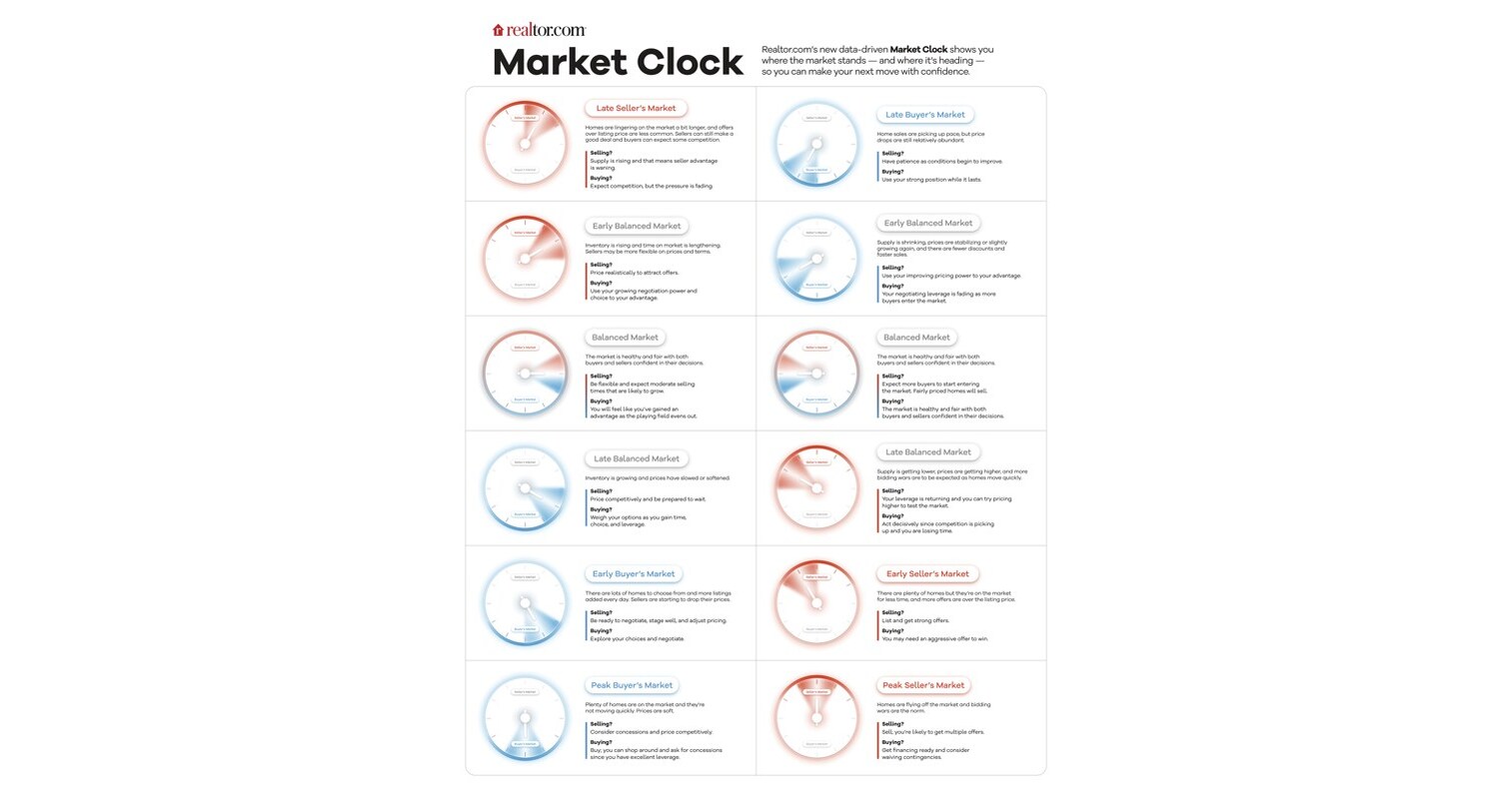
Realtor.com Launches Market Clock Tool for Housing Insights
- Market Trend Analysis: According to a recent analysis by Realtor.com, over 60% of the nation's major housing markets have shifted into balanced or buyer-friendly territory, while only 26% remain seller's markets, impacting decision-making strategies for both buyers and sellers.
- Market Clock Tool: The newly launched Market Clock by Realtor.com places the national housing market at the 3 o'clock position, indicating a 'Balanced-Loosening' phase, suggesting that while the market is moving towards buyer-friendly conditions, the pace is not rapid, reflecting the market's complexity.
- Regional Market Variations: Among the top 50 metros, the South and West dominate the buyer's markets, with 7 out of 8 located in Florida and Texas, indicating increased inventory and price cuts, thereby enhancing buyers' negotiating power.
- Concentration of Seller Markets: Most seller markets are concentrated in the Midwest and Northeast, with 4 markets in 'Peak Seller' status, indicating that competition remains fierce in these areas, although seller advantages are beginning to soften.
See More
Realtor.com Launches Market Clock Tool for Housing Insights
- Market Condition Analysis: According to a new analysis from Realtor.com, over 60% of the nation's major housing markets have shifted into balanced or buyer-friendly territory, with only 26% remaining seller's markets, indicating potential impacts on future home buying decisions and market dynamics.
- Market Clock Tool: The newly launched Market Clock by Realtor.com positions the national housing market at 3 o'clock, indicating a 'Balanced-Loosening' phase, which, while changing slowly, provides clear guidance on market trends for both buyers and sellers.
- Regional Market Variations: The South and West dominate the buyer's markets, with 7 out of 8 located in Florida and Texas, suggesting that increasing inventory and price cuts in these areas may give buyers a negotiating edge.
- Concentration of Seller Markets: Most seller markets are concentrated in the Midwest and Northeast, with cities like Hartford and Milwaukee exhibiting 'Peak Seller' conditions, indicating that competition remains fierce and sellers hold an advantage in pricing.
See More
Rental Savings Gap Shrinks as Homeownership Goals Remain
- Rental Advantage Decline: The monthly savings from renting has shrunk by $136 year-over-year, even as the national median rent has declined for 32 consecutive months, indicating that the competitiveness of buying costs is increasing.
- Buying Cost Analysis: In Austin, Texas, the cost of buying exceeds renting by $1,719 (126.3%), suggesting that the savings from renting can be redirected towards a down payment, facilitating families' aspirations for homeownership.
- Market Trend Observation: Although rents decreased by 1.5% year-over-year in March 2026, the decline in buying costs is more significant, with projections indicating that buying will become the more economical choice within the next decade, particularly in markets where the gap between renting and buying is widest.
- Long-term Wealth Impact: According to Realtor.com's report, households purchasing their first home by age 30 have a 22.5% higher net worth by midlife compared to those who wait until their 40s, underscoring the importance of timely home purchases.
See More
Rental Savings Shrink as Home Buying Costs Decline
- Diminishing Rental Advantage: According to Realtor.com's report, the average monthly savings from renting versus buying has shrunk by $136 year-over-year, even as national median rent has declined for 32 consecutive months, indicating that buying costs are becoming increasingly competitive.
- Increased Buying Opportunities: In Austin, Texas, the cost of buying exceeds renting by $1,719 (126.3%), providing renters with the opportunity to redirect savings towards a down payment, thus accelerating their path to homeownership.
- Market Trend Analysis: Although rents decreased by 1.5% year-over-year in March 2026, the decline in buying costs is more significant, suggesting that buying could become the more economical option within the next decade, particularly in markets where the gap between renting and buying is widest.
- Long-Term Wealth Impact: Research indicates that households purchasing their first home before age 30 have a 22.5% higher net worth by midlife compared to those who wait until their 40s, underscoring the importance of timely home purchases in the context of a narrowing rental advantage.
See More
Potential Sellers Show Confidence as 83% Expect to Meet Asking Prices
- Market Confidence Rebounds: According to a survey by Realtor.com®, 83% of potential sellers expect to meet or exceed their asking prices, with 46% anticipating achieving their asking price and 37% expecting more, indicating a growing confidence in property values amidst a transitioning market.
- Timing Insight: The survey reveals that 75% of potential sellers expect to sell within four months, including 27% aiming for a sale within one to two months, aligning with the current average market time of 57 days, showcasing sellers' keen awareness of market timing.
- Diverse Motivations: 41% of potential sellers are motivated by profit potential, up from 36% in 2025, while 39% are looking for more space, indicating that lifestyle changes are driving market activity and influencing seller decisions.
- Divergent Market Dynamics: While 40% of sellers view the current market as favorable for sellers, those in the South and West are more cautious, reflecting significant regional differences in market conditions, which underscores the need for sellers to be flexible in pricing and concession strategies.
See More
Potential Sellers Show Confidence as 83% Expect to Meet Asking Prices
- Increased Market Confidence: A survey by Realtor.com® reveals that 83% of potential sellers expect to meet or exceed their asking prices, with 46% anticipating achieving their asking price and 37% expecting more, indicating a growing confidence in home values despite a shifting market.
- Timing Strategy: The survey indicates that 75% of sellers expect to sell within four months, including 27% who aim for a sale within one to two months, aligning with the current average market time of 57 days, reflecting sellers' keen awareness of market timing.
- Diverse Motivations: 41% of potential sellers are motivated by profit potential, up from 36% in 2025, while 39% are looking for more space, highlighting the increasing influence of lifestyle changes on sellers' decisions.
- Regional Market Variability: While 40% of sellers view the current market as a sellers' market, those in the South and West are more cautious, reflecting inventory changes and competition, emphasizing the need for sellers to be flexible in pricing and concession strategies.
See More
Realtor.com Launches Market Clock Tool for Housing Insights
- Market Trend Analysis: According to a recent analysis by Realtor.com, over 60% of the nation's major housing markets have shifted into balanced or buyer-friendly territory, while only 26% remain seller's markets, impacting decision-making strategies for both buyers and sellers.
- Market Clock Tool: The newly launched Market Clock by Realtor.com places the national housing market at the 3 o'clock position, indicating a 'Balanced-Loosening' phase, suggesting that while the market is moving towards buyer-friendly conditions, the pace is not rapid, reflecting the market's complexity.
- Regional Market Variations: Among the top 50 metros, the South and West dominate the buyer's markets, with 7 out of 8 located in Florida and Texas, indicating increased inventory and price cuts, thereby enhancing buyers' negotiating power.
- Concentration of Seller Markets: Most seller markets are concentrated in the Midwest and Northeast, with 4 markets in 'Peak Seller' status, indicating that competition remains fierce in these areas, although seller advantages are beginning to soften.
See More
Realtor.com Launches Market Clock Tool for Housing Insights
- Market Condition Analysis: According to a new analysis from Realtor.com, over 60% of the nation's major housing markets have shifted into balanced or buyer-friendly territory, with only 26% remaining seller's markets, indicating potential impacts on future home buying decisions and market dynamics.
- Market Clock Tool: The newly launched Market Clock by Realtor.com positions the national housing market at 3 o'clock, indicating a 'Balanced-Loosening' phase, which, while changing slowly, provides clear guidance on market trends for both buyers and sellers.
- Regional Market Variations: The South and West dominate the buyer's markets, with 7 out of 8 located in Florida and Texas, suggesting that increasing inventory and price cuts in these areas may give buyers a negotiating edge.
- Concentration of Seller Markets: Most seller markets are concentrated in the Midwest and Northeast, with cities like Hartford and Milwaukee exhibiting 'Peak Seller' conditions, indicating that competition remains fierce and sellers hold an advantage in pricing.
See More