Domestic Investors Support Indian Stock Market Amid Foreign Sell-Off
Written by Emily J. Thompson, Senior Investment Analyst
Updated: May 19 2026
0mins
Source: CNBC
- Significant Role of Domestic Investors: Amid a $35 billion foreign sell-off, Indian institutional investors injected a net $91 billion into the equity markets last year, effectively preventing a 'freefall' in the stock market and demonstrating the resilience and potential of the domestic market.
- Surge in Investor Registrations: The Bombay Stock Exchange (BSE) saw 35 million new investor registrations over the past year, indicating a growing participation of the Indian population in capital markets, which further strengthens the market's foundation.
- Market Performance Comparison: Despite the BSE Sensex declining 11% year-to-date, domestic capital inflows remain robust, with total inflows in equity mutual funds reaching 384.4 billion rupees (nearly $4 billion) in April, marking a 58% increase from the previous year.
- Bearish Foreign Sentiment: Foreign investors maintain a pessimistic outlook on India due to rising global oil prices and economic impacts, while the lack of a strong AI ecosystem dampens India's competitiveness in the global market, leading to continued capital outflows.
Trade with 70% Backtested Accuracy
Stop guessing "Should I Buy BSET?" and start using high-conviction signals backed by rigorous historical data.
Sign up today to access powerful investing tools and make smarter, data-driven decisions.
Analyst Views on BSET
About BSET
Bassett Furniture Industries, Incorporated is a retailer, manufacturer and marketer of branded home furnishings. Its products are sold through a network of Company-owned and licensee-owned branded stores under the Bassett Home Furnishings (BHF) name. Its segments include Wholesale and Retail-Company-owned stores. The Wholesale segment is involved in the design, manufacturing and sourcing of furniture products that are distributed through its BHF store network (both Company-owned and licensee-owned stores) and various independent retailers. The Retail-Company-owned stores segment consists of 58 BHF stores that provide consumers with a friendly and casual environment for buying furniture and accessories. The BHF stores feature custom order furniture, free in-home or virtual design visits (home makeovers) and coordinated decorating accessories. It also has a traditional wholesale business with more than 700 accounts on the open market, across the United States and internationally.
About the author

Emily J. Thompson
Emily J. Thompson, a Chartered Financial Analyst (CFA) with 12 years in investment research, graduated with honors from the Wharton School. Specializing in industrial and technology stocks, she provides in-depth analysis for Intellectia’s earnings and market brief reports.

India's National Stock Exchange Files for IPO, Expected to be Among Largest Listings

- IPO Application Overview: India's National Stock Exchange (NSE) has filed for an initial public offering (IPO), which is expected to be one of the largest listings in India this year, indicating a resurgence of confidence in large fundraising activities in the market.
- Stake Reduction by Shareholders: The IPO will be entirely an offer for sale, with several large domestic and foreign investors, including India's largest public sector bank, State Bank of India, Canada Pension Plan Investment Board, and Singapore's Temasek, reducing their stakes, reflecting a shift in market liquidity needs.
- Market Share and Impact: NSE commands a 93% share of India's cash market and accounts for nearly all equity futures trading in the country, with about 75% share in equity options trading, underscoring its dominant position in the Indian capital market.
- Future Outlook: Despite a slowdown in IPO activity due to weakened investor appetite amid the Middle East conflict, the situation is improving, and the combined IPOs of NSE and Reliance Jio are expected to raise over 600 billion rupees (approximately $6.3 billion), potentially accounting for one-third of the total funds raised through 104 mainboard IPOs last year.
See More
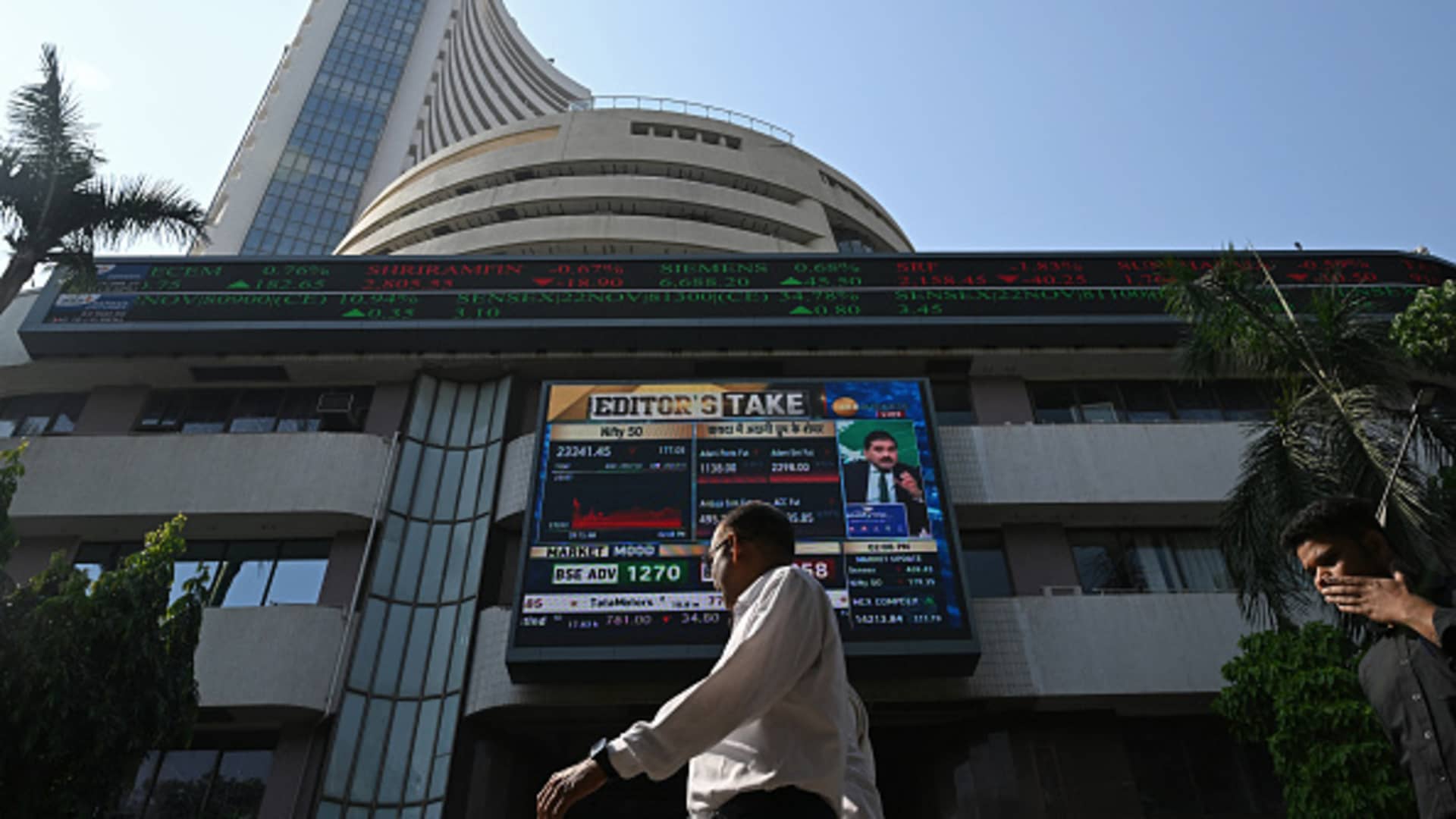
Domestic Investors Support Indian Stock Market Amid Foreign Sell-Off

- Significant Role of Domestic Investors: Amid a $35 billion foreign sell-off, Indian institutional investors injected a net $91 billion into the equity markets last year, effectively preventing a 'freefall' in the stock market and demonstrating the resilience and potential of the domestic market.
- Surge in Investor Registrations: The Bombay Stock Exchange (BSE) saw 35 million new investor registrations over the past year, indicating a growing participation of the Indian population in capital markets, which further strengthens the market's foundation.
- Market Performance Comparison: Despite the BSE Sensex declining 11% year-to-date, domestic capital inflows remain robust, with total inflows in equity mutual funds reaching 384.4 billion rupees (nearly $4 billion) in April, marking a 58% increase from the previous year.
- Bearish Foreign Sentiment: Foreign investors maintain a pessimistic outlook on India due to rising global oil prices and economic impacts, while the lack of a strong AI ecosystem dampens India's competitiveness in the global market, leading to continued capital outflows.
See More

Bassett CFO to Present at WTR Insights Conference
- Strategic Growth Initiatives: Bassett's CFO J. Michael Daniel will present the company's five strategic growth initiatives at the WTR Insights Conference on April 14, 2026, aimed at addressing sales challenges posed by high mortgage rates and geopolitical tensions.
- Financial Performance Overview: In its Fiscal 2026 Q1 earnings report, Bassett highlighted macroeconomic challenges, with management emphasizing the need to balance growth investments while controlling operating expenses to achieve organic revenue growth.
- Retail Network Expansion: The company plans to expand its retail network by increasing the number of corporate and licensed locations while driving e-commerce sales to enhance the omni-channel shopping experience, catering to the growing consumer demand.
- Wholesale Business Growth: Bassett aims to grow its wholesale distribution through Bassett Design Centers and Bassett Custom Studios, particularly targeting the interior design community and hospitality channels to strengthen its market competitiveness.
See More

Bassett Furniture Reports Revenue Decline Amid Market Challenges
- Revenue Decline: Bassett Furniture reported total consolidated revenue of $80.3 million, a 2.2% decrease, reflecting weak residential market activity and adverse weather impacting both retail and wholesale sales, which may hinder future sales growth.
- Margin Compression: Gross margin fell to 56.2%, an 80 basis point decline from the previous year, primarily due to delayed tariff cost adjustments, which negatively impacted profitability and is expected to exert ongoing pressure on second-quarter profits.
- Strategic Marketing Shift: The company successfully extended its President's Day promotional event to three weeks, driving retail sales growth, with double-digit increases in written orders in the latter half of February, indicating potential for improved sales in the upcoming quarter.
- E-commerce Growth: Bassett experienced a 28% increase in e-commerce orders and a 130% rise in conversion rates, demonstrating significant progress in its digital transformation efforts, which are expected to further enhance market share in the future.
See More

Bassett Furniture Q1 Fiscal 2026 Earnings Call Insights
- Demand Weakness Impact: Bassett Furniture reported consolidated revenue of $80.3 million for Q1 2026, reflecting a 2.2% decline primarily due to weak residential housing activity and severe weather disrupting retail and wholesale sales, indicating significant market challenges faced by the company.
- Margin Pressure: The company reported a gross margin of 56.2%, with the decline attributed to lower margins in both retail and wholesale businesses; the CEO indicated that retail pricing adjustments will be made to improve future margin performance, which is expected to gradually return to last year's levels.
- Cost Savings Initiatives: Bassett is implementing several cost-saving measures projected to save between $1.5 million and $2 million annually starting late in Q2, aimed at alleviating current cost pressures and supporting future growth initiatives.
- Market Strategy Adjustments: The company expanded its President's Day promotional event to three weeks, resulting in a double-digit increase in written orders for the latter half of February, demonstrating opportunities to enhance customer responsiveness through strategic marketing adjustments despite market challenges.
See More

Bassett Furniture Reports Decline in Q1 Profit
- Profit Decline: Bassett Furniture reported a net profit of $1.116 million for Q1, translating to $0.13 per share, which represents a 40% decrease from last year's $1.854 million and $0.21 per share, indicating a significant reduction in profitability.
- Revenue Drop: The company's revenue for the quarter was $80.340 million, down 2.2% from $82.162 million last year, reflecting the impact of weak market demand and increased competition.
- Market Challenges: The simultaneous decline in profit and revenue suggests that Bassett Furniture is facing greater market challenges in the current economic environment, potentially necessitating a reassessment of its market strategy to restore growth.
- Future Outlook: Despite the current poor performance, the company may need to enhance its competitiveness through product innovation and operational optimization to address future market fluctuations and changing consumer demands.
See More
India's National Stock Exchange Files for IPO, Expected to be Among Largest Listings
- IPO Application Overview: India's National Stock Exchange (NSE) has filed for an initial public offering (IPO), which is expected to be one of the largest listings in India this year, indicating a resurgence of confidence in large fundraising activities in the market.
- Stake Reduction by Shareholders: The IPO will be entirely an offer for sale, with several large domestic and foreign investors, including India's largest public sector bank, State Bank of India, Canada Pension Plan Investment Board, and Singapore's Temasek, reducing their stakes, reflecting a shift in market liquidity needs.
- Market Share and Impact: NSE commands a 93% share of India's cash market and accounts for nearly all equity futures trading in the country, with about 75% share in equity options trading, underscoring its dominant position in the Indian capital market.
- Future Outlook: Despite a slowdown in IPO activity due to weakened investor appetite amid the Middle East conflict, the situation is improving, and the combined IPOs of NSE and Reliance Jio are expected to raise over 600 billion rupees (approximately $6.3 billion), potentially accounting for one-third of the total funds raised through 104 mainboard IPOs last year.
See More
Domestic Investors Support Indian Stock Market Amid Foreign Sell-Off
- Significant Role of Domestic Investors: Amid a $35 billion foreign sell-off, Indian institutional investors injected a net $91 billion into the equity markets last year, effectively preventing a 'freefall' in the stock market and demonstrating the resilience and potential of the domestic market.
- Surge in Investor Registrations: The Bombay Stock Exchange (BSE) saw 35 million new investor registrations over the past year, indicating a growing participation of the Indian population in capital markets, which further strengthens the market's foundation.
- Market Performance Comparison: Despite the BSE Sensex declining 11% year-to-date, domestic capital inflows remain robust, with total inflows in equity mutual funds reaching 384.4 billion rupees (nearly $4 billion) in April, marking a 58% increase from the previous year.
- Bearish Foreign Sentiment: Foreign investors maintain a pessimistic outlook on India due to rising global oil prices and economic impacts, while the lack of a strong AI ecosystem dampens India's competitiveness in the global market, leading to continued capital outflows.
See More
Bassett CFO to Present at WTR Insights Conference
- Strategic Growth Initiatives: Bassett's CFO J. Michael Daniel will present the company's five strategic growth initiatives at the WTR Insights Conference on April 14, 2026, aimed at addressing sales challenges posed by high mortgage rates and geopolitical tensions.
- Financial Performance Overview: In its Fiscal 2026 Q1 earnings report, Bassett highlighted macroeconomic challenges, with management emphasizing the need to balance growth investments while controlling operating expenses to achieve organic revenue growth.
- Retail Network Expansion: The company plans to expand its retail network by increasing the number of corporate and licensed locations while driving e-commerce sales to enhance the omni-channel shopping experience, catering to the growing consumer demand.
- Wholesale Business Growth: Bassett aims to grow its wholesale distribution through Bassett Design Centers and Bassett Custom Studios, particularly targeting the interior design community and hospitality channels to strengthen its market competitiveness.
See More
Bassett Furniture Reports Revenue Decline Amid Market Challenges
- Revenue Decline: Bassett Furniture reported total consolidated revenue of $80.3 million, a 2.2% decrease, reflecting weak residential market activity and adverse weather impacting both retail and wholesale sales, which may hinder future sales growth.
- Margin Compression: Gross margin fell to 56.2%, an 80 basis point decline from the previous year, primarily due to delayed tariff cost adjustments, which negatively impacted profitability and is expected to exert ongoing pressure on second-quarter profits.
- Strategic Marketing Shift: The company successfully extended its President's Day promotional event to three weeks, driving retail sales growth, with double-digit increases in written orders in the latter half of February, indicating potential for improved sales in the upcoming quarter.
- E-commerce Growth: Bassett experienced a 28% increase in e-commerce orders and a 130% rise in conversion rates, demonstrating significant progress in its digital transformation efforts, which are expected to further enhance market share in the future.
See More
Bassett Furniture Q1 Fiscal 2026 Earnings Call Insights
- Demand Weakness Impact: Bassett Furniture reported consolidated revenue of $80.3 million for Q1 2026, reflecting a 2.2% decline primarily due to weak residential housing activity and severe weather disrupting retail and wholesale sales, indicating significant market challenges faced by the company.
- Margin Pressure: The company reported a gross margin of 56.2%, with the decline attributed to lower margins in both retail and wholesale businesses; the CEO indicated that retail pricing adjustments will be made to improve future margin performance, which is expected to gradually return to last year's levels.
- Cost Savings Initiatives: Bassett is implementing several cost-saving measures projected to save between $1.5 million and $2 million annually starting late in Q2, aimed at alleviating current cost pressures and supporting future growth initiatives.
- Market Strategy Adjustments: The company expanded its President's Day promotional event to three weeks, resulting in a double-digit increase in written orders for the latter half of February, demonstrating opportunities to enhance customer responsiveness through strategic marketing adjustments despite market challenges.
See More
Bassett Furniture Reports Decline in Q1 Profit
- Profit Decline: Bassett Furniture reported a net profit of $1.116 million for Q1, translating to $0.13 per share, which represents a 40% decrease from last year's $1.854 million and $0.21 per share, indicating a significant reduction in profitability.
- Revenue Drop: The company's revenue for the quarter was $80.340 million, down 2.2% from $82.162 million last year, reflecting the impact of weak market demand and increased competition.
- Market Challenges: The simultaneous decline in profit and revenue suggests that Bassett Furniture is facing greater market challenges in the current economic environment, potentially necessitating a reassessment of its market strategy to restore growth.
- Future Outlook: Despite the current poor performance, the company may need to enhance its competitiveness through product innovation and operational optimization to address future market fluctuations and changing consumer demands.
See More