Trump Administration to Invest in Quantum Computing Companies
Written by Emily J. Thompson, Senior Investment Analyst
Updated: May 21 2026
0mins


Source: NASDAQ.COM
- Government Investment Plan: The Trump Administration plans to allocate $2 billion in grants and equity stakes to nine quantum computing companies, notably excluding Quantum Computing (QUBT), highlighting its marginal position in the industry.
- Market Reaction: Despite a 16% surge in Quantum Computing's stock price on Thursday morning, analysts remain pessimistic about its profitability, predicting continued losses for the next few years due to the lack of government funding.
- Competitors Benefit: Rivals such as D-Wave Quantum, Infleqtion, and Rigetti Computing will each receive $100 million, while IBM is set to receive up to $1 billion, further solidifying their leading positions in the quantum computing sector.
- Investor Caution: Analysts advise investors to consider other stocks with higher potential returns before investing in Quantum Computing, indicating that the company may face significant market challenges ahead.
Trade with 70% Backtested Accuracy
Stop guessing "Should I Buy QUBT?" and start using high-conviction signals backed by rigorous historical data.
Sign up today to access powerful investing tools and make smarter, data-driven decisions.
Analyst Views on QUBT
Wall Street analysts forecast QUBT stock price to rise
5 Analyst Rating
3 Buy
2 Hold
0 Sell
Moderate Buy
Current: 12.240

Low
12.00
Averages
18.00
High
25.00
Current: 12.240
Low
12.00
Averages
18.00
High
25.00
About QUBT
Quantum Computing Inc. is an integrated quantum optics and nanophotonic technology company. The Company is utilizing integrated photonics and non-linear quantum optics to develop and deliver machines for quantum computing, reservoir computing, and remote sensing, imaging and cybersecurity applications. Its products are designed to operate at room temperature and low power. Its Entropy Quantum Computer is a full-stack system, incorporating the Company’s custom user interface software Qatalyst, which allows users to avoid the complexity of software development kits at the circuit level and has evolved from the Company’s primary Software as a Service offering to the software that powers its offerings. Its Reservoir Computer is a device that uses an integrated circuit that can be reprogrammed after manufacturing and optimized for recurrent neural network applications. Its Quantum Photonic Vibrometer is a proprietary, instrument for remote vibration detection, sensing, and inspection.
About the author

Emily J. Thompson
Emily J. Thompson, a Chartered Financial Analyst (CFA) with 12 years in investment research, graduated with honors from the Wharton School. Specializing in industrial and technology stocks, she provides in-depth analysis for Intellectia’s earnings and market brief reports.

IonQ Outperforms Quantum Computing Inc. in Revenue Stability

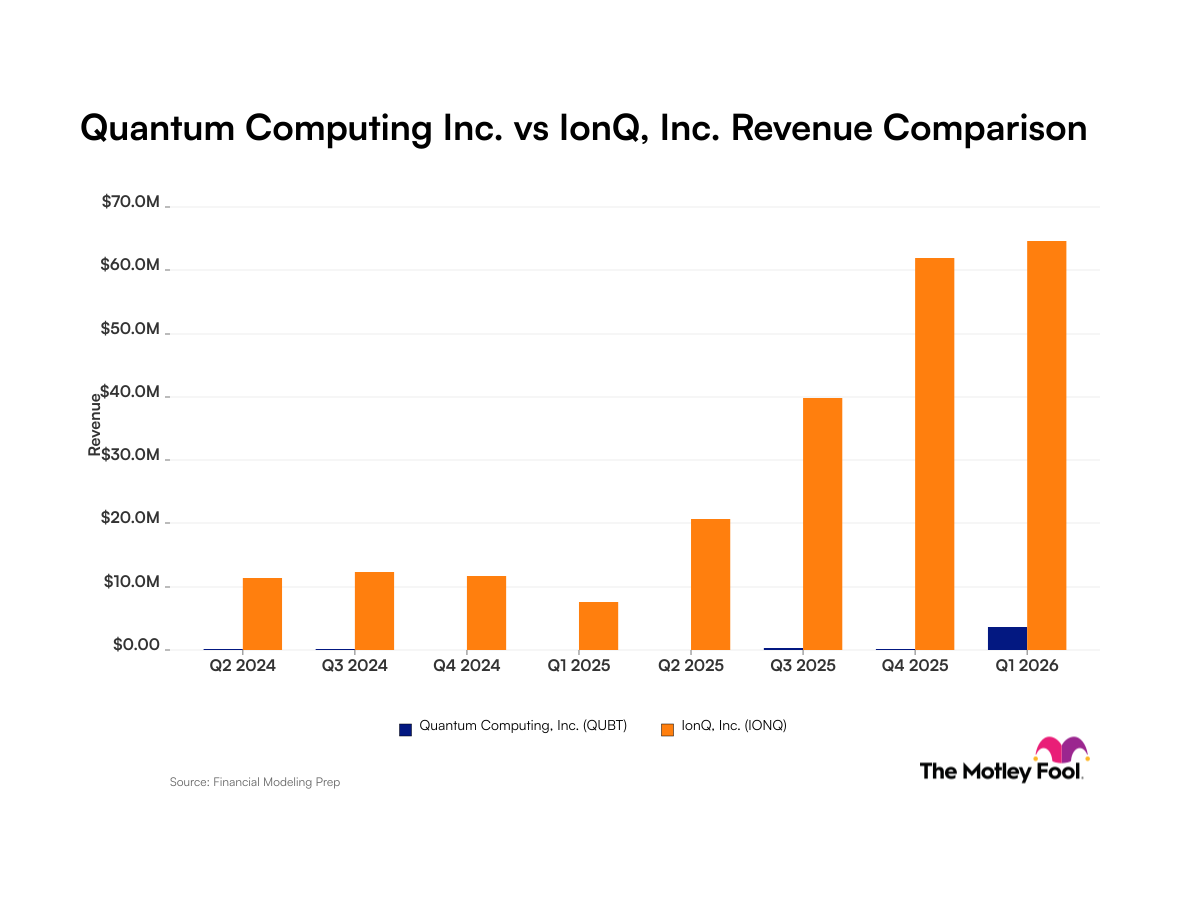
- Revenue Growth Comparison: IonQ has achieved consistent quarter-over-quarter revenue growth over the past eight quarters, reporting $64.7 million in Q1 with a staggering 755% year-over-year increase, indicating strong market demand for its ion-based quantum computing technology; in contrast, Quantum Computing Inc. reported only $3.7 million in Q1, primarily due to its acquisition of NuCrypt and Luminar Semiconductor, reflecting significant revenue volatility.
- Margin Analysis: IonQ's gross margin of approximately 24% in Q1 2026 highlights its profitability in the quantum computing sector, whereas Quantum Computing Inc. reported a negative net income margin of 110%, indicating substantial financial challenges that could deter future investments.
- Market Outlook Assessment: IonQ's stable revenue and robust growth rate position it as a standout investment in the quantum computing space, prompting investors to monitor whether the revenue gap with Quantum Computing Inc. continues to widen, which would underscore IonQ's advantages in customer acquisition and market share.
- Technological Competitiveness: Despite Quantum Computing Inc.'s advancements in launching a new computing architecture, its technology has yet to effectively attract customers, while IonQ's success demonstrates its competitive edge in the market, necessitating careful evaluation of Quantum Computing Inc.'s future growth potential.
See More
Quantum Computing Inc. Sees Revenue Surge
- Revenue Comparison: Quantum Computing Inc. (QCi) reported $3.7 million in revenue for Q1 2026, a significant increase from $39,000 in the previous year, although this surge was largely due to the acquisition of NuCrypt and Luminar Semiconductor, indicating its technology has yet to gain widespread customer traction.
- IonQ's Strong Performance: IonQ achieved $64.7 million in revenue for Q1 2026, representing a staggering 755% year-over-year growth, demonstrating that its ion-based quantum computing technology is rapidly capturing market share, consistently outperforming QCi.
- Gross Margin Analysis: IonQ's gross margin stands at approximately 24%, reflecting its profitability in the quantum computing sector, while QCi reported a negative net income margin of 110% for the same quarter, highlighting its challenging financial situation.
- Market Outlook: Despite QCi's revenue growth in Q1, the increase was primarily driven by acquisitions rather than sustainable customer growth, prompting investors to carefully assess its future market potential.
See More

D-Wave Quantum Shares Drop 5.37% Amid Funding and Valuation Concerns
- Stock Fluctuation: D-Wave Quantum closed at $27.81, down 5.25%, reflecting market reactions to CHIPS and Science Act funding news and concerns over the company's high valuation.
- Surge in Trading Volume: The trading volume reached 54.5 million shares, approximately 78% above the three-month average of 30.4 million shares, indicating ongoing investor interest in the quantum computing sector.
- Funding Update: D-Wave Quantum announced $100 million in new funding from the U.S. Department of Commerce last week; however, the stock pulled back, although this capital will support further development of its quantum computing systems.
- Research Controversy: Researchers from the Flatiron Institute challenged the superiority of quantum computing simulations, claiming classical computers can solve problems previously thought solvable only by quantum computers, to which D-Wave responded, emphasizing the effectiveness of their algorithms, highlighting potential risks associated with quantum stocks.
See More

D-Wave Quantum Stock Drops 5.25% Amid Funding and Valuation Concerns
- Stock Volatility: D-Wave Quantum closed at $27.81 on Tuesday, down 5.25%, reflecting investor reactions to recent CHIPS and Science Act funding news and concerns over its lofty valuation.
- Surge in Trading Volume: The trading volume reached 54.2 million shares on Tuesday, approximately 78% above the three-month average of 30.4 million shares, indicating heightened market interest and active trading in the stock.
- Funding Injection: D-Wave Quantum announced $100 million in new funding from the U.S. Department of Commerce last week, which initially spurred investor enthusiasm, but the stock subsequently pulled back due to challenges to quantum computing superiority.
- Market Competition Risks: Research from the Flatiron Institute claims classical computers can solve problems previously thought solvable only by quantum computers, highlighting risks faced by quantum stocks like D-Wave, especially given their high valuations.
See More

Financial Comparison of Quantum Computing Companies

- Revenue Concentration Risk: Rigetti Computing's fiscal year 2025 revenue heavily relies on government contracts, comprising 90.2% of total revenue, which fell to $7.1 million, a 34.3% decrease from the previous year, indicating significant exposure to potential budget cuts.
- Net Loss Situation: Rigetti reported a staggering net loss of $216.2 million with a net margin of -3,050.4%, highlighting that its expenditures far exceed its revenues, raising concerns about long-term sustainability.
- Market Competition Pressure: Quantum Computing achieved revenue of $682,000 in fiscal year 2025, an 82.8% increase year-over-year, yet it faced a net loss of $18.7 million, reflecting its fragile financial state under high R&D spending while competing against giants like IBM.
- Cash Flow Monitoring: Quantum Computing's free cash flow was approximately negative $37 million, with a current ratio of 102.4x, indicating ample liquid assets; however, the rapid depletion of cash reserves poses risks to its future growth potential.
See More

Quantum Computing Race Intensifies: Rigetti vs. Quantum Computing Analysis
- Rigetti Financials: Rigetti Computing reported $7.1 million in revenue for fiscal 2025, a 34.3% decline year-over-year, with a net loss of $216.2 million and a net margin of approximately -3,050.4%, highlighting significant risks tied to its reliance on government contracts.
- Quantum Computing Growth: Quantum Computing achieved roughly $682,000 in revenue for fiscal 2025, an 82.8% increase compared to the previous year, despite a net loss of $18.7 million and a net margin of -2,738.1%, indicating substantial R&D expenditures exceeding earnings.
- Risk Comparison: Rigetti faces revenue concentration risks from U.S. government contracts, while Quantum Computing relies on East Asian chip manufacturers, exposing it to geopolitical instability and trade restrictions, compounded by limited experience in large-scale manufacturing.
- Investment Choice: While both companies face valuation challenges, Rigetti emerges as the better long-term investment due to its higher revenue and the more widely adopted superconducting quantum technology, especially with Q1 2026 revenue reaching $4.4 million.
See More
IonQ Outperforms Quantum Computing Inc. in Revenue Stability
- Revenue Growth Comparison: IonQ has achieved consistent quarter-over-quarter revenue growth over the past eight quarters, reporting $64.7 million in Q1 with a staggering 755% year-over-year increase, indicating strong market demand for its ion-based quantum computing technology; in contrast, Quantum Computing Inc. reported only $3.7 million in Q1, primarily due to its acquisition of NuCrypt and Luminar Semiconductor, reflecting significant revenue volatility.
- Margin Analysis: IonQ's gross margin of approximately 24% in Q1 2026 highlights its profitability in the quantum computing sector, whereas Quantum Computing Inc. reported a negative net income margin of 110%, indicating substantial financial challenges that could deter future investments.
- Market Outlook Assessment: IonQ's stable revenue and robust growth rate position it as a standout investment in the quantum computing space, prompting investors to monitor whether the revenue gap with Quantum Computing Inc. continues to widen, which would underscore IonQ's advantages in customer acquisition and market share.
- Technological Competitiveness: Despite Quantum Computing Inc.'s advancements in launching a new computing architecture, its technology has yet to effectively attract customers, while IonQ's success demonstrates its competitive edge in the market, necessitating careful evaluation of Quantum Computing Inc.'s future growth potential.
See More
Quantum Computing Inc. Sees Revenue Surge
- Revenue Comparison: Quantum Computing Inc. (QCi) reported $3.7 million in revenue for Q1 2026, a significant increase from $39,000 in the previous year, although this surge was largely due to the acquisition of NuCrypt and Luminar Semiconductor, indicating its technology has yet to gain widespread customer traction.
- IonQ's Strong Performance: IonQ achieved $64.7 million in revenue for Q1 2026, representing a staggering 755% year-over-year growth, demonstrating that its ion-based quantum computing technology is rapidly capturing market share, consistently outperforming QCi.
- Gross Margin Analysis: IonQ's gross margin stands at approximately 24%, reflecting its profitability in the quantum computing sector, while QCi reported a negative net income margin of 110% for the same quarter, highlighting its challenging financial situation.
- Market Outlook: Despite QCi's revenue growth in Q1, the increase was primarily driven by acquisitions rather than sustainable customer growth, prompting investors to carefully assess its future market potential.
See More
D-Wave Quantum Shares Drop 5.37% Amid Funding and Valuation Concerns
- Stock Fluctuation: D-Wave Quantum closed at $27.81, down 5.25%, reflecting market reactions to CHIPS and Science Act funding news and concerns over the company's high valuation.
- Surge in Trading Volume: The trading volume reached 54.5 million shares, approximately 78% above the three-month average of 30.4 million shares, indicating ongoing investor interest in the quantum computing sector.
- Funding Update: D-Wave Quantum announced $100 million in new funding from the U.S. Department of Commerce last week; however, the stock pulled back, although this capital will support further development of its quantum computing systems.
- Research Controversy: Researchers from the Flatiron Institute challenged the superiority of quantum computing simulations, claiming classical computers can solve problems previously thought solvable only by quantum computers, to which D-Wave responded, emphasizing the effectiveness of their algorithms, highlighting potential risks associated with quantum stocks.
See More
D-Wave Quantum Stock Drops 5.25% Amid Funding and Valuation Concerns
- Stock Volatility: D-Wave Quantum closed at $27.81 on Tuesday, down 5.25%, reflecting investor reactions to recent CHIPS and Science Act funding news and concerns over its lofty valuation.
- Surge in Trading Volume: The trading volume reached 54.2 million shares on Tuesday, approximately 78% above the three-month average of 30.4 million shares, indicating heightened market interest and active trading in the stock.
- Funding Injection: D-Wave Quantum announced $100 million in new funding from the U.S. Department of Commerce last week, which initially spurred investor enthusiasm, but the stock subsequently pulled back due to challenges to quantum computing superiority.
- Market Competition Risks: Research from the Flatiron Institute claims classical computers can solve problems previously thought solvable only by quantum computers, highlighting risks faced by quantum stocks like D-Wave, especially given their high valuations.
See More
Financial Comparison of Quantum Computing Companies
- Revenue Concentration Risk: Rigetti Computing's fiscal year 2025 revenue heavily relies on government contracts, comprising 90.2% of total revenue, which fell to $7.1 million, a 34.3% decrease from the previous year, indicating significant exposure to potential budget cuts.
- Net Loss Situation: Rigetti reported a staggering net loss of $216.2 million with a net margin of -3,050.4%, highlighting that its expenditures far exceed its revenues, raising concerns about long-term sustainability.
- Market Competition Pressure: Quantum Computing achieved revenue of $682,000 in fiscal year 2025, an 82.8% increase year-over-year, yet it faced a net loss of $18.7 million, reflecting its fragile financial state under high R&D spending while competing against giants like IBM.
- Cash Flow Monitoring: Quantum Computing's free cash flow was approximately negative $37 million, with a current ratio of 102.4x, indicating ample liquid assets; however, the rapid depletion of cash reserves poses risks to its future growth potential.
See More
Quantum Computing Race Intensifies: Rigetti vs. Quantum Computing Analysis
- Rigetti Financials: Rigetti Computing reported $7.1 million in revenue for fiscal 2025, a 34.3% decline year-over-year, with a net loss of $216.2 million and a net margin of approximately -3,050.4%, highlighting significant risks tied to its reliance on government contracts.
- Quantum Computing Growth: Quantum Computing achieved roughly $682,000 in revenue for fiscal 2025, an 82.8% increase compared to the previous year, despite a net loss of $18.7 million and a net margin of -2,738.1%, indicating substantial R&D expenditures exceeding earnings.
- Risk Comparison: Rigetti faces revenue concentration risks from U.S. government contracts, while Quantum Computing relies on East Asian chip manufacturers, exposing it to geopolitical instability and trade restrictions, compounded by limited experience in large-scale manufacturing.
- Investment Choice: While both companies face valuation challenges, Rigetti emerges as the better long-term investment due to its higher revenue and the more widely adopted superconducting quantum technology, especially with Q1 2026 revenue reaching $4.4 million.
See More