

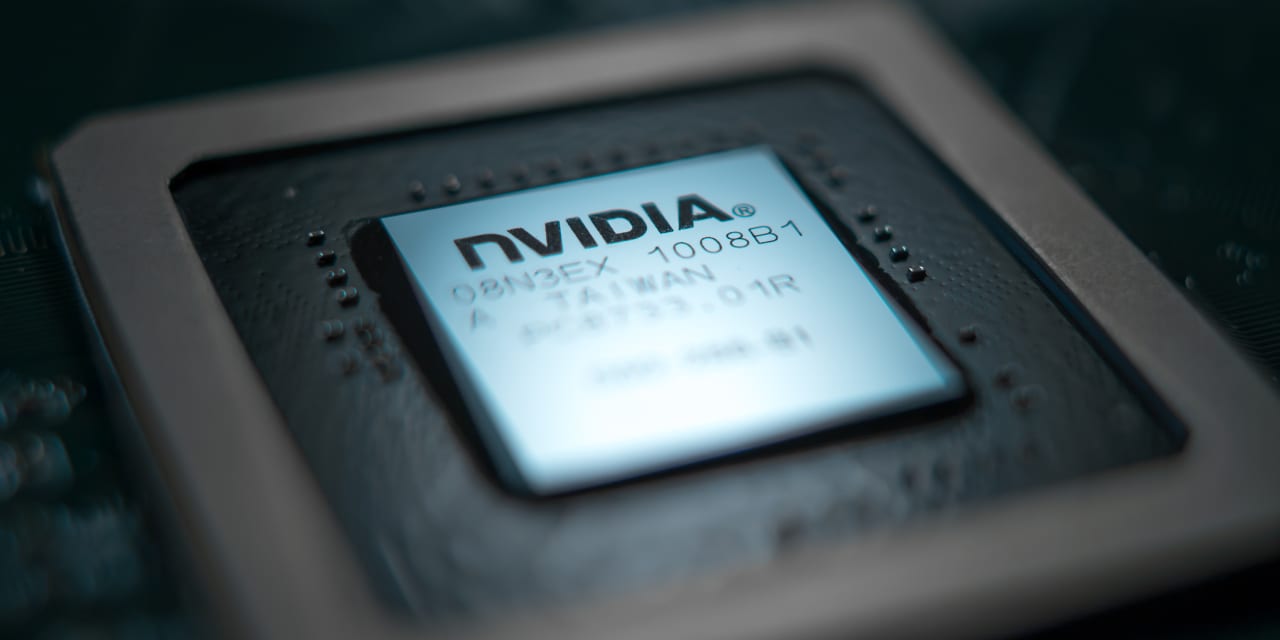
Nvidia's Valuation Stability Signals Optimistic Future
Written by Emily J. Thompson, Senior Investment Analyst
Updated: 6 days ago
0mins


Source: Fool
- Stock Performance: So far this year, Nvidia (NVDA) stock has gained 8%, slightly outperforming the S&P 500, indicating strong market performance and investor confidence in its future growth potential.
- Financial Data: In the first quarter of fiscal 2027, Nvidia's data center revenue surged 92% year-over-year to $75 billion, with management forecasting total revenue of $91 billion next quarter, showcasing robust growth momentum and market demand.
- Valuation Trends: Nvidia's forward P/E ratio has stabilized around 22, suggesting that while the market has priced in significant growth, this stability may indicate the early stages of valuation expansion on the horizon.
- Strategic Partnerships: Nvidia's investments in companies like Nokia, Coherent, Lumentum, and Marvell Technology broaden its market opportunities, advancing high-speed optical interconnects and networking technologies, laying the groundwork for future growth.
Trade with 70% Backtested Accuracy
Stop guessing "Should I Buy NVDA?" and start using high-conviction signals backed by rigorous historical data.
Sign up today to access powerful investing tools and make smarter, data-driven decisions.
Analyst Views on NVDA
Wall Street analysts forecast NVDA stock price to rise
41 Analyst Rating
39 Buy
1 Hold
1 Sell
Strong Buy
Current: 204.650

Low
200.00
Averages
264.97
High
352.00
Current: 204.650
Low
200.00
Averages
264.97
High
352.00
About NVDA
NVIDIA Corporation is an artificial intelligence (AI) infrastructure company. The Company is engaged in accelerated computing to help solve the challenging computational problems. Its segments include Compute & Networking and Graphics. The Compute & Networking segment includes its Data Center accelerated computing and networking platforms and AI solutions and software, and automotive platforms and autonomous and electric vehicle solutions, including software. The Graphics segment includes GeForce GPUs for gaming and personal computers (PCs), and Quadro/NVIDIA RTX GPUs for enterprise workstation graphics. Its technology stack includes the foundational NVIDIA CUDA development platform that runs on all NVIDIA GPUs, as well as hundreds of domain-specific software libraries, frameworks, algorithms, software development kits (SDKs), and application programming interfaces (APIs). Its platforms address four markets, which include Data Center, Gaming, Professional Visualization, and Automotive.
About the author

Emily J. Thompson
Emily J. Thompson, a Chartered Financial Analyst (CFA) with 12 years in investment research, graduated with honors from the Wharton School. Specializing in industrial and technology stocks, she provides in-depth analysis for Intellectia’s earnings and market brief reports.

Nvidia's Stock Surge and Dividend Analysis

- Outstanding Stock Performance: As of June 17, Nvidia's shares have surged 1,050% over the past five years, highlighting its strong position in the AI boom and attracting significant investor interest.
- Dividend Increase: In May, Nvidia raised its quarterly dividend from $0.01 to $0.25 per share, yet investors need to own 10,000 shares to generate $10,000 in annual income, indicating limited appeal for income-focused investors.
- High Investment Cost: At the current price of $206.45, investors would need to spend nearly $2.1 million to acquire enough shares for passive income, making it unattractive for those seeking stable cash flow.
- Low Dividend Yield: With a dividend yield of only 0.48%, significantly below the S&P 500 average of 1.04%, Nvidia is better suited for growth investors looking for capital appreciation rather than dividend income.
See More

United States Oil Fund Returns Just 22% Over a Decade
- Return Analysis: Over the past decade, the United States Oil Fund (USO) has only achieved a total return of 22.46%, while crude oil prices surged from $16.55 to $114.84, indicating that investors failed to effectively capture price movements, reflecting the fund's structural costs.
- Futures Roll Decay: USO rolls its front-month NYMEX WTI futures contracts monthly, and when the futures curve is in contango, the fund sells the cheaper expiring contract and buys the more expensive next one, leading to a monthly bleed in net asset value (NAV) even when spot crude prices remain flat.
- Tax Complexity: As a commodity pool limited partnership, USO investors receive a K-1 tax form, with long-term gains taxed at 60% and short-term gains at 40%, regardless of holding period, which adds unexpected accounting costs for investors.
- Market Risk Warning: As of June 17, 2026, USO is up 65.17% year-to-date, but analysts warn that if the Strait of Hormuz reopens, crude futures could quickly decline, erasing USO's yield advantage, with a 14.94% drop in the past week already observed.
See More

U.S. Inflation Rate Hits Three-Year High
- Rising Inflation: The U.S. inflation rate increased by 4.2% year-over-year in May, marking the highest level in three years, indicating heightened price pressures that may compel the Federal Reserve to adopt more aggressive rate hikes to control inflation.
- Interest Rate Policy Impact: Although the Fed kept its benchmark rate unchanged at 3.50%-3.75%, analysts widely expect rate hikes later this year if inflation continues to rise, which could negatively impact the stock market and reduce investment attractiveness.
- Bond ETF Performance: Traditional bond ETFs like the Vanguard Total Bond Market ETF (NASDAQ: BND) face risks of yields falling below inflation due to rising rates, with a current 30-day SEC yield of 4.5% that barely keeps pace with inflation, threatening negative returns for investors.
- Advantages of Inflation-Protected Bond ETFs: In response to inflation pressures, financial institutions have launched inflation-protected bond ETFs such as the Vanguard Short-Term Inflation-Protected Securities ETF (NASDAQ: VTIP), designed to safeguard principal value tied to the Consumer Price Index, although it offers a lower 30-day SEC yield of 1.05%.
See More

Coherent's Growth Potential in the AI Market

- Market Growth Drivers: As the AI market rapidly expands, Coherent's optical business has become its core growth engine, with revenue expected to grow at a 31% CAGR from 2025 to 2028, indicating strong market demand and business transformation potential.
- Investment and Collaboration: Nvidia's $2 billion investment in Coherent in early March underscores its emphasis on optical networking technology, with Coherent's stock rising approximately 30% since the announcement, reflecting market confidence in its future development.
- Product Innovation Catalyst: The sales growth of Coherent's ultra-fast 800G, 1.6T, and 3.2T optical products will drive revenue growth, particularly as data centers upgrade to fiber-optic components, further solidifying its market position.
- Optimistic Financial Outlook: Although Coherent's P/E ratio stands at 65 times, it is expected to achieve positive EPS in fiscal 2026 and grow at a 52% CAGR over the next two years, demonstrating its long-term investment value in the AI sector.
See More
Coherent's Optical Upgrades Propel AI Market Growth
- Significant Investment Potential: Coherent reported a 23% revenue increase in fiscal 2025, with analysts projecting a 31% CAGR through 2028, highlighting its strong potential in the AI market, particularly in optical product sales.
- Strategic Investment from Nvidia: Nvidia's $2 billion investment in March propelled Coherent's stock up approximately 30%, reflecting market confidence in Coherent as a long-term AI investment and reinforcing its leadership in the optical networking sector.
- Accelerated Technological Transformation: Coherent is transitioning from a cyclical networking business to a high-growth AI play, with expectations of maintaining a premium valuation driven by sales of ultra-fast 800G, 1.6T, and next-gen 3.2T optical products.
- Enhanced Government Support: Coherent secured $50 million in funding under the CHIPS and Science Act to expand its manufacturing plant in Sherman, Texas, which not only boosts its production capacity but also provides robust support for further expansion in the AI market.
See More

Moody's Expands Credit Rating Services to Tokenized Bonds

- Credit Rating Expansion: Moody's is expanding its credit rating services to cover tokenized bonds and fixed-income securities by directly placing ratings on Solana's blockchain, aiming to enhance investor confidence in tokenized assets and drive their adoption in the blockchain market.
- Efficiency in Trading: By tokenizing fixed-income securities, Moody's enables more efficient bond trading, allowing investors to trade 24/7 without intermediaries, significantly reducing transaction costs and eliminating cumbersome paperwork, thereby greatly enhancing market liquidity.
- Market Outlook for Solana: This move by Moody's provides strong support for Solana, as more financial institutions tokenize assets on the blockchain, Solana is likely to attract more investors, further solidifying its position as an efficient trading platform.
- Technological Competitive Edge: While Ethereum remains the market leader, Solana's Layer-1 blockchain offers significant speed advantages, and Moody's integration signals confidence in Solana's future development, potentially attracting more technological investments and application development.
See More
Nvidia's Stock Surge and Dividend Analysis
- Outstanding Stock Performance: As of June 17, Nvidia's shares have surged 1,050% over the past five years, highlighting its strong position in the AI boom and attracting significant investor interest.
- Dividend Increase: In May, Nvidia raised its quarterly dividend from $0.01 to $0.25 per share, yet investors need to own 10,000 shares to generate $10,000 in annual income, indicating limited appeal for income-focused investors.
- High Investment Cost: At the current price of $206.45, investors would need to spend nearly $2.1 million to acquire enough shares for passive income, making it unattractive for those seeking stable cash flow.
- Low Dividend Yield: With a dividend yield of only 0.48%, significantly below the S&P 500 average of 1.04%, Nvidia is better suited for growth investors looking for capital appreciation rather than dividend income.
See More
United States Oil Fund Returns Just 22% Over a Decade
- Return Analysis: Over the past decade, the United States Oil Fund (USO) has only achieved a total return of 22.46%, while crude oil prices surged from $16.55 to $114.84, indicating that investors failed to effectively capture price movements, reflecting the fund's structural costs.
- Futures Roll Decay: USO rolls its front-month NYMEX WTI futures contracts monthly, and when the futures curve is in contango, the fund sells the cheaper expiring contract and buys the more expensive next one, leading to a monthly bleed in net asset value (NAV) even when spot crude prices remain flat.
- Tax Complexity: As a commodity pool limited partnership, USO investors receive a K-1 tax form, with long-term gains taxed at 60% and short-term gains at 40%, regardless of holding period, which adds unexpected accounting costs for investors.
- Market Risk Warning: As of June 17, 2026, USO is up 65.17% year-to-date, but analysts warn that if the Strait of Hormuz reopens, crude futures could quickly decline, erasing USO's yield advantage, with a 14.94% drop in the past week already observed.
See More
U.S. Inflation Rate Hits Three-Year High
- Rising Inflation: The U.S. inflation rate increased by 4.2% year-over-year in May, marking the highest level in three years, indicating heightened price pressures that may compel the Federal Reserve to adopt more aggressive rate hikes to control inflation.
- Interest Rate Policy Impact: Although the Fed kept its benchmark rate unchanged at 3.50%-3.75%, analysts widely expect rate hikes later this year if inflation continues to rise, which could negatively impact the stock market and reduce investment attractiveness.
- Bond ETF Performance: Traditional bond ETFs like the Vanguard Total Bond Market ETF (NASDAQ: BND) face risks of yields falling below inflation due to rising rates, with a current 30-day SEC yield of 4.5% that barely keeps pace with inflation, threatening negative returns for investors.
- Advantages of Inflation-Protected Bond ETFs: In response to inflation pressures, financial institutions have launched inflation-protected bond ETFs such as the Vanguard Short-Term Inflation-Protected Securities ETF (NASDAQ: VTIP), designed to safeguard principal value tied to the Consumer Price Index, although it offers a lower 30-day SEC yield of 1.05%.
See More
Coherent's Growth Potential in the AI Market
- Market Growth Drivers: As the AI market rapidly expands, Coherent's optical business has become its core growth engine, with revenue expected to grow at a 31% CAGR from 2025 to 2028, indicating strong market demand and business transformation potential.
- Investment and Collaboration: Nvidia's $2 billion investment in Coherent in early March underscores its emphasis on optical networking technology, with Coherent's stock rising approximately 30% since the announcement, reflecting market confidence in its future development.
- Product Innovation Catalyst: The sales growth of Coherent's ultra-fast 800G, 1.6T, and 3.2T optical products will drive revenue growth, particularly as data centers upgrade to fiber-optic components, further solidifying its market position.
- Optimistic Financial Outlook: Although Coherent's P/E ratio stands at 65 times, it is expected to achieve positive EPS in fiscal 2026 and grow at a 52% CAGR over the next two years, demonstrating its long-term investment value in the AI sector.
See More
Coherent's Optical Upgrades Propel AI Market Growth
- Significant Investment Potential: Coherent reported a 23% revenue increase in fiscal 2025, with analysts projecting a 31% CAGR through 2028, highlighting its strong potential in the AI market, particularly in optical product sales.
- Strategic Investment from Nvidia: Nvidia's $2 billion investment in March propelled Coherent's stock up approximately 30%, reflecting market confidence in Coherent as a long-term AI investment and reinforcing its leadership in the optical networking sector.
- Accelerated Technological Transformation: Coherent is transitioning from a cyclical networking business to a high-growth AI play, with expectations of maintaining a premium valuation driven by sales of ultra-fast 800G, 1.6T, and next-gen 3.2T optical products.
- Enhanced Government Support: Coherent secured $50 million in funding under the CHIPS and Science Act to expand its manufacturing plant in Sherman, Texas, which not only boosts its production capacity but also provides robust support for further expansion in the AI market.
See More
Moody's Expands Credit Rating Services to Tokenized Bonds
- Credit Rating Expansion: Moody's is expanding its credit rating services to cover tokenized bonds and fixed-income securities by directly placing ratings on Solana's blockchain, aiming to enhance investor confidence in tokenized assets and drive their adoption in the blockchain market.
- Efficiency in Trading: By tokenizing fixed-income securities, Moody's enables more efficient bond trading, allowing investors to trade 24/7 without intermediaries, significantly reducing transaction costs and eliminating cumbersome paperwork, thereby greatly enhancing market liquidity.
- Market Outlook for Solana: This move by Moody's provides strong support for Solana, as more financial institutions tokenize assets on the blockchain, Solana is likely to attract more investors, further solidifying its position as an efficient trading platform.
- Technological Competitive Edge: While Ethereum remains the market leader, Solana's Layer-1 blockchain offers significant speed advantages, and Moody's integration signals confidence in Solana's future development, potentially attracting more technological investments and application development.
See More




