
Key Takeaway
SpaceX's upcoming IPO at a staggering $1.75 to $1.77 trillion valuation has triggered a wave of speculation about capital rotation away from Tesla. While short-term selling pressure is undeniable as investors chase the next Elon Musk blockbuster, the deeper structural relationship between these two companies suggests that Tesla shareholders who maintain their positions stand to benefit significantly from SpaceX's public market debut. The convergence thesis rests on multiple pillars: Tesla's substantial SpaceX shareholdings, the revolutionary Terafab chip manufacturing joint venture, deepening commercial synergies, and mounting speculation about a potential merger that could create a $2.4 trillion combined entity.
The investment logic extends beyond simple portfolio diversification. Tesla currently derives approximately $650 million annually from SpaceX and xAI through various commercial arrangements, while simultaneously securing strategic advantages in chip supply through their shared Terafab facility. This facility represents a critical hedge against Taiwan Semiconductor Manufacturing Company's capacity constraints, which have plagued the automotive and AI industries alike. For investors contemplating whether to rotate from Tesla into SpaceX, the analysis suggests that patience may prove more rewarding than chasing IPO momentum, particularly given SpaceX's limited float, astronomical valuation multiples, and ongoing losses compared to Tesla's established profitability.
The SpaceX IPO: Unprecedented Scale and Valuation
SpaceX is preparing to launch what could become the largest IPO in market history, targeting a valuation between $1.75 trillion and $1.77 trillion with shares priced at approximately $135 each. The offering aims to raise roughly $75 billion, with pricing expected around June 11, 2026, and trading commencing shortly thereafter. At this valuation, SpaceX would instantly become the seventh-largest company in the United States by market capitalization, surpassing established giants across multiple sectors.
The numbers underlying this valuation are staggering. SpaceX generated approximately $18.7 billion in revenue for 2025, representing a 33% year-over-year increase from 2024. However, the company remains deeply unprofitable, with losses expected to expand as it pursues aggressive growth initiatives including the Starship program, Starlink expansion, and various classified government contracts. At the proposed valuation, SpaceX would trade at roughly 94 times trailing revenue and approximately 73 times projected 2026 revenue estimates of $22-24 billion. These multiples dwarf even the most aggressive tech valuations seen during the 2021 peak.
For context, Tesla currently trades at a price-to-sales ratio of approximately 12 times, generating $224 billion in quarterly revenue with established profitability and positive free cash flow. The valuation gap between these two Musk-led enterprises highlights the premium investors are willing to pay for SpaceX's growth narrative and strategic positioning in the space economy, despite its current financial profile remaining firmly in the red.
Tesla's Hidden Asset: 19 Million SpaceX Shares
One of the most compelling yet underappreciated aspects of the SpaceX IPO for Tesla investors is the electric vehicle maker's substantial equity stake in the space company. Tesla holds approximately 19 million shares of SpaceX Class A stock, a position that would be valued at roughly $2.57 billion at the proposed $135 IPO price. This holding represents a significant unrealized asset on Tesla's balance sheet that will finally achieve transparent market valuation once SpaceX begins trading.
The accounting implications are meaningful. This stake will directly increase Tesla's book value per share, providing a tangible boost to the company's net asset position. For a company that has historically traded at premium multiples to book value, this enhancement provides additional fundamental support for Tesla's valuation, particularly during periods of market volatility or when growth narratives face skepticism.
Beyond the immediate balance sheet impact, this shareholding creates an important alignment of interests between the two companies. Tesla shareholders effectively gain exposure to SpaceX's growth trajectory without needing to deploy additional capital or navigate the complexities of the IPO allocation process. This embedded optionality represents a hidden source of value that passive index investors and even many active managers may overlook when evaluating Tesla's investment proposition.
Terafab: The Convergence Engine
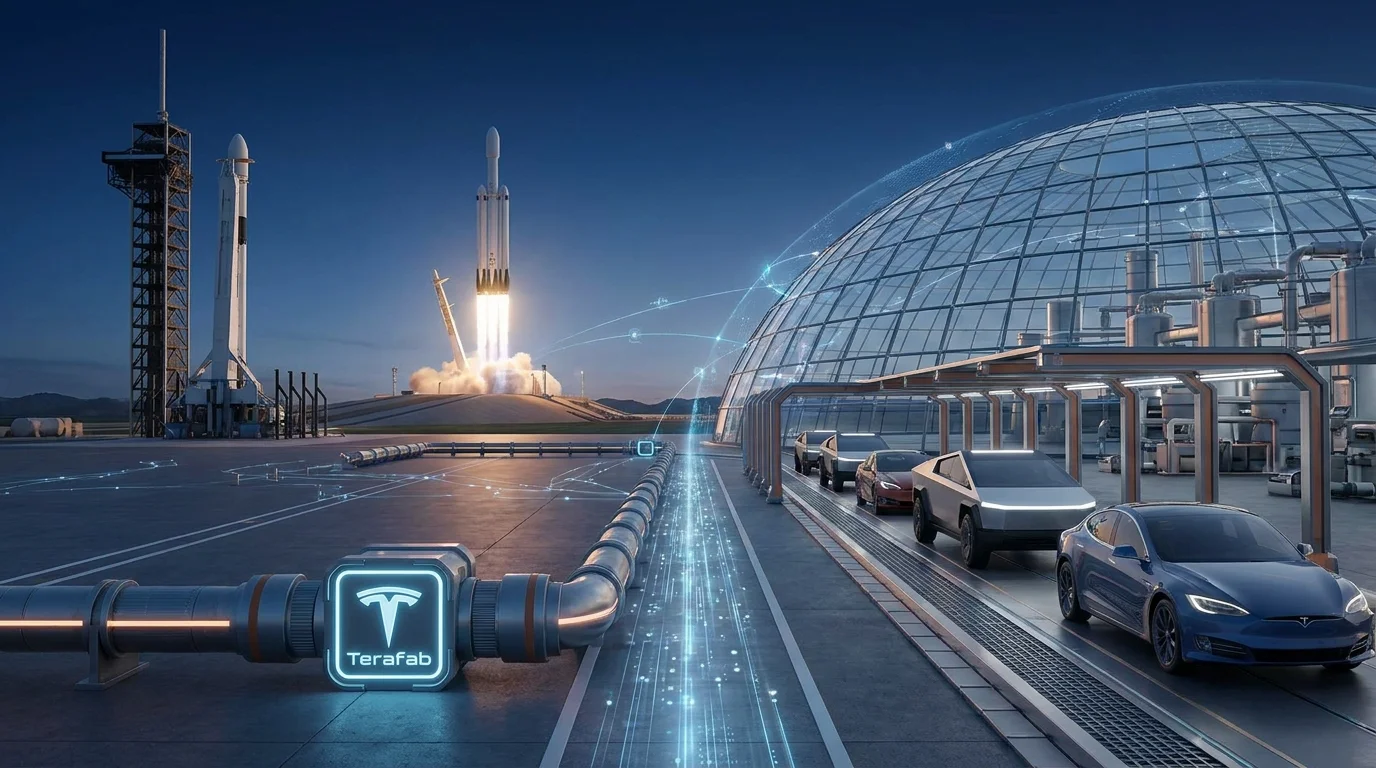
The Terafab semiconductor manufacturing facility represents perhaps the most strategically significant development in the Tesla-SpaceX relationship, serving as both a commercial bridge and a technological moat for both companies. Announced in March 2026, this $25 billion joint venture between Tesla, SpaceX, and xAI—later expanded to include Intel—aims to produce cutting-edge AI chips at scale, with total investment potentially reaching $119 billion according to recent filings.
The facility's strategic importance cannot be overstated. Located near Giga Texas in Austin, Terafab will manufacture two primary chip families: the AI5 and AI6 processors powering Tesla's vehicles and Optimus humanoid robots, alongside specialized chips for SpaceX's space-based AI computing infrastructure. This vertical integration addresses one of the most critical bottlenecks facing both companies: dependence on external semiconductor suppliers, particularly TSMC, whose capacity constraints have hampered production across the automotive and AI sectors.
For Tesla specifically, Terafab provides supply chain security for its Full Self-Driving (FSD) chip program and the neural processing units essential to Optimus. The facility's pilot production is targeted for late 2026, with full-scale operations expected by 2027. This timeline aligns critically with Tesla's projected ramp in autonomous vehicle deployment and robotics manufacturing, ensuring that chip supply will not constrain the company's most ambitious growth initiatives.
The joint venture structure itself signals deeper integration. By sharing manufacturing infrastructure, engineering talent, and intellectual property, Tesla and SpaceX are effectively creating a unified technology platform that spans terrestrial and extraterrestrial applications. This convergence reduces costs through economies of scale while accelerating innovation through shared learning and resource allocation.
Commercial Synergies: A $650 Million Annual Relationship
The financial interdependence between Tesla and SpaceX extends far beyond equity stakes and shared facilities. According to SpaceX's IPO prospectus, Tesla appears in the document 87 times—a frequency that underscores the depth of their commercial relationship. Currently, Tesla generates approximately $650 million in annual revenue from SpaceX and xAI combined through multiple channels.
The most visible component is Tesla's energy storage business. SpaceX has purchased Megapack energy storage systems worth up to $697 million, deploying these massive battery systems to support its launch facilities, ground stations, and emerging data center operations. Additionally, SpaceX has spent approximately $131 million on Tesla electric vehicles for executive transportation, employee fleets, and facility operations. These transactions provide Tesla with high-margin revenue while giving SpaceX access to cutting-edge sustainable technology that aligns with its broader mission narrative.
Looking forward, the synergy potential expands dramatically. SpaceX's Starlink satellite constellation—already the largest in history with thousands of operational satellites—provides Tesla vehicles with truly global connectivity. This capability enhances FSD training through real-time data transmission, enables over-the-air updates in remote locations, and supports emerging services like in-car streaming and productivity applications. As Starlink expands and Tesla's autonomous fleet grows, this symbiotic relationship will likely deepen.
Perhaps most intriguingly, SpaceX is positioned to become Tesla's largest customer for Optimus humanoid robots. The space company's ambitious plans for Mars colonization and orbital manufacturing will require vast numbers of general-purpose robots capable of operating in hazardous environments. Tesla's Optimus, designed for terrestrial factory work but theoretically adaptable to space applications, represents a natural solution. Early indications suggest SpaceX could purchase thousands of units annually once production scales, providing Tesla with a guaranteed demand base for its most speculative but potentially transformative product line.
The Merger Speculation: 80% Probability by 2027?
Perhaps no aspect of the Tesla-SpaceX relationship has generated more investor interest than speculation about a potential merger. Wedbush analyst Dan Ives has assigned an 80-90% probability to a combination occurring as early as 2027, citing the deepening operational integration, shared board members, and Elon Musk's own statements about his companies "trending towards convergence."
The strategic logic for a merger is compelling. Combining Tesla's automotive and energy businesses with SpaceX's space launch, satellite communications, and emerging AI capabilities would create a vertically integrated physical AI platform spanning Earth and space. The combined entity, potentially valued at over $2.4 trillion, would control critical infrastructure across transportation, energy, communications, and computing—positioning it as one of the most strategically significant corporations in history.
However, significant obstacles remain. SpaceX's status as a major U.S. defense contractor subjects it to ITAR (International Traffic in Arms Regulations) restrictions that could complicate integration with Tesla, whose largest manufacturing facility outside the United States is located in Shanghai. Regulatory scrutiny would be intense, with antitrust authorities likely to examine the competitive implications of combining such diverse but complementary assets under single control.
Even if a full merger proves politically or regulatorily challenging, the expectation itself creates value for Tesla shareholders. The possibility of future combination provides a valuation floor and a catalyst narrative that can support share prices during periods of operational transition or market weakness. Investors holding Tesla shares effectively own a call option on this convergence outcome, with the Terafab joint venture serving as a pilot program for deeper integration.
Financial Comparison: Profitability vs. Promise
When evaluating the relative attractiveness of Tesla versus SpaceX at current valuations, the financial comparison heavily favors the incumbent. Tesla generated $224 billion in revenue during the first quarter of 2026 alone, with net income of $4.77 billion and robust free cash flow generation. The company has achieved sustainable profitability while maintaining aggressive growth investments in autonomous driving, robotics, and energy storage.
SpaceX, by contrast, remains firmly in growth-at-all-costs mode. While 2025 revenue of $18.7 billion represents impressive 33% year-over-year growth, the company's losses are expanding as it funds Starship development, Starlink expansion, and various speculative projects including orbital data centers and Mars colonization infrastructure. The path to profitability remains unclear, with some analysts suggesting SpaceX may not generate positive net income until the 2030s.
The valuation differential is stark. Tesla trades at approximately 12 times sales—a premium multiple reflecting its growth and technology leadership, but one grounded in demonstrated earnings power. SpaceX at 94 times trailing sales represents a pure speculation on future dominance of the space economy, with investors paying a massive premium for growth potential that may take decades to materialize.
For investors considering rotating from Tesla into SpaceX, this comparison suggests caution. While SpaceX's growth story is undeniably compelling, the entry price at IPO reflects an enormous amount of future success already priced in. Tesla, despite its own premium valuation, offers a more balanced risk-reward profile with proven profitability, established market positions, and the embedded SpaceX exposure through its 19 million share stake.
IPO Mechanics: The Float Problem
SpaceX's IPO structure presents unique challenges for retail investors that further complicate the investment case. The public offering represents only 4.2% of total shares outstanding, with the remaining 95.8% held by Elon Musk and internal stakeholders. This extremely limited float creates several dynamics that prospective investors should understand.
First, the scarcity premium could drive significant first-day volatility. With institutional demand reportedly overwhelming supply by multiples, the stock could experience a substantial pop on opening—potentially pricing out retail investors who failed to secure allocation. Historical precedents for high-profile tech IPOs suggest initial premiums of 20-50% above offering price are possible, creating immediate paper gains for fortunate allocators but less attractive entry points for secondary market buyers.
Second, the lockup structure employs a staggered release mechanism designed to manage selling pressure. Shares unlock in tranches beginning 70 days post-IPO (7% release), followed by additional 7% releases at 90 days and subsequent intervals. This gradual approach aims to stabilize the stock price as insiders monetize positions, but it also means persistent selling pressure will weigh on shares for at least a year following the offering.
Third, the cost basis disparity between insiders and public investors is extreme. Early investors and employees hold shares with an average cost basis of approximately $6.48, compared to the $135 IPO price. This 20-fold difference creates powerful incentives for profit-taking at virtually any price level above the IPO, potentially capping upside momentum as these holders diversify their concentrated positions.
For Tesla investors considering rotation, these mechanics suggest that waiting for post-IPO price discovery may prove wiser than chasing the initial pop. The staggered lockup releases will create natural buying opportunities as supply hits the market, while Tesla shares may find support as rotation pressure subsides.
Short-Term Pressure: The Rotation Trade
Despite the compelling long-term thesis for Tesla shareholders, short-term price pressure is undeniable. Analysts have observed significant selling in Tesla shares as investors position for SpaceX allocation, with some estimates suggesting $5-10 billion in rotation out of Tesla and into the IPO. This capital flight has contributed to recent weakness in TSLA, with the stock trading near $380—well below its 2026 highs above $400.
The technical picture shows Tesla testing support around $340, a level that has held through multiple market cycles and represents a critical line in the sand for bulls. A sustained break below this threshold could trigger additional selling as momentum traders exit positions and technical damage accumulates. However, for long-term investors with conviction in the convergence thesis, this weakness may represent an accumulation opportunity rather than a cause for concern.
The rotation dynamic is likely to persist through the IPO pricing and initial trading period, potentially creating a window of relative underperformance for Tesla compared to the broader market and growth stock peers. However, as SpaceX shares begin trading and price discovery occurs, the arbitrage between the two Musk-led companies should normalize, potentially allowing Tesla to recapture lost ground as investors recognize the embedded optionality in Tesla's SpaceX stake and the strategic value of the Terafab relationship.
Investment Strategy: Hold Tesla, Wait for SpaceX
For investors currently holding Tesla shares, the strategic recommendation emerging from this analysis is clear: maintain positions and allow the convergence thesis to play out rather than rotating into SpaceX at IPO. Several factors support this approach.
First, Tesla's 19 million SpaceX shares provide meaningful exposure to the space company's growth without requiring new capital allocation. At the proposed IPO price, this stake represents approximately $2.57 billion in value—roughly 0.5% of Tesla's market capitalization. As SpaceX grows, this embedded optionality will compound in value, providing Tesla shareholders with indirect participation in the space economy.
Second, Tesla's financial profile offers superior risk-adjusted returns at current valuations. With established profitability, positive cash flow, and a proven ability to scale manufacturing operations, Tesla provides fundamental support that SpaceX lacks. The 94x sales multiple for SpaceX versus 12x for Tesla suggests that much of the space company's growth is already priced in, while Tesla's valuation leaves room for positive surprises.
Third, the Terafab joint venture creates strategic value that is difficult to quantify but potentially enormous. Securing chip supply independent of TSMC addresses one of the most significant risks facing Tesla's autonomous driving and robotics ambitions. This supply chain security is worth a premium multiple that may not be fully reflected in current share prices.
For investors without Tesla exposure seeking to participate in the Musk ecosystem, a staged approach may prove optimal. Consider initiating or adding to Tesla positions during the current rotation-driven weakness, while waiting for SpaceX post-IPO price discovery before establishing positions in the space company. The staggered lockup releases will create natural entry points over the coming year, potentially at valuations more attractive than the IPO price.
Options Strategies for Tesla Holders
For investors seeking to enhance returns while maintaining Tesla exposure, options strategies can provide additional income and risk management tools. Two approaches merit consideration in the current environment.
The covered call strategy involves holding Tesla shares while selling out-of-the-money call options against the position. With Tesla trading near $380 and showing recent volatility, selling calls with strike prices around $450-470 could generate premium income of 2-3% monthly while maintaining upside participation to the strike price. This approach is particularly attractive for investors who believe Tesla will trade in a range near current levels as the SpaceX IPO plays out, allowing them to collect income while waiting for the convergence thesis to materialize.
Alternatively, cash-secured puts offer a method to acquire additional Tesla shares at discounted prices. Selling puts with strike prices around $340-350—the critical support level—allows investors to collect premium while committing to purchase shares if the stock declines. If the puts expire worthless, the investor retains the premium as income. If assigned, the effective purchase price is reduced by the premium collected, providing a lower entry point than the current market price.
Both strategies require careful position sizing and risk management, as options involve leverage and potential for significant losses if positions move against the investor. However, for experienced options traders, these approaches can enhance returns during the period of consolidation that may persist until SpaceX price discovery completes and the convergence narrative regains investor attention.
Conclusion
SpaceX's historic IPO represents a watershed moment for the Musk business ecosystem, but Tesla shareholders should resist the urge to rotate capital into the new offering. The structural relationships between these companies—including Tesla's 19 million SpaceX shares, the transformative Terafab joint venture, $650 million in annual commercial synergies, and the potential for eventual merger—create a compelling case for maintaining Tesla positions through the IPO period.
While short-term price pressure is inevitable as investors chase the SpaceX narrative, the long-term value creation story favors patient Tesla holders. The convergence of automotive, energy, space, and AI technologies under the Musk umbrella will likely reward those who maintain exposure to this ecosystem rather than attempting to time rotations between its components.
For investors seeking to capitalize on this opportunity, consider using Intellectia AI's stock screener to identify optimal entry points for Tesla during the current rotation-driven weakness. Our AI stock picker can help evaluate the relative attractiveness of Tesla versus other growth opportunities in the current market environment. Sign up today to access real-time analysis and personalized investment recommendations tailored to your risk tolerance and investment objectives.
The Musk empire is entering a new phase of public market evolution. For Tesla shareholders, the wisest course may be to stay the course and allow the convergence thesis to unfold.