
Key Takeaway
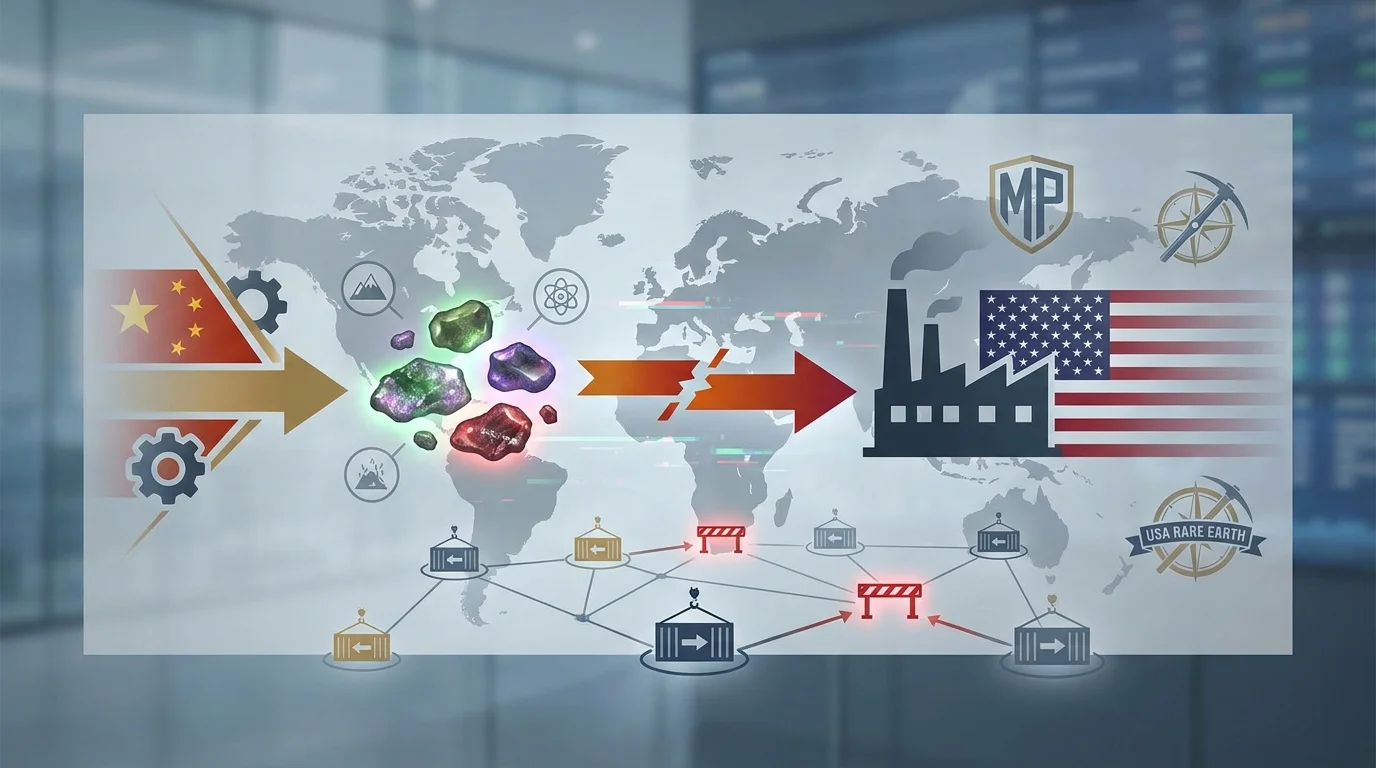
China's decision to add MP Materials and USA Rare Earth to its export control list marks a significant escalation in the ongoing trade war over critical minerals. This strategic move directly targets two of America's most important rare earth producers, potentially disrupting their access to Chinese dual-use technologies and equipment while simultaneously highlighting the strategic value of domestic rare earth supply chains. For investors, this development creates both immediate volatility in rare earth stocks and longer-term opportunities as Western governments accelerate efforts to build alternative supply chains independent of Chinese control.
The implications extend far beyond the two targeted companies. Rare earth elements are essential components in everything from fighter jet engines and missile guidance systems to electric vehicle motors and smartphone components. With China controlling approximately 60% of global rare earth mining and 90% of processing capacity, any disruption to supply chains sends ripples through multiple industries and creates significant investment implications across the defense, technology, and clean energy sectors.
Understanding China's Export Control Measures
On June 22, 2026, China's Ministry of Commerce announced the addition of ten US companies to its export control list, with MP Materials and USA Rare Earth being the most prominent names. The designation effectively bars Chinese firms from supplying dual-use items to these entities and prohibits any organization or individual worldwide from transferring Chinese-origin dual-use products to them. This sweeping restriction goes beyond simple trade barriers, creating a comprehensive blockade on technology and equipment that these companies might need for their operations.
The timing of this announcement is particularly significant. It comes as a direct response to Washington's recent expansion of its own blacklist targeting Chinese military-linked firms, demonstrating Beijing's willingness to retaliate proportionally in the technology and critical minerals space. The Chinese ministry stated that the measures were taken to safeguard national security and fulfill international non-proliferation obligations, framing the action as defensive rather than aggressive.
For investors seeking to navigate this complex geopolitical landscape, consider using Alphio AI's copy trading feature to mirror successful traders who specialize in geopolitical risk analysis and critical minerals investments.

The Targeted Companies: MP Materials and USA Rare Earth
MP Materials operates the Mountain Pass rare earth mine in California, which represents the only active rare earth mining and processing operation of scale in the United States. The company has received significant backing from the US Department of Defense, including a $400 million equity investment announced in 2025, underscoring the strategic importance of domestic rare earth production. Mountain Pass is one of the world's richest rare earth deposits, containing approximately 1.9 million metric tons of rare earth oxides.
The company has invested nearly $1 billion to restore a fully integrated rare earth supply chain in the United States, including the Independence facility in Fort Worth, Texas, which produces neodymium-iron-boron permanent magnets. In 2024, MP Materials achieved record production at Mountain Pass, delivering more than 45,000 metric tons of rare earth oxides in concentrate. The company's stock has been volatile as investors weigh the impact of trade restrictions against the strategic value of domestic rare earth production.
USA Rare Earth, the other targeted company, is developing a mine-to-magnet supply chain in Texas and represents another key player in America's effort to reduce dependence on Chinese rare earth supplies. While not yet at the same production scale as MP Materials, USA Rare Earth is advancing projects that could significantly expand domestic processing capacity for these critical materials.
Strategic Importance of Rare Earth Elements
Rare earth elements comprise seventeen metallic elements that are essential for advanced manufacturing, clean technology, and defense applications. Despite their name, these elements are relatively abundant in the Earth's crust, but economically viable concentrations are rare, and the processing required to separate and purify them is complex and environmentally challenging. This processing complexity has allowed China to dominate the global supply chain, controlling not just mining but the sophisticated separation and refining capabilities needed to produce usable materials.
The applications for rare earth elements are remarkably diverse and strategically critical. Neodymium and praseodymium are essential for the permanent magnets used in electric vehicle motors, wind turbines, and precision-guided munitions. Dysprosium and terbium improve the performance of these magnets at high temperatures, making them indispensable for military applications. Other rare earths are used in everything from aircraft engines and radar systems to smartphones and medical imaging equipment.
The concentration of supply chain control in China has long been recognized as a strategic vulnerability by Western governments. China's dominance extends beyond raw materials to the specialized knowledge, equipment, and processing capabilities required to transform ore into high-purity metals and magnets. This vertical integration gives Beijing significant leverage in trade negotiations and creates potential supply chain risks for industries dependent on these materials.
Investment Implications and Market Reaction
The announcement of export controls triggered immediate volatility in rare earth-related stocks. MP Materials shares experienced significant price swings as investors attempted to assess the net impact of the restrictions. While the export controls could create operational challenges by limiting access to Chinese equipment and technology, they also underscore the strategic importance of domestic rare earth production and may accelerate government support for the sector.
Analysts at Bank of America Securities interpreted China's addition of MP Materials to its export control list as having little to no operational impact, viewing the move instead as a reaffirmation of the company's strategic value. The analysis suggests that MP Materials has already been preparing for supply chain disruptions and has developed alternative sourcing strategies for critical equipment and technology.
The broader investment thesis for domestic rare earth producers may actually strengthen as a result of these tensions. Western governments are increasingly prioritizing supply chain resilience and strategic autonomy, which could translate into additional subsidies, procurement preferences, and regulatory support for domestic rare earth production. The European Union, Japan, and Australia have all announced initiatives to develop alternative rare earth supply chains, creating potential export markets for US producers.
Impact on US Defense and Technology Sectors
The Department of Defense's significant investment in MP Materials reflects the critical importance of rare earth elements for national security. These materials are essential components in F-35 fighter jets, precision-guided missiles, submarine propulsion systems, and satellite communications equipment. Any disruption to rare earth supplies could impact defense readiness and increase costs for military procurement.
For traders looking to capitalize on defense sector developments, Alphio AI's agentic trading can help automate portfolio management with AI-powered strategies that respond to geopolitical developments and sector rotations.

The technology sector faces similar supply chain risks. Electric vehicle manufacturers, wind turbine producers, and consumer electronics companies all depend on rare earth magnets for their products. Tesla, General Motors, and other automakers have been working to secure long-term supply agreements for rare earth materials as they scale electric vehicle production. The export controls may accelerate these efforts and increase willingness to pay premium prices for non-Chinese sources.
Apple, which relies on rare earths for iPhone components and MacBook motors, has been particularly focused on supply chain diversification. The company has reportedly been exploring alternative magnet technologies and working with suppliers to reduce dependence on Chinese rare earth processing. Similar efforts are underway across the technology sector as companies recognize the strategic risks of concentrated supply chains.
Global Supply Chain Restructuring
The latest escalation in rare earth trade tensions is accelerating a broader restructuring of global supply chains that has been underway for several years. Western governments and companies are investing billions of dollars to develop alternative sources of rare earth materials and processing capabilities. This restructuring represents both a significant challenge and a substantial opportunity for investors positioned to benefit from the transition.
Australia, which possesses significant rare earth reserves, has emerged as a key alternative supplier. Lynas Rare Earths, the largest rare earth producer outside China, has expanded production capacity and secured contracts with US and Japanese customers. The company has also received US government funding to develop processing capabilities, reducing dependence on Chinese refining capacity.
Canada and several African nations are also developing rare earth projects with Western investment and support. The challenge for these projects is not just mining ore but developing the sophisticated processing capabilities needed to produce high-purity rare earth metals and magnets. This processing expertise has been concentrated in China for decades, creating a significant barrier to entry for new market participants.
For investors seeking to set up conditional workflows and automate their response to market developments, Alphio AI's automations provide powerful tools for executing trades based on predefined criteria and supply chain news.

Long-Term Investment Themes
The rare earth trade war highlights several long-term investment themes that extend beyond the immediate targeted companies. Supply chain resilience and strategic autonomy are becoming increasingly important considerations for both governments and corporations, creating investment opportunities across multiple sectors and geographies.
Critical minerals more broadly are receiving increased attention from policymakers and investors. Lithium, cobalt, nickel, and graphite are essential for batteries and clean energy technologies, and their supply chains face similar concentration risks to rare earths. Companies developing alternative sources of these materials, or technologies that reduce dependence on them, may benefit from increased investment and policy support.
The defense technology sector is particularly sensitive to rare earth supply chain risks. Companies developing next-generation weapons systems, electronic warfare capabilities, and advanced communications equipment all depend on rare earth materials. As geopolitical tensions increase defense spending, companies with secure supply chains for critical materials may gain competitive advantages.
Clean energy technologies also depend heavily on rare earth elements. Electric vehicle motors, wind turbine generators, and energy storage systems all require rare earth magnets and materials. The transition to clean energy creates growing demand for these materials while simultaneously highlighting the risks of supply chain concentration. This tension between demand growth and supply security creates both risks and opportunities for investors in the clean energy sector.
Risks and Uncertainties
Despite the compelling long-term investment thesis, significant risks and uncertainties remain in the rare earth sector. The development of new mining and processing capacity requires substantial capital investment and technical expertise, with long lead times from project conception to commercial production. Many announced projects have faced delays, cost overruns, and technical challenges that have limited their impact on global supply chains.
China retains significant leverage in the rare earth market through its control of processing capacity and technical expertise. Even if Western companies can develop alternative mining operations, they may still depend on Chinese processing capabilities for the foreseeable future. This dependence creates ongoing risks of supply disruptions and price volatility.
Technological developments could also disrupt the rare earth investment thesis. Researchers are actively working on alternative magnet technologies that reduce or eliminate dependence on rare earth elements. While these alternatives currently cannot match the performance of rare earth magnets, continued innovation could eventually reduce demand for these materials in some applications.
Environmental and regulatory risks also present challenges for rare earth producers. The processing of rare earth ores generates significant waste and environmental concerns, creating regulatory risks and potential opposition from local communities. Balancing the need for domestic production with environmental protection will be an ongoing challenge for policymakers and companies in the sector.
Conclusion
China's decision to add MP Materials and USA Rare Earth to its export control list represents a significant escalation in the critical minerals trade war, with far-reaching implications for investors, policymakers, and industries dependent on these essential materials. While the immediate impact creates volatility and uncertainty, the longer-term trend toward supply chain diversification and strategic autonomy appears firmly established.
For investors, the rare earth sector presents a complex mix of risks and opportunities. Companies like MP Materials that have invested in domestic supply chain capabilities may benefit from increased government support and strategic importance, even as they face operational challenges from trade restrictions. The broader theme of supply chain resilience extends beyond rare earths to encompass critical minerals more generally, creating investment opportunities across the mining, processing, and technology sectors.
As markets continue to digest the implications of these trade tensions, investors should consider leveraging advanced trading tools to capture opportunities and manage risk. Alphio AI's conversational trading allows you to execute trades via chat, making it easier to respond quickly to geopolitical developments and implement your investment strategies.

Whether you're looking to mirror successful traders through copy trading, automate your portfolio with agentic trading, set up conditional workflows, or execute trades conversationally, Alphio AI provides the tools you need to navigate this dynamic market environment. The rare earth trade war has created a new investment landscape focused on supply chain resilience and strategic autonomy—make sure you have the right technology to capitalize on it.