
Key Takeaway
The Federal Reserve's June 2026 meeting delivered a surprising hawkish twist that has reshaped market expectations for monetary policy. While the central bank held the federal funds rate steady at 3.50% to 3.75% in a unanimous 12-0 vote, the closely watched dot plot revealed a dramatic shift in policymakers' outlook. For the first time since the rate-cutting cycle began, the median projection now implies a potential rate hike by year-end rather than the cuts markets had anticipated.
This pivot reflects growing concerns about persistent inflation, which has proven stickier than the Fed's 2% target despite previous monetary tightening. Seventeen of eighteen Fed officials now judge inflation risks to be tilted to the upside, a striking consensus that underscores the central bank's renewed vigilance. For investors, this signals a fundamental reassessment of the interest rate trajectory that will influence asset allocation decisions across equity, fixed income, and alternative investments for the remainder of 2026.
The market reaction was immediate and pronounced. Treasury yields jumped across the curve while growth stocks, particularly in the technology sector, experienced heightened volatility. The divergence between Goldman Sachs, which now expects no cuts in 2026, and JPMorgan, which projects a potential hike in 2027, highlights the uncertainty facing investors as they navigate this shifting monetary landscape.
The June 2026 FOMC Decision: Hold Now, Hike Later?
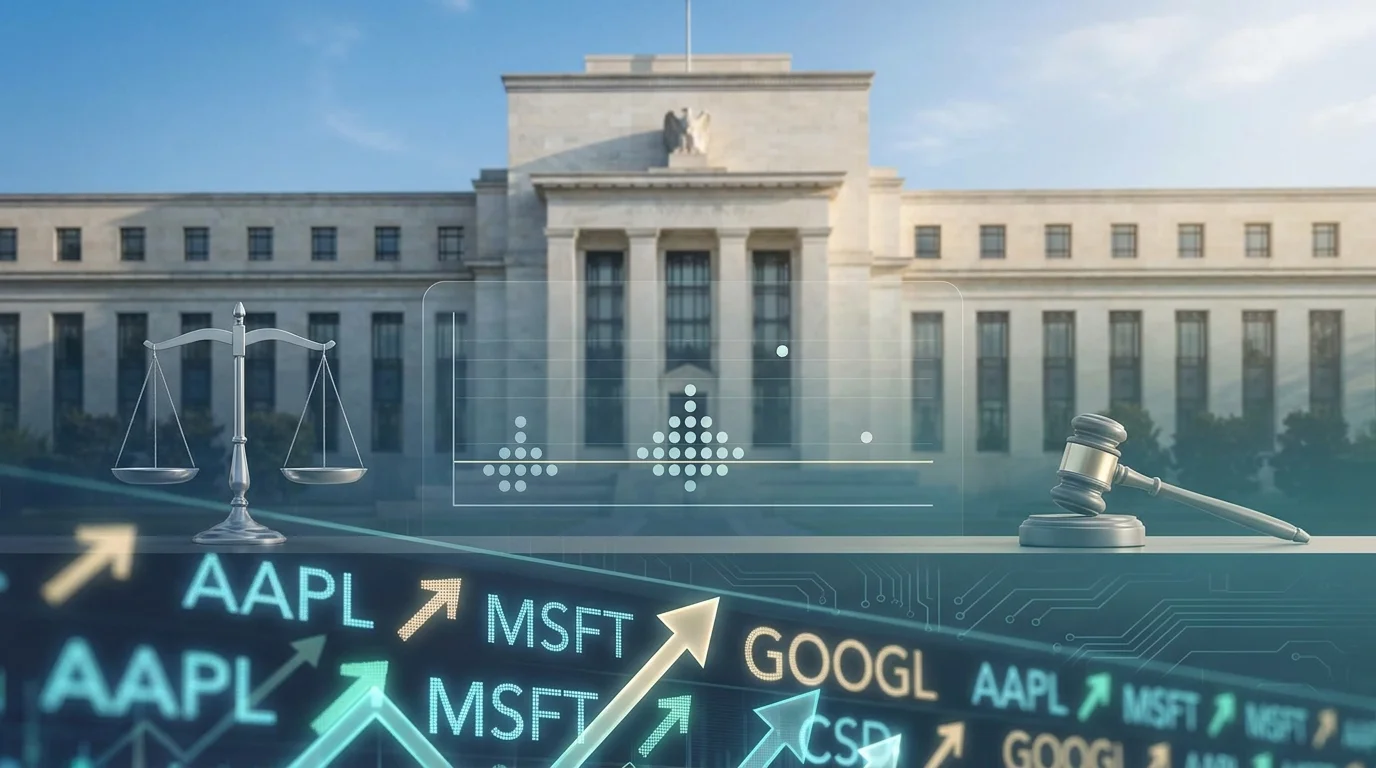
The Federal Open Market Committee's decision to maintain the federal funds rate at its current range of 3.50% to 3.75% was widely anticipated by markets, with the CME FedWatch Tool pricing in roughly 97% probability of no change ahead of the meeting. What caught investors off guard was the dramatic revision to the Summary of Economic Projections, particularly the dot plot that maps each Fed official's expected policy path.
The median projection for the federal funds rate at year-end 2026 rose to 3.8% from 3.4% in March, effectively shifting from an implied rate cut to a potential rate increase. This marks a significant departure from the dovish tone that had characterized Fed communications in recent months and suggests policymakers are growing increasingly uncomfortable with inflation's persistence above target.
The unanimous vote to hold rates steady belies the underlying divisions revealed in the dot plot distribution. Eight participants projected rates remaining at current levels through year-end, one anticipated a cut, while nine saw rates moving higher. This split reflects the genuine uncertainty facing monetary policymakers as they weigh competing signals from inflation data, labor market conditions, and broader economic momentum.
Fed Chair Kevin Warsh, presiding over his first FOMC meeting since taking the helm, struck a measured tone in his post-meeting press conference. While emphasizing the committee's commitment to its dual mandate of price stability and maximum employment, Warsh acknowledged that the inflation outlook had deteriorated somewhat since the March meeting. His comments reinforced the message that the Fed remains data-dependent and prepared to adjust policy as conditions warrant.
Understanding the Dot Plot's Hawkish Shift
The dot plot has become one of the most closely scrutinized elements of Fed communications since its introduction in 2012, offering investors a window into the collective thinking of monetary policymakers. The June 2026 iteration revealed a committee that has grown meaningfully more hawkish in its assessment of the appropriate policy path, even as the immediate decision to hold rates was unanimous.
The shift from a median projection implying a rate cut to one suggesting a potential hike represents more than a technical adjustment. It signals a fundamental reassessment of the inflation outlook and the neutral rate of interest that neither stimulates nor constrains economic activity. The long-run neutral rate projection remained anchored around 3.0%, but the expected path to reach that equilibrium has steepened considerably.
Several factors appear to have driven this hawkish repricing. Core inflation measures have remained stubbornly elevated above the Fed's 2% target, with the core PCE price index running around 2.8% in recent readings. The labor market has shown remarkable resilience, with unemployment holding steady in the 4.3% to 4.5% range and wage growth continuing at a pace inconsistent with price stability. Additionally, geopolitical developments, including the conflict in Iran, have introduced new upside risks to energy prices and broader inflation expectations.
The dot plot's predictive power is admittedly imperfect, as past projections have frequently diverged from actual policy outcomes. However, the directional shift in the June 2026 projections carries significant signaling value. When seventeen of eighteen officials see inflation risks tilted to the upside, it creates a high bar for any dovish pivot and suggests the Fed is more likely to err on the side of overtightening than undertightening in its inflation fight.
Wall Street Divided: Goldman vs. JPMorgan Rate Forecasts
The Fed's hawkish pivot has exposed significant divisions among Wall Street's most influential forecasters, with Goldman Sachs and JPMorgan offering starkly different visions of the monetary policy trajectory ahead. These divergent views reflect genuine uncertainty about the economic outlook and highlight the challenges facing investors attempting to position portfolios for an uncertain rate environment.
Goldman Sachs, which had previously anticipated two rate cuts in 2026, abruptly reversed course following the June FOMC meeting. The firm now expects the Fed to hold rates steady through the remainder of the year, pushing its projected cuts to June and December 2027. This revision brings Goldman more in line with market pricing, which currently assigns roughly 75% probability to a rate hike by year-end rather than any easing.
For investors seeking to navigate these conflicting signals, consider using Alphio AI's copy trading feature to mirror the strategies of successful traders who specialize in macro-driven positioning.

JPMorgan has taken an even more hawkish stance, with its economists projecting zero cuts through the rest of 2026 and a 25-basis-point hike in the third quarter of 2027. The bank's analysis emphasizes the stickiness of core inflation and the risk that premature easing could entrench inflationary expectations. JPMorgan also notes that Fed Chair Warsh has historically advocated for a smaller central bank balance sheet, which could contribute to tighter financial conditions even without explicit rate increases.
These divergent forecasts have meaningful implications for asset allocation. Goldman's scenario suggests a relatively benign environment for growth stocks and longer-duration assets, while JPMorgan's outlook would favor financials, short-duration fixed income, and defensive equity sectors. The wide dispersion in forecasts underscores the importance of maintaining portfolio flexibility and avoiding concentrated bets on any single policy outcome.
Tech Stocks and Rising Rates: The AI Semiconductor Test
The technology sector has emerged as a key battleground in the debate over Fed policy and its market implications. High-growth tech stocks, particularly those in the artificial intelligence and semiconductor spaces, are theoretically most vulnerable to rising interest rates due to their long-duration cash flow profiles and elevated valuation multiples. Yet recent performance suggests the relationship between rates and tech valuations has become more nuanced.
ASML Holding, the Dutch semiconductor equipment manufacturer that holds a near-monopoly on extreme ultraviolet lithography systems, provides a compelling case study. The company reported strong first-quarter 2026 results, with net sales of €8.8 billion and gross margins of 53%, while raising its full-year guidance to a range of €36 billion to €40 billion. This bullish outlook reflects accelerating demand from AI infrastructure investments, as customers like TSMC, Intel, and Samsung ramp capacity to meet surging chip demand.
Despite the Fed's hawkish pivot, ASML shares have demonstrated remarkable resilience, rising approximately 40% year-to-date and trading near all-time highs. This performance suggests that company-specific fundamentals, particularly exposure to secular growth trends like AI, can outweigh macro headwinds from monetary policy. The company's €38.8 billion order backlog provides substantial revenue visibility that insulates it from near-term economic uncertainty.
However, the broader semiconductor complex has experienced significant volatility in response to shifting rate expectations. The PHLX Semiconductor Index has seen sharp swings as investors recalibrate discount rates and earnings multiples. Companies with less certain growth trajectories or higher leverage have underperformed, while market leaders with dominant competitive positions have held up better. This bifurcation suggests that stock selection within the tech sector will be increasingly important in a higher-for-longer rate environment.
Investment Strategies for the Higher-for-Longer Era
The Fed's hawkish shift necessitates a reassessment of portfolio positioning for the remainder of 2026 and beyond. Investors who positioned for aggressive rate cuts may need to recalibrate expectations and adjust allocations to reflect a more restrictive monetary policy stance that could persist well into 2027.
For equity investors, the traditional playbook for rising rates favors financial stocks, which benefit from wider net interest margins, and defensive sectors like consumer staples and utilities that offer stable cash flows. Value stocks, which had already been enjoying a resurgence, may continue to outperform growth as discount rates rise and earnings stability becomes more prized.
Alternatively, explore Alphio's agentic trading capabilities to automate your portfolio management with AI-powered strategies that adapt to changing market conditions.

Fixed income investors face a more complex calculus. While rising rates typically pressure bond prices, the starting point for yields is now significantly higher than in recent years, offering more attractive income opportunities. Short-duration Treasury and investment-grade corporate bonds can provide attractive risk-adjusted returns while limiting interest rate sensitivity. The iShares iBoxx Investment Grade Corporate Bond ETF has returned over 4% year-to-date, outperforming the aggregate bond index by roughly 180 basis points.
For those seeking to navigate this environment with greater precision, Alphio's automation features enable conditional workflows that can respond dynamically to Fed policy shifts and market volatility.

Alternative investments, including commodities and real assets, may offer diversification benefits in an inflationary environment. The conflict in Iran has already driven Brent crude oil prices toward $100 per barrel, demonstrating how geopolitical developments can create inflationary pressures that complicate the Fed's policy calculus. A modest allocation to commodity exposure can serve as a hedge against both inflation and geopolitical risk.
Global Implications and Currency Markets
The Fed's hawkish pivot has reverberated through global currency markets, strengthening the U.S. dollar and creating ripple effects for international trade and capital flows. The dollar index, which measures the greenback against a basket of major currencies, has rallied from multi-year lows as interest rate differentials widened in favor of the United States.
This dollar strength presents a mixed bag for U.S. investors. On the positive side, it enhances the purchasing power of American consumers and businesses buying foreign goods and services. It also provides a natural hedge for U.S.-based investors holding international assets, as dollar appreciation reduces the local currency value of overseas holdings.
However, a stronger dollar also creates headwinds for U.S. multinationals by making American exports less competitive in global markets and reducing the dollar value of foreign earnings when repatriated. Companies with significant international revenue exposure, particularly in the technology and consumer discretionary sectors, may face earnings pressure from currency translation effects.
Emerging markets face particular challenges from Fed hawkishness and dollar strength. Many developing economies have borrowed heavily in U.S. dollars, and a stronger greenback increases the real burden of servicing this debt. Capital flows to emerging markets typically reverse when U.S. rates rise, as the relative attractiveness of higher-yielding developing market assets diminishes. Investors with emerging market exposure should monitor these dynamics closely and consider reducing allocations if dollar strength persists.
Conclusion
The Federal Reserve's June 2026 meeting marked a watershed moment in the post-pandemic monetary policy cycle, with the dot plot's hawkish shift signaling a potential end to the easing trajectory that had supported asset prices. While the immediate decision to hold rates steady was expected, the revelation that policymakers now see upside risks to inflation and a possible rate hike by year-end has forced investors to recalibrate expectations and portfolio positioning.
For the remainder of 2026, successful investing will likely require greater selectivity and a focus on fundamentals rather than macro tailwinds. Companies with pricing power, strong balance sheets, and exposure to secular growth trends like artificial intelligence may continue to outperform even as monetary conditions tighten. Conversely, businesses dependent on cheap financing, speculative growth narratives, or cyclical demand could face significant headwinds.
The divergence between Goldman Sachs and JPMorgan forecasts underscores the genuine uncertainty facing markets. Rather than attempting to predict the precise path of Fed policy, investors should construct resilient portfolios that can perform across a range of scenarios. This means maintaining diversification across asset classes, sectors, and geographies while remaining alert to opportunities created by market dislocations.
To execute trades seamlessly while monitoring Fed policy developments, try Alphio's conversational trading interface that allows you to manage positions through natural language commands.
The Fed's message is clear: the fight against inflation is not yet won, and policymakers are prepared to maintain restrictive conditions for as long as necessary to achieve their price stability mandate. Investors who align their strategies with this reality will be best positioned to navigate the challenges and opportunities of the higher-for-longer interest rate environment.