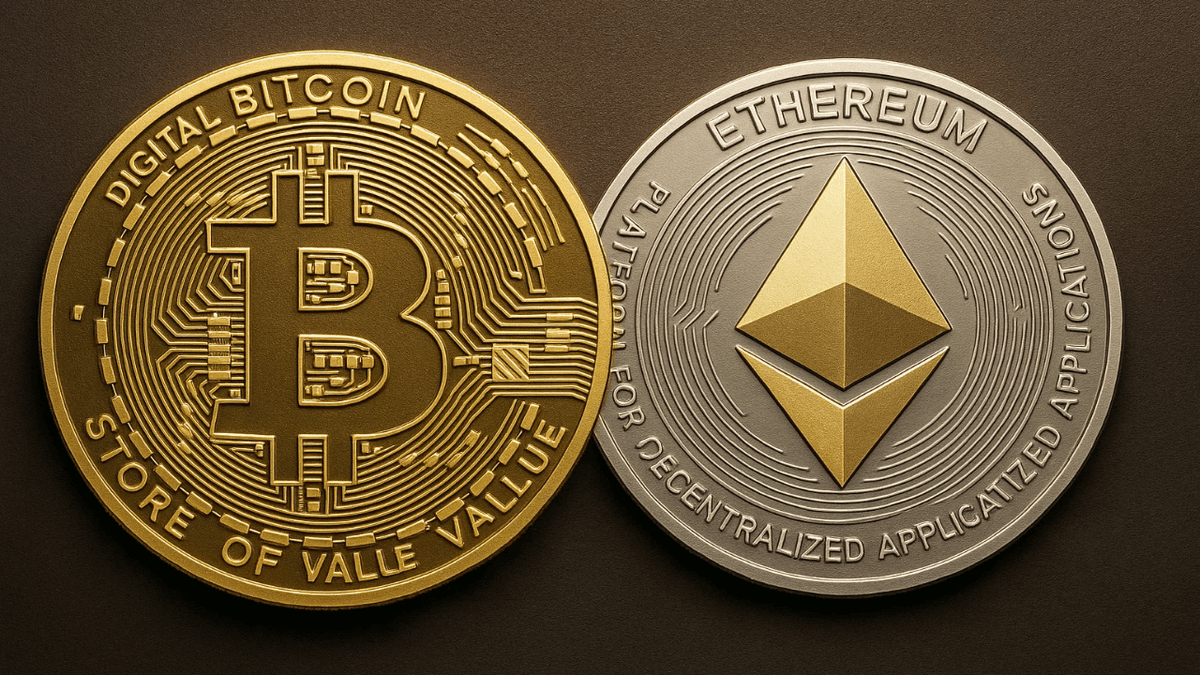

Key Takeaways
- Bitcoin acts like digital gold for storing value securely, while Ethereum powers innovative apps and smart contracts.
- In terms of BTC vs ETH investment, Bitcoin offers stability for conservative plays, but Ethereum shines with growth from DeFi and dApps.
- The differences between Bitcoin and Ethereum include supply models—Bitcoin's capped at 21 million, Ethereum's more flexible—and transaction speeds, where Ethereum often edges out with faster processing.
- Wondering which is better, BTC or ETH? It depends on your risk tolerance, but combining both can balance your portfolio beautifully.
Introduction
Have you ever felt overwhelmed trying to decide between Bitcoin and Ethereum, especially with crypto markets swinging wildly? You're not alone—many investors grapple with the Bitcoin vs Ethereum comparison, wondering about the differences between Bitcoin and Ethereum and which is better BTC or ETH for their goals. The problem is the flood of info out there, making it hard to spot real opportunities without getting burned by volatility.
But aggregate that with expert insights, and patterns emerge: Bitcoin's strength as a store of value contrasts Ethereum's versatility for building decentralized worlds. As someone who's navigated these waters, I've seen how understanding BTC vs ETH investment can turn confusion into confidence.
That's where expertise comes in—tools like those from Intellectia.ai cut through the noise with AI-driven analysis. The solution? Use AI for precise predictions and strategies, like Intellectia.ai's crypto technical analysis to gauge trends in real time. For example, imagine checking "$BTC technical analysis" and getting instant signals that helped you avoid a dip—I've experienced that edge, and it could be yours too.

Introduction to BTC and ETH
Bitcoin, commonly abbreviated as BTC, ignited the entire cryptocurrency revolution when it debuted in 2009 as the pioneering decentralized digital currency, crafted by the enigmatic Satoshi Nakamoto. It's frequently dubbed "digital gold" due to its primary function as a resilient store of value, serving as a protective shield against inflation, geopolitical instabilities, or traditional economic downturns, akin to how one might safeguard wealth with physical gold reserves during uncertain times.
Ethereum, or ETH, entered the scene in 2015, elevating the concept significantly beyond mere currency. Conceived by Vitalik Buterin and his team, it's not merely a token but an expansive platform designed for developing and deploying decentralized applications, known as dApps, which operate without central authorities. This includes revolutionary elements like smart contracts that automate agreements based on predefined conditions, eliminating the need for intermediaries in transactions.
Both cryptocurrencies fundamentally rely on blockchain technology for transparency and security, yet their underlying philosophies diverge markedly. BTC prioritizes utmost security, decentralization, and limited supply to maintain its value proposition, while ETH champions adaptability, programmability, and ecosystem expansion to foster widespread adoption.

Key Differences Between BTC and ETH
Venturing deeper into the specifics, the differences between Bitcoin and Ethereum form the crux of why selecting one over the other can profoundly impact your investment outcomes, especially in a year like 2025 marked by rapid evolutions.
Purpose: BTC as Digital Gold Vs. ETH as a Smart Contract Platform
At its essence, Bitcoin's purpose remains elegantly simple and focused—originally envisioned as a peer-to-peer electronic cash system, it has matured into a premier digital store of value, allowing you to hold wealth independently of traditional banking systems and governmental controls, particularly valuable during periods of fiat currency devaluation or financial crises.
In contrast, Ethereum extends far beyond transactional utility; its foundational purpose is to facilitate smart contracts and a multitude of dApps, empowering you to engage in complex operations like creating decentralized financial instruments, launching tokenized assets, or even building virtual worlds.
For those passionate about technological innovation and emerging use cases, ETH unlocks possibilities that BTC inherently sidesteps, such as participating in yield farming or minting unique digital collectibles.
Technology: BTC’s Blockchain Vs. ETH’s Support for Dapps and Defi
Bitcoin's blockchain architecture emphasizes unparalleled security and operational simplicity, employing a proof-of-work (PoW) consensus mechanism where miners solve complex puzzles to validate transactions, rendering the network extraordinarily resistant to hacks and manipulations, though at the expense of higher energy consumption.
Ethereum, having successfully transitioned to proof-of-stake (PoS) via its Ethereum 2.0 upgrade years ago, offers enhanced energy efficiency and scalability, robustly supporting an extensive array of dApps and DeFi protocols that enable lending, borrowing, and trading without centralized intermediaries. This technological edge allows for seamless integration of diverse applications, something Bitcoin's more rigid design isn't suited for.
Supply: BTC’s Fixed 21 Million Cap Vs. ETH’s Inflationary Model
A pivotal element in the Bitcoin vs Ethereum comparison revolves around their supply structures: Bitcoin enforces a strict maximum of 21 million coins, a scarcity mechanism hardcoded to mimic precious metals, which inherently bolsters its long-term value appreciation as demand grows against this finite backdrop.
Ethereum adopts a more dynamic approach without a hardcoded cap; instead, it features an inflationary issuance tempered by transaction fee burns introduced in updates like EIP-1559, which can even render the supply deflationary during high network activity periods. This flexibility supports continuous development and incentives for validators but introduces greater unpredictability in valuation.
For modeling potential supply impacts on your investments, Intellectia.ai's ai-agent tool can simulate various economic scenarios with precision.

Transaction Speed and Costs: Compares BTC’s Slower, Costlier Transactions to ETH’s Faster Processing
Bitcoin's transaction processing typically averages around 10 minutes per block confirmation, with fees escalating dramatically during peak congestion—sometimes exceeding $20 or more per transfer—which prioritizes security over speed, making it less ideal for everyday micro-transactions or rapid trading environments.
Ethereum, bolstered by its PoS model and Layer-2 scaling solutions like Arbitrum or Optimism, achieves block times of about 12-15 seconds and significantly reduced costs, often mere cents, enhancing its suitability for frequent interactions. In bustling day trading scenarios, this efficiency can be a game-changer.
Investment Potential Comparison
Delving into BTC vs ETH investment prospects, Bitcoin maintains its venerable status for providing steadfast stability, having historically outperformed numerous traditional assets with remarkable surges during bull phases—envision it as the unyielding foundation anchoring your portfolio amidst turbulent seas, with recent records hitting $124,000 in August 2025 before a slight pullback to around $115,000.

Ethereum, conversely, embodies greater growth trajectories fueled by its thriving ecosystem, encompassing DeFi innovations, NFT marketplaces, and ongoing protocol enhancements that have propelled its price near $4,800 recently, now stabilizing at about $4,354 amid market corrections. As of mid-2025, ETH has benefited from substantial ETF inflows and corporate adoptions, occasionally surpassing BTC in percentage gains during rallies.

Which Should You Invest In?
Navigating the question of which is better BTC or ETH ultimately aligns with your unique investor persona and strategic outlook. For those favoring a prudent, risk-averse stance, Bitcoin emerges as the go-to choice—functioning much like a cornerstone blue-chip asset in the crypto realm, perfect for long-haul preservation of capital, especially given its dominance at 59% of the total crypto market cap in 2025.
Conversely, if your appetite leans toward aggressive growth and immersion in cutting-edge developments, Ethereum beckons with its exposure to burgeoning sectors like dApps, DeFi protocols, and tokenized real-world assets, potentially yielding amplified returns amid its ecosystem's expansion.
Start with BTC for basics, then add ETH for diversification. Check external resources Intellectia AI Crypto markets for regular updates, bitcoin.org for BTC fundamentals, or Ethereum.org for ETH's roadmap to inform your choice.

Combining BTC and ETH in a Portfolio
Why limit yourself to a binary choice when integrating both BTC and ETH can yield a more resilient portfolio? This diversification tactic adeptly counterbalances Bitcoin's inherent stability against Ethereum's inherent volatility, allowing you to capture steady value retention while pursuing amplified growth opportunities from ETH's innovative applications.
Consider a balanced allocation strategy, such as dedicating 60% to BTC for its defensive qualities amid economic shifts and 40% to ETH to leverage rallies driven by tech upgrades or DeFi booms—fine-tune this based on prevailing market conditions, like ETH's recent surge fueled by ETF approvals. Intellectia.ai shines in this arena through its hedge-fund-tracker and stock-monitor functionalities, adaptable for crypto portfolios to optimize allocations dynamically.

Bitcoin Vs. Ethereum: Choosing the Right Crypto for You
- Bitcoin delivers enduring stability as a premier store of value, reinforced by its fixed supply and institutional backing, making it a staple for hedging against inflation.
- Ethereum unlocks substantial growth avenues via its expansive smart contract ecosystem, DeFi integrations, and NFT innovations, appealing to forward-thinking investors eyeing high-potential returns.
- By incorporating both BTC and ETH strategically, you can harmonize risk mitigation with capitalization on their distinct advantages, fostering a robust, adaptable portfolio.
Conclusion
Concluding our exploration, the Bitcoin vs Ethereum comparison in 2025 underscores two formidable titans each boasting unique fortes—BTC excelling in dependable value storage amid its record highs and market dominance, while ETH propels forward with innovative growth through smart contracts, DeFi expansions, and recent price surges driven by institutional inflows.
Your preference between them, or a hybrid approach, should reflect your investment aims, whether prioritizing security or chasing dynamic opportunities in BTC vs ETH investment landscapes.
Key differences between Bitcoin and Ethereum—ranging from purpose and underlying technology to supply mechanisms and transactional efficiencies—all factor into ascertaining which is better BTC or ETH for your circumstances.
Ready to level up? Sign up at Intellectia.AI and subscribe for daily AI stock picks, AI trading signals & strategies, plus market analysis from Intellectia.ai. You'll get alerts on crypto moves, helping you trade smarter—don't miss out!