

Key Takeaway
The AI trading agent landscape has exploded in 2026, with multiple platforms offering distinct approaches to automated investing. Alphio AI leads with natural language trading across crypto and traditional markets, while AInvest excels at real-time stock screening with conversational interfaces. Robinhood's Agentic Trading brings automation to mainstream brokerage users, Tritonix.ai focuses on deep research and smart money tracking, and Claude Code enables developers to build custom solutions.
Each platform targets different investor needs—from casual traders wanting simple voice-activated trades to sophisticated investors requiring complex algorithmic strategies. Understanding these distinctions is crucial for selecting the right tool that aligns with your trading style, technical expertise, and risk tolerance. This comprehensive comparison examines the strengths, limitations, and ideal use cases for each major AI trading agent platform available in 2026.
Alphio AI: Natural Language Trading Across Markets
Alphio AI has emerged as one of the most versatile AI trading agents, distinguishing itself through powerful natural language processing that allows users to execute trades, automate workflows, and track real PnL using conversational commands. Unlike platforms limited to traditional stocks or crypto exclusively, Alphio bridges both worlds with integrations across major exchanges and Web3 wallets.
The platform's current integrations include Polymarket, Hyperliquid, Kucoin, OKEX, and various traditional stock brokers via secure APIs. This multi-market approach is particularly valuable for investors who maintain diversified portfolios spanning equities, cryptocurrencies, and prediction markets. Rather than managing multiple platforms and interfaces, Alphio provides a unified command center where natural language instructions translate into executed trades across all connected accounts.
What makes Alphio particularly accessible is its elimination of technical barriers. Users can set up complex conditional automations and recurring workflows using plain English rather than coding or navigating complex rule builders. For example, simply stating "sell 50% of my Bitcoin position if it drops below $60,000" creates an automated trigger that executes without further intervention. This conversational approach dramatically lowers the entry barrier for sophisticated trading strategies.
Security architecture deserves special mention. Alphio connects via non-custodial APIs and WalletConnect, meaning the platform never holds user funds or private keys. This design preserves the self-custody principles important to crypto investors while still enabling powerful automation. Users retain full control of their assets while benefiting from AI-driven execution and monitoring.
The platform also includes a hyper-realistic Demo Mode where users can test AI-driven strategies with virtual funds before risking real capital. This feature is invaluable for validating automation logic and understanding how the AI interprets various commands. Combined with instant cross-platform notifications via mobile app, email, or Telegram, Alphio provides comprehensive trade monitoring without requiring constant platform checking.
AInvest: Conversational Stock Screening and Analysis
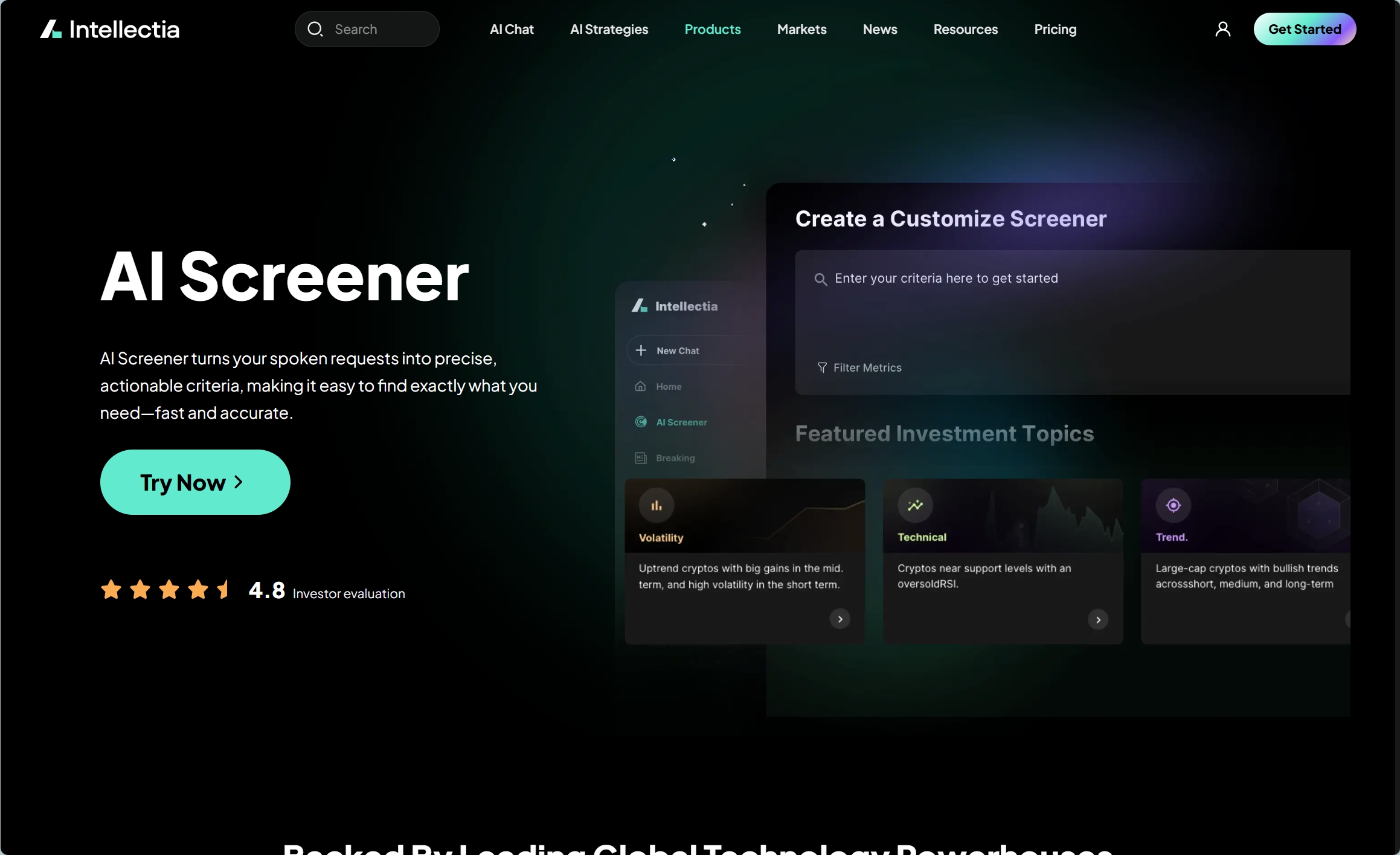
AInvest has carved out a dominant position in AI-powered stock analysis through its flagship AIME (AI Market Engine) assistant. The platform's core innovation is replacing complex filter menus with natural language queries, allowing investors to describe what they're looking for in plain English and receive instant, actionable results.
The conversational screener represents a fundamental UX breakthrough. Rather than clicking through dropdown boxes for market cap, P/E ratios, technical indicators, and sector classifications, users simply type requests like "show me mid-cap tech stocks with RSI below 30 and positive earnings momentum." The AI parses these instructions, applies the appropriate filters across technical, fundamental, and sentiment dimensions, and returns matching securities in seconds.
AInvest offers 27 ready-made strategies for investors who prefer starting with proven approaches, while also supporting fully custom screeners with granular controls for price gaps, relative volume (RVOL), RSI thresholds, EMA crossovers, and MACD signals. All data streams are real-time rather than delayed, ensuring decisions are based on current market conditions rather than stale information.
Beyond screening, AIME functions as a comprehensive research assistant capable of revealing holdings of famous investors like Warren Buffett, analyzing individual stocks in depth, summarizing news articles, and delivering Wall Street analyst opinions. This multi-faceted approach ensures investors have context beyond raw numbers when making decisions.
The platform's event-driven analysis capabilities are particularly sophisticated. AIME can dig into years of historical market data, grouping similar events such as earnings calls or FOMC meetings, then calculating probability distributions including win rates, maximum gains, and worst-case drawdowns. This historical pattern recognition helps investors understand the likely range of outcomes for current positions rather than relying on single-point predictions.
Robinhood Agentic Trading: Mainstream Automation
Robinhood's Agentic Trading represents perhaps the most significant development in democratizing AI trading, bringing automated investing capabilities to one of the largest retail brokerage platforms. This integration matters because it removes the friction of managing multiple accounts and APIs, allowing users to connect AI agents directly to their existing Robinhood accounts.
The setup process exemplifies accessibility. Users paste a single URL into their MCP (Model Context Protocol) configuration to connect most AI agents, fund a dedicated agentic account with their chosen trading budget, and the agent can begin analyzing markets and placing trades immediately. All activity and performance are visible directly in the familiar Robinhood app interface, providing transparency that standalone trading bots often lack.
Safety features are central to Robinhood's approach. The platform requires a dedicated account for agent trading with a defined budget, sends notifications for each executed trade, and provides a one-tap kill switch to disconnect the agent instantly. These controls address legitimate concerns about ceding control to automated systems. The beta launch currently supports stock trading with planned expansion to options, crypto, event contracts, futures, and prediction markets.
As CEO Vlad Tenev stated at launch, "Our mission has always been to democratize finance for all, and now, that mission extends to AI agents." This positioning suggests AI trading capabilities will become standard features across major brokerages rather than specialized tools for tech-savvy investors.
Practical applications enabled by this integration include automated portfolio rebalancing in response to specific events, executing trades when stocks hit predetermined price levels, analyzing concentration risk and sector exposure, and scanning analyst notes for new investment opportunities. The combination of natural language instruction and direct execution creates a powerful interface for translating investment ideas into action without manual order entry.
Tritonix.ai: Deep Research and Smart Money Intelligence
Tritonix.ai positions itself as the research-focused AI investment agent, designed for investors who want comprehensive analysis before making decisions. The platform distinguishes itself through one-click stock deep dives, watchlist creation, and professional-grade PDF and HTML report generation suitable for client presentations or investment committee reviews.
The core value proposition centers on research workflow automation. Rather than spending hours manually gathering financial statements, analyst reports, and market data, users leverage the AI agent to compile comprehensive investment memos in minutes. This efficiency gain proves particularly valuable for active investors managing multiple positions or financial advisors serving multiple clients.
Tritonix's emphasis on privacy and secure financial data handling addresses critical concerns for users entrusting sensitive information to AI systems. The platform's security architecture ensures proprietary research and portfolio information remain protected while still enabling powerful AI-driven analysis.
What sets Tritonix apart from execution-focused trading bots is its synthesis of information from multiple sources, identifying consensus picks among institutional investors and highlighting smart money movements that might signal emerging opportunities. For investors who prefer maintaining final decision-making authority but want AI assistance in the research phase, Tritonix offers an attractive middle ground.
The integration of copy trading features adds a social dimension, allowing users to follow strategies from successful investors and learn from their approaches. This creates a hybrid model where algorithmic analysis and human expertise complement each other, potentially accelerating the learning curve for newer investors while providing validation signals for experienced practitioners.
Claude Code: Building Custom Trading Solutions
For investors with technical backgrounds or specific requirements that off-the-shelf platforms cannot meet, Claude Code by Anthropic offers a fundamentally different path to AI-powered trading. As an AI coding agent designed for terminal and IDE integration, Claude Code enables developers to build custom trading systems tailored to exact specifications.
The value proposition here is maximum flexibility and control. Rather than accepting the features and limitations of existing platforms, developers can create bespoke solutions integrating multiple data sources, implementing proprietary algorithms, and connecting to various brokerage APIs. This approach requires more upfront investment but yields systems that precisely match the investor's strategy and risk tolerance.
Claude Code excels at technical implementation aspects of trading automation. It assists with writing data collection scripts, building backtesting frameworks, implementing risk management rules, and creating monitoring dashboards. For quantitative investors with unique alpha signals or complex portfolio construction requirements, this capability proves invaluable.
The emerging "vibe coding" trend for trading bots illustrates how Claude Code lowers barriers to custom trading system development. Investors describe desired functionality in natural language, and the AI generates underlying code. This democratization means sophisticated automation is no longer limited to those with formal computer science backgrounds.
Open-source projects like AI-Trader on GitHub demonstrate this approach's potential, offering fully automated agent-native trading systems compatible with Claude Code, OpenClaw, Codex, and Cursor. These community-driven efforts provide transparency, customization options, and alternatives for privacy-conscious users preferring not to share strategies with third-party services.
Platform Comparison: Choosing the Right Tool
Understanding each platform's positioning helps investors select appropriate tools for their needs. Alphio AI excels for investors wanting natural language trading across both crypto and traditional markets, with particular strength in conditional automation and cross-platform integration. The non-custodial security model appeals to users prioritizing asset control.
AInvest targets active stock traders needing sophisticated screening capabilities through conversational interfaces. Its real-time data and event-driven historical analysis provide context that pure execution platforms often lack. Investors who value research depth and pattern recognition will find AInvest particularly compelling.
Robinhood Agentic Trading serves mainstream investors seeking straightforward automation within familiar brokerage infrastructure. The safety controls and transparent reporting address concerns about ceding control to automated systems. As the platform expands beyond stocks, its appeal to diverse trading styles will grow significantly.
Tritonix appeals to fundamental investors and advisors managing portfolios for others who need comprehensive research before execution. The report generation and smart money tracking features support thorough due diligence processes.
Claude Code serves technically proficient investors requiring custom solutions that commercial platforms cannot provide. The ability to build proprietary systems, integrate niche data sources, and implement unique strategies attracts quantitative traders and algorithmic investors with specialized requirements.
Many sophisticated investors will likely use multiple tools—perhaps Alphio for execution, AInvest for screening, Tritonix for research, and Claude Code for custom analytics—creating personalized AI trading stacks that leverage each platform's strengths.
Risk Management and Best Practices
Regardless of platform choice, AI trading requires careful risk management. Automated systems execute trades faster than humans but can also compound errors at machine speed if improperly configured. The first principle should always be limiting exposure: never allocate more capital to an AI agent than you can afford to lose entirely.
Starting with paper trading or simulation environments is essential before deploying real capital. Alphio's Demo Mode and similar features across platforms allow thorough validation of automation logic across different market conditions. An agent performing well in bull markets may suffer significant drawdowns during corrections if not designed for diverse scenarios.
Understanding what the AI is actually doing proves crucial. Black-box systems generating recommendations without explaining reasoning should be treated skeptically. The best platforms provide transparency into decision factors—whether technical indicators, fundamental metrics, sentiment analysis, or smart money flows.
Regular monitoring and intervention capabilities are non-negotiable. Even sophisticated AI agents encounter situations their training didn't anticipate—market halts, extreme volatility events, or structural trading pattern changes. Platforms providing real-time notifications and kill switches offer important safeguards.
Diversification applies to AI trading just as to portfolio construction. Relying on a single agent, strategy, or platform concentrates risk. Consider using multiple agents with different approaches, or maintaining hybrid portfolios where some positions are AI-managed while others reflect manual decisions.
The Future of AI Trading Agents
Looking ahead, AI trading agent capabilities will expand rapidly. Multimodal agents processing not just numerical data but news articles, earnings transcripts, social media sentiment, and video content are already emerging. Integration with decentralized finance protocols may enable seamless operation across traditional and crypto markets.
Regulatory frameworks will evolve alongside technology. Current regulations focus primarily on institutional algorithmic trading, but democratization of AI trading tools raises new questions about investor protection and market integrity. Platforms proactively addressing these concerns through transparency and safety controls will likely thrive.
The competitive dynamics between established brokerages, fintech startups, and open-source projects will drive innovation while creating fragmentation. Investors may face choices between comprehensive end-to-end platforms versus best-of-breed tools requiring integration. Winners will likely deliver sophisticated capabilities through intuitive interfaces while maintaining trust essential for managing capital.
Conclusion: Navigating the AI Trading Landscape
The platforms examined—Alphio AI, AInvest, Robinhood Agentic Trading, Tritonix.ai, and Claude Code—represent the vanguard of AI-powered investing in 2026. Each offers distinct approaches harnessing artificial intelligence for investment decisions, from natural language execution to deep research automation to custom development frameworks.
For investors considering adoption, begin with education and experimentation. Understand what each platform offers and how it aligns with your investment style. Test agents in simulation environments before deploying real capital. Start with modest allocations and scale up only as confidence in system performance grows.
The benefits of well-implemented AI trading include reduced emotional decision-making, 24/7 market monitoring, rapid execution, and analytical capabilities impossible to replicate manually. But these benefits come with responsibilities—understanding technology, managing risks appropriately, and maintaining human judgment that no AI can fully replace.
Ready to explore how AI can enhance your investment process? Sign up for Intellectia.ai to access advanced AI-powered stock analysis, screening tools, and portfolio insights that complement the trading agent platforms discussed here. Whether automating research, executing strategies, or building custom solutions, the right combination of AI tools can help navigate markets with greater confidence and efficiency.
The future of investing lies not in choosing between human and artificial intelligence, but in thoughtfully integrating both—leveraging AI for what machines do best while investors provide judgment, values, and long-term perspective that drive sustainable wealth creation.