
Key Takeaway
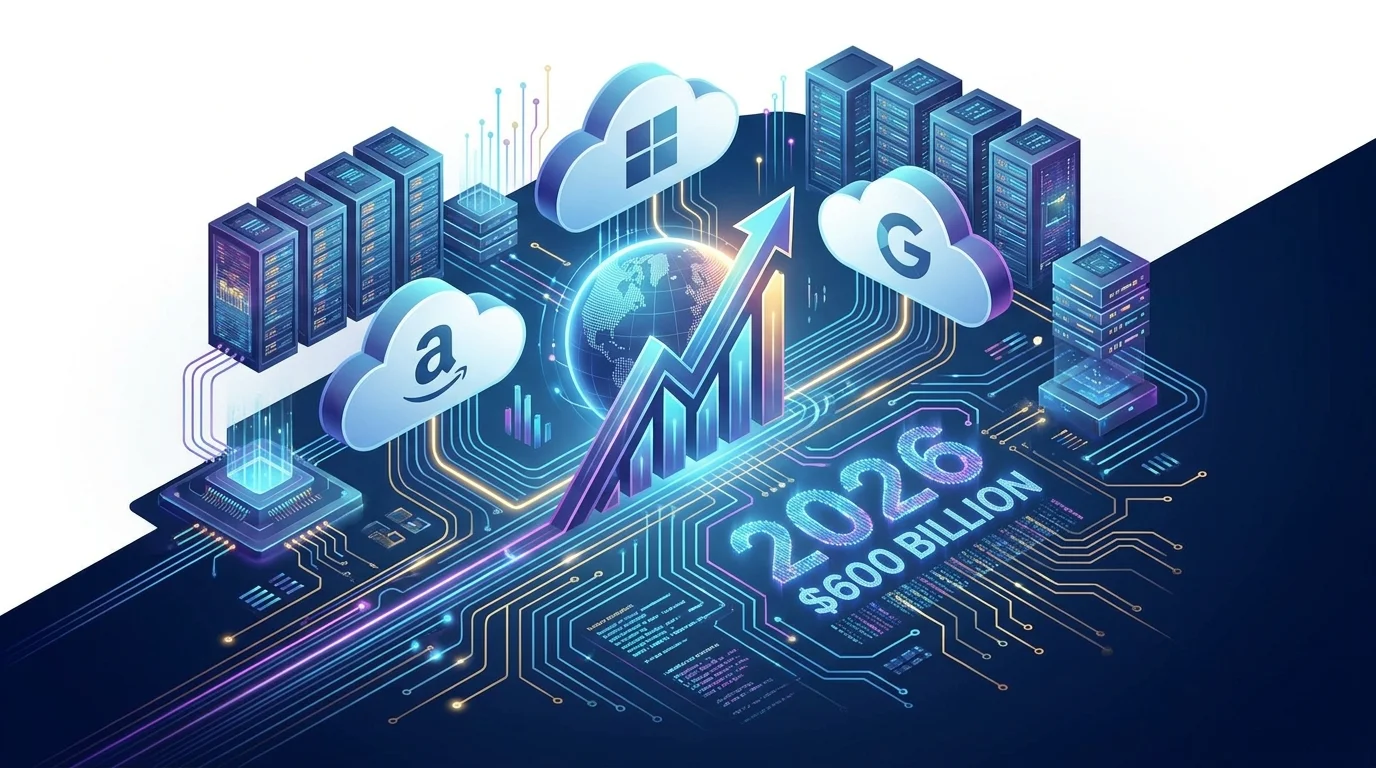
The artificial intelligence revolution has triggered the largest peacetime infrastructure investment cycle in human history. In 2026, the five major hyperscalers—Amazon, Microsoft, Google, Meta, and Oracle—are projected to spend a combined $602 billion on capital expenditures, with approximately 75% ($450 billion) directed specifically toward AI infrastructure. This unprecedented spending spree represents 1.9% of U.S. GDP, surpassing historic investments like the Apollo program, the interstate highway system, and the broadband expansion era combined.
For investors, this mega-trend presents both extraordinary opportunities and significant risks. Companies positioned throughout the AI infrastructure value chain—from semiconductor manufacturers and data center operators to power and cooling solution providers—stand to benefit from years of sustained demand. However, questions about return on investment, power constraints, and the sustainability of current spending levels loom large as the market weighs whether this boom represents a transformative shift or an overheated bubble.
The implications extend far beyond technology stocks. This infrastructure buildout is reshaping energy markets, driving demand for commodities like copper and lithium, and transforming the competitive landscape across industries. Understanding where this capital is flowing—and which companies are best positioned to capture it—is essential for navigating markets in the second half of 2026.
The Scale of AI Infrastructure Investment in 2026
Understanding the $602 Billion Capex Figure
The sheer magnitude of hyperscaler spending in 2026 is difficult to overstate. According to Dell'Oro Group and multiple Wall Street analysts, the top five U.S. cloud providers are on track to invest $602 billion this year, representing a 36% increase from 2025 levels. To put this in perspective, this single-year investment exceeds the market capitalization of most Fortune 500 companies and rivals the annual GDP of countries like Switzerland or Taiwan.
What makes this spending particularly notable is its concentration. Unlike previous technology investment cycles that were distributed across thousands of companies, the current AI infrastructure boom is dominated by just five players. Amazon leads the pack with approximately $200 billion in planned spending, followed by Alphabet at $185 billion, Meta at $135 billion, Microsoft at $105 billion, and Oracle with additional billions. This concentration creates both supply chain bottlenecks and extraordinary pricing power for vendors who can meet hyperscaler demands.
The 75% AI allocation ratio is equally significant. In previous years, these companies' capital expenditures were spread across general cloud infrastructure, corporate facilities, and various technology initiatives. Today, three-quarters of every dollar spent goes directly toward AI capabilities—data centers, GPUs, networking equipment, and specialized cooling systems. This represents a fundamental reallocation of corporate resources that reflects board-level conviction that AI will drive the next decade of growth.
Historical Context: How This Compares to Past Infrastructure Booms
To truly appreciate the scale of current AI infrastructure investment, it helps to compare it to transformative infrastructure programs of the past. The Apollo space program, which landed humans on the moon, cost approximately $25 billion over 13 years—roughly $280 billion in today's dollars, or about 0.6% of GDP at its peak. The U.S. interstate highway system, which fundamentally transformed American commerce and mobility, cost $129 billion over 35 years—approximately $500 billion in current dollars, also representing about 0.6% of annual GDP during its construction.
Today's hyperscaler AI investment at 1.9% of GDP dwarfs these historic programs. It exceeds the total cost of the Marshall Plan, the Manhattan Project, and the Louisiana Purchase combined when adjusted for inflation. The only comparable peacetime investments are wartime mobilizations, which typically reach 5-10% of GDP but are driven by government rather than private capital.
This comparison matters because it frames the stakes involved. If the AI revolution delivers on its promise—transforming productivity across every industry—the current investment levels will appear prescient. If the technology fails to achieve widespread adoption or meaningful productivity gains, the current spending will represent one of the largest capital misallocations in corporate history. The outcome will likely determine which companies emerge as the dominant technology platforms of the next decade.
Who's Spending What: Breaking Down Hyperscaler Commitments
Amazon's $200 Billion Bet
Amazon Web Services (AWS) has emerged as the most aggressive investor in AI infrastructure, with planned 2026 capital expenditures approaching $200 billion. This massive commitment reflects AWS's determination to maintain its cloud computing leadership position against intensifying competition from Microsoft Azure and Google Cloud Platform. The spending is directed toward expanding data center capacity across multiple continents, acquiring cutting-edge AI accelerators from Nvidia and custom chips from its Annapurna Labs division, and building out the networking infrastructure required to train and deploy massive AI models.
Amazon's investment strategy differs from its competitors in several important ways. First, AWS is leveraging its existing logistics and supply chain expertise to accelerate data center construction timelines, potentially achieving faster time-to-market for new capacity. Second, Amazon is placing significant bets on custom silicon, developing its own Trainium and Inferentia chips to reduce dependence on Nvidia and lower long-term compute costs. Third, the company is investing heavily in renewable energy projects to power its expanding infrastructure, with commitments to match 100% of its electricity use with renewable sources.
The financial implications for Amazon are substantial. At $200 billion, capital expenditures will exceed the company's annual operating cash flow, requiring Amazon to access debt markets for the first time in years. This shift from self-funded growth to external financing represents a fundamental change in Amazon's capital structure and financial strategy. Investors are watching closely to see whether this increased leverage affects Amazon's credit rating or shareholder return policies.
Microsoft's Strategic Positioning
Microsoft has committed approximately $105 billion to capital expenditures in 2026, with the vast majority directed toward AI infrastructure. This investment is intrinsically linked to Microsoft's partnership with OpenAI and the integration of AI capabilities across its product suite, from Copilot in Office 365 to Azure OpenAI Service for enterprise customers. Microsoft's spending reflects a bet that AI will become the primary interface for computing, transforming how users interact with software and services.
The company's infrastructure strategy centers on building AI-optimized data centers capable of training and serving large language models at scale. Microsoft is also investing heavily in edge computing infrastructure to reduce latency for AI-powered applications, recognizing that many enterprise use cases require real-time inference rather than cloud-based processing. Additionally, the company is expanding its global footprint to meet data sovereignty requirements as governments impose stricter regulations on where AI data can be stored and processed.
Microsoft's balance sheet strength gives it advantages in this capital-intensive race. With over $80 billion in cash and equivalents and a AAA credit rating, Microsoft can fund its AI investments without straining its financial position. The company has also been more disciplined than some competitors in linking capital expenditures to customer commitments, often securing long-term contracts before breaking ground on new facilities. This approach reduces the risk of overbuilding capacity that sits underutilized.
Alphabet, Meta, and Oracle's Competitive Responses
Alphabet's $185 billion capital expenditure plan for 2026 reflects Google's urgent need to catch up in the generative AI race. Despite pioneering much of the foundational research in deep learning, Google found itself playing catch-up following ChatGPT's launch. The company's spending is focused on expanding its Tensor Processing Unit (TPU) infrastructure, building out data center capacity for its Bard and Gemini AI services, and acquiring the GPUs necessary to train next-generation models. Alphabet is also investing in specialized infrastructure for AI-powered search, which requires fundamentally different compute architectures than traditional web indexing.
Meta Platforms has committed $135 billion to AI infrastructure, representing the highest capital intensity relative to revenue among the major hyperscalers. CEO Mark Zuckerberg has made AI the company's top priority, with investments spanning recommendation algorithms for Instagram and Facebook, generative AI features across its apps, and ambitious research into artificial general intelligence through its FAIR lab. Meta's spending reflects a recognition that AI capabilities will determine the winner in social media's next phase, where personalized content creation and AI assistants become core product features.
Oracle, while smaller than its competitors with estimated spending in the tens of billions, has carved out a niche in enterprise AI workloads and sovereign cloud deployments. The company's strategy focuses on providing AI infrastructure for regulated industries like healthcare and financial services that require specialized compliance capabilities. Oracle's acquisition of Cerner and its healthcare data assets position it to capture significant value as AI transforms medical diagnostics and drug discovery.
The Infrastructure Value Chain: Investment Opportunities
Semiconductor and Chip Manufacturers
The most direct beneficiaries of hyperscaler AI spending are semiconductor companies, particularly Nvidia, which dominates the market for AI training accelerators. Nvidia's data center revenue has grown from $3 billion in fiscal 2020 to over $90 billion in fiscal 2025, and the company is projected to generate more than $150 billion in data center sales in 2026 as hyperscaler demand continues to outstrip supply. The company's H100 and upcoming Blackwell architectures have become the standard infrastructure for training large AI models, giving Nvidia extraordinary pricing power and gross margins exceeding 70%.
However, hyperscalers are actively working to reduce their dependence on Nvidia. Each major cloud provider has developed or is developing custom AI chips: Google's TPUs, Amazon's Trainium and Inferentia, Microsoft's Maia, and Meta's MTIA. While these alternatives currently lag Nvidia's offerings in performance and software ecosystem maturity, they represent a long-term threat to Nvidia's dominance. Investors should monitor the adoption rates of these custom chips as an indicator of Nvidia's competitive moat durability.
Beyond Nvidia, companies like AMD, Intel, and Broadcom are positioning to capture AI infrastructure spending. AMD's MI300 series accelerators have gained traction with hyperscalers seeking alternatives to Nvidia, while Intel is betting on its Gaudi accelerators and process technology improvements to regain relevance in AI computing. Broadcom benefits from custom chip design contracts with hyperscalers and the networking chips essential for connecting AI clusters. Each of these companies offers different risk-reward profiles for investors seeking exposure to AI semiconductor demand.
Data Center Real Estate and Infrastructure
The physical infrastructure supporting AI workloads represents another major investment opportunity. Data center REITs like Equinix, Digital Realty, and American Tower have seen their valuations surge as investors recognize the scarcity value of data center capacity in prime locations. These companies provide the land, power, and cooling infrastructure that hyperscalers lease to deploy their AI hardware, often signing long-term contracts with annual escalators that provide predictable cash flows.
The constraints on data center development have intensified competition for suitable sites. AI workloads require significantly more power density than traditional cloud computing—a single AI training cluster can consume as much electricity as a small city. This has created bottlenecks in power availability, with many prime data center markets like Northern Virginia and Phoenix facing multi-year waits for utility interconnection. Companies that secured power and land positions early are now commanding premium valuations.
New entrants are also disrupting the data center market. Specialized AI data center developers like CoreWeave and Lambda Labs have raised billions in private capital to build GPU-focused facilities optimized for AI workloads. These companies offer hyperscalers and AI startups access to scarce compute resources without the capital requirements of building their own facilities. As the AI infrastructure market matures, we expect consolidation between these specialized players and established REITs.
Power, Cooling, and Supporting Infrastructure
AI data centers consume extraordinary amounts of electricity, creating opportunities for companies throughout the energy value chain. A single large AI training facility can require 100 megawatts or more of power capacity, equivalent to roughly 80,000 homes. This demand is driving investments in power generation, transmission infrastructure, and alternative energy sources to meet sustainability commitments.
Cooling represents another critical infrastructure component. Traditional air cooling is insufficient for the heat densities generated by AI accelerators, driving adoption of liquid cooling technologies. Companies like Vertiv, Schneider Electric, and Modine Manufacturing provide the specialized cooling equipment required for AI data centers. As power densities continue to increase with each new generation of AI chips, demand for advanced cooling solutions is expected to grow at double-digit rates for years.
The supporting infrastructure ecosystem extends to electrical equipment, networking hardware, and construction services. Companies like Eaton, nVent, and Arista Networks are seeing surging demand for their products as data center construction accelerates. The construction industry is also adapting, with specialized contractors developing expertise in the rapid deployment of hyperscale facilities. These supporting players often trade at more reasonable valuations than the headline AI names while still benefiting from the infrastructure buildout.
Financing the AI Infrastructure Boom
The Shift to Debt-Funded Expansion
Perhaps the most underappreciated aspect of the AI infrastructure boom is how it's being financed. Historically, hyperscalers funded capital expenditures primarily through operating cash flow, maintaining fortress balance sheets with minimal debt. That model has changed dramatically. In 2025, big tech AI companies issued over $245 billion in investment-grade bonds, making the sector the largest source of new supply in global credit markets. Meta alone priced a $30 billion financing in October 2025, among the largest corporate bond offerings in history.
This shift from self-funded to debt-funded expansion reflects the sheer scale of AI investments relative to cash flow generation. When aggregate capital expenditures exceed free cash flow after dividends and buybacks, external financing becomes necessary. For investors, this has several implications. First, it demonstrates management conviction—companies are willing to lever up because they believe AI investments will generate returns exceeding their cost of capital. Second, it creates new risks around interest rate sensitivity and credit quality if AI returns disappoint.
The bond market has absorbed this supply surprisingly well, with AI-related corporate bonds trading at tight spreads to Treasuries. Investors appear willing to fund AI infrastructure at low rates, suggesting broad confidence in the technology's commercial potential. However, this could change quickly if AI adoption slows or competitive dynamics erode returns. Companies that have loaded up on debt to fund AI investments may face refinancing challenges if credit markets become less accommodating.
Private Credit and Off-Balance-Sheet Financing
Beyond traditional corporate bonds, hyperscalers are increasingly using private credit and off-balance-sheet structures to finance AI infrastructure. A common arrangement involves creating special purpose vehicles (SPVs) that own data center assets, with hyperscalers providing equity and private credit funds supplying debt financing. The hyperscaler then leases back the facility through long-term operating agreements, effectively converting capital expenditures to operating expenses while keeping debt off the corporate balance sheet.
These arrangements, which the Bank for International Settlements has termed "shadow borrowing," have grown rapidly as private credit markets expand. Institutional investors including insurance companies, pension funds, and sovereign wealth funds are eager to deploy capital into AI infrastructure, viewing it as an attractive alternative to traditional fixed income with higher yields and inflation protection. The typical structure offers investment-grade risk profiles backed by hyperscaler creditworthiness and long-term lease contracts.
For investors in private credit funds or REITs with data center exposure, understanding these structures is essential. While they can enhance returns through leverage, they also introduce complexity around recourse, default scenarios, and refinancing risk. As the AI infrastructure market matures, we expect these financing structures to become increasingly standardized and transparent.
Risks and Challenges Facing the AI Infrastructure Buildout
The Return on Investment Question
The most significant risk to the AI infrastructure boom is whether the massive capital expenditures will generate adequate returns. Hyperscalers are spending hundreds of billions of dollars on AI infrastructure based on the assumption that demand for AI compute will continue growing exponentially. If that demand fails to materialize—or if competition drives down pricing faster than expected—these investments could become stranded assets.
Early signs are mixed. While AI adoption is growing rapidly, with ChatGPT reaching 100 million users faster than any application in history, monetization remains challenging. Many AI features are being offered free or at low cost to drive adoption, with unclear paths to profitability. Enterprise customers are still evaluating how to integrate AI into their workflows, and budget approvals for large-scale AI deployments are proceeding more slowly than initially hoped.
The concentration of AI infrastructure spending in training large language models creates additional risk. If the industry shifts toward smaller, more efficient models or alternative AI architectures that require less compute, much of the current infrastructure investment could become obsolete. The history of technology is littered with examples of overinvestment in infrastructure that was quickly superseded by new approaches. Investors should maintain healthy skepticism about whether current spending levels are sustainable.
Power and Environmental Constraints
AI data centers' voracious appetite for electricity is creating real constraints on growth. Many prime data center markets are already facing power shortages, with utilities unable to add new capacity fast enough to meet demand. This has led to project delays, cost overruns, and increased competition for scarce power resources. Some communities are pushing back against data center developments due to concerns about grid stability, water usage for cooling, and environmental impact.
The environmental implications are significant. If current trends continue, AI data centers could consume 8% of U.S. electricity by 2030, up from roughly 4% today. This conflicts with corporate sustainability commitments and regulatory pressures to reduce carbon emissions. Hyperscalers are investing heavily in renewable energy and exploring alternative power sources including nuclear small modular reactors, but scaling these solutions takes time.
Water usage presents another challenge. Data centers in drought-prone regions like Arizona and California consume millions of gallons of water annually for cooling. As climate change intensifies water scarcity, regulatory restrictions on data center water use are likely to increase. Companies that have secured water rights and invested in water-efficient cooling technologies will have competitive advantages.
Geopolitical and Regulatory Risks
The AI infrastructure buildout is increasingly intertwined with geopolitics. Governments around the world are imposing restrictions on AI technology exports, data localization requirements, and foreign investment in critical infrastructure. The U.S. has restricted sales of advanced AI chips to China, while China is developing its own domestic AI chip capabilities. These tensions create supply chain risks and market access challenges for hyperscalers operating globally.
Regulatory scrutiny of AI is also intensifying. The European Union's AI Act imposes strict requirements on high-risk AI applications, while the U.S. is developing its own regulatory framework. Data privacy regulations like GDPR in Europe and emerging state-level laws in the U.S. create compliance costs and operational complexity. As AI becomes more powerful, governments may impose additional restrictions on training large models or deploying AI in sensitive applications.
Antitrust concerns add another layer of risk. Regulators in the U.S. and Europe are examining whether hyperscalers' dominance of AI infrastructure creates unfair competitive advantages. Potential remedies could include forced divestitures, data sharing requirements, or restrictions on exclusive partnerships. Any significant regulatory action could reshape the competitive landscape and affect returns on AI infrastructure investments.
Investment Strategies for the AI Infrastructure Era
Direct Exposure: Picking Winners in the Value Chain
For investors seeking direct exposure to AI infrastructure spending, the semiconductor sector offers the most leveraged plays. Nvidia remains the dominant supplier of AI training chips, though its valuation reflects high expectations. AMD offers an alternative with its MI300 accelerators gaining traction. For investors concerned about chip cyclicality, companies like Broadcom and Marvell provide exposure to AI networking and custom chip design with more diversified revenue streams.
Data center REITs offer income-oriented investors a way to participate in the infrastructure buildout. Equinix and Digital Realty provide global exposure, while smaller players like CyrusOne and QTS offer more concentrated bets. These companies typically pay dividends in the 2-4% range with growth potential from rent escalators and new development. The key risk is interest rate sensitivity, as REIT valuations tend to decline when rates rise.
Infrastructure suppliers represent a less crowded trade. Companies providing cooling, power distribution, and electrical equipment for data centers are seeing demand surge while trading at more reasonable valuations than the headline AI names. Vertiv, Eaton, and Schneider Electric are examples of companies that benefit from AI infrastructure growth without the same level of investor attention.
Diversified Approaches: ETFs and Thematic Funds
For investors seeking diversified exposure without picking individual stocks, several ETFs focus on AI and data center infrastructure. The Global X Data Center & Digital Infrastructure ETF (DTCR) provides exposure to data center REITs and infrastructure providers. The VanEck Semiconductor ETF (SMH) offers broad exposure to the chip sector including Nvidia, AMD, and equipment suppliers. These vehicles provide instant diversification but may include companies with limited AI exposure.
Thematic mutual funds and private equity vehicles are also targeting AI infrastructure. These funds often have access to private companies not available in public markets, including specialized data center developers and AI infrastructure startups. However, they typically charge higher fees and have longer lock-up periods than public market alternatives.
Risk Management: Position Sizing and Portfolio Balance
Given the uncertainties surrounding AI infrastructure returns, prudent position sizing is essential. While the potential upside is substantial, the risks of overinvestment, technological disruption, and regulatory intervention are real. Most portfolios should limit concentrated bets on any single AI infrastructure name, maintaining diversification across sectors and geographies.
Investors should also consider hedging strategies. Options on semiconductor ETFs can provide downside protection against a potential correction in AI stocks. Short positions in companies that may be disrupted by AI—or that are overearning from the current infrastructure boom—can serve as portfolio hedges. As with any thematic investment, maintaining liquidity and flexibility to adjust positions as the story evolves is crucial.
For investors seeking AI-powered insights to navigate these complex markets, tools like the AI Screener can help identify opportunities across the AI infrastructure value chain. The platform's advanced analytics provide real-time monitoring of key stocks and sectors.
The Road Ahead: What to Watch in 2026 and Beyond
Key Metrics for Tracking the Infrastructure Buildout
Investors should monitor several key metrics to assess the health of the AI infrastructure investment cycle. Hyperscaler capital expenditure guidance, typically provided quarterly, offers the most direct read on demand trends. Any significant cuts to capex plans would signal potential trouble ahead. Data center utilization rates and rental rates provide real-time indicators of supply-demand balance in physical infrastructure.
AI model training costs and inference pricing are also important to watch. If costs decline faster than expected due to efficiency improvements or competitive pressure, returns on infrastructure investments could suffer. Conversely, if demand for AI compute continues to outstrip supply, pricing power should remain strong. Cloud revenue growth rates and AI-specific revenue disclosures from hyperscalers offer additional clues about monetization progress.
Supply chain indicators matter too. Lead times for GPUs, data center equipment, and specialized components reveal bottlenecks and capacity constraints. Any signs of order cancellations or inventory buildup would be concerning. Conversely, continued supply shortages suggest demand remains robust.
The Path to $1 Trillion and Beyond
Industry analysts project that global data center capital expenditures could reach $1 trillion annually by 2028 and $1.7 trillion by 2030 according to Dell'Oro Group. This would represent a near-tripling from 2024 levels and would make data center infrastructure one of the largest capital-intensive industries in the world. Achieving these projections requires sustained demand growth, continued AI adoption, and the resolution of power and supply chain constraints.
Goldman Sachs estimates that the data center infrastructure market will exceed $1 trillion annually by 2030, with AI-specific infrastructure representing the majority of spending. This growth would support years of demand for the companies positioned throughout the value chain. However, these projections assume that current trends continue uninterrupted—a bold assumption given the history of technology investment cycles.
The transition from training-focused to inference-focused infrastructure may also shift investment patterns. While training large models requires massive compute clusters, deploying AI applications at scale requires distributed inference infrastructure closer to end users. This could drive investment toward edge computing, networking, and software infrastructure rather than centralized data centers.
For investors looking to stay ahead of these trends, the AI Stock Picker provides data-driven recommendations based on fundamental analysis and market positioning.
Conclusion
The AI infrastructure investment boom of 2026 represents a defining moment for technology markets and the broader economy. With hyperscalers committing over $600 billion to AI infrastructure—75% of their total capital expenditures—investors are witnessing the largest peacetime infrastructure buildout in history. This spending is reshaping competitive dynamics across industries, creating opportunities for companies positioned throughout the value chain while posing significant risks if returns fail to materialize.
For investors, the key is balancing enthusiasm for AI's transformative potential with prudent risk management. The infrastructure buildout is real, with tangible investments in data centers, semiconductors, and supporting equipment creating near-term revenue for suppliers. However, the long-term sustainability of current spending levels depends on AI achieving widespread commercial adoption—a outcome that remains uncertain.
The most attractive investment opportunities may lie not in the most obvious AI names but in the infrastructure suppliers, data center operators, and supporting technology providers that benefit from the buildout without the same valuation premiums. As the market evolves, maintaining flexibility and monitoring key metrics will be essential for navigating what promises to be a transformative period in technology investing.
Ready to capitalize on the AI infrastructure investment trend? Sign up for Intellectia.ai today to access AI-powered stock analysis, real-time market insights, and personalized investment recommendations. Our platform helps you identify the best opportunities across the AI value chain—from semiconductor leaders to emerging infrastructure plays—so you can make informed investment decisions in this rapidly evolving market.