
Key Takeaway
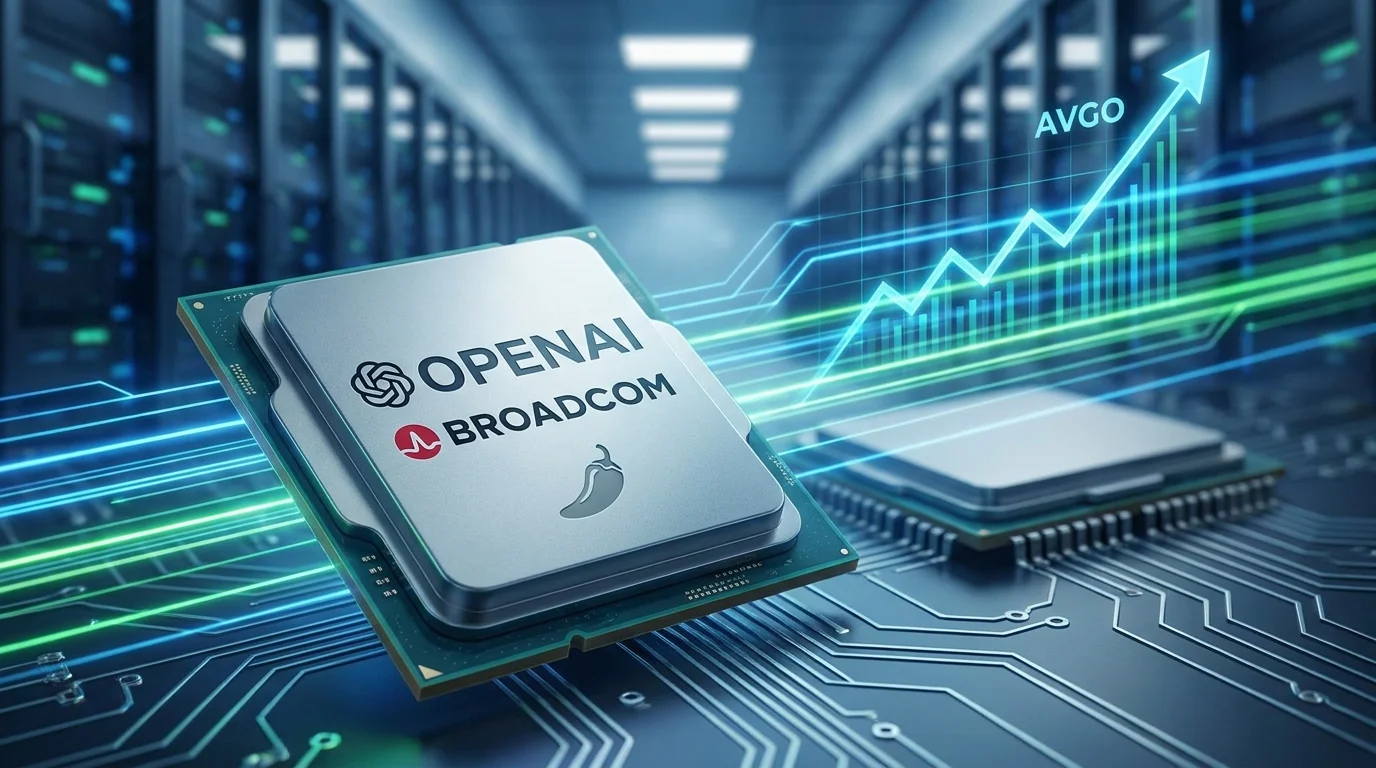
On June 24, 2026, OpenAI and Broadcom (NASDAQ: AVGO) unveiled Jalapeno, OpenAI's first custom-built AI inference processor, marking a pivotal moment in the artificial intelligence hardware landscape. This strategic partnership represents OpenAI's most significant step toward reducing its near-total dependence on Nvidia GPUs while positioning Broadcom as an increasingly formidable player in the custom AI silicon market. The chip, developed from design to production in just nine months with assistance from OpenAI's own AI models, promises substantially better performance per watt than current state-of-the-art alternatives. For investors, this development signals a potential shift in the AI chip market dynamics, with Broadcom's stock gaining immediate traction as the market digests the implications of this landmark collaboration.
The Jalapeno announcement arrives at a critical juncture for the AI industry. With hyperscalers planning to spend over $700 billion on AI infrastructure in 2026 alone, the stakes for semiconductor dominance have never been higher. OpenAI's decision to build custom silicon reflects a broader industry trend where major technology companies are increasingly designing their own chips to optimize performance and control costs. This move places OpenAI alongside Google with its Tensor Processing Units, Amazon with Trainium and Inferentia, and Meta with its custom AI accelerators. For Broadcom, the partnership validates its strategy of partnering with hyperscalers to develop custom silicon and could accelerate its path toward CEO Hock Tan's ambitious target of over $100 billion in AI semiconductor sales by 2027.
The Jalapeno Chip: Technical Breakthrough and Strategic Significance
What Makes Jalapeno Different
Jalapeno represents a fundamentally different approach to AI inference hardware. Unlike general-purpose GPUs designed to handle a wide variety of workloads, Jalapeno was architected specifically around OpenAI's vision for the future of large language model inference. The chip was built from the ground up with deep insights into LLM fundamentals, informed by OpenAI's roadmap of models, kernels, serving systems, and product needs. This domain-specific optimization allows Jalapeno to deliver superior performance per watt compared to more general-purpose alternatives, a critical advantage when operating at gigawatt-scale data center deployment.
The development timeline itself tells a remarkable story. Moving from initial design to production-ready silicon in just nine months represents an unprecedented pace in the semiconductor industry, where traditional chip development cycles typically span two to three years. OpenAI attributes this acceleration to its own AI models, which assisted in the chip development process. This creates a fascinating feedback loop where AI is being used to design the hardware that runs AI, potentially compressing future development cycles even further. Engineering samples are already running ML workloads in OpenAI laboratories at production target frequency and power, including models related to GPT and Codex platforms.
Strategic Implications for OpenAI
For OpenAI, Jalapeno addresses several critical business challenges. Until now, the company has been almost entirely dependent on Nvidia for its AI compute infrastructure, a position that creates both cost vulnerability and supply chain risk. While OpenAI had access to an essentially unlimited supply of Nvidia GPUs through its relationship with Microsoft and the Stargate infrastructure project, the economics of LLM inference at the scale OpenAI operates make even marginal improvements in performance per watt enormously valuable when multiplied across gigawatt-scale data centers.
The chip is specifically optimized for inference rather than training, meaning OpenAI will likely continue relying on Nvidia and other hardware suppliers for the most computationally intensive model development tasks. However, reducing inference costs could provide substantial savings as hundreds of millions of users interact with ChatGPT and other AI services daily. OpenAI emphasized the chip's low operating cost when running real-time coding models, suggesting that the initial deployment will focus on high-volume, latency-sensitive applications where efficiency gains translate directly to bottom-line improvements.
Broadcom's Rising Position in the AI Chip Market
The Custom Silicon Strategy
Broadcom's partnership with OpenAI represents the culmination of a long-term strategy to position itself as the go-to partner for hyperscalers developing custom AI silicon. Unlike Nvidia, which sells standardized GPUs to the broader market, Broadcom has focused on building deep partnerships with major technology companies to develop tailored solutions for specific workloads. This approach has already yielded significant partnerships with Google for Tensor Processing Units, Meta for custom AI accelerators, and now OpenAI for the Jalapeno chip.
The financial implications of this strategy are becoming increasingly apparent. Broadcom's AI chip revenue reached $8.4 billion in Q1 FY2026, up 106% year over year, with Q2 AI semiconductor revenue guided to $10.7 billion. The company ended the quarter with a $73 billion backlog, providing visibility into multi-quarter growth. CEO Hock Tan has set an ambitious target of over $100 billion in AI semiconductor sales by 2027, a figure that would represent a transformative shift in Broadcom's business mix.
Competitive Positioning Against Nvidia
The 2026 AI chip market is increasingly characterized by coexistence rather than winner-take-all dynamics. Nvidia maintains dominant positions in training and high-performance computing, supported by its CUDA ecosystem and the upcoming Vera Rubin platform. However, Broadcom is carving out a distinct niche in inference and hyperscaler-specific applications where custom silicon can deliver superior efficiency.
The competitive landscape is further complicated by the emergence of AMD as a credible alternative in the AI accelerator space, with its MI300 series gaining traction among hyperscalers. For investors, the key question is whether the AI chip market will support multiple winners or whether network effects and ecosystem lock-in will ultimately favor a single dominant player. Early evidence suggests that the market's explosive growth may create room for multiple successful strategies, with Nvidia, Broadcom, and AMD each addressing different segments of the value chain.
Investment Analysis: What Jalapeno Means for AVGO Stock
Valuation and Growth Prospects
Broadcom's stock has gained approximately 60% over the past year, a strong return that reflects the market's recognition of the company's AI growth story. However, this performance lags Nvidia's 53% rolling annual return, suggesting that Broadcom may still offer relative value for investors seeking exposure to AI infrastructure growth. The company's forward P/E ratio remains more reasonable than Nvidia's premium valuation, providing a potential entry point for investors who find Nvidia's multiples too demanding.
The OpenAI partnership adds a significant new dimension to Broadcom's growth trajectory. While the company already had strong visibility through its existing backlog, the Jalapeno collaboration demonstrates Broadcom's ability to win business from the most demanding customers in the AI space. This validation effect could accelerate partnerships with other hyperscalers seeking to develop custom inference solutions, expanding Broadcom's total addressable market beyond current estimates.
Risk Factors to Consider
Despite the positive momentum, investors should remain aware of several risk factors. The custom silicon business model requires substantial upfront investment in design and engineering, with payback periods that extend over multiple years. If AI demand growth slows or if hyperscalers shift strategies, Broadcom could face underutilized capacity and impaired returns on these investments.
Additionally, the competitive environment is intensifying. Nvidia is not standing still, with its Blackwell architecture delivering significant performance improvements and the Vera Rubin platform promising further advances. AMD continues to gain share in the data center market, while new entrants like Cerebras are pursuing disruptive approaches to AI acceleration. Broadcom's success depends on maintaining its position as the preferred custom silicon partner while these dynamics evolve.

For investors seeking to identify the next generation of AI winners, tools like Intellectia's AI Stock Picker can provide data-driven insights into emerging opportunities in the semiconductor space. The platform's AI-powered analysis can help investors navigate the complex competitive dynamics between established players like Nvidia and Broadcom while identifying potential disruptors before they reach mainstream attention.
The Broader AI Infrastructure Investment Theme
Hyperscaler Spending Trends
The Jalapeno announcement must be understood within the context of unprecedented hyperscaler capital expenditure on AI infrastructure. Major technology companies are planning to spend over $700 billion on data centers and AI chips in 2026, creating a massive addressable market for semiconductor suppliers. This spending is driven by the recognition that AI capabilities are becoming a core competitive differentiator, with the companies that can deploy the most efficient inference infrastructure gaining significant advantages in product quality and cost structure.
Data center equipment and infrastructure investment reached approximately $290 billion in 2024, with projections suggesting the market could approach $1 trillion by 2030. This creates a multi-year growth runway for companies supplying the essential components of AI infrastructure, from GPUs and custom accelerators to networking equipment and memory solutions. For investors, the implication is that AI infrastructure spending represents a durable trend rather than a fleeting cycle, with demand supported by the ongoing expansion of AI applications across industries.
Ecosystem and Partnership Dynamics
The AI chip market is increasingly defined by ecosystem relationships rather than pure technology specifications. Nvidia's CUDA platform has created significant developer lock-in, making it difficult for competitors to gain traction even when offering superior hardware performance. However, the rise of custom silicon suggests that hyperscalers with sufficient scale and engineering resources may be willing to invest in breaking this dependency to achieve better efficiency and cost control.
Broadcom's partnership model addresses this dynamic by providing hyperscalers with the benefits of custom silicon without requiring them to build full semiconductor design capabilities in-house. This hybrid approach allows companies like OpenAI to optimize their hardware for specific workloads while leveraging Broadcom's manufacturing relationships and design expertise. If this model proves successful, it could accelerate the fragmentation of the AI chip market, with increasing customization replacing the one-size-fits-all approach that has characterized the GPU era.

Investors looking to track these complex ecosystem dynamics can benefit from Intellectia's AI Screener, which monitors partnership announcements, supply chain relationships, and competitive positioning across the AI infrastructure landscape. By aggregating data from multiple sources and applying machine learning analysis, the platform can identify emerging trends before they become apparent through traditional research methods.
Industry Implications and Future Outlook
The Shift Toward Inference Optimization
Jalapeno's focus on inference rather than training reflects a broader industry shift in AI economics. While training large models requires massive computational resources, the ongoing cost of serving these models to users often exceeds training expenses at scale. As AI applications become more ubiquitous, the efficiency of inference infrastructure increasingly determines the economic viability of AI-powered products.
This shift has significant implications for the competitive landscape. Nvidia's historical strength has been in training, where its GPUs offer unmatched performance and ecosystem support. However, inference workloads have different characteristics that may favor specialized architectures. Lower precision requirements, different memory access patterns, and the importance of latency optimization create opportunities for custom silicon to outperform general-purpose GPUs in specific applications.
The Future of AI Hardware Development
The nine-month development timeline for Jalapeno suggests that the pace of AI hardware innovation may accelerate beyond historical semiconductor industry norms. If AI-assisted design can consistently compress development cycles, the competitive advantage may shift toward companies that can most effectively leverage AI in their design processes. This creates a potential virtuous cycle where AI hardware companies use AI to build better AI hardware, potentially accelerating the already rapid pace of improvement in AI capabilities.
Looking ahead, the AI chip market appears poised for continued evolution and fragmentation. The one-size-fits-all approach of the GPU era is giving way to a more nuanced landscape where different workloads are optimized on different hardware. Nvidia will likely maintain dominant positions in training and general-purpose acceleration, while companies like Broadcom capture growing shares of the custom inference market. For investors, this suggests that multiple winners may emerge from the AI infrastructure build-out, with success depending on execution within specific market segments rather than overall market dominance.
For active investors seeking to capitalize on volatility in the AI semiconductor space, Intellectia's platform offers real-time analytics and trading signals based on technical and fundamental factors. The AI sector's rapid evolution creates frequent mispricings that informed investors can exploit, particularly around product announcements, earnings reports, and partnership disclosures.
Conclusion
The unveiling of OpenAI and Broadcom's Jalapeno chip represents more than just a new product announcement—it signals a potential inflection point in the AI hardware market. For OpenAI, custom silicon offers a path to greater cost control and operational efficiency at a time when inference costs are becoming a critical business factor. For Broadcom, the partnership validates its custom silicon strategy and could accelerate its growth trajectory toward the ambitious targets set by management.
For investors, the key takeaway is that the AI chip market is evolving beyond the Nvidia-dominated landscape of the past several years. While Nvidia remains a formidable competitor with significant advantages in training and ecosystem development, the rise of custom inference silicon creates new opportunities for companies like Broadcom to capture value. The market's explosive growth may support multiple successful strategies, with winners determined by execution within specific segments rather than overall dominance.
As the AI infrastructure build-out continues, investors should monitor partnership announcements, product roadmaps, and competitive dynamics for signs of shifting market share. The companies that can most effectively address the evolving needs of hyperscalers and AI application developers are likely to generate the strongest returns in the coming years. To stay ahead of these developments and identify emerging opportunities in the AI semiconductor space, consider signing up for Intellectia's AI-powered investment platform, which provides real-time analysis and actionable insights on the stocks shaping the future of artificial intelligence.